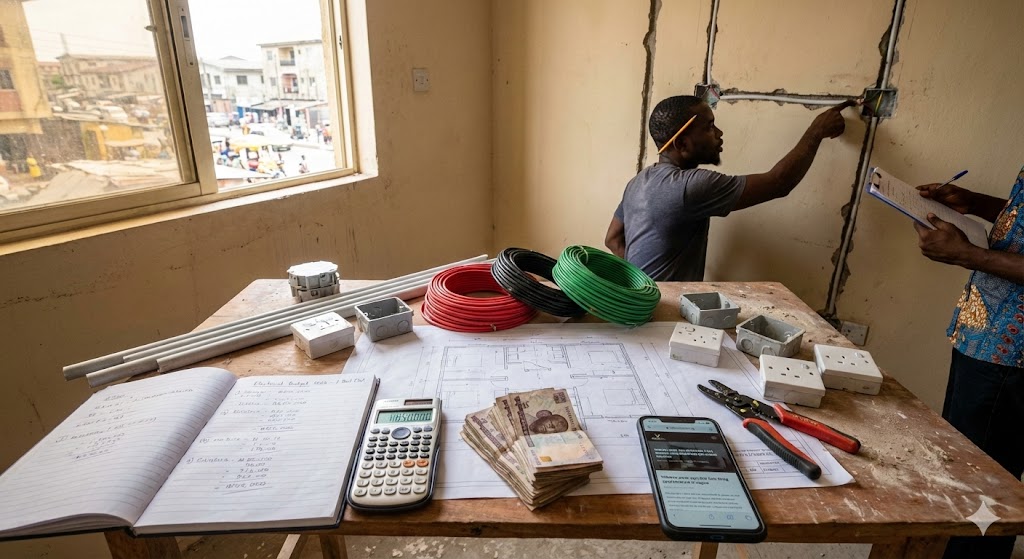
When I started building my 2 bedroom flat in Benin City last year, the electrical wiring quotation nearly gave me a heart attack. The electrician casually mentioned a figure that made me question whether I was wiring a house or funding a small business. After weeks of research, market visits, and painful negotiations, I finally understood what electrical wiring actually costs in Nigeria and how to budget properly without cutting dangerous corners.
If you are planning to wire a 2 bedroom flat in Nigeria in 2026, expect to spend between ₦300,000 and ₦500,000 for a complete installation. This covers materials, labor, and basic testing. However, this range can swing dramatically depending on your choices, and I learned this the expensive way.
This guide shares everything I discovered during my own electrical wiring project. I will break down actual material costs, labor charges across different Nigerian cities, the mistakes that cost me extra money, and how you can avoid them. Whether you are building from scratch or rewiring an existing apartment, this information will help you budget accurately and find reliable electricians.
How Much Does It Cost to Wire a 2 Bedroom Flat in Nigeria in 2026?
Let me give you the direct answer first, then we can dive into the details.
For a standard 2 bedroom bungalow in Nigeria, the total electrical wiring cost in 2026 ranges from ₦300,000 to ₦500,000. This includes all materials, electrician labor, and basic testing. The breakdown typically looks like this:
Materials account for about 60 to 70 percent of your total budget, which means roughly ₦180,000 to ₦350,000 depending on the brands you choose. Labor takes up the remaining 30 to 40 percent, ranging from ₦80,000 to ₦150,000 for basic installations, though some electricians in Lagos and Abuja charge significantly more.
Here is a realistic cost breakdown based on current market prices:
| Cost Component | Budget Estimate | Mid-Range Estimate | Premium Estimate |
|---|---|---|---|
| Wires and Cables | ₦50,000 to ₦80,000 | ₦80,000 to ₦120,000 | ₦150,000 to ₦200,000 |
| Conduits and Accessories | ₦30,000 to ₦50,000 | ₦50,000 to ₦70,000 | ₦80,000 to ₦100,000 |
| Switches and Sockets | ₦40,000 to ₦60,000 | ₦60,000 to ₦100,000 | ₦150,000 to ₦250,000 |
| Distribution Board | ₦20,000 to ₦30,000 | ₦30,000 to ₦45,000 | ₦50,000 to ₦60,000 |
| Light Fittings | ₦30,000 to ₦50,000 | ₦50,000 to ₦80,000 | ₦100,000 to ₦150,000 |
| Other Accessories | ₦10,000 to ₦20,000 | ₦20,000 to ₦35,000 | ₦40,000 to ₦60,000 |
| Electrician Labor | ₦80,000 to ₦150,000 | ₦150,000 to ₦200,000 | ₦200,000 to ₦250,000 |
| Permits and Inspections | ₦10,000 to ₦20,000 | ₦15,000 to ₦25,000 | ₦20,000 to ₦40,000 |
| Total | ₦270,000 to ₦460,000 | ₦455,000 to ₦675,000 | ₦790,000 to ₦1,110,000 |
Important note: The premium tier estimates reflect duplex-level finishes with high-end European brands and full concealed wiring. For a standard 2 bedroom bungalow with quality Nigerian materials, the ₦300,000 to ₦500,000 range is most realistic.
When I wired my own flat, I ended up spending around ₦420,000 total. I went with mid-range materials from Coleman and Cutix, chose half-conduit wiring instead of full concealed installation, and hired an experienced electrician who came recommended by my architect. More on those decisions later.
My Personal Experience: What They Do Not Tell You About Electrical Wiring Costs
Before I share the technical details, let me tell you what really happens when you start an electrical wiring project in Nigeria. The journey taught me lessons that no price list could have prepared me for.
The First Quotation Shock
My first quotation came from an electrician who walked through the building, nodded wisely at various walls, and then quoted ₦750,000. When I asked for a breakdown, he simply said “that is the standard price for this kind of building.” No material list, no labor breakdown, just a number pulled from thin air.
I later discovered this is common practice. Many electricians give inflated quotes hoping you will negotiate down to their actual target price. Others genuinely do not know how to itemize costs because they have always worked on day-rate arrangements.
The Material Market Education
Frustrated with vague quotations, I decided to visit the electrical market in Benin City myself. That single decision probably saved me a significant amount. I discovered that the same 2.5mm Coleman cable that one electrician quoted at ₦85,000 per coil was actually selling for ₦50,000 to ₦55,000 at the market. The markup was ridiculous.
Here is what I learned: electricians often add a significant markup to material prices as their procurement fee. This can range from 20 to 40 percent depending on the contractor. While this is technically fair if they are doing the shopping for you, you should know about it upfront and factor it into your budget.
The Three Stage Reality
Nobody told me that electrical wiring happens in three distinct stages, each with its own timeline and payment structure. The first stage happens during construction when the walls are still bare. The second stage comes after plastering. The third stage is the final installation of switches, sockets, and light fittings.
Understanding this changed everything about how I planned my budget and timeline. I will explain each stage in detail later, but know this: if your electrician wants full payment upfront, that is a red flag.
Factors That Affect Electrical Wiring Costs in Nigeria
Your final bill depends on several factors, and understanding these helped me make informed decisions that balanced quality with affordability.
Wiring Type and Method
The wiring method you choose has the biggest impact on your total cost after the quality of materials. Here are your three main options:
Surface Wiring is the most affordable option where cables and conduits run along the outside of walls and ceilings. You can see everything. It costs roughly 40 percent less than concealed wiring because it requires minimal construction work. However, it looks industrial and can reduce your property value. I only recommend this for warehouses, workshops, or temporary structures.
Half-Conduit Wiring is what most modern Nigerian homes use, and it is what I chose for my flat. The conduit pipes run along the walls but are concealed at the ceiling level. This method offers a good balance between aesthetics and cost. For a 2 bedroom flat, half-conduit installation costs between ₦180,000 and ₦230,000 for labor alone.
Full Concealed Wiring hides everything inside the walls. It looks the cleanest but costs significantly more because it requires extensive wall chasing, more materials, and skilled labor. This method is standard in high-end developments and duplexes. For a 2 bedroom flat, expect to pay 50 to 70 percent more than half-conduit installation.
My advice: unless you are building a luxury property or have specific aesthetic requirements, half-conduit wiring offers the best value for money in Nigeria.
Quality of Electrical Materials
This is where I see people make costly mistakes in both directions. Some people buy the cheapest materials available and face electrical faults within two years. Others overspend on premium European brands when quality Nigerian brands would serve them just as well.
According to industry guidelines from the Standards Organisation of Nigeria, electrical cables used in Nigerian projects need to comply with Nigerian Industrial Standards for safety and quality, as well as International Electrotechnical Commission standards that provide benchmarks for electrical wire specifications.
For cables, the main brands you will encounter are Coleman, Nigerchin, Cutix, and Vecan. All four are reputable Nigerian manufacturers, but prices vary significantly.
Here is what I found at the market for a standard coil of 100 metres:
| Wire Size | Coleman | Cutix | Nigerchin | Vecan |
|---|---|---|---|---|
| 1.5mm single core | ₦42,000 to ₦45,000 | ₦44,000 to ₦48,000 | ₦48,000 to ₦52,000 | ₦70,000 to ₦75,000 |
| 2.5mm single core | ₦50,000 to ₦55,000 | ₦53,000 to ₦58,000 | ₦68,000 to ₦72,000 | ₦78,000 to ₦82,000 |
| 4.0mm single core | ₦115,000 to ₦120,000 | ₦115,000 to ₦118,000 | ₦108,000 to ₦112,000 | ₦110,000 to ₦115,000 |
I went with Coleman for most of my wiring because it offered the best balance of quality and price. Vecan is considered premium and costs noticeably more, but I could not justify the difference for a standard 2 bedroom flat.
Cable Specifications and Quality Standards
Understanding cable specifications helps you avoid substandard materials. For residential wiring in Nigeria, copper conductors are preferred over aluminum due to superior conductivity and safety. According to electrical industry standards, copper provides better conductivity, durability, and is less likely to overheat, making it the safer and more efficient choice.
Cable sizing matters critically:
- 1.5mm² cables are used for lighting circuits only. They handle the relatively low power draw of LED bulbs and ceiling fans safely.
- 2.5mm² cables are the standard for general socket outlets and most household appliances. This is your primary cable size for a 2 bedroom flat.
- 4.0mm² cables handle high-power appliances like air conditioners, water heaters, and electric cookers.
- 6.0mm² or 10mm² cables run from your meter to your distribution board depending on your total load.
Insulation types to know:
- PVC insulation is most common for indoor residential wiring due to flexibility, affordability, and ease of installation. However, it has lower heat resistance up to 70 degrees Celsius.
- XLPE insulation offers superior thermal stability up to 90 degrees Celsius and excellent moisture resistance. This is recommended for outdoor installations or areas with high heat exposure.
When purchasing cables, always check for the SON certification mark and verify the actual copper content. Some counterfeit cables use thinner copper cores than specified, creating serious safety hazards.
Building Layout and Complexity
A straightforward rectangular 2 bedroom flat costs less to wire than one with complex angles, multiple corridors, or unusual room shapes. Every corner requires additional conduit bends and junction boxes. Every long corridor needs more cable length.
The number of electrical points also matters significantly. A basic 2 bedroom flat might have 20 to 25 lighting points and socket outlets combined. A more comfortable setup with multiple sockets in each room, dedicated circuits for appliances, and ceiling fan points could have 35 to 45 points.
When I planned my electrical points, I made the mistake of being too conservative initially. Adding extra points after the first fix stage cost me almost double per point compared to including them in the original plan. My advice is to plan for more points than you think you need, especially for socket outlets.
If you are setting up a workspace at home, our guide on how to set up a home office in a bedroom covers electrical requirements for productive workspaces that you should factor into your planning.
Location and Regional Price Differences
Where you are building significantly affects both material and labor costs. Lagos and Abuja have the highest prices across the board, sometimes 20 to 30 percent higher than other parts of Nigeria.
Based on my research and conversations with electricians across different states, here are approximate labor cost variations:
| Location | 2 Bedroom Labor Cost |
|---|---|
| Lagos Island | ₦220,000 to ₦300,000 |
| Lagos Mainland | ₦180,000 to ₦250,000 |
| Abuja | ₦200,000 to ₦280,000 |
| Port Harcourt | ₦150,000 to ₦220,000 |
| Benin City | ₦120,000 to ₦180,000 |
| Ibadan | ₦100,000 to ₦150,000 |
| Enugu | ₦110,000 to ₦160,000 |
Material prices are more uniform because most come from the same sources, but transportation costs add up in areas far from major distribution centers. If you are building in a rural area, factor in delivery costs that can add ₦20,000 to ₦50,000 to your material budget.
For context on how these costs fit into broader living expenses, our comprehensive cost of living in Lagos guide provides useful perspective.
Complete Wiring Quotation for 2 Bedroom Flat in Nigeria: Detailed Material List
After visiting multiple electrical markets and getting quotes from five different electricians, I compiled a comprehensive material list for a standard 2 bedroom flat. This is based on half-conduit wiring with mid-range materials and verified quantities from actual quotations.
Cables and Wiring Specifications
You need different cable sizes for different purposes. Here is what a typical 2 bedroom flat requires:
| Cable Type | Size | Quantity Needed | Purpose | Price Per Coil |
|---|---|---|---|---|
| Single core copper | 1.5mm² | 1 to 2 coils (100m each) | Lighting circuits | ₦42,000 to ₦52,000 |
| Single core copper | 2.5mm² | 2 to 3 coils (100m each) | Socket outlets | ₦50,000 to ₦72,000 |
| Single core copper | 4.0mm² | 0.5 to 1 coil | AC and heavy appliances | ₦108,000 to ₦120,000 |
| Single core copper | 6.0mm² or 10mm² | 10 to 20 metres | Meter to DB connection | ₦1,500 to ₦3,000 per metre |
| Earth wire | 2.5mm² green/yellow | 1 coil | Earthing system | ₦50,000 to ₦60,000 |
Important cable quality checks:
- Verify the cable diameter with a micrometer if possible
- Check that insulation is uniform without thin spots
- Confirm the manufacturer stamp and SON certification
- Avoid cables with stiff or brittle insulation
Conduit Pipes and Fittings with Exact Quantities
PVC conduit pipes protect your cables and provide a clean installation. Based on verified quotations for a standard 2 bedroom flat, here are the specific quantities you will need:
| Item | Quantity | Unit Price | Total Estimate |
|---|---|---|---|
| 25mm PVC Conduit (4 metre lengths) | 40 pieces | ₦500 to ₦700 | ₦20,000 to ₦28,000 |
| 20mm PVC Conduit (4 metre lengths) | 70 pieces | ₦300 to ₦500 | ₦21,000 to ₦35,000 |
| U-Box (junction box) | 100 pieces | ₦200 to ₦400 | ₦20,000 to ₦40,000 |
| Y-Box (branching box) | 130 pieces | ₦200 to ₦400 | ₦26,000 to ₦52,000 |
| Knockout Box | 100 pieces | ₦150 to ₦300 | ₦15,000 to ₦30,000 |
| Through Box | 3 pieces | ₦300 to ₦500 | ₦900 to ₦1,500 |
| Stop End Box | 20 pieces | ₦100 to ₦200 | ₦2,000 to ₦4,000 |
| Male Bush 20mm | 100 pieces | ₦30 to ₦50 | ₦3,000 to ₦5,000 |
| Male Bush 25mm | 50 pieces | ₦40 to ₦60 | ₦2,000 to ₦3,000 |
| Conduit clips | 200 pieces | ₦20 to ₦40 | ₦4,000 to ₦8,000 |
| Flexible conduit (for bends) | 10 metres | ₦500 to ₦800 per metre | ₦5,000 to ₦8,000 |
Why these specific quantities matter: The 25mm conduit is used for main runs from the distribution board, while 20mm handles branch circuits to individual rooms. Y-boxes are needed wherever circuits split, which happens frequently in a 2 bedroom layout. Having 130 Y-boxes might seem excessive, but running short mid-project means emergency market trips at premium prices.
Switches, Sockets, and Accessories
This category has the widest price variation because your choices range from basic to luxury:
| Item | Typical Quantity | Budget Price | Mid-Range Price | Premium Price |
|---|---|---|---|---|
| Single gang light switch | 8 to 12 | ₦1,500 each | ₦3,000 each | ₦8,000 each |
| Double gang light switch | 4 to 6 | ₦2,000 each | ₦4,500 each | ₦12,000 each |
| 13A single socket outlet | 12 to 18 | ₦1,800 each | ₦3,500 each | ₦9,000 each |
| 13A double socket outlet | 4 to 8 | ₦2,500 each | ₦5,000 each | ₦15,000 each |
| 15A socket for AC | 2 to 4 | ₦2,000 each | ₦4,000 each | ₦10,000 each |
| Bell push switch | 1 | ₦1,500 | ₦3,000 | ₦6,000 |
| Door bell | 1 | ₦3,000 | ₦8,000 | ₦15,000 |
| TV aerial socket | 2 to 4 | ₦2,000 each | ₦4,500 each | ₦12,000 each |
| Ceiling rose | 8 to 12 | ₦500 each | ₦1,000 each | ₦2,500 each |
| Batten holder | 4 to 6 | ₦300 each | ₦600 each | ₦1,500 each |
Brand recommendations by tier:
- Budget: Local brands without specific names, adequate for rental properties
- Mid-range: MK, Legrand, or quality local brands with SON certification
- Premium: Schneider Electric, ABB, or Siemens for long-term reliability
I used mid-range switches and sockets throughout my flat, except for the kitchen and bathroom where I installed premium waterproof units. This mixed approach saved money while ensuring durability where it matters most.
Distribution Board and Protection Devices
The distribution board is the heart of your electrical system. Do not compromise on quality here:
| Item | Specification | Price Range |
|---|---|---|
| Distribution Board | 8-way with enclosure | ₦20,000 to ₦35,000 |
| Distribution Board | 12-way with enclosure | ₦30,000 to ₦50,000 |
| MCB 6A | For lighting circuits | ₦2,500 to ₦4,000 each |
| MCB 16A | For socket circuits | ₦2,500 to ₦4,500 each |
| MCB 20A | For AC circuits | ₦3,000 to ₦5,000 each |
| MCB 32A | For water heater | ₦3,500 to ₦5,500 each |
| Main Switch 60A or 100A | Isolator | ₦8,000 to ₦15,000 |
| RCD 63A 30mA | Residual current device | ₦15,000 to ₦25,000 |
| Surge Protector | Type 2 SPD | ₦15,000 to ₦30,000 |
| Earth Rod | 1.5 metre copper bonded | ₦8,000 to ₦12,000 |
| Earth clamp and accessories | Complete set | ₦3,000 to ₦5,000 |
I recommend a 12-way distribution board even for a 2 bedroom flat. The extra slots give you room for future expansion without rewiring. This small investment saved me headaches later when I decided to add dedicated circuits for a home office setup.
Light Fittings
| Fitting Type | Typical Quantity | Budget Price | Mid-Range Price | Premium Price |
|---|---|---|---|---|
| LED panel light (surface) | 6 to 8 | ₦3,000 each | ₦6,000 each | ₦12,000 each |
| LED bulb holder fitting | 4 to 6 | ₦1,500 each | ₦3,000 each | ₦6,000 each |
| Ceiling fan with light | 2 to 3 | ₦15,000 each | ₦30,000 each | ₦60,000 each |
| Wall bracket light | 2 to 4 | ₦2,500 each | ₦5,000 each | ₦15,000 each |
| Outdoor security light | 1 to 2 | ₦5,000 each | ₦10,000 each | ₦25,000 each |
Cost of Electrician Labor for 2 Bedroom Flat in Nigeria
Labor costs vary significantly based on the electrician’s experience, location, and how you structure the engagement. Here is what I learned from getting multiple quotes.
Understanding the Three Stages of Electrical Installation
Electrical wiring in Nigerian construction typically follows three stages, each with distinct work and payment milestones:
First Fix (Roughing In) happens during construction when walls are up but not yet plastered. The electrician installs all conduit pipes, junction boxes, and may pull cables through to each point. This is the most labor-intensive stage and typically represents 40 to 50 percent of total labor costs. For a 2 bedroom flat, expect ₦50,000 to ₦75,000 for economy installations.
Second Fix occurs after plastering and painting. The electrician connects all wires, installs the distribution board, and ensures all circuits are properly wired. This stage costs about 30 to 35 percent of total labor, roughly ₦40,000 to ₦60,000.
Third Fix (Final Installation) involves mounting all switches, sockets, light fittings, and accessories. This is the visible part of the installation. It costs 15 to 25 percent of total labor, around ₦25,000 to ₦45,000.
Testing and Commissioning is sometimes included in the third fix or charged separately. The electrician tests all circuits, checks for faults, and ensures everything works safely. Budget ₦15,000 to ₦30,000 for thorough testing.
Sample Labor Quotations
Based on my research across different Nigerian cities, here are realistic labor quotations for a 2 bedroom flat using half-conduit wiring:
| Service | Economy | Standard | Premium |
|---|---|---|---|
| First Fix | ₦50,000 | ₦70,000 | ₦90,000 |
| Second Fix | ₦35,000 | ₦50,000 | ₦65,000 |
| Third Fix | ₦25,000 | ₦35,000 | ₦50,000 |
| Testing | ₦15,000 | ₦25,000 | ₦35,000 |
| Total Labor | ₦125,000 | ₦180,000 | ₦240,000 |
The economy tier gets you a competent electrician who does clean work but may not have formal certification. Standard tier electricians typically have more experience and better finishing. Premium tier includes certified electricians who provide documentation, warranties, and often use testing equipment to verify their work.
I went with a standard tier electrician and negotiated a total labor price of ₦185,000 paid across the three stages. This arrangement protected both of us because neither party was overcommitted.
Recommended Payment Structure
Based on my experience, here is a safe payment arrangement that protects you while keeping your electrician motivated:
| Stage | Payment Percentage | Milestone Requirement |
|---|---|---|
| Deposit | 20% | Before first fix begins, after materials are verified |
| First fix complete | 30% | All conduits installed, positions verified |
| Second fix complete | 30% | All wiring connected, distribution board installed |
| Final fix and testing | 20% | All accessories installed, every point tested and working |
This structure ensures the electrician has funds to work while you retain leverage until the job is complete and verified. Never pay more than 50 percent before second fix is complete.
How Much Would It Cost to Rewire a 2 Bedroom Flat?
Rewiring an existing building costs significantly more than new installation because of the additional work involved. If you are moving into an older apartment and need to update the electrical system, here is what to expect.
Signs That Indicate Rewiring Is Necessary
Before deciding on rewiring, check for these warning signs:
- Frequent circuit breaker trips even with normal appliance usage
- Flickering or dimming lights when other appliances turn on
- Burning smell near outlets or switches
- Discolored or warm outlet covers indicating overheating
- Two-prong outlets throughout the house indicating outdated wiring without earth
- Aluminum wiring in homes built in the 1970s which is now considered unsafe
- Visible wire damage from rodents, water, or age
- Electrical shocks when touching appliances or switches
If you notice multiple signs, get a professional inspection before making a decision.
Why Rewiring Costs More
Rewiring requires removing old wiring, which often means breaking into walls that are already plastered and painted. After the new wiring is installed, you need to repair and repaint those walls. These additional costs can add 40 to 60 percent to a standard wiring budget.
Here is a realistic breakdown for rewiring a 2 bedroom flat:
| Work Component | Cost Estimate |
|---|---|
| Removing old wiring | ₦30,000 to ₦50,000 |
| Wall chasing for concealed routing | ₦50,000 to ₦80,000 |
| New materials | ₦180,000 to ₦300,000 |
| New installation labor | ₦150,000 to ₦230,000 |
| Wall repairs and plastering | ₦40,000 to ₦70,000 |
| Repainting affected areas | ₦30,000 to ₦50,000 |
| Total Rewiring Cost | ₦480,000 to ₦780,000 |
Alternatives to Full Rewiring
If your existing wiring is not dangerous but just outdated, consider partial upgrades instead of full rewiring:
Distribution board upgrade costs ₦80,000 to ₦150,000 and modernizes your protection system without touching the cables. This is often sufficient if the existing cables are in good condition.
Adding new circuits for high-power appliances costs ₦30,000 to ₦80,000 per circuit, useful if you are adding air conditioners or setting up a home office with heavy equipment.
Replacing switches and sockets only costs ₦40,000 to ₦100,000 and can refresh the look of your electrical system without major work.
Earth system installation costs ₦25,000 to ₦50,000 if the existing wiring lacks proper earthing but is otherwise sound.
Before deciding on rewiring, have a qualified electrician inspect your existing installation. Sometimes the cables are fine but the accessories and protection devices need updating.
Electrical Wiring Diagram of 2 Bedroom Flat: Why You Need One
One of the smartest decisions I made was getting a proper electrical wiring diagram before starting the project. This document shows exactly where every cable, switch, socket, and junction box will be located.
Benefits of Having a Wiring Diagram
A professional wiring diagram costs between ₦200,000 and ₦450,000 depending on the complexity and the engineer’s reputation. Here is why it is worth considering:
Accurate quotations become possible when electricians can see exactly what is required. Without a diagram, they add buffer amounts to cover uncertainties, and you end up paying for that uncertainty.
Material calculation becomes precise. My diagram specified exactly how many metres of each cable size I needed, how many junction boxes, and the exact positions for all accessories. This eliminated both overspending and emergency market runs mid-project.
Future maintenance becomes straightforward. When something goes wrong years later, the diagram shows exactly where cables run and how circuits connect. This saves diagnostic time and prevents unnecessary wall breaking.
Code compliance is easier to verify. A professional diagram follows Nigerian electrical standards and local building codes, which matters if you ever need to sell the property or get insurance.
What Should a 2 Bedroom Wiring Diagram Include?
A complete electrical wiring diagram for a 2 bedroom flat should show:
- Lighting circuits, typically 2 separate circuits for redundancy
- Power socket circuits, usually 2 to 3 circuits depending on the number of points
- Dedicated circuits for high-power appliances like air conditioners, water heaters, and electric cookers
- The distribution board layout showing which circuit breaker controls which area
- Earth bonding points and grounding system
- Cable sizes for each circuit type
- Load calculations to verify circuit capacity
If a full wiring diagram is not in your budget, at least create a simple layout showing where you want sockets and switches in each room. This helps your electrician understand your requirements and prevents expensive changes mid-project.
Comparing Costs: 2 Bedroom, 3 Bedroom, and 4 Bedroom Properties
While this guide focuses on 2 bedroom flats, understanding how costs scale helps with perspective and future planning.
Wiring Cost Comparison Table
| Cost Component | 2 Bedroom Flat | 3 Bedroom Flat | 4 Bedroom Duplex |
|---|---|---|---|
| Cables and wires | ₦70,000 to ₦160,000 | ₦100,000 to ₦220,000 | ₦180,000 to ₦350,000 |
| Conduits and fittings | ₦45,000 to ₦90,000 | ₦60,000 to ₦130,000 | ₦100,000 to ₦200,000 |
| Switches and sockets | ₦60,000 to ₦150,000 | ₦80,000 to ₦200,000 | ₦120,000 to ₦300,000 |
| Distribution board | ₦25,000 to ₦50,000 | ₦35,000 to ₦65,000 | ₦50,000 to ₦90,000 |
| Light fittings | ₦40,000 to ₦80,000 | ₦55,000 to ₦110,000 | ₦80,000 to ₦150,000 |
| Labor | ₦125,000 to ₦240,000 | ₦200,000 to ₦400,000 | ₦350,000 to ₦600,000 |
| Total | ₦300,000 to ₦500,000 | ₦400,000 to ₦700,000 | ₦600,000 to ₦1,200,000 |
Key Differences by Property Size
3 Bedroom Flat: Expect 30 to 40 percent higher costs than a 2 bedroom. The additional room means more electrical points, longer cable runs, and usually an extra circuit or two. Material quantities increase roughly proportionally, but labor increases more because of the additional complexity.
4 Bedroom Duplex: Costs can double or triple compared to a 2 bedroom flat. Duplexes require vertical cable runs between floors, often need multiple distribution boards, and typically include more high-power circuits for multiple air conditioners. The two-storey layout also makes installation more challenging and time-consuming.
Bungalow vs Storey Building: Even with the same number of bedrooms, a storey building costs more to wire than a bungalow. Vertical runs, staircase lighting, and the complexity of running conduits between floors all add to costs.
If you are considering solar power integration for a larger property, our guide on solar power costs for 3 bedroom flats provides detailed breakdowns.
Tips for Reducing Electrical Wiring Costs Without Compromising Safety
After completing my project and helping two friends budget theirs, here are the strategies that genuinely save money:
Buy Materials Yourself
This single decision can save you 20 to 40 percent on materials. Visit the electrical market with your material list, compare prices from multiple sellers, and negotiate for bulk discounts. Most sellers give better prices when you buy complete project quantities.
However, only do this if you have a verified material list, either from a wiring diagram or a detailed quotation from a trusted electrician. Buying random materials without specifications leads to waste and compatibility issues.
Get Multiple Quotations
I got five quotations for my project. The highest was ₦750,000 and the lowest was ₦320,000 for the same scope of work. This massive variation shows why comparing quotes is essential.
When comparing, ensure each quotation covers the same scope. Some electricians quote only for first fix, expecting you to pay separately for subsequent stages. Others include testing and certification while others charge extra.
Choose Half-Conduit Over Full Concealed
Unless you have specific aesthetic requirements, half-conduit wiring provides excellent value. It meets all safety standards, looks reasonably clean, and costs significantly less than full concealed installation.
The money you save on labor can go toward higher quality materials or a better distribution board, which matter more for long-term reliability.
Plan Electrical Points Carefully
Every electrical point costs money for materials and labor. While you should not skimp on necessary points, avoid adding unnecessary ones. A socket behind where your bed will always be is wasted money. A socket where you will actually use appliances is an investment.
Think through your furniture layout and daily routines before finalizing electrical points. This planning also applies to ceiling fan and light positions.
Avoid Mid-Project Changes
Changes during installation are expensive. Moving a socket point after the first fix stage can cost ₦5,000 to ₦15,000 depending on how much rework is required. Finalizing your plan before work begins saves money and reduces project stress.
Common Mistakes That Increase Wiring Costs
Learn from other people’s expensive lessons:
Not Getting a Written Quotation
Verbal agreements lead to disputes. Always get a written quotation that specifies materials, labor, timeline, and payment terms. This protects both you and the electrician.
Using Undersized Cables
Some people try to save money by using 1.5mm cables everywhere instead of proper 2.5mm for sockets. This is dangerous. Undersized cables overheat, damage appliances, and can cause electrical fires. The savings are not worth the risk.
Ignoring Earthing Requirements
Proper earthing protects you from electric shock if something goes wrong. It requires earth rods, earth cables, and proper connections at every socket. Some contractors skip this to save time and materials. Insist on proper earthing even if it costs extra.
Not Planning for Future Needs
Your electrical needs will change. Maybe you will add air conditioning later. Maybe you will need a home office with multiple monitors. A 12-way distribution board instead of 8-way costs a few thousand naira more but saves massive rewiring costs later.
If you are considering solar power backup, check our guide on solar inverter setup for Nigerian 2 bedroom flats to understand how your electrical system should accommodate backup power.
Buying Counterfeit Materials
Counterfeit cables and switches are common in Nigerian markets. They look similar to genuine products but use inferior materials that fail prematurely or create fire hazards. Buy only from authorized dealers and verify SON certification marks.
How to Find Reliable Electricians in Nigeria
Finding a skilled and honest electrician is half the battle. Here is how I found mine and what to look for:
Get Recommendations
Start with recommendations from people who have recently completed building projects. Ask to see the finished work if possible. Quality electricians build reputations through word of mouth.
My electrician came recommended by my architect, who had worked with him on multiple projects. That existing relationship gave me confidence and gave the electrician incentive to maintain his reputation.
Verify Experience
Ask how many similar projects the electrician has completed. Request references and actually call them. Ask about the electrician’s strengths and any issues that arose.
Request Detailed Quotations
A competent electrician should be able to provide a detailed quotation that breaks down materials and labor. Vague quotations with single lump sums suggest either inexperience or an intention to overcharge.
Check for Certification
While certification is not universally required in Nigeria, electricians with training certificates from technical schools or professional bodies typically deliver better work. Ask to see any certificates or training documentation.
Discuss Timeline and Payment Terms
Agree on realistic timelines for each stage and tie payments to completed milestones. This arrangement motivates timely completion and gives you leverage if work quality falls below expectations.
Budgeting Your Electrical Wiring Project
Based on everything I have shared, here is how to create a realistic budget for your 2 bedroom flat electrical wiring project:
Budget Tier 1: Economy (₦300,000 to ₦380,000)
Use budget-friendly but safe materials from verified sources. Opt for surface or basic half-conduit wiring. Hire a competent local electrician. Suitable for rental properties or tight budgets where you need functional wiring without premium finishes.
Budget Tier 2: Standard (₦400,000 to ₦500,000)
Use quality Nigerian brands like Coleman or Cutix for cables and mid-range accessories. Implement proper half-conduit wiring. Include a 12-way distribution board for future expansion. Hire an experienced electrician with good references. This represents the best balance of cost and quality for most owner-occupied homes.
Budget Tier 3: Premium (₦600,000 to ₦800,000)
Use premium brands for critical components including Schneider or ABB for distribution boards and protection devices. Implement full concealed wiring with high-end switch and socket finishes. Include surge protection, RCD protection on all circuits, and smart home preparation. Hire a certified electrician with documentation. Suitable for high-end properties or those with specific technical requirements.
If you are also furnishing your new apartment, our guide on how to furnish a mini flat in Nigeria for under ₦500,000 might help you budget the next phase of your project.
Frequently Asked Questions
How much does it cost to wire a 2 bedroom flat in Nigeria in 2026?
The average cost ranges from ₦300,000 to ₦500,000 for a complete installation including materials and labor. This uses half-conduit wiring with mid-range quality materials. Budget installations can cost as low as ₦270,000 while premium installations with concealed wiring and high-end brands can exceed ₦700,000.
What is the cost of electrical wiring per point?
Each electrical point, whether socket or switch, costs approximately ₦500 to ₦1,500 for installation labor. Add material costs of ₦3,000 to ₦15,000 per point depending on the type and brand of accessory installed.
How much would it cost to rewire a 2 bedroom flat?
Rewiring an existing 2 bedroom flat costs between ₦480,000 and ₦780,000 because it includes removal of old wiring, wall repairs, and repainting in addition to the new installation. Partial upgrades cost less if the existing wiring is fundamentally sound.
Which cable brand is best for house wiring in Nigeria?
Coleman, Cutix, Nigerchin, and Vecan are all reputable Nigerian cable manufacturers that meet Nigerian Industrial Standards. Coleman and Cutix offer excellent value for money while Vecan is considered premium. All four brands meet safety standards when purchased from authorized dealers. Avoid unnamed brands regardless of price.
What wire size is recommended for different applications?
According to industry standards, use 1.5mm² copper cables for lighting circuits and 2.5mm² copper cables for general socket outlets. For high-power appliances like air conditioners and water heaters, use 4.0mm² or larger depending on the appliance rating.
Is concealed wiring worth the extra cost?
For most 2 bedroom flats, half-conduit wiring provides the best value. Full concealed wiring costs 50 to 70 percent more and offers primarily aesthetic benefits. Choose concealed wiring if you prioritize clean wall appearance and plan to stay in the property long-term.
How long does electrical wiring take for a 2 bedroom flat?
The actual work takes approximately 2 to 3 weeks total across all three stages. However, these stages are spread across your construction timeline because first fix happens before plastering and final fix happens after painting. Plan for 6 to 8 weeks from first fix to completion in a typical construction schedule.
Can I do electrical wiring myself to save money?
Electrical work is dangerous and requires technical knowledge. While homeowners can legally do some electrical work in Nigeria, professional installation ensures safety, proper functioning, and compliance with any insurance requirements. The labor cost savings rarely justify the risks.
What should I check before paying my electrician?
Test every socket, switch, and light point before final payment. Check that the distribution board is properly labeled showing which breaker controls which circuit. Verify that earthing is properly installed by testing with an earth tester or having the electrician demonstrate continuity. Ask for a testing certificate if your electrician provides one. Retain the final 20 percent payment until you are satisfied with the work.
How much does a professional wiring diagram cost?
A professional electrical wiring diagram for a 2 bedroom flat costs between ₦200,000 and ₦450,000 depending on the engineer’s reputation and the level of detail required. While this seems expensive, it can save money through accurate material calculation and prevent costly mid-project changes.
Making the Right Choices for Your Project
Electrical wiring is one of those building components you want to get right the first time. Cutting corners here creates safety risks and expensive problems down the line. But that does not mean you need to overspend.
The key insights from my experience are these: buy your own materials to avoid markups, get detailed quotations from multiple electricians before deciding, choose half-conduit wiring for the best value, and never compromise on cable sizing or earthing.
With proper planning and the right choices, you can wire a 2 bedroom flat in Nigeria for ₦350,000 to ₦450,000 while getting quality that will serve you reliably for decades.
For those dealing with power supply challenges after completing your wiring, consider exploring rechargeable fan options and productivity apps that work offline to maintain comfort and productivity during outages.
Whatever budget tier you choose, remember that electrical wiring is an investment in your safety and property value. Spend wisely, hire competently, and do not rush decisions that you will live with for years.

Oladepo Babatunde (Prince Babatee Tunde) is a Computer Scientist, researcher, and professional content writer with a Higher National Diploma in Computer Science from Kwara State Polytechnic, Nigeria.
With a background in technology and a passion for clear communication, Babatunde specializes in creating thoroughly researched, reader-focused content on productivity, personal development, home living, and technology. Every article he writes is backed by extensive research and fact-checking to ensure readers receive accurate, actionable information.
As a freelance writer, he has helped brands and publications deliver content that educates, engages, and empowers their audiences. His mission at Vibena is simple: make complex topics easy to understand and help Nigerians live smarter, more productive lives.