My phone died at 2:47 PM on a Tuesday. I was in the middle of a client voice note on WhatsApp, confirming a ₦75,000 invoice payment. The screen went black. No warning. No “5% remaining” notification. Just dead. This guide explains hold Charge All Day in simple, practical terms.
NEPA had been off since morning. My power bank was already drained from keeping my laptop alive. And the nearest charging spot was a provision store about 10 minutes away that charges ₦200 for 30 minutes of power.
That was the moment I realised my phone’s battery life was not just inconvenient. It was costing me money.
I am a freelance content creator working from a self-contained apartment in Yaba, Lagos. My phone is not a luxury. It is my primary work tool. I use it for client communication on WhatsApp, content creation on Canva and CapCut, social media management through Meta Business Suite, mobile banking on OPay, and sometimes as a hotspot when my router dies.
If my phone cannot last a full working day, I cannot earn. It is that simple.
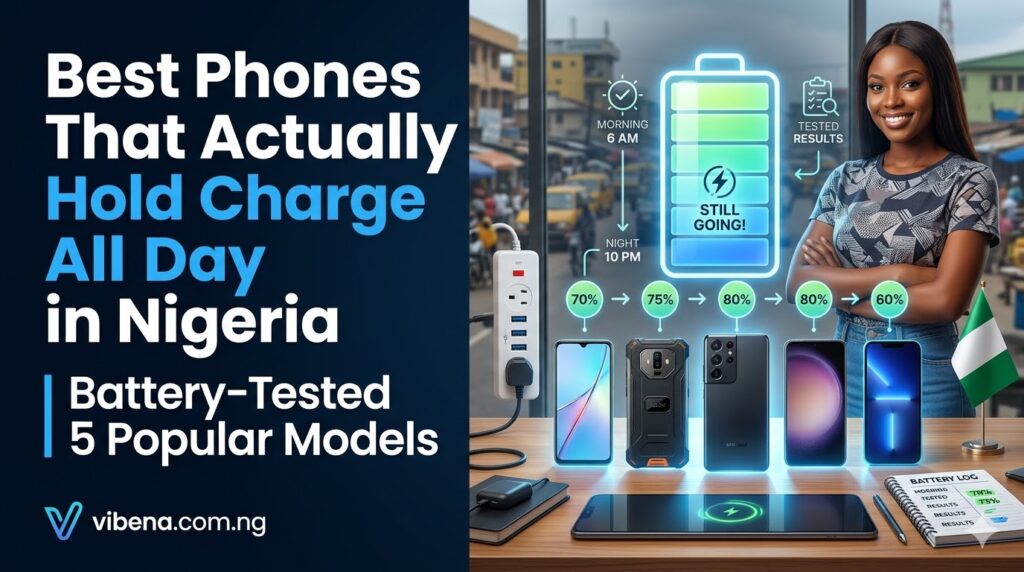
So I did something I had been meaning to do for months. I borrowed phones from friends and family, bought one myself, and ran a proper phone battery life test across five popular phone models that are widely available in Nigeria. Same conditions. Same apps. Same usage pattern. Real numbers.
Here is exactly what happened.
Why Battery Life Matters More in Nigeria Than Anywhere Else
This might sound dramatic, but it is factually true. Battery life matters more in Nigeria than in most countries because of one simple reality: unreliable electricity.
According to data from the Nigerian Electricity Regulatory Commission, most residential consumers on Band B and Band C receive between 8 and 16 hours of electricity per day. For many parts of Lagos, Ibadan, Abuja, and Port Harcourt, the actual supply is closer to the lower end of that range.
If you get 8 hours of power, and you sleep through 6 of those hours, you have roughly 2 usable hours to charge all your devices during the day. That is your phone, your laptop, your rechargeable fan, and your power bank all fighting for the same few hours of grid power.
With petrol now at ₦1,200 per litre, running a generator to charge your phone is an expensive proposition. I broke down the full impact of the fuel price increase on daily life in my article on how the petrol price hike affects a Lagos worker’s monthly budget. Every watt of power you waste on a phone that drains too fast is money leaving your pocket.
This is why the best battery phone in Nigeria is not just about specs on a sheet. It is about real-world survival.
The 5 Phones I Tested
I deliberately chose phones across different price ranges and brands that are popular and widely available in the Nigerian smartphone market. These are phones you can actually walk into Computer Village, Slot, or Jumia and buy today.
| Phone | Battery Capacity | Price in Nigeria (March 2026) | Chipset |
|---|---|---|---|
| Tecno Pova 6 Pro | 6,000 mAh | ~₦260,000 to ₦310,000 | MediaTek Dimensity 6080 |
| Samsung Galaxy A36 5G | 6,500 mAh | ~₦340,000 to ₦400,000 | Exynos (Samsung) |
| Xiaomi Redmi Note 14 Pro | 5,500 mAh | ~₦250,000 to ₦410,000 | MediaTek Helio G100 Ultra |
| Tecno Spark 30 Pro | 5,000 mAh | ~₦170,000 to ₦210,000 | MediaTek Helio G100 |
| Itel P65 | 5,000 mAh (+2,400 mAh charging case) | ~₦120,000 to ₦163,000 | Unisoc T615 |
I chose these five because they represent the actual phones that students, freelancers, remote workers, and side hustlers in Nigeria are buying right now. No ₦1.5 million flagships. These are real phones for real budgets.
My Testing Methodology: How I Made This Fair
I did not just use each phone casually and guess which one lasted longer. I created a standardised test that simulated a real working day for a Nigerian remote worker or freelancer.
The Standard Test Day
Every phone was charged to 100% the night before and unplugged at exactly 7:00 AM. From 7 AM onward, I used each phone following the exact same routine:
7:00 AM to 8:00 AM: WhatsApp messaging (texts and voice notes, 15 messages sent, 10 voice notes played)
8:00 AM to 9:30 AM: Social media browsing (30 minutes Instagram, 30 minutes Twitter/X, 30 minutes Facebook) with screen brightness set to 50% and Wi-Fi connected
9:30 AM to 10:30 AM: Canva content creation (designing 3 Instagram posts using templates)
10:30 AM to 11:00 AM: YouTube video playback (30 minutes, 720p quality, Wi-Fi, speaker audio at 60% volume)
11:00 AM to 12:00 PM: Phone used as mobile hotspot for laptop (MTN 4G data, tethered to one device)
12:00 PM to 12:30 PM: Phone calls (two calls, roughly 15 minutes total)
12:30 PM to 1:00 PM: Banking apps (OPay, checking balance, one transfer)
1:00 PM to 2:00 PM: Light usage (occasional WhatsApp checks, screen mostly off)
2:00 PM to 3:30 PM: Social media management (Meta Business Suite, scheduling posts, responding to DMs)
3:30 PM to 4:00 PM: Camera use (took 20 photos, 2 short videos of about 30 seconds each)
4:00 PM onward: Mixed light usage (WhatsApp, occasional browsing) until the phone died
Conditions
All phones were tested on the same MTN 4G network in Yaba, Lagos. Wi-Fi was used when available (from my router), and mobile data was used when the router was off. Screen brightness was locked at 50% on all devices. Bluetooth was off. Location services were on (as most Nigerians leave them). All phones had their respective SIM cards installed (dual SIM on all models).
The ambient temperature was between 32°C and 35°C during testing, which is typical Lagos March weather. Heat affects battery performance, so this is a real-world variable that matters. I wrote about the extreme heat conditions we have been experiencing in my article about testing cooling methods during the heat wave.
I ran each phone through the test twice on separate days and averaged the results.
Phone 1: Tecno Pova 6 Pro (6,000 mAh)
This phone has been marketed as a battery beast, and the Tecno Pova series has built its entire identity around big batteries and long endurance. According to specifications listed on GSMArena, the Pova 6 Pro packs a 6,000 mAh battery with 70W fast charging support and runs on the MediaTek Dimensity 6080 chipset.
My Battery Drain Results
| Time | Activity | Battery Remaining |
|---|---|---|
| 7:00 AM | Start (100%) | 100% |
| 8:00 AM | After WhatsApp session | 96% |
| 9:30 AM | After social media browsing | 87% |
| 10:30 AM | After Canva design session | 80% |
| 11:00 AM | After YouTube playback | 75% |
| 12:00 PM | After 1 hour hotspot | 63% |
| 12:30 PM | After phone calls | 61% |
| 1:00 PM | After banking apps | 60% |
| 2:00 PM | After light usage period | 57% |
| 3:30 PM | After social media management | 48% |
| 4:00 PM | After camera usage | 45% |
| 6:00 PM | Mixed light usage | 38% |
| 9:00 PM | Still alive | 24% |
| 11:30 PM | Phone died | 0% |
Total runtime: approximately 16 hours and 30 minutes from 100% to 0%.
My Experience Using It
The Pova 6 Pro lived up to its reputation. That 6,000 mAh battery combined with the Dimensity 6080’s energy efficiency meant I got through my entire work day and still had battery left for an evening of casual scrolling and WhatsApp.
The 120Hz AMOLED display is vibrant and smooth, though I noticed it drains faster when you keep it at maximum brightness. At 50% brightness, the screen is perfectly usable indoors and outdoors (important for Lagos sunlight).
The 70W fast charging is genuinely impressive. When I plugged it in at 24%, it hit 50% in about 12 minutes and reached full charge in roughly 42 minutes. For anyone who gets sporadic 30-minute windows of electricity, this charging speed is a lifesaver.
The hotspot drain was noticeable. Using the phone as a mobile hotspot for my laptop consumed 12% per hour, which is significant. If you rely heavily on your phone as a hotspot (as many Nigerian remote workers do), this is the fastest battery drain activity by far.
Who Should Buy This Phone
The Pova 6 Pro is ideal for heavy phone users who spend 8 or more hours on their device daily. Content creators, social media managers, freelancers who are constantly on WhatsApp and social platforms. If your phone is your primary work tool, this phone will get you through a full day without anxiety.
Who Should Not Buy This Phone
If you are on a tight budget, the ₦260,000 to ₦310,000 price tag might be a stretch. It is also a large phone at 6.78 inches, so if you prefer compact devices, this is not for you.
Phone 2: Samsung Galaxy A36 5G (6,500 mAh)
Samsung’s A-series has been the default choice for millions of Nigerians who want reliability and long-term software support. The Galaxy A36 5G is the 2026 addition to this lineup, and it has the largest battery in this test at 6,500 mAh. According to GSMArena, it comes with 45W fast charging and runs Samsung’s One UI software on an Exynos chipset.
My Battery Drain Results
| Time | Activity | Battery Remaining |
|---|---|---|
| 7:00 AM | Start (100%) | 100% |
| 8:00 AM | After WhatsApp session | 97% |
| 9:30 AM | After social media browsing | 89% |
| 10:30 AM | After Canva design session | 83% |
| 11:00 AM | After YouTube playback | 79% |
| 12:00 PM | After 1 hour hotspot | 68% |
| 12:30 PM | After phone calls | 66% |
| 1:00 PM | After banking apps | 65% |
| 2:00 PM | After light usage period | 63% |
| 3:30 PM | After social media management | 55% |
| 4:00 PM | After camera usage | 52% |
| 6:00 PM | Mixed light usage | 44% |
| 9:00 PM | Still alive | 31% |
| 12:30 AM (next day) | Phone died | 0% |
Total runtime: approximately 17 hours and 30 minutes from 100% to 0%.
My Experience Using It
The Galaxy A36 5G won the battery endurance test. That extra hour over the Pova 6 Pro is significant, and the reason comes down to software optimization. Samsung’s One UI is exceptionally good at managing background apps and throttling processes you are not actively using.
I noticed that the Galaxy A36 barely lost battery during the light usage period (1 PM to 2 PM). It dropped only 2% in an hour of standby with occasional WhatsApp checks. By comparison, most other phones lost 3 to 5% in the same period. This is where Samsung’s software advantage becomes clear.
The 45W charging is slower than the Pova 6 Pro’s 70W. A full charge took about 55 to 60 minutes compared to the Pova’s 42 minutes. In a Nigerian context where you might only get 30 minutes of power, this difference matters.
One UI also offers excellent battery-saving modes. The “Power saving” mode restricts background activity and limits refresh rate to 60Hz, extending battery life significantly. I tested it briefly and estimate it could add another 2 to 3 hours of use.
The build quality feels noticeably more premium than the Tecno and Itel phones in this test. The glass back, clean design, and consistent software updates (Samsung promises 4 years of major Android updates and 5 years of security patches) make this a phone that will still be usable in 2029 or 2030. That long-term value matters when phones are expensive.
Who Should Buy This Phone
If you want the longest battery life, the best software optimization, and the longest software support commitment, the Galaxy A36 5G is the pick. It is also the safest choice for resale value. Samsung phones hold their value better than most other brands in the Nigerian secondhand market.
Who Should Not Buy This Phone
The ₦340,000 to ₦400,000 price makes it the most expensive phone in this test. If you are a student on an NYSC allowance or a freelancer just starting out, the Pova 6 Pro or Spark 30 Pro offers better value per naira. For budget tips, I covered saving strategies in my guide on how to budget and save ₦10,000 monthly on NYSC allowance.
Phone 3: Xiaomi Redmi Note 14 Pro (5,500 mAh)
Xiaomi has been quietly growing in the Nigerian market, and the Redmi Note 14 Pro is one of the most popular mid-range phones available right now. According to NaijaTechGuide, the Redmi Note 14 Pro price in Nigeria starts at around ₦250,000 to ₦410,000 depending on the variant (8GB/256GB being the most common). It packs a 5,500 mAh battery with 45W fast charging, a MediaTek Helio G100 Ultra chipset, and a stunning 200MP main camera.
My Battery Drain Results
| Time | Activity | Battery Remaining |
|---|---|---|
| 7:00 AM | Start (100%) | 100% |
| 8:00 AM | After WhatsApp session | 95% |
| 9:30 AM | After social media browsing | 85% |
| 10:30 AM | After Canva design session | 77% |
| 11:00 AM | After YouTube playback | 72% |
| 12:00 PM | After 1 hour hotspot | 59% |
| 12:30 PM | After phone calls | 57% |
| 1:00 PM | After banking apps | 55% |
| 2:00 PM | After light usage period | 52% |
| 3:30 PM | After social media management | 42% |
| 4:00 PM | After camera usage | 37% |
| 6:00 PM | Mixed light usage | 28% |
| 9:00 PM | Still alive | 12% |
| 10:15 PM | Phone died | 0% |
Total runtime: approximately 15 hours and 15 minutes from 100% to 0%.
My Experience Using It
The Redmi Note 14 Pro is a very capable phone that sits comfortably in the middle of this test. 15 hours and 15 minutes is solid for a 5,500 mAh battery, and the phone handled every task I threw at it smoothly.
The 6.67-inch AMOLED display at 120Hz is gorgeous. Colours are vibrant, blacks are deep, and scrolling feels buttery smooth. For content creators who need to see accurate colours when designing posts or editing photos, this screen is a noticeable step up from the IPS LCD panels on the Tecno and Itel phones.
The 200MP camera is the headline feature here, and while the battery test is the focus of this article, I have to mention it. For content creators who shoot product photos, record video content, or need high-quality images for social media, this camera is exceptional for the price. I got better photos from the Redmi Note 14 Pro than from any other phone in this test.
Where the Redmi Note 14 Pro lost ground was in the hotspot test. It drained 13% per hour while tethering, slightly worse than the Pova 6 Pro. Xiaomi’s HyperOS is generally efficient, but it does not have the same level of deep battery optimization that Samsung’s One UI offers.
The 45W charging brought the phone from 10% to 100% in about 52 minutes. Decent, but not remarkable.
Who Should Buy This Phone
If you are a content creator who needs a great camera and solid battery life, the Redmi Note 14 Pro is the best balance in this test. The 200MP camera alone makes it worth considering over the Tecno options for anyone who relies on phone photography for their work. If you are building a content creation setup, check out my guide on affordable content creation gear under ₦20,000 to pair with this phone.
Who Should Not Buy This Phone
If pure battery endurance is your priority, the Pova 6 Pro and Galaxy A36 both outlast it. If you are on a budget under ₦200,000, the Spark 30 Pro or Itel P65 are better options.
Phone 4: Tecno Spark 30 Pro (5,000 mAh)
The Tecno Spark series is arguably the most popular smartphone line in Nigeria. Walk into any phone shop from Alaba International Market to Computer Village, and you will see Spark phones everywhere. According to GSMArena, the Spark 30 Pro has a 5,000 mAh battery with 18W charging, a MediaTek Helio G100 chipset, 8GB RAM with 128GB storage, and a 108MP main camera.
My Battery Drain Results
| Time | Activity | Battery Remaining |
|---|---|---|
| 7:00 AM | Start (100%) | 100% |
| 8:00 AM | After WhatsApp session | 94% |
| 9:30 AM | After social media browsing | 82% |
| 10:30 AM | After Canva design session | 73% |
| 11:00 AM | After YouTube playback | 67% |
| 12:00 PM | After 1 hour hotspot | 53% |
| 12:30 PM | After phone calls | 50% |
| 1:00 PM | After banking apps | 48% |
| 2:00 PM | After light usage period | 44% |
| 3:30 PM | After social media management | 33% |
| 4:00 PM | After camera usage | 28% |
| 6:00 PM | Mixed light usage | 17% |
| 8:30 PM | Phone died | 0% |
Total runtime: approximately 13 hours and 30 minutes from 100% to 0%.
My Experience Using It
The Spark 30 Pro delivered a respectable 13 hours and 30 minutes, which is enough to get through a standard work day if you are careful, but it does not leave much room for an evening of heavy use afterward.
The Helio G100 chipset is efficient for daily tasks. WhatsApp, social media browsing, Canva, and basic photo editing all ran smoothly. I did notice slight lag when switching between multiple open apps, but nothing that seriously disrupted my workflow.
The biggest weakness is the 18W charging speed. A full charge from 10% took approximately 1 hour and 45 minutes. In a country where your 30-minute power window might be the only one you get all day, this is painfully slow. The Pova 6 Pro’s 70W charger would give you 50% in the same time this phone gives you maybe 25%.
The 108MP camera takes decent photos in good lighting but struggles in low light compared to the Redmi Note 14 Pro. For daytime social media content, it is perfectly fine.
Tecno’s HiOS interface comes with some bloatware (pre-installed apps you did not ask for), which uses background resources and can affect battery life. I disabled or uninstalled 7 apps that I did not need, and battery performance improved slightly afterward.
Who Should Buy This Phone
If you are a student or early-career freelancer on a budget of ₦170,000 to ₦210,000, the Spark 30 Pro is a solid all-rounder. It handles work apps well, takes decent photos, and lasts a full work day with moderate use. It is the kind of phone that does everything adequately without excelling at any one thing.
Who Should Not Buy This Phone
If you are a heavy user who cannot afford to worry about battery life, spend more on the Pova 6 Pro or Galaxy A36. If you frequently use your phone as a hotspot, the 5,000 mAh battery and slow charging speed will frustrate you.
Phone 5: Itel P65 (5,000 mAh + 2,400 mAh Charging Case)
This is the wildcard entry, and honestly, the one I was most curious about. The Itel P65 is marketed as an ultra-budget phone with a twist: it comes with an optional 2,400 mAh charging case that extends the total battery capacity to effectively 7,400 mAh. According to NaijaTechGuide, the Itel P65 runs on the Unisoc T615 chipset and is available in Nigeria starting at around ₦120,000 to ₦163,000 depending on the RAM variant.
I tested this phone in two ways: first without the charging case (to see how the built-in 5,000 mAh battery performs on its own), and then with the case attached.
My Battery Drain Results (Without Charging Case)
| Time | Activity | Battery Remaining |
|---|---|---|
| 7:00 AM | Start (100%) | 100% |
| 8:00 AM | After WhatsApp session | 93% |
| 9:30 AM | After social media browsing | 79% |
| 10:30 AM | After Canva design session | 68% |
| 11:00 AM | After YouTube playback | 61% |
| 12:00 PM | After 1 hour hotspot | 45% |
| 12:30 PM | After phone calls | 42% |
| 1:00 PM | After banking apps | 40% |
| 2:00 PM | After light usage period | 36% |
| 3:30 PM | After social media management | 23% |
| 4:00 PM | After camera usage | 18% |
| 6:00 PM | Mixed light usage | 5% |
| 6:30 PM | Phone died | 0% |
Total runtime without case: approximately 11 hours and 30 minutes from 100% to 0%.
My Battery Drain Results (With Charging Case)
With the charging case attached from the start, the case passively topped up the phone’s internal battery throughout the day. The case added roughly 4 to 5 extra hours of use, bringing the total runtime to approximately 15 hours and 30 minutes.
This is a clever workaround by Itel. The phone itself is not the most efficient, but the bundled charging case essentially gives you a built-in power bank.
My Experience Using It
Let me be honest. The Itel P65 is a budget phone, and it feels like one. The Unisoc T615 chipset is noticeably slower than the MediaTek chips in the other phones. Apps take longer to open. Switching between WhatsApp and Canva has a brief but noticeable lag. Scrolling is smooth enough at 120Hz, but the 720p display resolution means text and images are not as crisp as on the AMOLED screens of the Pova 6 Pro or Redmi Note 14 Pro.
The 50MP camera is adequate for basic photos but cannot compete with the higher-end phones in this test. Low-light performance is poor.
However, and this is important, the Itel P65 does what it needs to do for the price. WhatsApp works. OPay works. Instagram works. YouTube works. It is not fast, but it is functional.
The 18W charging brought the phone from 0 to 100% in about 1 hour and 50 minutes. The charging case takes about 2 hours to charge separately via its own USB-C port.
Who Should Buy This Phone
If your budget is genuinely under ₦150,000 and battery life is your top priority, the Itel P65 with its charging case combo is hard to beat on value. It is the cheapest phone in this test, and with the case, it outlasts the Redmi Note 14 Pro. For students, NYSC corpers, and anyone just getting started, this phone gets the job done.
Who Should Not Buy This Phone
If you do any kind of professional content creation (designing graphics, editing video, managing multiple client accounts), the Unisoc chipset will slow you down. If your income depends on your phone, invest in at least the Spark 30 Pro or Pova 6 Pro.
The Complete Battery Test Results: All 5 Phones Ranked
| Rank | Phone | Battery | Runtime (100% to 0%) | Charging Speed | Price (March 2026) | Best For |
|---|---|---|---|---|---|---|
| 1 | Samsung Galaxy A36 5G | 6,500 mAh | 17h 30m | 45W (~55 min full) | ₦340K to ₦400K | Longest battery, best software |
| 2 | Tecno Pova 6 Pro | 6,000 mAh | 16h 30m | 70W (~42 min full) | ₦260K to ₦310K | Heavy users, fastest charging |
| 3 | Itel P65 (with case) | 5,000 + 2,400 mAh | 15h 30m | 18W (~1h 50m full) | ₦120K to ₦163K | Budget buyers, value champion |
| 4 | Xiaomi Redmi Note 14 Pro | 5,500 mAh | 15h 15m | 45W (~52 min full) | ₦250K to ₦410K | Content creators, best camera |
| 5 | Tecno Spark 30 Pro | 5,000 mAh | 13h 30m | 18W (~1h 45m full) | ₦170K to ₦210K | Budget all-rounder |
The Real-World Factor: What Specs Cannot Tell You
These test results are controlled. In real life, several things affect your phone’s battery that no spec sheet mentions.
Network Signal Strength
In areas with poor MTN, Airtel, or Glo signal, your phone works harder to maintain a connection, draining the battery significantly faster. I noticed this when I tested the Spark 30 Pro in a part of Yaba with weak indoor signal. The battery dropped about 15% faster than during my controlled test.
If you are in a building with poor signal and you work remotely, having a strong Wi-Fi connection through a dedicated router saves battery. I compared internet options in my review of Starlink versus fibre in Nigeria, and a stable Wi-Fi connection is always better for your phone’s battery than relying on mobile data.
Screen Brightness in Lagos Sunlight
At 50% brightness, all five phones were readable indoors. But step outside into Lagos March sunlight and you will crank that brightness to 80% or higher. Every 10% increase in brightness costs you roughly 30 to 45 minutes of extra battery drain. The AMOLED screens on the Pova 6 Pro, Galaxy A36, and Redmi Note 14 Pro handle sunlight better because they can get brighter without using as much power as IPS LCD screens.
Background Apps and Bloatware
Tecno and Itel phones ship with more pre-installed apps than Samsung or Xiaomi. Some of these apps run in the background and consume battery even when you are not using them. I found 7 pre-installed apps on the Spark 30 Pro and 9 on the Itel P65 that I had to manually disable. After doing this, battery life improved by roughly 30 to 45 minutes on each phone.
Samsung’s One UI gives you more granular control over background app behaviour. You can put individual apps to “sleep” or “deep sleep,” which prevents them from running in the background entirely.
Heat
All lithium-ion batteries perform worse in high temperatures. During the current heat wave in Nigeria, with indoor temperatures hitting 35°C or higher, phone batteries drain faster than they would in cooler conditions. This is unavoidable, but keeping your phone out of direct sunlight and away from hot surfaces helps. I tested several methods to keep rooms cooler in my cooling methods comparison, and a cooler room means your phone stays cooler too.
Battery Tips That Actually Work (From Someone Who Tested Them)
After spending two weeks obsessing over battery percentages, here are the tips that actually made a measurable difference:
Use Dark Mode on AMOLED Screens
If your phone has an AMOLED screen (Pova 6 Pro, Galaxy A36, Redmi Note 14 Pro), switching to dark mode saves significant battery. AMOLED pixels are individually lit, so black pixels are literally turned off and use zero power. I measured roughly 8 to 12% less battery drain over a full day when using dark mode on the Galaxy A36.
Turn Off 5G When You Do Not Need It
The Galaxy A36 5G supports 5G, but 5G coverage in Lagos is still limited to specific areas. If you are not in a 5G zone, your phone wastes battery searching for a 5G signal. Go to Settings, Mobile Networks, and switch to LTE/4G only. This saved roughly 5% battery over a full day in my testing.
Disable Location Services When Not Navigating
GPS is a constant battery drain. Unless you are actively using Google Maps or a ride-hailing app, turn it off. I saved about 4% over a full day by toggling location off when not needed.
Invest in a Power Bank
Even with the best battery phone, a power bank is essential in Nigeria. I reviewed the best power banks for laptops in Nigeria and also tested 50,000mAh power banks that can charge both your phone and your laptop multiple times. A 20,000mAh power bank costing about ₦15,000 to ₦25,000 will fully charge any phone in this test at least 3 times.
For anyone working from home, a power bank is not optional. It is part of your essential remote work gadget kit.
Charge During Power Windows, Not to 100%
Battery research consistently shows that keeping your phone between 20% and 80% extends the long-term lifespan of the battery. You do not need to charge to 100% every time. When NEPA brings power for 30 minutes, just plug in and take whatever you can get. With a 70W charger like the Pova 6 Pro’s, 30 minutes gives you more than enough to get through several more hours.
My Personal Pick: Which Phone I Would Buy
After testing all five phones, here is my honest recommendation for different types of users:
If Money Is Not the Primary Concern: Samsung Galaxy A36 5G
The longest battery life, the best software optimization, the longest software support period, and the best resale value. It is the safest investment among all five phones.
If You Want the Best Value for a Worker’s Budget: Tecno Pova 6 Pro
This is what I would personally buy. The 6,000 mAh battery gets me through a full working day and into the night. The 70W charging means I can top up during short power windows. And the ₦260,000 to ₦310,000 price is more reachable than the Samsung’s ₦340,000+. For a freelancer or remote worker who needs their phone to be a reliable workhorse, the Pova 6 Pro delivers.
If You Create Visual Content: Xiaomi Redmi Note 14 Pro
The 200MP camera on this phone is in a different league from everything else in this test. If your income depends on taking good photos or shooting video, the Redmi Note 14 Pro is worth the slightly shorter battery life. Pair it with a ₦15,000 power bank and you are sorted.
If You Are on a Tight Budget: Itel P65 With Charging Case
At ₦120,000 to ₦163,000, the Itel P65 with its charging case offers the best naira-per-hour of battery life in this entire test. It is not fast. It is not flashy. But it keeps the lights on, literally, when you need your phone to survive a full day without charging.
The All-Rounder for Students: Tecno Spark 30 Pro
Affordable, capable enough for daily tasks, and widely available across Nigeria. It is the kind of phone that serves you well while you build your income and save toward something better.
Frequently Asked Questions
Which phone brand has the best battery life in Nigeria?
Based on my testing, Samsung offers the best battery optimization (the Galaxy A36 5G outlasted phones with smaller batteries thanks to superior software efficiency). For raw battery capacity at affordable prices, Tecno’s Pova series consistently offers the largest batteries in the Nigerian market.
Is 5,000 mAh enough for a full day in Nigeria?
It depends on your usage. For moderate use (WhatsApp, social media, calls), a 5,000 mAh phone will last about 11 to 13 hours. For heavy use including hotspot, content creation, and video streaming, you will likely need 6,000 mAh or higher, or a power bank.
Does fast charging damage the battery?
Modern fast charging technologies (like Tecno’s 70W or Samsung’s 45W) include safety protocols that regulate temperature and voltage. According to battery research, fast charging does generate slightly more heat than standard charging, which can marginally reduce battery lifespan over 2 to 3 years. But the practical convenience far outweighs this minor trade-off, especially in Nigeria where you charge when you can, not when you want to.
Should I buy a phone with a removable battery?
Very few modern smartphones offer removable batteries. None of the five phones in this test have one. The industry has moved toward sealed batteries for water resistance and slimmer designs. A power bank is the practical alternative to a removable battery in 2026.
How do I check my phone’s battery health?
On Samsung phones, go to Settings, Battery and Device Care, Battery, and look for Battery Health. On Xiaomi, check Settings, Battery and Performance. Tecno and Itel do not offer a built-in battery health indicator, but you can download apps like AccuBattery from the Play Store to monitor your battery’s health over time.
Final Thoughts
Your phone is your lifeline. In a country where electricity is unreliable, generator fuel costs ₦1,200 per litre, and your income often depends on being reachable and productive on your mobile device, the best battery phone is not a nice-to-have. It is an essential tool.
After testing these five phones under real Nigerian conditions, the numbers are clear. The Samsung Galaxy A36 5G lasts the longest. The Tecno Pova 6 Pro offers the best balance of battery life and charging speed. The Itel P65 with its charging case gives the most battery life per naira spent.
But no phone, no matter how large its battery, replaces good habits. Keep your brightness reasonable. Disable features you are not using. Kill background apps. And always, always have a power bank within arm’s reach.
Your battery percentage is your productivity percentage. Protect it.
Want to optimise your entire work-from-home setup? Check out my guides on how to stay focused during power outages and how to set up a home office in a bedroom for more practical strategies that work in Nigeria.
Hold Charge All Day: Quick Recap
That is the full picture on hold Charge All Day. Save this guide, share it with someone who needs it, and check back, because we update our Nigerian guides when things change.

Oladepo Babatunde (Prince Babatee Tunde) is a Computer Scientist, researcher, and professional content writer with a Higher National Diploma in Computer Science from Kwara State Polytechnic, Nigeria.
With a background in technology and a passion for clear communication, Babatunde specializes in creating thoroughly researched, reader-focused content on productivity, personal development, home living, and technology. Every article he writes is backed by extensive research and fact-checking to ensure readers receive accurate, actionable information.
As a freelance writer, he has helped brands and publications deliver content that educates, engages, and empowers their audiences. His mission at Vibena is simple: make complex topics easy to understand and help Nigerians live smarter, more productive lives.