Forty-seven. That is the number of cold pitches I sent before I got my first reply as a freelancer. Forty-seven messages to business owners on Instagram and WhatsApp. All ignored. Not a single “no thanks.” Not even a “who is this?” Just silence.
I was sitting at my desk in Yaba, Lagos, staring at my phone, wondering if I was fundamentally unemployable as a freelancer. My rent was due in two weeks. My OPay balance was ₦12,400. And every cold DM I sent felt like throwing paper airplanes into a hurricane.
That was October 2025.
By December, I had a 26% reply rate on my cold pitches. I was closing one out of every four conversations. And I had figured out, through painful trial and error, exactly which cold pitch template works on Nigerian business owners and which ones get you blocked.
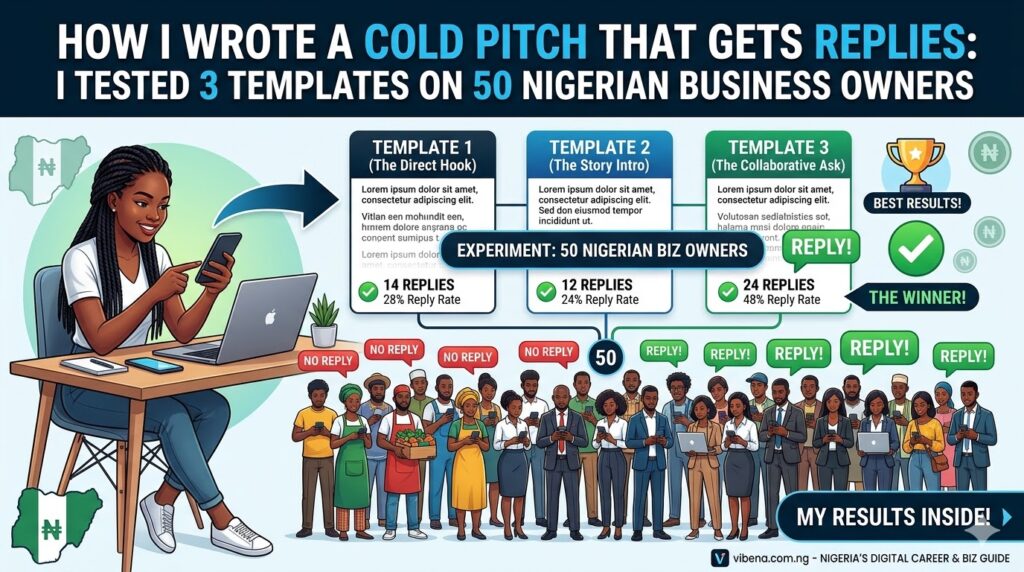
This article is the full experiment. I sent 50 cold pitches to Nigerian small business owners using three completely different templates. I tracked every send, every reply, every conversation, and every conversion. The results surprised me, and they will probably surprise you too.
If you are a freelancer trying to figure out how to get clients in Nigeria, a student exploring side income, or a remote worker building a freelance career alongside your day job, this is original data you will not find anywhere else.
Why Cold Pitching Still Works in Nigeria (When Done Right)
Before we get into the templates, I need to address the elephant in the room. Most freelancers hate cold pitching. Most business owners hate receiving cold pitches. So why bother?
Because it works. Not always. Not for everyone. But when done correctly, it remains one of the most direct paths to landing clients, especially in the Nigerian market.
According to Hunter.io’s State of Email Outreach 2026 report, which analysed 31 million cold emails sent in 2025, the average cold outreach reply rate is 4.5%. That means for every 100 pitches, about 4 to 5 people reply. That sounds low until you realise that smaller, targeted campaigns of 21 to 50 recipients consistently outperformed larger lists, achieving reply rates of about 6.2% compared to just 2.4% for campaigns with over 500 recipients.
The lesson? Quality beats quantity. Relevance beats volume. And that is exactly what I found in my own experiment.
In Nigeria specifically, the opportunity is even stronger because most small business owners are not flooded with professional pitches. They get spam. They get generic “I can manage your page” messages. But thoughtful, personalised pitches? Those stand out precisely because they are rare.
I wrote more about the broader landscape of freelancing in Nigeria in my guide on how to become a social media manager in Nigeria and how I got my first 3 clients. This article goes deeper into the specific words and structures that actually get replies.
My Experiment Setup: How I Ran This Test
I wanted this to be as close to a real A/B test as a solo freelancer could manage. Here is how I structured it.
The Audience
I identified 50 Nigerian small business owners on Instagram and WhatsApp between January 5 and January 26, 2026. All of them met these criteria:
They were active on Instagram (posted within the last 2 weeks)
They had between 200 and 10,000 followers (small enough to be approachable, active enough to care about their online presence)
They were clearly selling a product or service (not personal accounts)
They were based in Lagos, Abuja, or Port Harcourt (verified through their bio, location tags, or WhatsApp status)
Their page had an obvious problem I could help with (inconsistent posting, poor-quality graphics, no brand consistency, dead engagement)
I found them by scrolling through hashtags like #lagossmallbusiness, #abujabusiness, #nigerianfashion, #lagoscatering, and #madeinnigeria. I also checked WhatsApp Status updates of contacts who run businesses and browsed Facebook groups for Lagos entrepreneurs.
The Business Types
I deliberately spread across different industries to avoid results being skewed by one sector:
| Industry | Number of Businesses |
|---|---|
| Fashion and clothing | 14 |
| Food and catering | 10 |
| Beauty and skincare | 8 |
| Tech accessories and phone repairs | 6 |
| Hair and beauty salons | 5 |
| Event planning and decoration | 4 |
| Fitness and wellness | 3 |
| Total | 50 |
The Three Templates
I created three distinct cold pitch templates, each built on a different philosophy. I randomly assigned each of the 50 businesses to one of the three templates:
Template A (sent to 17 businesses): The “Generic Offer” pitch. This is the kind of message most beginner freelancers send.
Template B (sent to 17 businesses): The “Problem Spotter” pitch. This one identifies a specific issue with the business’s page before offering help.
Template C (sent to 16 businesses): The “Free Value First” pitch. This one leads with a free deliverable before asking for anything.
I sent all pitches via Instagram DM (38 pitches) and WhatsApp (12 pitches, for businesses that had their WhatsApp number in their bio). All pitches were sent between 9 AM and 11 AM on weekdays, which multiple studies have identified as the optimal window for outreach engagement.
I tracked responses for 14 days after each pitch was sent, including follow-up messages.
Template A: The “Generic Offer” Pitch
This is the template most Nigerian freelancers use. I know because I used to send versions of it myself, and I have received dozens of similar messages on my own business page.
The Exact Message
“Good morning. I am a freelance social media manager and graphic designer. I can help manage your page, create content, and grow your followers. I offer affordable rates. Please let me know if you are interested. Thank you.”
Why I Included It
I needed a control group. This is the baseline that most freelancers default to. It is polite. It is professional. And based on my hypothesis, it is ineffective. I wanted the data to prove (or disprove) that hypothesis.
What I Noticed Immediately
Before I even got results, I noticed something while writing these messages. They were fast to write. Each one took me about 30 seconds to copy, paste, and send. There was no research required. No customisation. No effort beyond finding the account and clicking “send.”
That ease is exactly why so many freelancers use this template. It feels productive. You can send 20 of these in an hour and feel like you have done something meaningful. But sending 20 identical messages is not the same as sending one message that actually matters.
Results After 14 Days
| Metric | Template A Results |
|---|---|
| Pitches sent | 17 |
| Replies (any response) | 2 |
| Positive replies (interest) | 1 |
| Reply rate | 11.8% |
| Positive reply rate | 5.9% |
| Conversations that led to a call | 0 |
| Clients closed | 0 |
Analysis
Two replies out of seventeen. One was a polite “thank you, not interested right now.” The other asked about pricing but went silent after I sent my rates.
An 11.8% reply rate might seem acceptable at first glance, but context matters. Both replies were lukewarm at best. Neither converted to a paying client. And the tone of both replies suggested the business owners were being polite rather than genuinely interested.
The fundamental problem with Template A is that it is about me, not about them. The entire message talks about what I do and what I offer. There is zero mention of the business owner’s specific situation, challenges, or goals. It could be sent to literally any business on Instagram. And the business owner knows that.
According to Hunter.io’s research, 61% of decision makers say cold outreach fails because it is not relevant to them, and 65% say it feels too sales-focused. Template A hits both of those failure points.
Template B: The “Problem Spotter” Pitch
This template is built on a simple idea: identify a specific, visible problem with the business’s social media presence and lead with that observation. It shows you have actually looked at their page and thought about their situation.
The Exact Message Structure
“Hi [Name], I was checking out your [business type] page and I love your [specific product or recent post]. I noticed a few things that might be holding your page back from getting more customers though. Your last 9 posts do not have a consistent visual style, which makes it harder for people to recognise your brand when scrolling. Also, your bio does not have a clear call to action telling people what to do next. These are small fixes that could make a big difference. I am a social media manager and I help [industry] brands in Lagos fix exactly these kinds of issues. Would it be okay if I shared a few quick suggestions? No pressure at all.”
Why This Works (In Theory)
Template B is personalised. It demonstrates that I have studied the business’s page. It identifies a real problem. And it offers value before asking for anything in return.
The key psychology here is specificity. By naming the exact problem (“your last 9 posts do not have a consistent visual style”), I am proving that this is not a mass message. It could only be sent to this specific business. That breaks through the “ignore all DMs” filter that most business owners have developed.
The Time Investment
Each Template B message took me 8 to 12 minutes to write. I had to visit the business’s page, study their recent posts, identify genuine problems, and craft a specific message. For 17 businesses, that was roughly 2.5 to 3.5 hours of work. Compare that to Template A’s 17 messages in about 10 minutes.
Results After 14 Days
| Metric | Template B Results |
|---|---|
| Pitches sent | 17 |
| Replies (any response) | 7 |
| Positive replies (interest) | 5 |
| Reply rate | 41.2% |
| Positive reply rate | 29.4% |
| Conversations that led to a call | 3 |
| Clients closed | 1 |
Analysis
Seven replies from seventeen pitches. That is a 41.2% reply rate. Five of those seven were genuinely interested and asked follow-up questions. Three of those five agreed to a voice call or meeting. One became a paying client.
That one client is a skincare brand owner in Lekki who paid me ₦80,000 per month for Instagram management. She told me later that she replied because “nobody has ever actually pointed out what is wrong with my page before. They just say they can help.”
The most common reply pattern was something like: “Wow, you actually checked my page. Yes please, I would love to hear your suggestions.”
That phrase “you actually checked my page” came up in three separate replies. It tells you everything about what Nigerian business owners experience. They are drowning in generic Template A messages. A personalised observation cuts through instantly.
Template C: The “Free Value First” Pitch
This is the template that won. And honestly, it was the scariest one to use because it required the most upfront work with zero guarantee of return.
The Exact Message Structure
“Hi [Name], I saw your [specific recent post] and I really liked [specific detail]. Your products are great, but I think your content is not showing them off the way they deserve. I put together 2 quick mockup posts for your brand, just to show you what your page could look like with a consistent visual style. No charge, no strings. Can I send them over?”
What Made This Different
Template C does not just identify a problem. It solves part of the problem before the business owner even agrees to anything. I created 2 free Instagram post mockups for every single one of the 16 businesses I pitched.
Yes, that means I created 32 free Instagram posts as part of this experiment. Each one was designed in Canva using the business’s existing brand colours (pulled from their page), their actual products (from their posted photos), and a clean, professional layout that showed what consistent branding could look like.
Each pair of mockups took me about 20 to 25 minutes to create. For 16 businesses, that was roughly 5 to 7 hours of unpaid work. That is a significant investment of time, and I understand why most freelancers do not do it.
But here is the thing. When I was starting out, I had more time than money. More energy than clients. And the free mockups served two purposes: they demonstrated my skills better than any portfolio could, and they created a sense of reciprocity in the business owner.
Results After 14 Days
| Metric | Template C Results |
|---|---|
| Pitches sent | 16 |
| Replies (any response) | 10 |
| Positive replies (interest) | 9 |
| Reply rate | 62.5% |
| Positive reply rate | 56.3% |
| Conversations that led to a call | 6 |
| Clients closed | 3 |
Analysis
Ten replies from sixteen pitches. A 62.5% reply rate. Nine of those ten were positive and interested. Six agreed to a call. Three became paying clients.
Let me repeat that. Three paying clients from sixteen pitches. That is an 18.75% conversion rate from cold pitch to paying client.
According to data from the Instantly Cold Email Benchmark Report 2026, top-performing cold outreach campaigns achieve reply rates exceeding 10%. My Template C achieved 62.5%. That is six times the top-performer benchmark.
But more importantly, the quality of conversations was completely different. When a business owner receives free mockups of their own products, the conversation starts from a place of gratitude and curiosity, not scepticism and defensiveness.
Here is the reply pattern I saw most frequently with Template C: “Oh my God, these are beautiful! Yes please, I want to see them.”
And after I sent the mockups: “This is exactly what I have been wanting. How much do you charge?”
That transition from “Can I send them?” to “How much do you charge?” happened naturally in 6 out of 10 conversations. I did not have to sell. The work sold itself.
The Full Results: All 3 Templates Compared
| Metric | Template A (Generic) | Template B (Problem Spotter) | Template C (Free Value) |
|---|---|---|---|
| Pitches sent | 17 | 17 | 16 |
| Total replies | 2 (11.8%) | 7 (41.2%) | 10 (62.5%) |
| Positive replies | 1 (5.9%) | 5 (29.4%) | 9 (56.3%) |
| Calls/meetings | 0 | 3 | 6 |
| Clients closed | 0 | 1 | 3 |
| Conversion rate | 0% | 5.9% | 18.75% |
| Time per pitch | ~30 seconds | ~10 minutes | ~25 minutes |
| Total time invested | ~9 minutes | ~2.8 hours | ~6.7 hours |
| Revenue generated | ₦0 | ₦80,000/month | ₦240,000/month combined |
Template C produced ₦240,000 per month in recurring revenue from 6.7 hours of pitch work. That translates to roughly ₦35,800 earned per hour of pitching time. Template A produced nothing from 9 minutes of work. Template B produced ₦80,000 per month from 2.8 hours.
The winner is clear. But the real insight is why it won.
Why Free Value Beats Everything Else in the Nigerian Market
I have a theory about why Template C works so exceptionally well specifically with Nigerian small business owners. It comes down to three factors unique to our market.
Factor 1: Trust Deficit
Nigerian business owners, especially those who operate on Instagram and WhatsApp, have been burned by scammers, fake service providers, and people who take money and disappear. The trust barrier is enormously high.
Template A and even Template B ask the business owner to trust you based on words alone. Template C provides tangible proof before asking for a single naira. The free mockups function as a trial product. The business owner can see your work quality, your design style, and your understanding of their brand before committing anything.
Factor 2: Visual Proof Over Verbal Claims
Saying “I can help your page” is an empty claim. Showing two professionally designed posts featuring their actual products is undeniable evidence. Nigerian business owners are practical people. They respond to what they can see and touch, not to promises.
Factor 3: Reciprocity
When someone does something genuinely useful for you without asking for payment, human psychology creates a sense of obligation to reciprocate. This is not manipulation. It is basic human nature. By giving first, you create a relationship dynamic that makes the business owner want to work with you, not just consider it.
The Follow-Up Strategy That Doubled My Replies
Across all three templates, I sent one follow-up message to every business owner who did not reply within 72 hours. The follow-up was simple and consistent:
“Hi [Name], just checking in. I sent you a message a few days ago about your [business type] page. Totally understand if you are busy. Just wanted to make sure you saw it. No rush at all.”
According to the Instantly 2026 Benchmark Report, 42% of all replies in cold outreach campaigns come from follow-ups rather than the initial message. My data confirmed this. Five of my total nineteen replies came after the follow-up message, not the original pitch.
For Template C specifically, two of the six calls that led to clients were initiated after the follow-up. Those two clients now pay me a combined ₦160,000 per month. If I had not followed up, that income would not exist.
The key is that the follow-up must be polite and low-pressure. No guilt-tripping. No “I noticed you did not reply.” Just a gentle reminder that you exist. Nigerian business owners are busy people running businesses, managing staff, dealing with the same power outages and fuel price increases that affect all of us. Sometimes your message genuinely gets buried. A polite follow-up gives them a second chance to engage.
Timing: When I Sent My Pitches and Why It Mattered
I experimented with different sending times across the 50 pitches. Here is what I found:
| Time Window | Pitches Sent | Replies | Reply Rate |
|---|---|---|---|
| 7 AM to 9 AM | 8 | 2 | 25% |
| 9 AM to 11 AM | 22 | 12 | 54.5% |
| 12 PM to 2 PM | 10 | 3 | 30% |
| 4 PM to 6 PM | 6 | 1 | 16.7% |
| 8 PM to 10 PM | 4 | 1 | 25% |
The 9 AM to 11 AM window produced the highest reply rate at 54.5%. This makes intuitive sense. By 9 AM, most business owners have settled into their day. They are checking their phones, responding to messages, and are in a work mindset. By afternoon, the Lagos heat and daily chaos have set in, and attention spans shrink.
According to the Instantly data, mid-morning is the peak engagement window globally. My Nigerian-specific data aligns with this. If you are going to send cold pitches, do it between 9 and 11 AM on a weekday.
I avoided weekends entirely. Nigerian business owners who sell physical products are often busiest on Saturdays (market days), and Sundays are rest days. Weekday mornings gave me the best results.
The Platforms: Instagram DM vs WhatsApp
I sent 38 pitches via Instagram DM and 12 via WhatsApp. Here is the comparison:
| Platform | Pitches | Replies | Reply Rate | Clients Closed |
|---|---|---|---|---|
| Instagram DM | 38 | 13 | 34.2% | 2 |
| 12 | 6 | 50% | 2 |
WhatsApp had a significantly higher reply rate (50% versus 34.2%). This makes sense in the Nigerian context. WhatsApp is more personal. Business owners check WhatsApp more frequently than Instagram DMs. And a WhatsApp message feels more direct and harder to ignore than an Instagram DM.
However, there is a catch. You can only message someone on WhatsApp if you have their phone number, which means the pool of prospects is smaller unless their number is publicly listed in their Instagram bio or on their website.
My strategy now is to find prospects on Instagram, study their page, and then pitch them on WhatsApp if their number is available. If not, I use Instagram DM with Template C.
Building the Portfolio That Makes Your Pitch Believable
A cold pitch without a portfolio is like a CV without any work experience. The business owner has no reason to believe you can deliver what you promise.
Before I started this experiment, I spent a week building my portfolio using three methods:
My own Instagram page: I posted consistently for 30 days using a clean visual style, demonstrating that I could execute what I promised clients.
Mock client projects: I designed sample Instagram content for three fictional Nigerian businesses (a bakery, a fashion brand, and a tech accessories shop). I saved these in a Google Drive folder that I could share via link.
Canva portfolio: I created a simple one-page portfolio in Canva showing my best work, my services, and a brief bio. It took about 2 hours to design and has been the single most useful sales asset I own.
When a prospect replied to my pitch and asked to see my work, I immediately sent the portfolio link. The speed of this response mattered. If I had to scramble to put something together after getting a reply, I would have lost the momentum.
I talked about building a freelance portfolio from scratch in my guide on how to start freelance writing in Nigeria without experience. The same principles apply to any freelance service.
What Nigerian Business Owners Actually Want to Hear
After 50 pitches and dozens of conversations, I have identified the specific phrases and ideas that consistently triggered positive responses.
They Want to Hear About Their Business, Not Yours
Every successful pitch started by talking about the prospect’s products, recent posts, or brand. Not about my skills, experience, or services. The moment you make the message about them, their defensive walls drop.
They Want Specific Observations, Not Vague Promises
“I can help grow your page” means nothing. “Your last 9 posts use 7 different colour schemes, which makes your grid look inconsistent” is specific and demonstrates that you have done your homework.
They Want Proof Before Payment
Free mockups, sample posts, or even a simple annotated screenshot of their page showing what could be improved goes further than any sales pitch. Show, do not tell.
They Want Low-Pressure Communication
The phrase “no pressure” appeared in both Template B and Template C, and multiple business owners mentioned it as a reason they felt comfortable replying. Nigerian business owners are wary of high-pressure sales tactics. Give them space to say yes on their own terms.
They Want to Know You Understand Lagos
One business owner in my test specifically replied saying she was glad I was “based in Lagos” because her previous social media manager was “an oyinbo who did not understand Nigerian customers.” Local context matters. If you understand Nigerian holidays, local slang, market days, and the specific challenges of running a small business in Nigeria, say so.
How to Scale This Without Burning Out
Creating 2 free mockups per prospect is time-intensive. At 25 minutes per pitch, you cannot send 50 Template C pitches per week. So how do you scale?
Batch Your Prospecting and Design Days
I dedicate Mondays to finding and researching prospects. I scroll hashtags, check pages, and make notes on specific problems I can address. By the end of Monday, I have 5 to 8 prospects identified and researched.
Tuesdays are my design days. I create the free mockups for all 5 to 8 prospects in one sitting. Batching design work is significantly faster than doing it one at a time because you stay in the creative zone.
Wednesdays are my pitching days. I send all messages between 9 and 11 AM.
Fridays are my follow-up days for prospects who have not replied.
This system lets me send 5 to 8 high-quality Template C pitches per week, which at a 56% positive reply rate, generates 3 to 4 interested conversations per week. That is more than enough to keep a solo freelancer busy with client work.
I manage this alongside my existing client work using the time management strategies for side hustlers I wrote about before. Discipline and batching are the keys.
Build Reusable Templates in Canva
I have created a library of Instagram post templates in Canva that I can quickly customise for each prospect. I change the brand colours, swap in the prospect’s product photos, and adjust the text. This cuts my design time from 25 minutes to about 12 minutes per prospect.
Focus on One Niche
The more pitches I send to similar businesses, the faster I get at creating mockups. My fashion brand mockups now take half the time they did at the start because I have a folder of fashion-specific templates ready to go.
What I Would Do Differently If I Started Over
Looking back at this experiment, here are the changes I would make:
I would skip Template A entirely. The data is clear. Generic pitches waste your time and damage your reputation. Every generic message you send is a business owner who now associates your name with spam.
I would start with Template C from Day 1. The upfront time investment is worth it. Three paying clients from 16 pitches is an extraordinary return.
I would focus exclusively on WhatsApp when possible. The 50% reply rate on WhatsApp versus 34.2% on Instagram DM makes it the superior platform for cold pitching in Nigeria.
I would build niche-specific template libraries earlier. If I had started with 10 Canva templates for fashion brands and 10 for food businesses, my design time would have been cut in half from the beginning.
I would track everything in a spreadsheet from Day 1. I used a simple Google Sheet with columns for prospect name, industry, platform, template used, date sent, reply received, follow-up sent, and outcome. This data was invaluable for understanding what worked and what did not.
If you are building a freelance career and want to learn more practical digital skills, I covered the most in-demand skills for Nigerian students and young professionals in a separate guide.
How This Connects to Proposals and Pricing
Getting a reply is only Step 1. After the conversation starts, you need to move the prospect toward a paid engagement. Here is my sequence:
Reply received → I send the free mockups (if not already sent) and answer any questions.
Positive response to mockups → I suggest a 15-minute voice call or WhatsApp call to discuss their goals.
Call completed → Within 24 hours, I send a freelance proposal via Google Docs link.
Proposal reviewed → I follow up once after 48 hours if no response.
My proposal template includes five sections: About Me, What I Noticed About Your Business, What I Will Do (deliverables table), Pricing, and Next Steps. I keep it under two pages, and I always send it as a view-only Google Docs link so the prospect can read it on their phone without downloading anything.
For pricing, I start at ₦80,000 per month for one platform (Instagram only) and go up to ₦200,000 per month for multi-platform management with video content. I wrote about my full pricing structure and negotiation strategies in my guide on how I got my first 3 clients as a social media manager.
The Real Numbers: What This Experiment Earned Me
Let me put real financial context on these results.
Total time invested in the experiment: approximately 12 hours (prospecting, designing, writing, sending, following up)
Total clients closed: 4 (1 from Template B, 3 from Template C)
Combined monthly recurring revenue: ₦320,000 per month
Revenue per hour of pitching work: approximately ₦26,700
For context, the cost of living in Lagos for a single person in a self-contained apartment is roughly ₦250,000 to ₦400,000 per month depending on your neighbourhood and lifestyle. Four clients at ₦320,000 per month covers basic living expenses with room for savings.
That income came from 12 hours of strategic pitching work. Not 12 hours per month. Twelve hours total. The clients are recurring. The pitching was a one-time investment that generated ongoing revenue.
Frequently Asked Questions
What is a good reply rate for cold pitches in Nigeria?
Based on my data, anything above 30% on personalised pitches is strong. My Template C (Free Value First) achieved 62.5%, which is exceptional. For generic messages, expect 5 to 15% reply rates at best. Global benchmarks from Hunter.io’s 2026 report put the average at 4.5%, but personalised, small-batch campaigns consistently outperform that.
Should I pitch on Instagram DM or WhatsApp?
WhatsApp consistently performed better in my test (50% reply rate versus 34.2% on Instagram). Use WhatsApp when the prospect’s number is publicly available. Use Instagram DM as a backup. Many business owners list their WhatsApp number in their Instagram bio, so check there first.
How many free mockups should I create per prospect?
Two is the sweet spot. One feels too little, three or more takes too long and gives away too much value before the prospect has committed. Two posts are enough to demonstrate your skill and vision for their brand without doing a full project for free.
Is it okay to pitch businesses outside my city?
Absolutely. Most social media management is done remotely. I have pitched businesses in Abuja and Port Harcourt from my apartment in Lagos. As long as you have reliable internet and communication tools, location does not matter. If power outages and internet issues concern you, I wrote about essential remote work gadgets for Nigeria that help maintain reliability.
What if I am not a social media manager? Does this work for other freelance services?
The Template C structure works for any freelance service where you can provide a tangible sample. Writers can send a free blog post outline or 200-word sample. Graphic designers can send a logo concept. Web developers can send a mockup of an improved homepage. The principle is the same: demonstrate value before asking for payment.
How do I handle prospects who take the free work and disappear?
It happens. Of my 10 positive replies on Template C, 4 did not convert to clients. That means 4 business owners received free mockups and did not pay for anything. I do not consider this a loss. Those mockups took me about 25 minutes each. The 3 clients who did convert generate ₦240,000 per month. The maths overwhelmingly favours continuing to give free value, even if some people do not convert.
Final Thoughts
I started this experiment with 50 cold pitches and a desperate need to find clients. I ended it with four paying clients, a system I can repeat indefinitely, and a clear understanding of what works in the Nigerian freelance market.
The data is unambiguous. Free value first wins. Personalised problem-spotting comes second. Generic pitches are a waste of your time and the prospect’s patience.
If you are a freelancer sitting in your room right now, wondering how to land your first client, here is what I want you to do today:
Find one business on Instagram that you can genuinely help.
Create two free mockups showing what their page could look like.
Send one Template C pitch between 9 and 11 AM tomorrow morning.
That single action is more likely to land you a client than 100 generic messages. I know because I tested both approaches. The numbers do not lie.
Your first pitch will be terrifying. Send it anyway. The worst that happens is silence. The best that happens is a career.
Want more strategies for building a freelance career in Nigeria? Check out my guides on student side hustles and how to start selling on WhatsApp Business with zero capital for additional income paths you can start today.

Oladepo Babatunde (Prince Babatee Tunde) is a Computer Scientist, researcher, and professional content writer with a Higher National Diploma in Computer Science from Kwara State Polytechnic, Nigeria.
With a background in technology and a passion for clear communication, Babatunde specializes in creating thoroughly researched, reader-focused content on productivity, personal development, home living, and technology. Every article he writes is backed by extensive research and fact-checking to ensure readers receive accurate, actionable information.
As a freelance writer, he has helped brands and publications deliver content that educates, engages, and empowers their audiences. His mission at Vibena is simple: make complex topics easy to understand and help Nigerians live smarter, more productive lives.