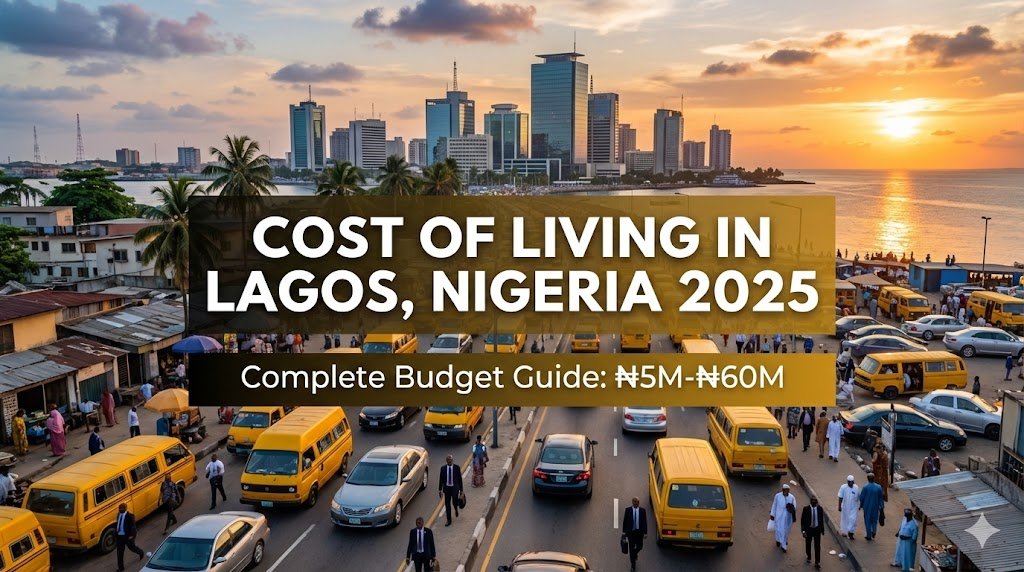
If you’re searching for the cost of living in Lagos Nigeria 2026, here’s the practical answer: Lagos costs can range from “manageably expensive” to “elite-level pricey,” depending on where you live (Mainland vs Island), how you commute, and how you handle power (grid vs generator or solar).
This guide breaks down the real Lagos budget using January 2026 official indicators and Lagos-specific realities like annual rent payments and estate service charges. Whether you’re earning ₦200,000 or ₦2 million monthly, you’ll find realistic budget scenarios that match your situation.
Quick Numbers for 2026:
- Frugal single (Mainland, shared housing): ₦400,000 to ₦600,000 monthly
- Single professional (own apartment, mixed transport): ₦700,000 to ₦1.2 million monthly
- Family of four (rent, school, power, car): ₦1.5 million to ₦3.5 million+ monthly
According to Numbeo’s January 2026 data, the estimated monthly costs for a family of four are approximately $1,393 (₦2 million) including rent [per Living Cost Index], while a single person needs around $500 (₦715,000) monthly excluding rent. However, these figures represent baseline costs, and actual Lagos expenses often run higher depending on lifestyle choices.
How Much Does It Cost to Live in Lagos Nigeria Per Month? (2026 Overview)
Your Lagos budget depends heavily on lifestyle choices. Rent alone accounts for up to 40% of total living costs for most households, with many Lagos residents spending over half their income on housing.
| Lifestyle Level | Monthly Budget | Annual Budget | Who It’s For |
|---|---|---|---|
| Survival/Basic | ₦400K to ₦800K | ₦5M to ₦10M | Single person, shared flat on Mainland, public transport, local markets |
| Moderate | ₦1.2M to ₦2M | ₦15M to ₦24M | Small family or single professional, decent 2-bedroom in Surulere or Ikeja, occasional Uber |
| Comfortable | ₦2.5M to ₦4M | ₦30M to ₦50M | Family of 4, standard 3-bedroom in Lekki or VI, personal car, private schools |
| Luxury | ₦5M+ | ₦60M+ | Expat-level, premium Ikoyi location, international schools, full-time staff |
According to Nomads.com January 2026 data, the cost of living for an expat in Lagos is approximately $765 per month, while families need around $1,066 monthly. These figures align with Mainland lifestyle costs but underestimate Island living expenses.
Understanding Lagos’s Cost Structure in 2026
Lagos operates on two different economies: the Mainland economy and the Island economy. The cost gap between these areas is massive, often 50% to 100% for equivalent housing and services.
Key Cost Drivers
Housing Pressure: According to TechEconomy’s 2026 analysis, big cities like Lagos face annual rent increases of 10% to 30% in many areas due to increased rural-urban migration while housing supply lags behind demand.
Currency Impact: With the naira trading between ₦1,430 and ₦1,500 per dollar according to Nigeria Housing Market analysis, imported goods have spiked in price.
Food Inflation Reality: Research indicates that lower-income households spend up to 70% of their income on food. A recent viral comparison showed that grocery items costing ₦25,225 in 2020 now cost ₦147,050 in 2026, representing a 582% increase over five years.
Infrastructure Costs: You pay extra for private security, water treatment, and electricity generation because public infrastructure remains unreliable.
Upfront Move-In Costs: The “Lagos Shock” Most People Don’t Budget For
Before calculating monthly expenses, understand the substantial upfront costs required to move into a Lagos apartment. This is where many newcomers get blindsided.
Standard Move-In Cost Breakdown
| Cost Category | Typical Amount | Notes |
|---|---|---|
| Rent (1 to 2 years upfront) | ₦1.5M to ₦15M+ | Most landlords require advance payment |
| Agency Fee | 10% of annual rent | Lagos guidelines cap this at 10% |
| Legal/Agreement Fee | 10% of annual rent | For tenancy agreement preparation |
| Caution Deposit | 10% of annual rent | Refundable security deposit |
| Service Charge | ₦500K to ₦3.5M annually | For estates with shared amenities |
| Prepaid Meter | ₦80,000 to ₦150,000 | If not already installed |
| Moving Logistics | ₦50,000 to ₦200,000 | Depending on distance and volume |
Important Legal Context: The Lagos State government has a draft Tenancy and Recovery of Premises Bill (2025) proposing to limit advance rent demands to no more than one year for new tenants. However, this remains a draft proposal and has not yet become law. Currently, landlords can still legally demand 1 to 2 years upfront.
Total Move-In Budget Example: For a ₦2.5 million annual rent apartment, expect to pay approximately ₦3.25 million to ₦3.5 million upfront before you can move in.
Housing and Rent Costs in Lagos: ₦400K to ₦25M+ Annually
Housing typically consumes 40% to 60% of your budget in Lagos. According to market reports, residential prices nationwide are projected to grow between 5% and 15% in 2026, with Lagos Island commanding premium increases.
Lagos Mainland Rent Prices (More Affordable)
Alimosho, Ikotun, Ikorodu: ₦400,000 to ₦1.2M annually for a decent 2-bedroom flat
Yaba, Surulere: Tech hubs and middle-class favorites cost ₦1.5M to ₦2.5M annually for a 2-bedroom apartment
Ikeja (State Capital): For a 2-bedroom flat in a secure estate, budget ₦2M to ₦3.5M annually
Lagos Island Rent Prices (Premium)
Lekki Phase 1: A standard 2 to 3 bedroom apartment ranges from ₦8M to ₦12M annually
Victoria Island (VI): Expect ₦10M to ₦15M annually for a 2 to 3 bedroom flat. According to Numbeo, a 1-bedroom apartment in city centre Lagos averages $886.61 monthly (approximately ₦1.27M monthly or ₦15.2M annually)
Ikoyi: Peak luxury with family-sized apartments ranging from ₦15M to ₦25M+ annually
Service Charge Warning: In high-end estates, service charges covering security, water, and power can add ₦500k to ₦3M to your annual housing bill. Always verify this before signing.
What is the Cheapest Place to Live in Lagos?
The most affordable Lagos neighborhoods with decent city access include:
Ikorodu: Decent 2-bedroom flats for ₦350,000 to ₦800,000 annually
Epe and parts of Badagry: Similar pricing with newer developments
Trade-off: You save 60% to 70% on rent but may spend 2 to 3 hours in daily traffic
Middle-ground options: Ojodu and Berger offer balance with rents of ₦800k to ₦1.5M and direct Lagos-Ibadan expressway access
Planning to move to Lagos? Declutter before your move to reduce moving costs.
Food and Groceries Budget: ₦80K to ₦600K Monthly
Food costs represent a major household expense, with many families spending over half their income on food according to market reports.
Current Grocery Prices (January 2026)
According to Numbeo:
| Item | Price |
|---|---|
| Rice (1 lb / 0.45kg) | $0.76 (₦1,090) |
| Eggs (12) | $1.75 (₦2,500) |
| Chicken Fillets (1 lb) | $1.85 (₦2,650) |
| Milk (1 gallon) | $10.34 (₦14,800) |
| Bread (1 lb loaf) | $1.13 (₦1,620) |
| Tomato (1 lb) | $0.92 (₦1,320) |
Local Markets vs Supermarkets
Local Markets (Mile 12, Oyingbo):
- 50kg bag of rice: ₦110,000 to ₦125,000
- Family of 4 budget: ₦150,000 to ₦250,000 monthly
Supermarkets (Spar, Shoprite):
- Weekly shop for a family: ₦80,000 to ₦150,000
- Family of 4 budget: ₦320,000 to ₦600,000 monthly
Budget Tip: Local canteens (“Mama Put”) cost ₦1,500 to ₦2,000 per meal versus ₦4,500+ at fast-food chains. According to Numbeo, a meal at an inexpensive restaurant costs around $3 (₦4,300).
To stretch your food budget, follow a strategic meal prep schedule designed for Nigerian workers.
Transportation Costs in Lagos: ₦30K to ₦300K Monthly
Lagos traffic is legendary, and your transport budget depends entirely on how you move.
Public Transportation (2026 Updates)
Danfo (Yellow Buses): Typical trip costs ₦300 to ₦500. Monthly budget: ₦30,000 to ₦50,000
BRT (Bus Rapid Transit): LAMATA announced an 18% fare increase effective February 2025. Monthly budget now approximately ₦45,000 to ₦65,000. According to Numbeo, a monthly public transport pass costs approximately $36.35 (₦52,000)
Ride-hailing (Uber/Bolt): Mainland to Island trip costs ₦6,000 to ₦10,000 one way. Monthly budget: ₦150,000 to ₦300,000
Owning a Car in Lagos
Fuel (PMS): NBS Price Watch data shows Lagos petrol prices averaging around ₦1,021 per liter. Filling a tank costs ₦55,000+. Monthly fuel budget: ₦100,000 to ₦200,000
Maintenance: Lagos roads are rough on suspension and tires. Monthly average: ₦30,000 to ₦50,000
Total for car owners: Budget ₦150,000 to ₦300,000+ monthly
Utilities in Lagos: ₦30K to ₦300K Monthly
Utilities are the “silent killer” of budgets. You pay for both grid power and backup generation.
Electricity Costs
Grid Power (Baseline): According to Numbeo, basic utilities (electricity, water, garbage) for a 915 sq ft apartment average $41.81 (₦60,000) monthly. Band A customers (20+ hours) pay ₦200 to ₦225 per kWh
Generator Costs: Running a small petrol generator for 6 hours daily costs ₦150,000+ monthly in fuel
Solar Alternative: Inverter systems cost ₦1.2M+ upfront but pay for themselves in approximately 18 months. Learn about solar inverter setup for Nigerian flats
Other Utilities
Internet: Unlimited fiber or wifi costs ₦30,000 to ₦80,000 monthly. Numbeo shows internet with 60 Mbps+ averaging $33.22 (₦47,500) monthly
Mobile Phone Plan: Approximately $9 (₦12,900) monthly according to Numbeo
Cooking Gas: 12.5kg cylinder costs ₦14,000 to ₦18,000
To reduce electricity costs, discover ways to cool your house without AC.
School Fees in Lagos: ₦10K to ₦24M+ Annually
For parents, education is typically the second largest expense after rent.
| School Type | Annual Cost |
|---|---|
| Public Schools | ₦10,000 to ₦30,000 |
| Low-tier Private | ₦100,000 to ₦300,000 per term |
| Mid-tier Private | ₦300,000 to ₦800,000 per term |
| Top Nigerian Schools | ₦1.5M to ₦3M+ per session |
| International Schools | ₦10M to ₦24M+ annually |
According to Numbeo, preschool monthly fees for private schools average $78.38 (₦112,000), while international primary schools average $2,298.32 (₦3.3M) annually.
Healthcare, Entertainment, and Staff Costs
Healthcare: ₦20K to ₦600K Annually
Health Insurance (HMO): Family plan costs ₦300,000 to ₦600,000 annually
Out of Pocket: Private hospital consultation ₦20,000 to ₦50,000; Malaria treatment ₦20,000 to ₦40,000
Entertainment: ₦50K to ₦1M+ Monthly
Cinema: $5.82 (₦8,300) per ticket according to Numbeo
Gym Membership: $31.25 (₦44,700) average monthly
Dining Out: Date night at a nice restaurant costs ₦70,000 to ₦150,000
Domestic Staff: ₦50K to ₦150K+ Monthly
House help: ₦50,000 to ₦80,000 monthly
Driver: ₦80,000 to ₦150,000 monthly
Explore stress-free weekend activities that cost little while helping you recharge.
Average Monthly Salary in Lagos Nigeria vs Cost of Living
| Position | Monthly Salary Range |
|---|---|
| Minimum Wage (Lagos State) | ₦85,000 |
| Level 7 Civil Servant | ₦100,000 to ₦120,000 |
| Teachers | ₦40k to ₦1M+ |
| Private Sector Entry (Banking/Tech) | ₦250k to ₦600k |
| Private Sector Mid-level | ₦800k to ₦2M |
According to Numbeo, the average monthly net salary in Lagos is approximately $120.63 (₦172,500). This highlights why many Lagos residents spend over half their income on rent alone, leaving limited funds for food or education.
Critical Reality: The minimum wage covers barely one week of comfortable living expenses. Learn to balance your 9-5 with side income. If you’re working in Abuja and you need a cheaper working space, you can take a look at the list of cheap working space in Abuja.
Is ₦150,000 Enough to Live in Lagos for a Family of Three?
₦150,000 monthly is extremely challenging for a family in Lagos. This budget could potentially work only with:
- Shared accommodation in areas like Ikorodu (₦30,000 to ₦50,000 monthly portion)
- Exclusive use of public transport (₦20,000 to ₦30,000)
- Strict local market shopping (₦60,000 to ₦80,000 for food)
- Minimal utilities and no generator use
Realistically, this leaves almost nothing for emergencies, healthcare, or children’s education. A family of three should target minimum ₦400,000 to ₦600,000 monthly for basic survival, with ₦800,000+ for modest comfort.
Lagos Cost of Living Compared to Other Nigerian Cities
| City | Monthly Cost (Single) | Monthly Cost (Family) | Key Difference |
|---|---|---|---|
| Lagos | ₦400K to ₦800K | ₦1.5M to ₦3M | Most expensive, best opportunities |
| Abuja | ₦350K to ₦700K | ₦1.2M to ₦2.5M | High rents, cheaper transport |
| Port Harcourt | ₦300K to ₦600K | ₦1M to ₦2M | Oil industry presence |
| Ibadan | ₦200K to ₦400K | ₦600K to ₦1.5M | 40% to 50% cheaper |
Money-Saving Tips for Living in Lagos on a Budget
Live on the Mainland: Save ₦500,000+ annually on rent alone
Use BRT Over Ride-Hailing: Monthly savings of ₦100,000+
Shop in Local Markets: Mile 12 or Oyingbo prices are 30% to 40% cheaper
Invest in Solar: Eliminate daily generator fuel costs within 18 months
Cook at Home: Save ₦100,000+ monthly compared to regular eating out
Real-Life Budget Example: Meet Chioma
Chioma is a 28-year-old marketing executive living in Yaba:
| Expense Category | Monthly Amount |
|---|---|
| Rent (₦2M/year amortized) | ₦167,000 |
| Food and Groceries | ₦120,000 |
| Transport (Uber/Bolt mix) | ₦80,000 |
| Utilities (grid + backup) | ₦85,000 |
| Entertainment | ₦50,000 |
| Savings | ₦200,000 |
| Total | ₦702,000 |
Chioma earns ₦850,000 monthly. By living in Yaba instead of Victoria Island, she saves ₦500,000+ annually on rent while maintaining comfortable lifestyle with meaningful savings.
Frequently Asked Questions
How Much Does a Single Person Need to Live in Lagos Nigeria Per Month?
A single person needs approximately ₦400,000 to ₦800,000 monthly for basic to moderate living, or ₦1 million to ₦1.5 million monthly for comfortable Island lifestyle. According to Numbeo, baseline costs excluding rent are approximately $500 (₦715,000) monthly.
What Are the Most Expensive Places in Lagos?
The most expensive Lagos neighborhoods are Ikoyi (₦15M to ₦25M+ annual rent), Victoria Island (₦10M to ₦17M), Lekki Phase 1 (₦8M to ₦14M), and Banana Island (₦30M+). These areas also have the highest service charges.
What is the Average Cost of Living in Lagos Nigeria Per Month?
Monthly costs range from ₦400,000 (survival) to ₦5 million+ (luxury). According to cost of living indices, a family of four needs approximately ₦2.2 million to ₦2.6 million monthly excluding rent for moderate lifestyle.
Now that you understand Lagos’s costs, set concrete financial goals using the SMART framework to track your progress.

Oladepo Babatunde (Prince Babatee Tunde) is a Computer Scientist, researcher, and professional content writer with a Higher National Diploma in Computer Science from Kwara State Polytechnic, Nigeria.
With a background in technology and a passion for clear communication, Babatunde specializes in creating thoroughly researched, reader-focused content on productivity, personal development, home living, and technology. Every article he writes is backed by extensive research and fact-checking to ensure readers receive accurate, actionable information.
As a freelance writer, he has helped brands and publications deliver content that educates, engages, and empowers their audiences. His mission at Vibena is simple: make complex topics easy to understand and help Nigerians live smarter, more productive lives.