When NEPA (now DISCO) bills and generator fuel pushed my monthly electricity spend past ₦145,000, especially with the NERC approved Band A tariffs hitting ₦209/kWh as reported by TechCabal, I knew I had to make a change. Before I installed solar, I relied on strategies to stay focused during power outages, but nothing beats having reliable power. I was tired of the noise, the late-night fuel runs, and the sweating at 2 AM because the gen suddenly switched off.
I decided to find out the real cost of solar power for a 3-bedroom flat in Nigeria. I didn’t want estimates. I wanted a solution. After collecting quotes from 7 installers across Lagos and Abuja (and visiting Alaba International Market myself), I finally installed a 5kW hybrid system for ₦3.8 million in May 2025.
Eight months later, I’ve tracked every naira saved and every problem I encountered. This guide shares my actual data, my mistakes, and a complete price breakdown so you can make an informed decision without the “wahala” I went through.
Disclaimer: I’m not a solar engineer. I’m a homeowner who did extensive research. I consulted with 3 COREN-registered electrical engineers before installation and verified all prices against the Rural Electrification Agency’s 2025 benchmark report.
To ensure you don’t get cheated by installers, you need to know the price of the parts first.
Cost of Solar Panels for 3-Bedroom House in Nigeria (Component Breakdown)
Before I show you full system prices, let me break down what each component costs individually so you can spot an inflated quote immediately.
If you want to buy components yourself, here are the verified street prices for solar panels I found in Lagos (Alabamart/Alaba International) as of January 2026:
- 200W Mono: ₦50,000 – ₦65,000
- 300W Mono: ₦70,000 – ₦85,000
- 450W Mono: ₦100,000 – ₦115,000
- 550W Mono (Most Popular): ₦130,000 – ₦150,000
- 600W+ Mono: ₦148,000 – ₦165,000
Budget Tip: Bifacial panels like the JA 575W (₦100,000) and ZN 590W (₦109,500) offer excellent value. They capture light from both sides (generating 5-30% more power) and currently cost less than standard Jinko 555W panels.
Warning: You might see “1000W Solar Panels” advertised on social media. These are usually fake stickers on smaller panels or two 500W panels taped together. Physically, a single residential panel larger than 650W is extremely rare and difficult to handle on a roof.
Price Warning: The same panel can cost ₦75,000 on Jiji and ₦171,250 on Jumia. Always compare at least 3 platforms (Jiji, Facebook Marketplace, Alabamart) before buying.
Now that you know the individual panel prices, let’s look at the total cost for a full setup.
Solar System for a 3-Bedroom House in Nigeria: Complete Cost Breakdown
If you are looking for a quick answer, here is the reality of the market in early 2026. I cross-referenced these street prices with reports from Techpoint Africa and the REA (Rural Electrification Agency) to ensure they are accurate.
For a standard 3-bedroom flat, you generally need a 5kVA (5kW) system. This size sits in the “Goldilocks” zone. It provides enough power to run your freezer, fridge, pumping machine, and even one inverter AC during the day, without breaking the bank like a 10kVA system would.
Here are the current average market prices I verified during my research:
| System Size | Price Range (2025/26) | Best For |
|---|---|---|
| 3.5kVA Basic | ₦1.8M – ₦3.2M | Light loads (Fans, TV, Laptop). No AC, No Freezer. |
| 5kVA / 5kW (Standard) | ₦3.4M – ₦6.0M | Most 3-Bedroom Flats. Runs Fridge, Freezer, Pumping machine + 1 AC (Daytime). |
| 6kW Lithium Package | ₦6.5M – ₦7.8M | Heavy users. 8-12 hours backup with AC running periodically. |
| 8kW Premium | ₦9.8M – ₦12.5M | 24-hour power assurance, multiple ACs, large families. |
| 10kVA Commercial | ₦7.5M – ₦13.0M | Large duplexes, offices, or homes with heavy inductive loads. |
Note: These prices include installation and accessories. The wide gap in the 5kVA range depends heavily on whether you choose Tubular Batteries (cheaper) or Lithium Batteries (expensive but longer-lasting).
These figures give you a baseline, but the real lessons come from the actual buying process.
My Personal Solar Installation Story
Here’s what actually happened during my installation, the parts no one tells you about.
The Decision (April 2025)
I live in a 3-bedroom flat in the Lekki-Ajah axis. My monthly expenses were choking me:
- Fuel: ₦95,000 (Running the gen 6 hours/day at ~₦1,150/litre). If you’re still running a generator while saving for solar, our guide on generator room organization can help you manage the space safely.
- NEPA (Band A): ₦50,000.
- Total: ₦145,000 per month.
I realized that in two years, I would burn ₦3.5 million just on light. That was my budget.
Shopping at Alaba vs. Installers
I visited Alaba International Market to price components directly. While prices were roughly 15% cheaper than installer quotes, the risk was high. One shop offered me “German” panels that looked suspiciously like rebranded generic ones.
I didn’t just trust the trader’s word. I called a friend who is a COREN-registered engineer to verify the specs of the inverter and battery weight before paying. Based on his advice, I decided to go with a reputable installer who offered a 1-year warranty on labor rather than risking self-assembly.
My Actual Invoice (May 2025)
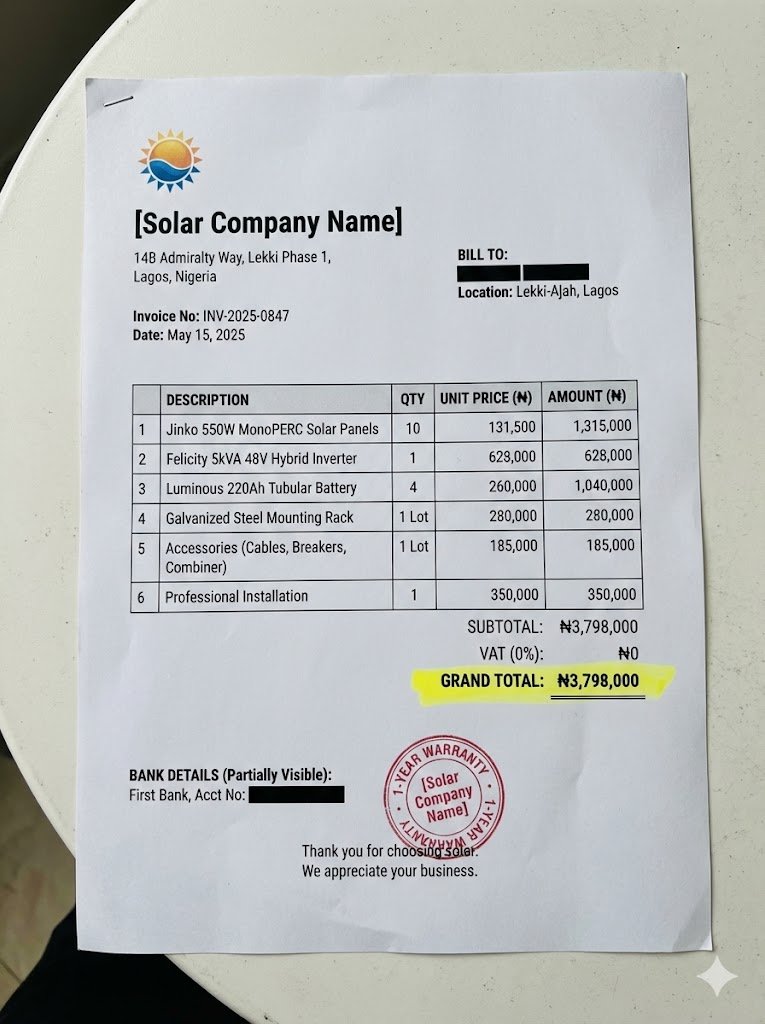
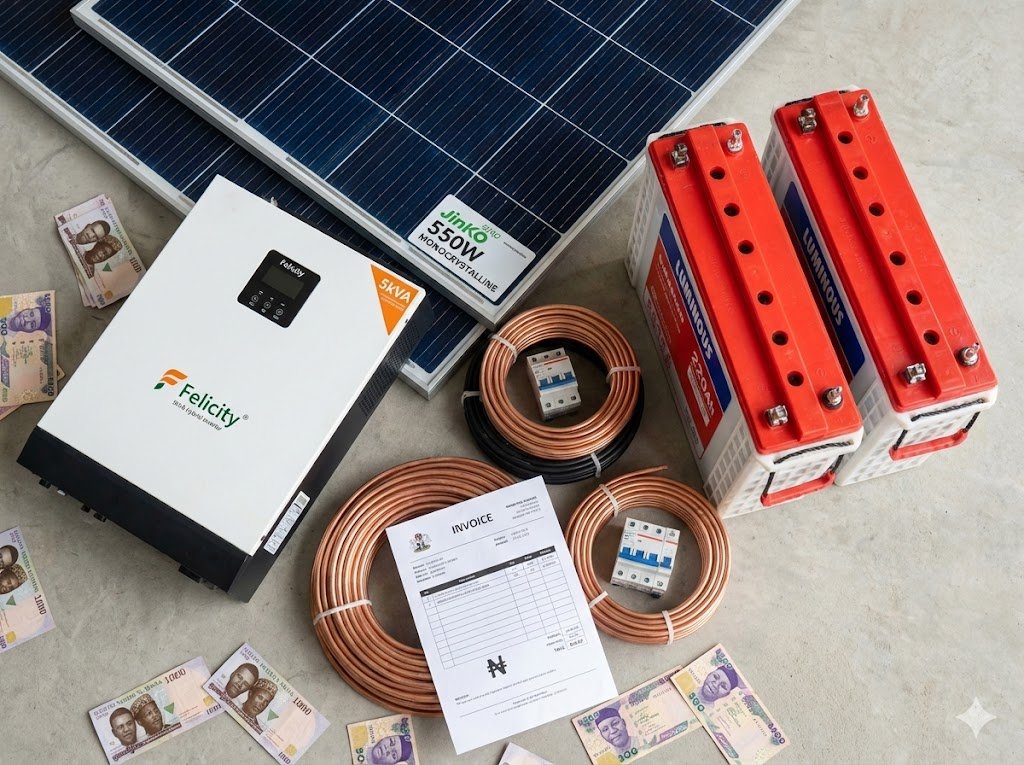
I opted for a Hybrid Setup using Tubular batteries to keep upfront costs down, with a plan to upgrade to Lithium later.
| Component | Brand / Specs | Quantity | Price Paid (₦) |
|---|---|---|---|
| Solar Panels | Jinko 550W MonoPERC | 10 | ₦1,315,000 |
| Inverter | Felicity 5kVA 48V Hybrid | 1 | ₦628,000 |
| Batteries | Luminous 220Ah Tubular | 4 | ₦1,040,000 |
| Mounting Rack | Galvanized Steel | 1 Lot | ₦280,000 |
| Accessories | Cables, Breakers, Combiner | 1 Lot | ₦185,000 |
| Installation | Professional (Lagos) | — | ₦350,000 |
| Total Cost | ₦3,798,000* |
Wait? Ideally, I wanted to spend ₦3.5M. I negotiated hard. I removed the “online monitoring wifi dongle” (saved ₦45k) and switched the panel brand from Canadian Solar to Jinko (saved ₦15k per panel). Final price: ~₦3.8M.
Installation Day “Wahala”
The installation took two days.
- Day 1: Mounting panels. We discovered my roof rafters were weak. I had to pay a carpenter an extra ₦15,000 to reinforce the wood with 2×3 hardwood planks before they could screw in the racks. Check your roof first!
- Day 2: Wiring. The installer insisted on creating a separate distribution board (DB) for “heavy loads” (AC, electric cooker) so they wouldn’t drain the batteries. This was smart.
Choosing the right panels is important, but picking the right system size is what determines if your freezer stays cold.
3.5kVA vs 5kVA Solar System: Which Is Right for Your Flat?
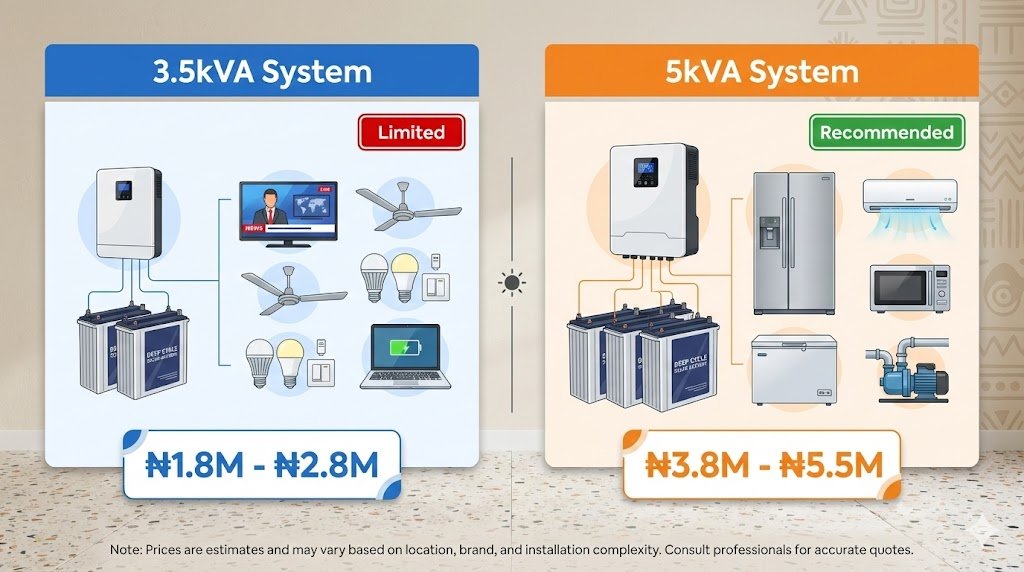
I struggled with this choice. The price difference was about ₦600k, but the performance gap is huge.
3.5kVA Solar System Price in Nigeria
- Price: ~₦1.8M – ₦2.8M
- Battery Voltage: 24V (2 Batteries)
- Capacity: Good for TV, decoder, fans, and laptops. For lighter loads, pairing solar with quality rechargeable fans reduces your battery drain—see our rechargeable fan buyers guide for recommendations.
- The Trap: If you turn on a pumping machine or a microwave, the system might trip (shut down) due to overload. You cannot use a pressing iron.
5kVA Solar System Price in Nigeria (2026)
- Price: ~₦3.8M – ₦5.5M
- Battery Voltage: 48V (4 Batteries)
- Capacity: Can handle surges. I use my microwave, pressing iron (during the day when sun is shining), and pumping machine comfortably.
- Verdict: For a family of 4 in a 3-bedroom flat, do not buy less than 5kVA. You will regret the 3.5kVA limits within 3 months.
What Can a 5kVA System Actually Power? (Daily Load Profile)
Based on industry audits, a typical 3-bedroom flat uses approximately 15-31 kWh daily.
To understand if a 5kVA system can handle your needs, look at this breakdown of typical appliance consumption. If you work from home and need to set up a home office in a bedroom, factor those appliances into your solar load calculation.
| Appliance | Qty | Wattage | Hours/Day | Daily Wh |
|---|---|---|---|---|
| LED Bulbs | 15 | 150W total | 7 | 1,050 |
| Standing Fans | 6 | 450W total | 14 | 6,300 |
| 1.5HP Inverter AC | 2 | 2,400W | 5 | 12,000 |
| Fridge + Freezer | 2 | 300W | 24 | 7,200 |
| TV + Decoder | 2 | 300W | 6 | 1,800 |
| Water Pump | 1 | 750W | 0.5 | 375 |
| Daily Total | ~31 kWh |
The Reality Check: If you add 20% system loss, you would need 37 kWh daily. However, a 5kW system produces roughly 27-33 kWh daily in Lagos. This covers moderate use but not heavy AC usage at night. You must manage your load (e.g., turn off ACs when the sun goes down) to keep the system running effectively. If your budget doesn’t allow for a system that runs AC at night, learn how to cool down a hot house without AC while you save for an upgrade.
Also, while solar handles your home, consider our list of best power banks for laptops in Nigeria for mobile backup to ensure you stay connected.
The equipment is expensive, but the hidden costs of installation can also catch you by surprise.
How Much Does Solar Installation Cost in Nigeria? (Labor + Hidden Fees)
Many people forget to budget for the human element. The “Cost of solar installation in Nigeria” isn’t just buying the box.
- Professional Labor: ₦350,000 – ₦550,000. (Don’t use a “quack” electrician. DC current can cause fire if connections are loose).
- Roof Reinforcement: ₦0 – ₦50,000 (If your wood is old).
- Cabling: This is a major hidden cost. 16mm pure copper cable currently costs between ₦3,000 and ₦5,200 per meter. If your panels are far from your batteries, this adds up fast.
- Earthing: ₦25,000. Essential for lightning protection.
Personal Insight: My installer quoted ₦350,000, but I paid roughly ₦390,000 total because I asked them to rewire my changeover switch to be automatic.
With the system installed, the next logical question is whether you can go even bigger to power everything.
Is 10kW Enough to Run a House in Nigeria?
A common question is, “Is 10kW enough?”
Yes, absolutely. A 10kW (or 10kVA) system is massive for a residential home.
- It produces roughly 40–50 kWh of electricity daily in Nigerian sunlight.
- My 3-bedroom flat uses about 15 kWh daily.
- With 10kW, you can run 3 ACs simultaneously, your freezer, fridge, and lights, and still charge your batteries full by 2 PM.
However, a 10kW setup costs between ₦7.5M and ₦13M. Unless you have a duplex or run a home office with heavy servers, 5kVA is usually sufficient.
Now comes the most important part. Did this investment actually save me money?
My 8-Month Solar Performance Log (Real Data)
This is the part that proves if the money was worth it.
The Setup: 5kVA Inverter + 4x 220Ah Tubular Batteries + 10x 555W Panels.
Monthly Savings Log
| Month | Old Cost (Gen + NEPA) | Solar Cost (Maintenance) | Actual Savings |
|---|---|---|---|
| Month 1 (June) | ₦145,000 | ₦0 | ₦145,000 |
| Month 2 (July) | ₦138,000 | ₦0 | ₦138,000 |
| Month 3 (Aug) | ₦152,000 | ₦5,000 (Top up water) | ₦147,000 |
| Month 6 (Nov) | ₦160,000* | ₦0 | ₦160,000 |
| Month 8 (Jan) | ₦155,000 | ₦0 | ₦155,000 |
| TOTAL | ₦750,000 | ₦5,000 | ₦745,000 |
*Note: Fuel prices fluctuated in late 2025. In Jan 2026, NNPC reduced prices to ~₦815/liter, while Dangote/MRS stations sold for ~₦739/liter. Even with this reduction, solar remains far cheaper.
ROI Calculation
- Annual Savings: ~₦1.1 million
- Payback period: 3.4 years at ~₦93,000/month average savings. With the rising cost of living in Lagos, saving ₦93,000 monthly on electricity makes a real difference.
- After 3.4 years: My electricity is essentially free.
Problems I Faced
- Dust in Harmattan: In December, my power generation dropped by 30%. I climbed up to check the panels. They were brown with dust. (I took a photo of the panels before washing them—they looked like I had painted them brown with mud). I had to wash them early in the morning with plain water. Lesson: Clean your panels every 3 weeks during dry season.
- Rainy Season Performance: During the peak rainy season (June–September), expect 20-30% lower generation due to cloud cover. In July, I had to run my generator for 2 hours once a week just to top up the batteries after 3 days of non-stop rain.
- Battery Water: Since I chose Tubular batteries, I have to top them up with distilled water every 2-3 months. It’s messy and smells slightly acidic. If you can afford Lithium, buy Lithium.
If you don’t have a 3-bedroom flat, you might be wondering what a smaller setup looks like.
Comparison: Cost of Solar Panels for 2-Bedroom House
If you are reading this but have a smaller space (or a BQ), here is a quick estimate for you.
- System Size: 2.5kVA or 3.5kVA.
- Price Range: ₦1.8M – ₦2.8M.
- Capacity: Can run a small fridge, fans, TV, and lights.
- Best For: Young couples, students, or those who don’t need AC on solar.
If you have a smaller space, check out our detailed guide on solar inverter setup for a 2-bedroom flat which covers budget-friendly options.
Location also matters. Prices in Lagos are not the same as prices in Abuja or Port Harcourt.
Regional Price Differences (Lagos vs. Abuja vs. PH)
Prices are not the same everywhere. Logistics and local factors affect the final bill.
| City | Est. Price Increase | Main Reason |
|---|---|---|
| Lagos | Base Price | Cheapest. Near ports (Apapa/Tincan) & Alaba Market. |
| Abuja | + 5% to 8% | Transport logistics from Lagos + higher “service” fees in city center. |
| Port Harcourt | + 10% to 15% | Logistics + Risk. Humidity also requires higher-grade mounting racks (Galvanized/Aluminum) to prevent rust. |
| Northern States | + 10% | Logistics. However, you get 15-20% more power due to better sunlight hours. |
One of my biggest decisions was the battery type. Here is why I have some regrets.
Lithium vs. Tubular Batteries: My Regret?
I bought Tubular to save money. Here is the breakdown:
Tubular (Lead-Acid)
- Cost: ~₦285,000 each (₦1.14M for 4).
- Lifespan: 3-4 years.
- Maintenance: High (Water top-up).
- Pros: Cheap upfront. Robust.
Lithium (LiFePO4)
- Cost: ~₦2.8M – ₦3.5M (for a 10kWh bank to match 4 tubulars).
- Lifespan: 10-15 years.
- Maintenance: Zero.
- Pros: Looks sleeker (wall mounted), charges faster, lasts 3x longer.
My Advice: If you have the extra ₦1.5M, go for Lithium. I am already planning to switch when my current batteries die in 2028.
Finally, if the upfront cost is too scary, there are ways to spread the payment.
Financing Options for Solar in Nigeria (2025)
You don’t have to pay cash down. I checked these options:
- REA Solar Power Naija: The [suspicious link removed] has programs, but they are often for communities, not individual urban flats.
- Sterling Bank (Specta/AltPower): They offer solar loans. Interest rates are around 20-25% per annum.
- Imperium (First Bank): Similar structure. Connects you with verified vendors.
- Carbon / FairMoney: Personal loans work, but interest rates are high (up to 30%).
- Pay-As-You-Go (SunKing/d.light): Good for small kits, but expensive for a full 3-bedroom flat setup.
Just moved in? Our guide on how to furnish a mini flat in Nigeria for under ₦500k pairs well with budget solar planning.
How to Spot a Bad Solar Deal (Red Flags)
Don’t let “cheap” kill your investment. Here are the signs I learned to look out for:
- Platform Price Gaps: Be aware of massive price differences. For example, a JA Solar 550W panel might sell for ₦100,000 on Facebook Marketplace but ₦171,250 on Jumia. If an installer quotes Jumia-level prices for goods sourced from cheaper markets (Jiji quality), you should negotiate hard.
- “1000W Panels” Advertised: These don’t exist for residential use. If you see a sticker saying 1000W on a standard-sized panel, it is fake.
- No Warranty Documentation: If they can’t write it down, they won’t honor it.
- Prices >30% Below Market: If everyone is selling 5kVA for ₦3.8M and someone offers it for ₦2.5M, they are likely using used batteries or fake inverters.
- No Itemized Invoice: “Global sum” quotes hide inflated labor costs and cheap components.
- “German” or “USA” Branded Panels: Most panels are made in China (Jinko, Longi, JA). Generic “German Technology” stickers with no brand name are a major red flag.
- Suspiciously Light Batteries: A good 220Ah tubular battery is heavy (60kg+). If you can lift it easily with one hand, it might be refurbished or fake.
People always ask me these questions…
FAQ
How much does it cost to power a 3-bedroom flat with solar in Nigeria?
To power a 3-bedroom flat comfortably (including a fridge and freezer), budget between ₦3.8 million and ₦6.0 million in 2026. This typically covers a 5kVA system with adequate battery backup.
What size solar system do I need for a 3-bedroom house?
A 5kVA (5kW) inverter with at least 5kWh of battery storage is the standard requirement. This size allows you to run essential appliances like freezers and pumping machines, plus an inverter AC during the day.
How much is a 5kW solar system in Nigeria?
A complete 5kW solar system in Nigeria currently costs between ₦3.8 million and ₦6.0 million. The price difference depends heavily on your battery choice. Tubular battery setups are on the lower end (₦3.8M), while Lithium battery systems are on the higher end (₦6M+).
How much does it cost to install solar in Nigeria?
Professional installation fees typically range from ₦350,000 to ₦550,000 for a standard residential system. This fee usually covers labor and basic setup, but excludes additional costs like cabling (which can cost ₦3,000–₦5,200 per meter), roof reinforcement, and earthing materials.
What are the prices of solar panels in Nigeria?
As of January 2026, verified street prices for mono-crystalline solar panels are roughly:
200W Mono: ₦50,000 – ₦65,000
300W Mono: ₦70,000 – ₦85,000
450W Mono: ₦100,000 – ₦115,000
550W Mono (Most Popular): ₦130,000 – ₦150,000
600W+ Mono: ₦148,000 – ₦165,000 Prices vary by brand and location.
How long does a solar system last in Nigeria?
Solar Panels: 25 years.
Inverter: 10–15 years (repairable).
Batteries: 3–5 years for Tubular (Lead-Acid) or 10–15 years for Lithium (LiFePO4).
Can solar power run an air conditioner in Nigeria?
Yes. A 5kVA system can run a 1HP Inverter AC during the day when the sun is shining directly on the panels. To run ACs at night, you would need a much larger battery bank (10kWh+), which significantly increases the total cost.
Is solar cheaper than generator in Nigeria?
In the long run, yes. Solar pays for itself in roughly 3 to 4 years. In contrast, a generator is a continuous expense that consumes fuel, oil, and maintenance fees forever without ever providing a return on investment.
Final Verdict
Spending ₦3.8 million felt like a hole in my pocket in May 2025. But tonight, as I write this in silence with my AC humming and my neighbors’ generators roaring outside, I know I made the right choice.
If you can afford it, start your solar journey today. The price of components (linked to the Dollar) rarely goes down. Even with solar, having productivity apps that work offline ensures you’re never caught off guard.
Do you have questions about my setup? Drop a comment below or share this with your “landlord” who refuses to fix the NEPA wire!
Sources & Methodology
Prices in this guide were verified against quotes from licensed installers and cross-referenced with reports from Techpoint Africa, TechCabal, and the Africa Solar Industry Association (AFSIA). Electricity tariff data sourced from the Nigerian Electricity Regulatory Commission (NERC).

Oladepo Babatunde (Prince Babatee Tunde) is a Computer Scientist, researcher, and professional content writer with a Higher National Diploma in Computer Science from Kwara State Polytechnic, Nigeria.
With a background in technology and a passion for clear communication, Babatunde specializes in creating thoroughly researched, reader-focused content on productivity, personal development, home living, and technology. Every article he writes is backed by extensive research and fact-checking to ensure readers receive accurate, actionable information.
As a freelance writer, he has helped brands and publications deliver content that educates, engages, and empowers their audiences. His mission at Vibena is simple: make complex topics easy to understand and help Nigerians live smarter, more productive lives.