My roommate Kemi graduated with a first-class degree in Economics last 2021. She applied to over fifty jobs in three months. Nothing. Meanwhile, her coursemate Adaora, who graduated with a 2:1 but had spent two years learning graphic design and data analysis, landed a remote job paying ₦450,000 monthly before their graduation ceremony.
The difference was not their grades. It was their skills.
According to a GetBundi survey cited by CGTN Africa, only 19 out of 100 NYSC members surveyed had any form of digital skill, and even that was mostly basic Microsoft Excel knowledge. According to GetBundi’s analysis, only 11 percent of Nigerian graduates receive formal digital training, leaving 85 percent without basic technical skills.
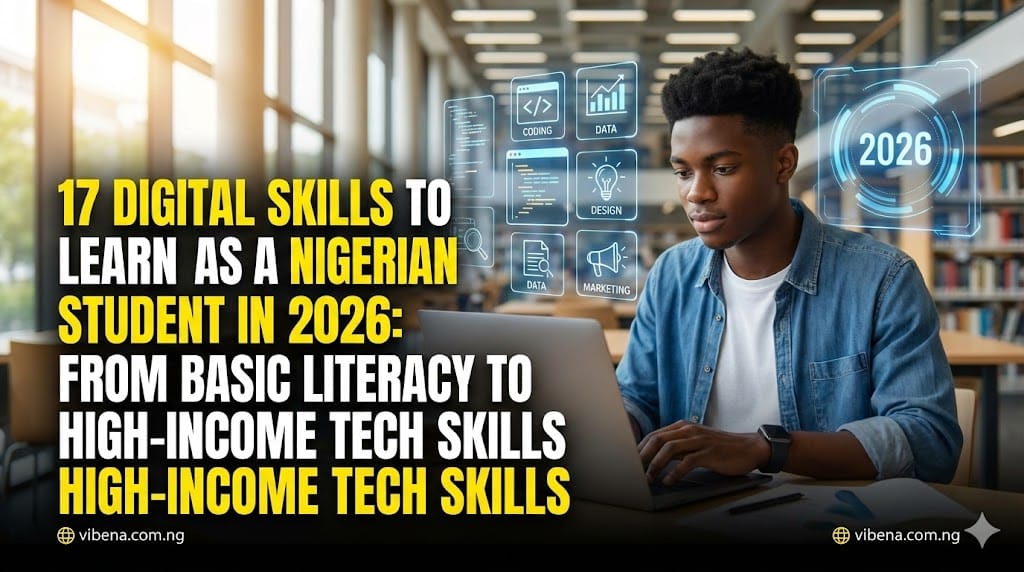
This guide breaks down 17 digital skills every Nigerian student should consider learning in 2026, with specific details on how to acquire each skill, where to learn, and exactly how to monetize your knowledge.
The Digital Skills Crisis: Why This Matters Now
The numbers are stark. According to UNICEF Nigeria’s Education Specialist Babagana Aminu, speaking at a media dialogue in Lagos, the digital skills gap is costing Nigeria an estimated $11 billion yearly. The Sector Skills Council for ICT confirms this figure, warning that Nigeria could lose up to $11 billion annually in unrealised digital-economy value due to the skills shortage.
According to UNICEF’s presentation, 70 percent of Nigeria’s population is under 35, yet 10.5 million children are out of school, the highest number globally. Every year, 3.5 million young Nigerians enter the labour market, but 55 percent of them are unemployed or underemployed. There is also a 60 percent mismatch between university output and employer needs.
The Social Media Paradox
The GetBundi survey reveals a troubling contrast. Of the 100 NYSC members surveyed, 89 had active Instagram, Facebook, and Twitter accounts, but only 11 had LinkedIn accounts. Most are active consumers of social media content, yet they have little or no knowledge of any digital skills that could turn that familiarity into income.
The gap between social media consumption and professional digital capability is stark. Being able to scroll through Instagram is not the same as being able to manage an Instagram business account for a client.
Where Digital Skills Come From
According to the GetBundi survey, all seven NYSC members who had basic knowledge of programming, machine learning, and data science studied outside Nigeria. Five studied in the UK, one in the United States, and one in Malaysia. This powerfully illustrates why improving domestic digital education matters so urgently.
About 15 of the surveyed members carried some form of science-based field certificate but had no practical knowledge when tested in their areas of study. Certificates without skills create a false sense of readiness.
The Gender and Access Divide
The digital skills gap is not evenly distributed. According to UNICEF’s data presented at the media dialogue, only 2 percent of women without education have internet access, compared to 56 percent in the wealthiest quintile. This wealth and gender divide means that female students and those from lower-income backgrounds face additional barriers to acquiring digital skills.
Infrastructure Is Not the Only Barrier
According to UNICEF’s analysis, despite 80 percent internet coverage across Nigeria, usage has stagnated at 30 to 40 percent, hindered by cost, skill gaps, and outdated infrastructure. Having internet available does not automatically translate to having digital skills. The challenge is not just connectivity but capability.
The Government Response
According to BusinessDay’s analysis, in response to the skills crisis, government and development partners have rolled out large-scale initiatives such as the 3 Million Technical Talent (3MTT) programme, UNICEF-supported digital learning platforms, and private-sector training academies aimed at preparing young Nigerians for future jobs.
According to Ecofin Agency, in October 2025, the government launched a technical and vocational training programme that drew more than 1.3 million applications, with about 250,000 young people enrolled in centres across the country’s 36 states.
According to UNICEF, through its Generation Unlimited Nigeria initiative, over 11 million young Nigerians have already been impacted with access to digital learning, employment pathways, and civic engagement opportunities.
The Opportunity
According to BusinessDay’s analysis for Kolaking, despite the clear demand, Nigeria still faces a major digital skills gap caused by outdated curricula, limited infrastructure, and unequal access to technology, especially for women and youths in underserved regions.
However, experts say with investments in digital education, infrastructure, and inclusive training continuing, the country could turn its skills crisis into a demographic advantage.
What Digital Skills Are Most in Demand in Nigeria in 2026?
According to BusinessDay’s analysis of the digital skills crisis, the top tech skills Nigerians need to stay relevant in 2026 are:
| Skill Category | Why It Matters |
|---|---|
| AI and Machine Learning | AI-related roles are among the fastest-growing, with demand far outpacing supply |
| Cybersecurity | Rising cyber threats make security professionals critical for digital payments and online banking |
| Data Analytics and Data Science | Data literacy is quickly becoming a baseline requirement across industries |
| Software Development and Cloud Computing | Remains cornerstone of digital economy; cloud migration driving demand |
| Digital Marketing and Product Design | Businesses competing for online attention need these skills |
| Soft Skills | Communication, critical thinking, collaboration, and adaptability are decisive factors |
According to BusinessDay, there is an estimate that AI could add billions of dollars to Nigeria’s economy by 2030, creating new career paths such as prompt engineering, AI ethics consulting, and applied data science.
What Makes a Digital Skill Worth Learning?
Before diving into specific skills, understand what makes a skill valuable for your situation.
Valuable digital skills have these qualities:
High demand across many industries. Skills that multiple sectors need give you more options.
Practical and hands-on. Theory without application means nothing to employers.
Possible to learn alongside school. You need skills that fit your current schedule.
Can generate income before graduation. The best skills let you earn while learning.
Transferable to different career paths. Flexibility matters in an uncertain job market.
The 5 Basic Digital Skills Every Student Needs First
Before chasing advanced skills, master these fundamentals. They form the foundation everything else builds on.
1. Microsoft Office Suite Mastery
What it involves: Word processing, spreadsheet management, presentation design, and professional document creation.
According to the GetBundi survey, even the 19 NYSC members who had digital skills mostly knew only basic Microsoft Excel. This highlights how fundamental yet undervalued Office skills remain.
How to acquire this skill:
Free learning options:
- Microsoft Learn offers free Office tutorials
- YouTube comprehensive Office courses
- Google Digital Skills for Africa
How to make money from this skill:
Data entry jobs: Many businesses need people to input data into spreadsheets. Entry-level pay ranges from ₦30,000 to ₦80,000 monthly for part-time work.
Document formatting services: Students, businesses, and researchers pay for professionally formatted documents. Charge ₦2,000 to ₦10,000 per document depending on complexity.
Virtual assistant work: Combine Office skills with administrative tasks. Virtual assistants earn ₦50,000 to ₦150,000 monthly.
Where to find work:
- Fiverr and Upwork for international clients
- Local businesses and academic institutions
- LinkedIn for virtual assistant positions
My friend Chidi started doing data entry during his 200 level using skills he learned from free YouTube tutorials. Within four months, he was earning ₦45,000 monthly from three regular clients who needed weekly reports formatted.
2. Email Communication and Digital Etiquette
What it involves: Professional email writing, calendar management, meeting scheduling, and formal digital communication.
According to UNICEF’s Aminu, the 60 percent mismatch between university output and employer needs includes basic professional communication skills that employers expect but graduates lack.
How to acquire this skill:
Google Digital Garage and HubSpot Academy both offer free modules on professional digital communication.
How to make money:
Email management services: Busy professionals pay others to manage their inboxes. Rates range from ₦30,000 to ₦100,000 monthly per client.
Customer service roles: Many companies hire remote customer service representatives. Salaries range from ₦80,000 to ₦200,000 monthly.
3. Cloud Storage and Collaboration
What it involves: Using Google Drive, OneDrive, and collaborative tools effectively.
How to acquire this skill:
Google Workspace and Microsoft 365 both offer free tutorials. Most universities provide student access to these platforms.
How to make money:
Workspace setup services: Help small businesses set up cloud storage systems. Charge ₦20,000 to ₦50,000 per setup.
Training services: Teach organizations how to use collaborative tools. Corporate training sessions pay ₦50,000 to ₦150,000 per session.
4. Research and Information Literacy
What it involves: Finding credible information online, academic database searching, source verification, and citation management.
How to make money:
Research assistance: Academics, businesses, and students pay for research help. Rates range from ₦5,000 to ₦30,000 per research project.
Content research for writers: Content agencies need researchers to gather information. Pay ranges from ₦2,000 to ₦10,000 per article researched.
5. Basic Computer Operations and File Management
What it involves: Understanding operating systems, file organization, basic troubleshooting, and hardware knowledge.
According to the GetBundi survey, about 15 of the NYSC members surveyed carried some form of science-based field certificate but had no practical knowledge when tested in their areas of study. This gap between certification and capability starts with basic computer literacy.
How to make money:
Tech support services: Help non-technical people with computer issues. Charge ₦2,000 to ₦10,000 per service call.
Computer training: Teach basics to older adults or beginners. Individual lessons pay ₦3,000 to ₦10,000 per hour.
For students managing academic work alongside skill development, our guide on stopping procrastination with science-backed strategies covers techniques that actually work.
High-Demand Digital Skills to Learn in 2026
These skills have strong market demand and can generate significant income.
6. Digital Marketing and Growth Analytics
According to BusinessDay’s analysis, digital marketing and product design have gone beyond tech firms. From small retailers to large corporations, organisations need professionals who understand social media strategy, search optimisation, content analytics, and user-centred design.
What it includes: Social media management, content marketing, SEO, email marketing, and paid advertising.
How to acquire this skill:
Free options:
- Google Digital Garage offers free digital marketing certification
- HubSpot Academy provides free marketing courses
- Meta Blueprint covers Facebook and Instagram marketing
How to make money:
Social media management: Social media managers earn ₦15,000 to ₦50,000 per client monthly. Managing four clients generates ₦60,000 to ₦200,000 monthly.
Freelance marketing services: Create and manage ad campaigns for businesses. Campaign management fees range from ₦30,000 to ₦200,000 depending on budget and scope.
SEO services: Help websites rank higher on Google. Monthly retainers range from ₦50,000 to ₦300,000 per client.
Where to find clients:
- Local businesses in your community
- LinkedIn outreach to startups
- Fiverr and Upwork for international clients
- WhatsApp business groups
According to BusinessDay, these skills combine technology with creativity and communication, which makes them accessible entry points into the digital economy.
For a complete guide on building this into a career, our article on becoming a social media manager in Nigeria covers salary expectations and step-by-step pathways.
7. Data Analytics and Data Science
According to BusinessDay’s report on tech skills for 2026, data literacy is quickly becoming a baseline requirement across industries. By 2026, employers are expected to prioritise candidates who can collect, clean, analyse, and interpret data to support decision-making.
Data analysts and data scientists are increasingly needed in sectors such as agriculture, health, logistics, media, and government.
Tools to learn: Excel (advanced), SQL, Python basics, Power BI, Tableau.
How to acquire this skill:
Free options:
- Google Data Analytics Certificate (audit for free on Coursera)
- freeCodeCamp data analysis courses
- Kaggle free data science courses
According to BusinessDay, the ability to work with tools such as SQL, Python, Excel, and data visualisation platforms is now seen as a practical advantage, not a niche skill.
How to make money:
Data entry and cleaning: Entry-level work cleaning datasets pays ₦50,000 to ₦150,000 monthly.
Business intelligence reports: Create dashboards and reports for companies. Project fees range from ₦50,000 to ₦300,000.
Remote work: Data analysts working for international companies can earn $500 to $2,000 monthly.
Where to find work:
- LinkedIn data analyst job postings
- Upwork and Toptal for freelance projects
- Nigerian fintech companies (Paystack, Flutterwave, Kuda)
8. Content Creation and Copywriting
What it involves: Writing engaging content, creating videos, storytelling, and building online visibility.
According to the GetBundi survey, 89 out of 100 NYSC members surveyed had Instagram, Facebook, and Twitter accounts. But consuming content is not the same as creating value. Content creation turns that familiarity into income.
How to acquire this skill:
Free options:
- HubSpot Content Marketing certification
- Google Digital Garage writing courses
- YouTube tutorials on copywriting
How to make money:
Blog writing: Writers earn ₦10,000 to ₦60,000 per article depending on length and complexity.
Copywriting: Sales copy and ad copy pays ₦15,000 to ₦100,000 per project.
Social media content: Creating content packages for brands pays ₦30,000 to ₦150,000 monthly.
Video content: Short-form video creation pays ₦10,000 to ₦50,000 per video.
For a complete roadmap on content writing, our guide on starting freelance writing in Nigeria without experience covers everything from building a portfolio to landing clients.
9. Graphic Design and Visual Communication
What it involves: Creating visual content for digital and print, including social media graphics, logos, and marketing materials.
Tools to learn: Canva (beginner), Figma (intermediate), Adobe Illustrator and Photoshop (advanced).
How to acquire this skill:
Free options:
- Canva Design School
- YouTube tutorials on Adobe tools
- Figma free tutorials
How to make money:
Social media graphics: Create posts for businesses. Packages range from ₦20,000 to ₦100,000 monthly.
Logo design: Individual logos pay ₦10,000 to ₦100,000 depending on complexity and client.
Flyer and banner design: Event flyers pay ₦5,000 to ₦30,000 each.
Brand identity packages: Complete branding projects pay ₦100,000 to ₦500,000.
Where to find work:
- Fiverr and 99designs for international clients
- Local businesses and event planners
- Instagram direct outreach to brands
10. Product Design and UX/UI
What it involves: Designing user experiences for apps, websites, and digital products.
According to BusinessDay, UX/UI design is listed among the high-demand skills that combine technology with creativity.
Tools to learn: Figma, Adobe XD, Miro.
How to acquire this skill:
Free options:
- Google UX Design Certificate (audit on Coursera)
- Figma tutorials on YouTube
- Daily UI challenges for practice
How to make money:
Freelance UI design: Website and app designs pay ₦100,000 to ₦500,000 per project.
UX consulting: User research and testing projects pay ₦50,000 to ₦200,000.
Full-time roles: Product design roles in fintech pay among the highest for non-coding skills.
Where to find work:
- Dribbble and Behance for portfolio visibility
- LinkedIn UX designer jobs
- Nigerian tech startups
11. AI Tools and Automation
According to BusinessDay’s report, artificial intelligence tops the list of in-demand skills for 2026 as employers increasingly seek AI developers, machine learning engineers, and generative AI specialists to help automate processes, analyse data, and build intelligent systems.
According to the same source, AI-related roles are among the fastest-growing, with demand far outpacing supply. There is an estimate that AI could add billions of dollars to Nigeria’s economy by 2030, creating new career paths such as prompt engineering, AI ethics consulting, and applied data science.
What to learn: Using AI tools effectively, prompt engineering, and automating tasks with no-code tools.
Tools to learn: ChatGPT, Claude, Gemini, Zapier, Notion AI, Airtable.
How to acquire this skill:
Free options:
- Google AI courses
- Microsoft AI fundamentals
- Coursera AI courses (audit free)
How to make money:
AI consulting: Help businesses implement AI tools. Consulting fees range from ₦50,000 to ₦300,000 per project.
Prompt engineering: Create effective prompts for businesses. Rates range from ₦20,000 to ₦100,000 per prompt library.
Automation services: Set up automated workflows for businesses. Projects pay ₦30,000 to ₦150,000.
For AI tools that work well with Nigerian internet conditions, our guide on free AI tools that work on slow Nigerian data covers practical options.
12. E-commerce Management
What it involves: Running online stores, managing product listings, processing orders, and customer service.
Platforms to learn: Shopify, WooCommerce, Jumia seller portal, WhatsApp Business.
How to acquire this skill:
Free options:
- Shopify free courses
- Jumia seller academy
- YouTube e-commerce tutorials
How to make money:
Store management: Manage e-commerce stores for businesses. Monthly retainers range from ₦50,000 to ₦200,000.
Dropshipping: Run your own store without inventory. Profit margins vary widely.
E-commerce consulting: Help businesses set up online stores. Setup fees range from ₦50,000 to ₦300,000.
For selling without capital, our guide on starting a WhatsApp business with zero capital shows practical approaches.
Technical Digital Skills for Tech Career Paths
These skills require more dedicated learning but offer higher income potential.
13. Coding and Web Development
According to BusinessDay, despite the rise of no-code tools, software development remains a cornerstone of the digital economy. Skills in web and mobile app development, APIs, and backend systems will continue to open doors to both local and remote jobs.
Languages to start with: HTML, CSS, JavaScript, then Python or React.
How to acquire this skill:
Free options:
- freeCodeCamp comprehensive web development curriculum
- The Odin Project
- Codecademy free tier
How to make money:
Freelance web development: Simple websites pay ₦50,000 to ₦200,000. Complex web applications pay ₦200,000 to ₦2,000,000+.
Remote jobs: Junior developers earn ₦150,000 to ₦400,000 monthly. Senior developers earn ₦500,000 to ₦2,000,000+ monthly.
Where to find work:
- GitHub for portfolio visibility
- LinkedIn developer jobs
- Upwork and Toptal for freelance
- Nigerian tech companies
For students considering coding, our guide on best budget laptops for coding in Nigeria covers affordable hardware options.
14. Mobile App Development
What it involves: Building applications for iOS and Android devices.
Frameworks to learn: Flutter, React Native for cross-platform development.
How to acquire this skill:
Free options:
- Google’s Android development courses
- Apple’s Swift programming resources
- YouTube tutorials on Flutter and React Native
How to make money:
Freelance app development: Simple apps pay ₦200,000 to ₦500,000. Complex apps pay ₦500,000 to ₦5,000,000+.
Full-time roles: Mobile developers earn ₦300,000 to ₦1,500,000 monthly depending on experience.
15. Cybersecurity
According to BusinessDay, cybersecurity skills are no longer optional as more businesses move online. Organisations need professionals who can protect digital infrastructure, customer data, and financial systems from rising cyber threats.
Roles such as cybersecurity analysts, cloud security engineers, and ethical hackers are expected to remain in high demand through 2026.
According to the same source, with Nigeria’s growing digital payments and online banking sector, the shortage of cybersecurity talent could become a national risk if not urgently addressed.
How to acquire this skill:
Free options:
- Cybrary free courses
- Google Cybersecurity Certificate (audit on Coursera)
- TryHackMe free tier
How to make money:
Security consulting: Help businesses assess vulnerabilities. Projects pay ₦100,000 to ₦500,000.
Penetration testing: Ethical hacking services pay ₦200,000 to ₦1,000,000 per engagement.
Full-time roles: Cybersecurity analysts earn ₦300,000 to ₦1,500,000 monthly.
16. Cloud Computing
According to BusinessDay, as companies migrate to cloud platforms, demand is rising for cloud engineers skilled in deploying and managing services on platforms such as AWS, Microsoft Azure, and Google Cloud. These skills are particularly valuable for Nigerian professionals seeking global remote work opportunities.
Platforms to learn: Microsoft Azure, AWS, Google Cloud Platform.
How to acquire this skill:
Free options:
- AWS free tier and training
- Google Cloud free courses
- Microsoft Learn Azure fundamentals
How to make money:
Cloud administration: Manage cloud infrastructure for businesses. Monthly retainers range from ₦150,000 to ₦500,000.
Cloud migration services: Help businesses move to cloud. Projects pay ₦200,000 to ₦2,000,000.
Full-time roles: Cloud engineers earn ₦400,000 to ₦2,000,000 monthly.
Certifications that pay:
- Azure Administrator (AZ-104)
- AWS Solutions Architect
- Google Cloud Professional
17. Video Editing and Motion Graphics
What it involves: Editing videos and creating animated graphics for digital content.
Tools to learn: CapCut (mobile), DaVinci Resolve (free desktop), Adobe Premiere Pro, After Effects.
How to acquire this skill:
Free options:
- DaVinci Resolve (free professional software)
- YouTube tutorials on Premiere Pro and After Effects
- CapCut tutorials for mobile editing
How to make money:
Social media video editing: Short-form content pays ₦5,000 to ₦30,000 per video.
YouTube video editing: Long-form editing pays ₦20,000 to ₦100,000 per video.
Corporate video production: Company videos pay ₦50,000 to ₦500,000 per project.
Motion graphics: Animated content pays ₦30,000 to ₦200,000 per project.
Where to find work:
- Instagram and Twitter creator communities
- Fiverr video editing gigs
- Direct outreach to YouTubers and content creators
Soft Skills That Complement Digital Skills
According to BusinessDay’s analysis, while technical skills are important, employers consistently emphasise the importance of soft skills. Communication, critical thinking, collaboration, and adaptability are expected to be decisive factors in 2026.
According to the same report, many roles created by AI will require humans to work alongside intelligent systems, making problem-solving and ethical judgment more valuable than ever.
Key soft skills to develop:
- Communication and presentation
- Critical thinking and problem-solving
- Collaboration and teamwork
- Adaptability and continuous learning
- Time management and self-discipline
My coursemate Ngozi had solid graphic design skills but struggled to land clients initially. When she improved her communication and started clearly explaining her design process to potential clients, her conversion rate doubled. Technical skills get you noticed. Soft skills close the deal.
Digital Skills You Can Learn With Just Your Phone
For students without laptops, these skills are accessible on mobile devices:
| Skill | Apps and Tools |
|---|---|
| Graphic design | Canva mobile app |
| Video editing | CapCut, InShot, VN Editor |
| Content creation | Instagram, TikTok, YouTube |
| Basic coding | Sololearn, Grasshopper, Mimo |
| Digital marketing | Meta Business Suite, Buffer |
| Writing and notes | Google Docs mobile, Notion |
| Photo editing | Snapseed, Lightroom mobile |
Government Programs Supporting Digital Skills
According to UNICEF, experts at the media dialogue emphasised the need to invest in human capital, improve infrastructure, promote vocational training and specialised fields such as Artificial Intelligence and cybersecurity. They also urged the government to collaborate with educators and communities to invest in continuous teacher professional development and retraining.
Current government initiatives:
The 3 Million Technical Talent (3MTT) programme targets training in AI, data science, and cloud computing.
According to Ecofin Agency, the government’s technical and vocational training programme launched in October 2025 attracted 1.3 million applications, with about 250,000 young people enrolled in centres across the country’s 36 states.
According to UNICEF, through its Generation Unlimited Nigeria initiative, over 11 million young Nigerians have already been impacted with access to digital learning, employment pathways, and civic engagement opportunities.
According to Ecofin Agency, reforms announced in January 2026 aim to turn polytechnics into hubs for innovation and skills development. Education Minister Maruf Tunji Alausa announced that polytechnics must now train industry-ready graduates with practical, entrepreneurial and problem-solving skills to support economic growth.
Common Mistakes Nigerian Students Make
Waiting until final year: The best time to start learning digital skills is now.
Trying to learn everything at once: Focus on one or two skills first.
Only consuming content without practicing: Apply what you learn to real projects.
Not building a portfolio: Document every project you complete.
Learning skills with no market demand: Research what employers actually need.
Ignoring infrastructure realities: Plan around electricity and internet challenges.
Confusing social media use with digital skills: Having Instagram does not mean you can manage a business account.
For strategies on building confidence while developing new skills, our guide on building confidence in your career addresses mindset challenges common among young Nigerians.
Frequently Asked Questions
What digital skills are in demand in Nigeria in 2026?
According to BusinessDay’s analysis, the top tech skills Nigerians need are AI and machine learning, cybersecurity, data analytics, software development and cloud computing, digital marketing and product design, and soft skills like communication and critical thinking.
What percentage of Nigerian graduates lack digital skills?
According to GetBundi’s analysis, only 11 percent of Nigerian graduates receive formal digital training, leaving 85 percent without basic technical skills. A GetBundi survey of 100 NYSC members found that only 19 had any form of digital skill.
How much does Nigeria lose due to the digital skills gap?
According to the Sector Skills Council for ICT and UNICEF, Nigeria could be losing up to $11 billion annually in unrealised digital-economy value due to the skills shortage.
Which digital skill is easiest to learn and start earning from?
Digital marketing, e-commerce management, and content creation have the lowest barrier to entry. You can start helping local businesses quickly and build from there.
Can I learn digital skills with just my phone?
Yes. Skills like graphic design using Canva, video editing using CapCut, content creation, and basic coding using apps like Sololearn can be learned on mobile devices.
Why do so few Nigerians have programming skills?
According to the GetBundi survey, all seven NYSC members who had basic knowledge of programming, machine learning, and data science studied outside Nigeria. The domestic education system lacks practical digital skills training, forcing those who want advanced tech skills to seek education abroad.
Your 4-Week Action Plan
| Week | Tasks |
|---|---|
| Week 1 | Assess your interests and current skill level. Master Microsoft Office basics if needed. |
| Week 2 | Choose ONE advanced skill based on market demand and your interests. Enroll in a free course. |
| Week 3 | Complete initial training modules. Start a practice project applying what you learned. |
| Week 4 | Finish your first portfolio piece. Approach one local business to offer your services. |
The students who will thrive in Nigeria’s evolving job market are not necessarily the smartest or the ones with the best grades. They are the ones who recognize that practical skills matter and start building them early.
According to UNICEF’s Aminu, media shapes public perception, influences policy, and can mobilise action. The same applies to your personal brand. Start documenting your learning journey, sharing your projects, and positioning yourself as someone actively building valuable skills.
For additional income strategies while studying, our guide on student side hustles covers options that complement skill development.

Oladepo Babatunde (Prince Babatee Tunde) is a Computer Scientist, researcher, and professional content writer with a Higher National Diploma in Computer Science from Kwara State Polytechnic, Nigeria.
With a background in technology and a passion for clear communication, Babatunde specializes in creating thoroughly researched, reader-focused content on productivity, personal development, home living, and technology. Every article he writes is backed by extensive research and fact-checking to ensure readers receive accurate, actionable information.
As a freelance writer, he has helped brands and publications deliver content that educates, engages, and empowers their audiences. His mission at Vibena is simple: make complex topics easy to understand and help Nigerians live smarter, more productive lives.