Last rainy season, I spent three days shivering in bed with malaria after mosquitoes invaded my apartment in Yaba. It wasn’t just the sickness that annoyed me; it was the bill for the drugs and the lost work time. As someone who works from home (here’s how I set up my home office in a bedroom), I couldn’t afford to be offline for days. When I called a “professional” aluminium guy to quote me for netting two windows, he called a price of ₦45,000. I looked at him like he was joking. ₦45k just for net?
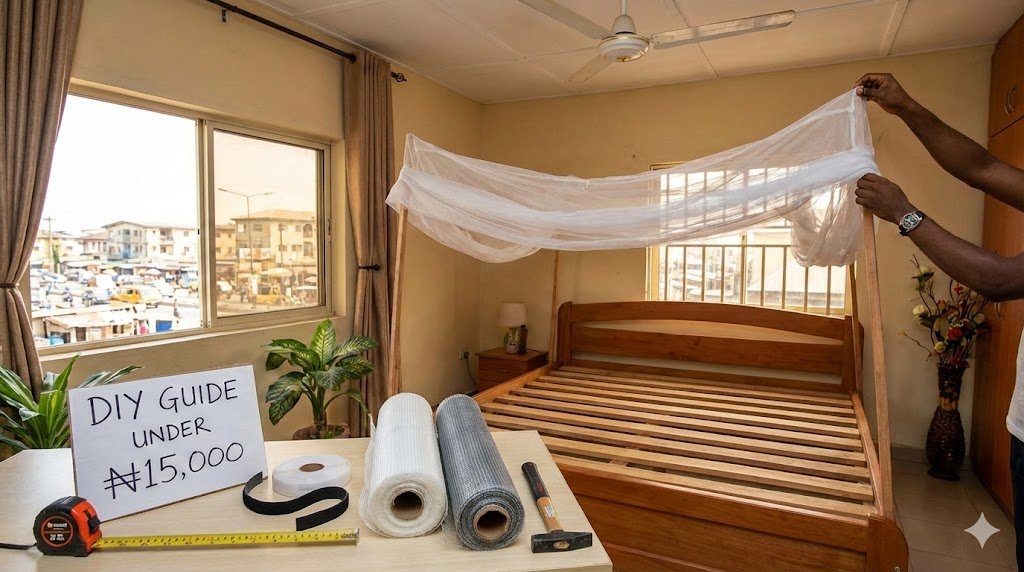
That quote felt like robbery. So, I decided to do it myself. I went to the market, bought materials, and built my own mosquito-proof netting DIY Lagos room setup for roughly ₦12,500. It has been eight months—through the tail end of the rainy season and the dusty harmattan—and not a single mosquito has passed through.
If you are tired of spending money on insecticides every night, here is exactly how I did it.
Why I Decided to Build My Own Mosquito Net in Lagos
Living in Lagos, specifically on the Mainland, means battling mosquitoes is a nightly routine. I used to rely on Mortein and mosquito coils, but the smell started choking me, and the cost was adding up. Spending ₦1,500 every few weeks on sprays creates a hole in the pocket—that is nearly ₦20,000 a year just on chemicals that you breathe in. For anyone managing cost of living in Lagos, cutting these recurring costs helps.
I realized that prevention is cheaper than cure. The Nigeria Centre for Disease Control (NCDC) confirms that malaria remains a leading public health challenge in Nigeria, making preventive measures like window screening essential. While sleeping under insecticide-treated nets is proven to reduce transmission, the standard nets you hang over the bed can make a small room feel crowded and hot. I wanted something sleek that stayed on the window and allowed cross-ventilation.
The thing no be beans (it wasn’t easy) at first because I didn’t know which material to buy, but once I figured it out, the installation took me less than 2 hours.
Now that you understand why this is a smart investment, let’s look at the actual costs so you can budget properly.
How Much Is a Mosquito Net in Nigeria?
Before we jump into the “how-to,” let’s talk about the price. Many people ask this exact question when planning their budget. The answer depends on if you want a simple bed net or a custom window screen. Prices vary wildly between local markets like Idumota and supermarkets in Lekki.
PermaNet Mosquito Net Price
If you just want a tent over your bed, the PermaNet mosquito net price usually ranges from ₦3,500 to ₦6,500 depending on the size (Family size vs. Single). These are treated with chemicals like deltamethrin to kill insects on contact. They are good, but they don’t stop mosquitoes from entering the room itself, leaving you exposed when you are not in bed.
Ready-Made vs DIY Cost Comparison Table
Here is the breakdown of what I found when comparing market prices in 2024/2025:
| Type of Netting | Professional Installation Cost | DIY Cost (Materials Only) | Savings |
|---|---|---|---|
| Aluminium Window Frame (Standard) | ₦15,000 – ₦25,000 per window | ₦8,000 – ₦12,000 | Low |
| Wooden Batten Frame (My Method) | ₦10,000 – ₦12,000 | ₦3,000 – ₦4,500 | High |
| Velcro/Magnetic Mesh (PVC) | ₦8,000 | ₦4,000 | Medium |
| Bed Canopy (Ready-made) | N/A | ₦4,500 – ₦7,000 | N/A |
If you’re setting up a new apartment on a budget, installing your own mosquito netting is one of several ways to save money. I covered more budget tips in my guide on how to furnish a mini flat in Nigeria for under ₦500k.
Knowing the price is good, but buying the wrong material is a waste of money. Let’s look at which mesh actually lasts in the Nigerian climate.
What Is the Best Material for Mosquito Nets? (Fiberglass vs Nylon vs Polyester)
When I got to the building material section at Balogun Market, I was confused. There were rolls of different nets everywhere. Here is what I learned about the materials specifically for our weather.
Fiberglass Netting Pros and Cons
This is what most modern windows use. It feels almost like plastic wire.
- Pros: It is fire resistant (important in dry season), it doesn’t crease, and it is almost invisible when you look through it. It allows breeze to enter well because the threads are thin but strong.
- Cons: It costs slightly more than nylon. If you handle it roughly during installation, the cut edges can scratch your hands like fine wire.
Nylon and Polyester Mesh Comparison
- Nylon: Very cheap and soft, like a wedding veil. However, I noticed that after one year of Lagos sun, nylon starts to tear. It becomes brittle and turns to powder.
- Polyester: Stronger than nylon, tear-resistant, and less prone to sagging than fiberglass. It is commonly used for pleated and retractable window screens. However, polyester mesh coated with thick vinyl reduces outward visibility compared to fiberglass.
Stainless Steel Mesh
- Stainless Steel Mesh: The most durable and secure option, but costs significantly more (₦25,000+). Ideal for ground-floor windows where security is also a concern.
Which Material I Chose and Why
I chose Fiberglass charcoal mesh (18×16 mesh count). Why? Because it looks neat. When I put it on my window, it looked like there was nothing there, unlike the blue or green nylon nets that make a house look old-school. Plus, the airflow is better, which is necessary when NEPA takes the light and you need ventilation.
You have picked your mesh. Now, let’s get your hands dirty and build the frame step-by-step.
How to Make a DIY Mosquito Net Frame (Step-by-Step)
This is the method I used for my bedroom window. It is sturdy and removable if you need to wash it. If you enjoy DIY room improvements, you might also want to check out my guide on how to soundproof a room in Nigeria—it uses similar frame-building techniques.
Materials You Need (With Lagos Market Prices)
- Fiberglass Mesh: 2 yards (approx ₦1,500 – ₦2,500 per yard). Buy “Charcoal” or “Grey” color; white gets dirty too fast.
- Wooden Battens (1-inch strips): ₦1,500 for a bundle at the timber shed. Ask for “1-by-2” planning wood, split into two.
- Wood Glue or Top Bond: ₦1,000.
- Staple Gun: A cheap manual staple gun is about ₦3,500. Alternative: If you don’t want to buy a gun, buy a packet of “shoe tacks” (small nails with big heads) for ₦200.
- Mounting Tape: Heavy-duty double-sided foam tape (₦1,500 per roll).
Tools Required
- Measuring tape (Steel tape is better than sewing tape)
- Scissors
- Saw (or ask the wood seller to cut it for you to rough size)
- Hammer
- Optional but Helpful: Carpenter’s square (or a hardcover book/tile edge)
Step 1: Measure Your Window or Door
Don’t just eyeball it.
- Check for Squareness: In many Lagos houses, windows aren’t perfectly square. Measure the width at the top, middle, and bottom.
- The Rule: If you are mounting the frame inside the window recess, use the smallest measurement. If you are mounting it on the face of the wall (covering the hole), use the largest measurement and add 2 inches (5cm) to overlap the wall.
- My Advice: Face mounting (sticking it on the wall around the window) is easier for beginners because you don’t need perfect precision.
Step 2: Cut and Build the Frame
- Cut your wooden battens to form a rectangle.
- Joining: You don’t need fancy carpentry joints. Just butt the ends together (form an ‘L’ shape).
- Critical Corner Tip: When joining the battens, ensure the corners are exactly 90 degrees. If the frame dries crooked (like a diamond shape instead of a square), it won’t sit flush against the window, and mosquitoes will find those gaps.
- How to check: Place the frame on a flat tiled floor (tiles usually have straight lines) or use a carpenter’s square to check the angle before the glue sets.
- Apply a generous amount of Top Bond glue to the connection.
- Hammer two small nails into each corner to hold it while the glue dries. Let it sit for 30 minutes on a flat floor so it doesn’t dry crooked.
Step 3: Attach the Mosquito Netting
Lay the wooden frame on the floor. Lay the fiberglass mesh over it.
- Anchor it: Staple the net to the top center of the wood frame.
- Stretch it: Pull the net gently to the bottom center. It should be taut like a drum, but not so tight that it bows the wood. Staple it.
- Sides: Move to the left center, pull and staple. Then the right center.
- Finish: Work your way out to the corners, stapling every 2 inches.
- Trim: Use a razor blade or sharp scissors to trim the excess net hanging off the sides.
Pro Tip: Using Sealing Cord Instead of stapling, you can press the mesh into the wooden frame groove using a rubber sealing cord (about ₦800). Roll the cord over the mesh into the groove using a screwdriver handle or bottle cap. This creates a drum-tight surface without visible staples.
Step 4: Install Without Permanent Fixtures
I didn’t want to drill holes in my landlord’s wall.
- Clean the window frame area with a damp cloth to remove dust. Ideally, wipe it with a little methylated spirit so the tape sticks well.
- Apply the double-sided mounting tape to the back of your wooden net frame.
- Peel and press it firmly against the wall or window frame. Hold it for 60 seconds.
Alternative: Z-Bracket Installation (Professional Finish)
If you want a more professional finish that is removable but very secure, use Z-shaped brackets (available at aluminium shops for about ₦500 for a set of 4).
- Mount Brackets: Screw two brackets at the top of the window frame and two at the bottom.
- The Trick: The top brackets should have longer shelves (4cm) than the bottom ones (2.5cm).
- Install: This allows you to insert the frame by pushing it up into the top brackets first, clearing the bottom ledge, and then dropping it into the bottom brackets to lock it in place.
If working with wood sounds too stressful or you don’t have a saw, there is an even easier method using electrical pipes.
How to Make a Mosquito Net for Windows at Home
If you don’t want to use wood, the PVC trunking method is very clever and requires only scissors/knife.
DIY Mosquito Netting for Windows (The PVC Method)
My neighbour tried this. You buy PVC electrical trunking (the square pipes electricians use to hide wires on walls). This costs under ₦5,000.
- Buy Materials: Get 25mm x 16mm PVC trunking. It comes in long strips.
- Stick the Base: The trunking has a “base” (the ‘U’ shape) and a “cap” (the flat cover). Use the self-adhesive on the back of the trunking (or add strong glue) to stick the base around your window frame borders.
- Lay the Net: Place your net over the open trunking base.
- Lock it: Snap the trunking cap back onto the base, trapping the net inside.
- Trim: Cut off the excess net sticking out. This creates a very neat white border that looks like expensive aluminium.
Velcro Mosquito Net Method (₦4,000-₦5,000)
This is the cheapest option for renters who cannot modify walls:
- Buy Materials: Buy a roll of heavy-duty Velcro tape (hook and loop).
- Stick the Hook: Stick the “hook” side (the rough side) around your window frame. Clean the frame first!
- Prepare the Net: Sew or glue the “loop” side (the soft side) to the edges of your mesh.
- Attach: Press the mesh onto the frame whenever needed. This method allows easy removal for cleaning but may not seal as tightly as framed options.
Aluminium Frame Mosquito Net for Windows
If you have the budget (around ₦20,000+), you can buy aluminium profiles. However, you need a hacksaw to cut the metal and a “spline roller” tool to push the rubber seal in. It is harder to DIY if you are not handy with tools.
Sometimes you can’t touch the windows at all—maybe you are in a hostel or temporary squat. In that case, focus on the bed.
Best Options for Tenants vs. Homeowners
Your living situation determines the best installation method.
- For Tenants: If you’re renting (and want to avoid losing your deposit due to hidden costs when apartment hunting in Lagos), protecting the walls is key. The Velcro or PVC channel methods are your best options. Both rely on adhesive tapes that can be removed with a scraper and some spirit without leaving permanent marks when you move out.
- For Homeowners: You can opt for the Wooden Batten or Aluminium Frame with Z-brackets. These are more permanent, look more integrated into the house design, and add value to the property.
How to Make a Mosquito Net for Bed at Home
Foldable Mosquito Net DIY
Making a foldable mosquito net from scratch is very hard because of the flexible spring-steel wires needed. For this, I honestly recommend just buying a pop-up tent net. They cost between ₦8,000 and ₦20,000 depending on size and frame quality, but save you the stress of building one yourself.
Ceiling-Hung Canopy Style
This is easy and adds style.
- The Hoop: Buy a “hula hoop” (plastic toy hoop) from a market or traffic hawker.
- The Net: Buy 8-10 yards of soft polyester tulle/netting.
- Assembly: Fold the net over the hoop and stitch it in place. Gather the fabric at the top into a point.
- Hang: Attach a rope to the gathered point and hang it from a simple hook in the ceiling. This gives you that “princess bed” look and protects you from malaria vectors.
Nets are great, but sometimes mosquitoes sneak in through other gaps. Here is how to seal the rest of the room.
What to Use Instead of a Mosquito Net?
Door and Window Seals
Mosquitoes are sneaky; they squeeze under doors.
- The Check: At night, turn off your room light and have someone shine a torch from outside the door. If you see light coming in at the bottom, a mosquito can get in.
- The Fix: I bought a rubber “door seal” or “door sweep” from a supermarket in Ikeja for ₦2,500. It has a sticky back and you just paste it at the bottom of the door. This blocks rats and roaches too.
Mosquito Repellents That Actually Work
- Plug-in fluids (Goodknight/Mortein): These work well but require electricity. If you want consistent power for electric repellents and fans, a solar inverter setup for a 2-bedroom flat might be worth considering.
- Mosquito Coils: Cheap, but the smoke is bad for your lungs. If you use them, burn them near the doorway, not right next to your head.
What Smells Do Mosquitoes Hate Most?
I planted Lemon Grass in pots on my balcony. Mosquitoes hate the smell of citrus and citronella. It helps, but it won’t stop a determined hungry mosquito alone.
Natural Methods That Keep Mosquitoes Away
Eliminate standing water. I noticed mosquitoes were breeding in an old tyre near my compound’s gate. Once we removed that, the population dropped. Even the water tray under your fridge can breed larvae—check it!
You might be wondering, does all this effort actually stop the biting? Science says yes.
Do Mosquito Nets Really Work? (What Research Says)
Yes, they work. But details matter.
What Size Hole Can a Mosquito Fit Through?
Mosquitoes are tiny. According to the World Health Organization (WHO), the ideal mesh size for mosquito nets is between 1.2mm and 1.5mm (roughly 156 meshes per square inch) to effectively block malaria-transmitting Anopheles mosquitoes while maintaining ventilation.
- The Reality Check: Many people buy the wrong size without knowing. A 2022 study published in the Journal of Entomology found that only 13% of houses surveyed (in a study based in Enugu) actually had mesh sizes within this WHO-recommended standard. A shocking 56% had holes between 1.6mm and 4.0mm—way too big to stop mosquitoes. This highlights why many Nigerians still struggle with mosquito entry despite having nets installed.
- The Specification: To be safe, look for standard window screening with an 18×16 mesh count. This equals about 250-300 holes per square inch, which is tight enough to block mosquitoes while still allowing airflow.
- Check the Label: If you buy a net with holes bigger than this (like some decorative fishing nets), you are just decorating your room, not protecting it.
- No Tears: A single hole the size of a coin is enough for 100 mosquitoes to enter in one night. Patch holes immediately with tape.
Treated vs Untreated Nets
Insecticide-treated nets (ITNs) are better for bed canopies because if a mosquito lands on the net trying to find a way in, the chemical kills it. My DIY window net is untreated, so it acts as a physical barrier only. This means the seal must be perfect—no gaps allowed!
Every solution has its challenges. Here is how I handled the downsides of using nets.
Common Problems With Mosquito Nets (And How I Solved Them)
Mosquito Net Burning Sensation Treatment
When I bought a brand new treated net for my village house, my face felt like it was burning after one night. This happens because of the Pyrethroid chemical. Solution: Do not use a fresh treated net immediately. Air it outside in the shade (not direct sun, which ruins the chemical) for 24 hours before hanging it over your bed.
Space and Setup Challenges in Lagos Rooms
Lagos “face-me-i-face-you” rooms can be small. A big bed net takes up space and makes the room feel smaller. If you’re redesigning your small Lagos room to maximize space while keeping it mosquito-free, see my tips on one-bedroom apartment design in Nigeria. This is why the window screen method is superior—it saves space inside the room and keeps the mosquitoes outside the house entirely.
Disadvantages of Mosquito Nets
- Reduced Airflow: Even with fiberglass, breeze reduces by about 20%. I keep a standing fan running near the window to pull air through. If you struggle with heat, check out my guide on how to cool down a hot house without AC for more ventilation tips that work with mosquito netting. A good rechargeable fan can also help maintain airflow even when NEPA takes the light.
- Dust: The net catches dust (which is good, it keeps your room cleaner). You need to wipe it down every month with a damp rag, or it will turn brown and block air.
Seasonal Maintenance: Harmattan and Rainy Season
Lagos weather is extreme, so you need to care for your nets differently depending on the season.
- Harmattan: During harmattan, the mesh will collect dust faster. Clean it bi-weekly with a damp cloth to maintain airflow. If you don’t, the dust will block the holes and make your room hot.
- Rainy Season: If you used staples or nails, check for rust monthly. High humidity can rust standard metal quickly. Dab a little oil or paint on any exposed metal heads to protect them.
If you want to go the extra mile, don’t stop at just one room.
How to Make Your Entire House Mosquito-Proof
Window Screening Tips
Do all windows, even the bathroom and kitchen. Mosquitoes love the moisture in bathrooms and will hide there during the day, waiting for you to sleep.
Door Sealing Methods
Check the frames. If you have those louvre windows that don’t close properly, use the “PVC Method” described above to build a screen that sits inside the burglar proof bars.
Multi-Room Scaling Cost Estimate
If you want to cover the whole house, it is cheaper to buy materials in bulk. For a typical 2-bedroom Lagos flat with 6 windows and 2 doors, expect to spend approximately ₦35,000-₦45,000 on DIY materials (mesh roll, wood bundle, glue, staples). This is still cheaper than one professional window installation.
Frequently Asked Questions
How do Japanese keep mosquitoes away?
The Japanese focus heavily on mesh screens on windows (just like this guide!) and burn mosquito coils containing pyrethrum. They are also very strict about removing standing water in their gardens.
What is the most effective DIY mosquito trap?
I tried the “Yeast and Sugar” trap. You mix sugar, warm water, and yeast in a cut plastic bottle. It produces Carbon Dioxide (CO2). Honestly? It caught a few fruit flies, but not many mosquitoes. Screening your windows is 100x more effective than trapping.
What attracts mosquitoes to trap them?
They are attracted to CO2 (what we breathe out), body heat, and the smell of sweat/lactic acid. This is why they buzz near your ears—they are tracking your breath.
What can I put on my skin to avoid mosquito bites?
Locally in Nigeria, people use creams containing DEET or Picaridin (like Odomos). For a natural option, Shea Butter mixed with lemon eucalyptus oil helps a little, but chemical repellents are stronger for high-risk areas.
Final Tip: Don’t wait for malaria to hit you before you act. With less than ₦15,000 and a free Saturday afternoon, you can protect your room. If you try this DIY, let me know how it goes!
Disclaimer: This article provides DIY home improvement guidance. For malaria prevention advice, consult the Nigeria Centre for Disease Control (NCDC) or a healthcare professional.

Oladepo Babatunde (Prince Babatee Tunde) is a Computer Scientist, researcher, and professional content writer with a Higher National Diploma in Computer Science from Kwara State Polytechnic, Nigeria.
With a background in technology and a passion for clear communication, Babatunde specializes in creating thoroughly researched, reader-focused content on productivity, personal development, home living, and technology. Every article he writes is backed by extensive research and fact-checking to ensure readers receive accurate, actionable information.
As a freelance writer, he has helped brands and publications deliver content that educates, engages, and empowers their audiences. His mission at Vibena is simple: make complex topics easy to understand and help Nigerians live smarter, more productive lives.