On Monday, March 10, I stepped onto a danfo at Ojuelegba heading to Ikeja for a client meeting. The conductor said “₦700.” I almost laughed. Not because it was funny. Because that same trip cost ₦400 in February. And ₦250 this time last year.
I did not laugh. I paid. I squeezed into the back seat between a woman holding a baby and a man whose elbows occupied both armrests. And as the bus crawled through traffic on Agege Motor Road, I opened my phone’s Notes app and started writing.
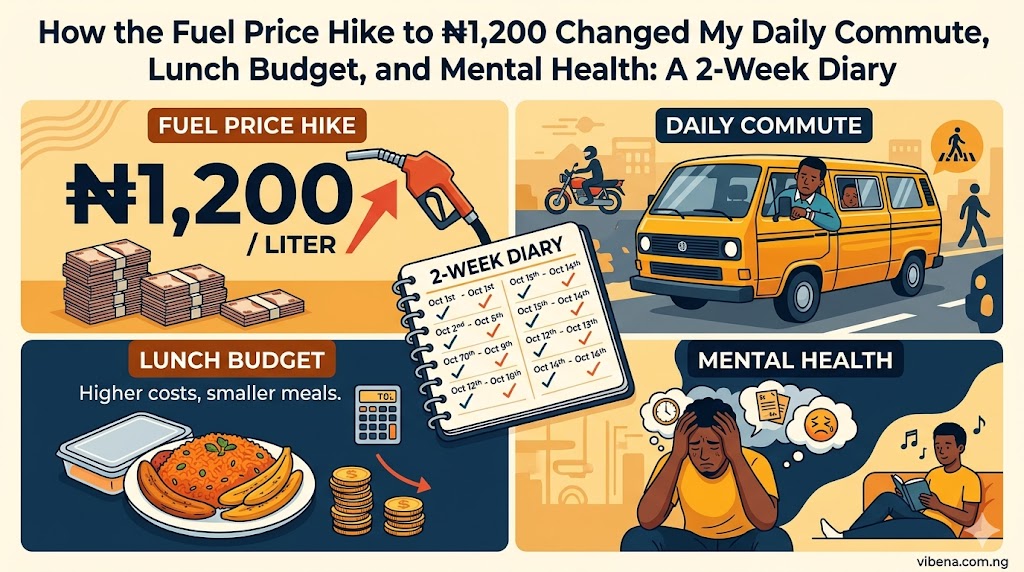
What I wrote that morning became this diary. For the next 14 days, from March 10 to March 23, 2026, I tracked every naira I spent on transport. Every meal I ate or skipped. Every mood shift, every moment of frustration, every small adaptation I made to survive the fuel price hike that has turned daily life in Lagos upside down.
I am a freelance writer living in Yaba, Lagos. I work from home most days, but I commute 2 to 3 times per week for client meetings, errands, and the occasional content shoot. This diary is not about economics in the abstract. It is about what happens to one person’s body, wallet, and mind when the price of petrol jumps by over 30% in a single month.
If you are a remote worker, freelancer, or student trying to figure out how to cope with high fuel prices in Nigeria, this is what the adjustment looks like up close.
The Price Timeline: How We Got Here
Before the diary starts, here is the context.
According to reporting from multiple Nigerian news outlets, the Dangote Petroleum Refinery increased its gantry price for petrol multiple times in March 2026. The price moved from ₦874 per litre on March 2 to ₦995 per litre on March 7, then to ₦1,175 per litre on March 9. By March 21, the gantry price had risen again to ₦1,245 per litre.
At the retail level, filling stations across Lagos are now dispensing petrol between ₦1,200 and ₦1,350 per litre depending on the operator and location. According to the National Bureau of Statistics, Nigeria’s headline inflation rate was 15.06% in February 2026, with food inflation at 12.12%. These figures were recorded before the March fuel price increases took full effect, meaning the next inflation reading will likely be higher.
In Abuja, the situation is even worse. According to multiple reports from Nigerian media, motorists in the Federal Capital Territory are paying between ₦1,260 and ₦1,280 per litre at most filling stations as of late March 2026.
I documented the full financial breakdown of how this affects a Lagos worker’s monthly budget in my earlier article on how the petrol price jump to ₦1,200 affects my budget. This diary is the emotional, physical, and practical companion to those numbers.
Week 1: The Shock Phase
Day 1 (Monday, March 10): The ₦700 Danfo
Transport spending: ₦1,400 (₦700 Yaba to Ikeja, ₦700 return) Lunch: ₦1,800 (rice and chicken from a buka near Ikeja Computer Village) Mood: 4/10 (frustrated, anxious)
The ₦700 fare from Ojuelegba to Ikeja was the first punch. I had budgeted ₦800 for the round trip based on February prices. Instead, I spent ₦1,400 just on transport. That is 75% more than I planned.
At lunchtime, the buka where I usually eat had increased their rice and chicken plate from ₦1,500 to ₦1,800. The woman serving told me the cooking gas had gone up again and the tomatoes from Mile 12 were more expensive because of transport costs. Everything connects back to fuel.
I got home at 6 PM feeling drained. Not physically tired from the commute. Mentally drained from the constant awareness that every naira was stretching thinner. I sat at my desk and stared at my laptop for 20 minutes before I could start working on a client deliverable. That is not procrastination. That is what financial anxiety does to your executive function.
Day 2 (Tuesday, March 11): Working From Home
Transport spending: ₦0 Lunch: ₦600 (garri and soup from ingredients I already had) Mood: 6/10 (calmer, productive)
I stayed home. Worked from my desk. Made garri and egusi soup from ingredients I had bought the previous weekend. Spent nothing on transport or outside food.
The contrast between Day 1 and Day 2 was stark. Not leaving the house saved me ₦2,000+ compared to the day before. My mood was noticeably better. I completed two full articles, responded to all client messages, and even had time for a 30-minute walk in the evening when the heat subsided.
I started thinking seriously about restructuring my week to minimise commutes. Not as a temporary fix. As a permanent lifestyle change. I had already written about setting up a home office in a bedroom and essential gadgets for remote work in Nigeria, but this was the first time the financial pressure made remote work feel less like a preference and more like a survival strategy.
Day 3 (Wednesday, March 12): The Generator Bill
Transport spending: ₦0 Lunch: ₦500 (bread and eggs at home) Generator fuel contribution: ₦2,000 Mood: 3/10 (angry, stressed)
My compound caretaker knocked on my door at 7 AM. The weekly generator fuel contribution had gone from ₦1,200 to ₦2,000 per flat. He showed me the receipt from the filling station: ₦1,250 per litre. The compound generator runs from about 7 PM to 11 PM on days when NEPA fails, which is most days.
This hit differently from the transport cost increase. Transport I can avoid by staying home. The generator contribution is unavoidable unless I want to sit in darkness every evening.
I spent the morning feeling genuinely angry. Not at the caretaker. Not even at the government. Just a diffuse, aimless anger at the situation. The kind of anger that does not have a target but settles into your chest and stays there.
I did the maths on my phone. At ₦2,000 per week for generator fuel contribution, that is ₦8,000 per month. Before the price increase, it was ₦4,800. An extra ₦3,200 per month just to have power in the evenings. For someone exploring alternatives, I reviewed the generator fuel cost calculator and the numbers confirmed what I was feeling: generator power is becoming unsustainable.
Day 4 (Thursday, March 13): The Lunch I Skipped
Transport spending: ₦1,600 (₦800 Yaba to Victoria Island, ₦800 return) Lunch: ₦0 (skipped) Mood: 3/10 (exhausted, headache)
I had a client meeting on Victoria Island that could not be done remotely. The danfo fare from Yaba to VI had climbed to ₦800 one way. ₦1,600 round trip. For comparison, this trip cost ₦500 round trip in January 2025.
At lunchtime, I looked at the menu at a fast food spot near my client’s office. The cheapest meal was ₦2,500. I had already spent ₦800 on the morning fare. I calculated: ₦800 more for the return trip. ₦2,500 for lunch would bring my total day spending to ₦3,900. For one meeting.
I skipped lunch. Drank water from the office dispenser. Told myself I would eat when I got home.
By 3 PM, I had a headache. By 5 PM on the bus home, I was dizzy. I ate jollof rice at home at 7 PM and went to bed by 9 PM. The headache lingered into the next morning.
Skipping meals to afford transport is not a budgeting strategy. It is a health crisis in slow motion. I have written about why you are always tired and have no energy, and skipping meals because of cost is one of the most common and least discussed reasons for chronic fatigue in Nigeria right now.
Day 5 (Friday, March 14): The First Adaptation
Transport spending: ₦0 Lunch: ₦800 (homemade jollof rice, bulk-cooked) Mood: 5/10 (determined, still stressed)
I decided to meal prep for the first time in months. I went to the market on Thursday evening and bought rice, tomatoes, onions, and chicken for ₦3,500. On Friday morning, I cooked a large pot of jollof rice that would last me through the weekend and into Monday.
This is a strategy I had written about before in my meal prep timetable for busy 9-to-5 workers, but I had been too lazy to follow it consistently. The fuel price hike made laziness a luxury I could no longer afford.
Bulk cooking at home versus buying ₦1,500 to ₦2,500 meals outside saves roughly ₦700 to ₦1,500 per day. Over a month, that is ₦15,000 to ₦30,000 in savings. Real money.
I also emailed two clients to propose converting our weekly in-person meetings to bi-weekly virtual meetings. Both agreed within hours. One said: “Honestly, I was going to suggest the same thing. Fuel is killing everybody.”
Days 6 and 7 (Saturday and Sunday, March 15 to 16): The Budget Weekend
Weekend transport spending: ₦0 Weekend food spending: ₦1,200 (from pre-cooked rice plus bread and eggs) Mood: 6/10 Saturday, 7/10 Sunday
I stayed home the entire weekend. Ate from my batch-cooked jollof rice. Read a book. Did laundry. Cleaned my room. Went for a walk on Saturday evening when the heat broke.
Total weekend spending: ₦1,200. My typical pre-hike weekend would have cost ₦5,000 to ₦8,000 between food, transport, and casual spending. I did a full no-spend weekend challenge recently and the skills from that experiment came in handy here.
By Sunday evening, I had started to feel a strange sense of pride. Not pride in the situation. Pride in the adaptation. I was figuring it out. Slowly, painfully, but I was figuring it out.
Week 1 Totals
| Category | Week 1 Total | What I Would Have Spent in February |
|---|---|---|
| Transport | ₦3,000 | ₦4,800 (more trips at lower fares) |
| Food | ₦4,900 | ₦12,500 (eating out more) |
| Generator contribution | ₦2,000 | ₦1,200 |
| Week 1 Total | ₦9,900 | ₦18,500 |
I saved ₦8,600 in Week 1, but not because things were cheaper. Because I changed my behaviour radically. Fewer trips. Home-cooked food. No eating out. No casual spending. The savings came from deprivation, not efficiency.
Week 2: The Adjustment Phase
Day 8 (Monday, March 17): The New Routine Takes Shape
Transport spending: ₦0 Lunch: ₦700 (home-cooked) Mood: 6/10
I started a new morning routine. Wake up at 6:30 AM. Work from 7 AM to 12 PM (my most focused hours). Cook lunch from what I have. Work again from 1:30 PM to 5 PM. Walk in the evening.
This routine eliminated the need for most commutes. I batch my client calls on Zoom and Google Meet, leaving only essential in-person meetings for one or two days per week. I described building a productive morning routine in my morning routine mastery guide, and the fuel crisis gave me the motivation to actually stick with it.
My productivity on Day 8 was the highest of the entire two weeks. I wrote 3,200 words, sent 4 client deliverables, and still had energy for an evening walk. The absence of commute stress freed up mental bandwidth I did not realise I was losing.
Day 9 (Tuesday, March 18): The Food Market Reality
Transport spending: ₦0 Market spending: ₦5,800 (weekly groceries) Mood: 4/10
I went to the market near my apartment for weekly groceries. My usual ₦4,000 weekly basket (rice, tomatoes, peppers, onions, cooking oil, protein) now cost ₦5,800.
The tomato seller explained it simply: “Everything come from farm by motor. Motor dey use fuel. Fuel don increase. So tomato go increase.”
She is right. Every item in a Nigerian market arrives by road. According to multiple reports, the vast majority of goods transport in Nigeria is road-based. When petrol goes from ₦874 to ₦1,245 per litre in three weeks, the transport cost of moving a basket of tomatoes from Oyo to Lagos increases by roughly 40%. That cost gets passed to the consumer. To me. To you. To every Nigerian who eats.
I did a food price comparison at Mile 12 versus local markets earlier this year, and the price gaps have gotten significantly wider since the fuel hike.
Day 10 (Wednesday, March 19): The Mental Health Dip
Transport spending: ₦0 Lunch: ₦500 (leftover soup and garri) Mood: 2/10
This was the worst day.
I woke up at 5 AM and could not fall back asleep. My mind was racing through calculations. Rent is due in 12 days. Generator contribution has doubled. Food is up 40%. Transport when I need it is up 75%. My income has not changed.
I lay in bed doing maths on my phone calculator until 6:30 AM. The numbers did not work. There was a gap of roughly ₦40,000 between my monthly expenses and my monthly income that did not exist in February.
I sat at my desk at 7 AM and stared at the blank document I was supposed to be writing. Nothing came. The cursor blinked. My fingers hovered over the keyboard. And my brain just… refused.
This is what financial stress does. It is not just worry. It is a cognitive shutdown. Your brain is so consumed with survival calculations that it has no bandwidth left for creative work, problem-solving, or even basic focus. Research from the American Psychological Association has consistently shown that financial stress impairs decision-making, reduces working memory capacity, and is one of the leading causes of anxiety and depression globally.
I closed the laptop at 9 AM, lay on my bed, and stared at the ceiling for an hour. Then I took a cold shower, ate garri and soup, and forced myself to write something, anything. I managed about 1,100 words by the end of the day. Below my usual output. But not zero.
If you are going through something similar, please read my guide on self-care ideas for Nigerians. And if it persists, talk to someone. A friend. A family member. A counsellor. Financial stress that turns into persistent inability to function is not something to power through alone.
Day 11 (Thursday, March 20): The Side Income Conversation
Transport spending: ₦0 Lunch: ₦600 (rice and stew, homemade) Mood: 5/10
I spent the morning not doing client work. Instead, I spent it thinking about income. The expense side of this equation is being squeezed by forces outside my control. The only thing I can control is the income side.
I sent three cold pitches to businesses I had been meaning to contact for weeks. I updated my portfolio. I reached out to two former clients about additional work. I wrote about my cold pitching methodology in my guide on how to write a cold pitch that gets replies, and I used the exact Template C approach from that experiment.
By evening, one of the three pitches had received a reply. Not a confirmed client yet, but a conversation started. That small win shifted my mood from despair to something closer to cautious determination.
I also explored additional income options. I wrote about student side hustles and how to start freelance writing without experience for my readers, and the irony of needing my own advice was not lost on me.
Day 12 (Friday, March 21): The Client Meeting I Could Not Avoid
Transport spending: ₦1,800 (₦900 each way, Yaba to Lekki Phase 1) Lunch: ₦0 (ate before leaving, carried biscuits) Mood: 4/10
A client in Lekki insisted on an in-person meeting. I could not refuse because the project was worth ₦150,000. The danfo fare from Yaba to Lekki was ₦900. Return was the same. ₦1,800 for a round trip that cost ₦600 six weeks ago.
This time, I prepared. I ate a full meal at home before leaving (following the lesson from Day 4’s skipped-lunch disaster). I carried cabin biscuits and a frozen water bottle in my bag. I left at 7:15 AM to avoid the worst traffic.
The meeting went well. The client signed the project. ₦150,000 coming in next month. The ₦1,800 transport cost was a necessary investment in future income. But I found myself calculating the ROI of every trip now. Before the fuel hike, I never thought about whether a meeting was “worth” the transport cost. Now every trip has a cost-benefit analysis running in the background.
Day 13 (Saturday, March 22): The Conversation With My Neighbour
Transport spending: ₦0 Food: ₦800 Mood: 6/10
My neighbour Chidi came by my door in the evening. We sat on the corridor bench and talked for about an hour. He works as a school teacher in Surulere and earns ₦85,000 per month.
He told me his transport to work (Yaba to Surulere and back) now costs ₦800 per day. That is ₦17,600 per month on transport alone, roughly 21% of his salary. Before the fuel hike, it was about ₦8,000 per month, or 9.4% of his salary.
“I am thinking of finding a school closer to Yaba,” he said. “Or finding a cheaper room closer to Surulere.”
This is what the fuel price effect on daily life in Nigeria looks like. It is not just numbers on a news headline. It is a teacher considering uprooting his life because he cannot afford to get to work. It is a writer skipping lunch. It is a compound generator contribution doubling overnight.
Day 14 (Sunday, March 23): The End of Week 2
Transport spending: ₦0 Food: ₦600 Mood: 7/10
The last day of the diary was quiet. I stayed home. Cooked. Cleaned. Did my Sunday reset routine. Planned the week ahead.
By the end of the two weeks, I had developed a rhythm that was sustainable, if not comfortable. Work from home 4 to 5 days per week. Cook every meal at home. Batch errands into one weekly trip. Eliminate all unnecessary spending.
It was not the life I had in February. But it was a life I could maintain.
Week 2 Totals
| Category | Week 2 Total | What I Would Have Spent in February |
|---|---|---|
| Transport | ₦1,800 | ₦4,800 |
| Food (groceries + meals) | ₦9,100 | ₦14,000 |
| Generator contribution | ₦2,000 | ₦1,200 |
| Week 2 Total | ₦12,900 | ₦20,000 |
The Full 2-Week Summary
| Metric | 2-Week Total | February Equivalent | Difference |
|---|---|---|---|
| Transport | ₦4,800 | ₦9,600 | -₦4,800 (cut trips in half) |
| Food | ₦14,000 | ₦26,500 | -₦12,500 (home cooking) |
| Generator | ₦4,000 | ₦2,400 | +₦1,600 (price increase) |
| Total | ₦22,800 | ₦38,500 | -₦15,700 saved |
I saved ₦15,700 over two weeks. But I want to be honest about how those savings happened. They came from:
- Cutting my commutes from 5 to 6 per week to 2
- Cooking every meal at home instead of eating out
- Skipping one meal entirely (which I do not recommend)
- Eliminating all leisure spending
- Staying home on both weekends
Those are not optimisations. They are sacrifices. And they are not sustainable indefinitely without affecting mental health, social connections, and quality of life.
What I Changed Permanently After This Diary
Not everything from these two weeks was suffering. Some of the adaptations I made were genuinely better than my old habits.
I Now Batch Cook Every Sunday
What started as a survival response has become a weekly routine. I spend about 2 hours on Sunday cooking enough food for Monday through Wednesday. Then I do a smaller cooking session on Wednesday evening for Thursday through Saturday.
My food spending dropped from roughly ₦50,000 per month (eating out frequently) to about ₦25,000 to ₦30,000 per month (cooking at home with smart shopping). That ₦20,000 to ₦25,000 monthly saving has nothing to do with fuel prices. It is a better habit that the crisis forced me to adopt.
I Converted 80% of My Meetings to Virtual
Two of my three regular clients now meet me exclusively on Zoom. The third agreed to bi-weekly in-person meetings instead of weekly. My monthly transport trips dropped from about 20 to 8. At current fare levels, that saves roughly ₦9,600 per month.
I Started Tracking Every Naira
I downloaded a simple expense tracker app and now record every single expenditure. The awareness alone changed my behaviour. When you see “₦700 danfo” written down next to “₦600 lunch,” you start making different decisions.
I Am Actively Building More Income Streams
The ₦40,000 monthly budget gap is real. Cutting expenses has closed about ₦25,000 of it. The remaining ₦15,000 needs to come from additional income. I have been pitching more aggressively, exploring digital skills that command higher rates, and considering adding social media management to my freelance services alongside writing.
How to Cope With High Fuel Prices in Nigeria: My Practical Framework
Based on these two weeks, here is the framework I would recommend to anyone in a similar situation.
Step 1: Know Your Numbers
Track your actual spending for one full week. Not estimates. Actual naira amounts, written down. You cannot optimise what you do not measure. Most people are shocked by how much they spend on transport and outside food when they see the real numbers.
Step 2: Eliminate Unnecessary Trips
Every trip you do not take saves ₦800 to ₦2,000 at current prices. Ask yourself before every outing: “Can this be done on a phone call, a WhatsApp message, or a Zoom meeting?” If yes, stay home.
Step 3: Cook at Home
Eating out costs 2 to 3 times more than cooking the same meal at home. Batch cooking on Sundays reduces the daily effort to reheating. This is the single biggest money-saving change you can make.
Step 4: Negotiate Remote Work
If you work for an employer, propose remote work days. Most reasonable employers understand the current reality. If you freelance, make virtual meetings your default and travel only for high-value engagements.
Step 5: Protect Your Mental Health
Financial stress is real and it compounds. Take breaks. Talk to people. Do not isolate. A 30-minute walk costs nothing and clears your head. A conversation with a friend costs nothing and reminds you that you are not alone. I wrote about quick stress relief methods at home and every single one of them became more important during these two weeks.
Step 6: Focus on Income, Not Just Expenses
There is a floor to how much you can cut. You cannot spend less than zero on transport if you need to go somewhere. You cannot eat less than one meal a day without damaging your health. After the cuts, the only path forward is earning more. Pitch new clients. Learn new skills. Explore side hustles. The crisis will not wait for you to feel ready.
Frequently Asked Questions
How much has transport cost increased in Lagos since the fuel hike?
Based on my tracking, danfo and minibus fares in Lagos have increased by approximately 50 to 75% since late February 2026. Routes that cost ₦400 now cost ₦700. Routes that cost ₦500 now cost ₦800 to ₦900. BRT fares also increased by 13% effective March 2, 2026, following approval by the Lagos State Government.
How much does a daily commute cost in Lagos in March 2026?
Depending on your route and distance, a daily round-trip commute in Lagos now costs between ₦1,000 and ₦2,000 using public transport. For workers commuting from mainland to island (Yaba to Victoria Island, for example), the daily cost is approximately ₦1,600 to ₦2,000. Monthly commute costs range from ₦22,000 to ₦44,000 for a 5-day work week.
What is the best way to reduce fuel-related expenses in Nigeria?
Based on my two-week experiment, the most impactful strategies are: (1) working from home as much as possible, (2) cooking meals at home instead of buying outside, (3) batching errands into fewer trips, (4) shifting to virtual meetings for work, and (5) travelling only during off-peak hours to reduce time stuck in traffic-fuelled frustration.
Will fuel prices come down again?
The outlook is uncertain. The price increases are driven partly by global crude oil prices (which have been elevated due to Middle East geopolitical tensions) and partly by the Dangote Refinery’s pricing decisions. According to energy analysts quoted by several Nigerian outlets, prices are unlikely to return to pre-March levels in the near term unless global crude oil prices drop significantly or the government intervenes with subsidies, which the current administration has shown no inclination to do.
Final Thoughts
Fourteen days. ₦22,800 spent versus ₦38,500 I would have spent in February. ₦15,700 saved through sacrifices I did not want to make.
The fuel price hike to ₦1,200 and beyond is not just an economic event. It is a daily lived experience that changes how you eat, how you move, how you work, and how you feel. It changes the calculation behind every decision. Do I take this trip? Can I afford this meal? Is this meeting worth the bus fare?
For remote workers and freelancers, the silver lining (and it is a thin one) is that we have more control over our commute than most. We can choose to stay home. We can build our income around a laptop and an internet connection rather than a physical office.
But for the millions of Nigerians who cannot work from home, who must commute daily, who have no choice but to pay the fare and buy the food and fill the generator, this crisis is relentless.
I am adapting. You can adapt. But adaptation should not be confused with acceptance. These prices are changing lives, and not for the better.
Track your numbers. Make your changes. Protect your health. And if you have the bandwidth to help someone else, even if it is just sharing a meal or giving your neighbour a ride, do it. We are all navigating the same storm. The boats are just different sizes.
Want more strategies for managing the current economic pressure? Check out my full budget breakdown in how the ₦1,200 petrol price affects a Lagos worker’s budget and my weekly transport spending tracker after the fuel hike.

Oladepo Babatunde (Prince Babatee Tunde) is a Computer Scientist, researcher, and professional content writer with a Higher National Diploma in Computer Science from Kwara State Polytechnic, Nigeria.
With a background in technology and a passion for clear communication, Babatunde specializes in creating thoroughly researched, reader-focused content on productivity, personal development, home living, and technology. Every article he writes is backed by extensive research and fact-checking to ensure readers receive accurate, actionable information.
As a freelance writer, he has helped brands and publications deliver content that educates, engages, and empowers their audiences. His mission at Vibena is simple: make complex topics easy to understand and help Nigerians live smarter, more productive lives.