It’s 2 PM on a scorching Lagos afternoon. You just got home, your living room feels like an oven, NEPA just took the light, and running your small generator all day is too expensive. This feeling of being trapped by the heat is one shared by millions of Nigerians every day. You are not alone in wondering how to cool down a hot house without air conditioning when your electricity bill is already too high.
I have personally lived through 15 years of Nigerian heat—from the dry, harsh sun of Abuja to the sticky, humid coastal heat of Port Harcourt—and spent over ₦45,000 on generator fuel in just two months during 2024 trying to stay comfortable. I became obsessed with finding effective, low-cost heat management strategies that work even when the power is gone. The good news is that you don’t need a heavy duty HVAC system or a huge budget to find thermal comfort.
This comprehensive guide delivers 15 proven methods that leverage science and strategy. By combining techniques like blocking solar gain (curtains/film), using evaporative cooling (ice bowl trick), and improving structural defense (insulation/thermal mass management), you can realistically expect to lower your indoor temperature by 3-7°C, turning an unbearable space into a tolerable one. We cover everything from emergency cooling hacks for immediate relief to long-term structural solutions for permanent comfort, complete with localized prices and security advice. These budget-friendly cooling strategies are perfect for our climate and work even when there’s an electricity shortage or power outage. Let’s get started on making your home comfortable again.
Understanding Why Your House Gets So Hot
Before we start cooling, let’s look at what causes houses to trap heat. It’s not magic; it’s physics! If you know how the heat is getting in, you can stop it.
How Heat Enters Nigerian Homes (Heat Transfer)
Heat transfer follows three thermodynamic principles—radiation, conduction, and convection. Understanding which affects your specific home most allows you to target the right solutions.
- Radiation: The sun’s rays shine directly through your windows, causing significant solar heat gain which heats up your furniture and floors. It’s the biggest cause of afternoon heat.
- Conduction: This is when heat moves through materials. In Nigerian homes with metal roofing, conduction typically dominates during afternoon hours when the sun has heated the roof surface to temperatures exceeding 70°C. This conducted heat then radiates downward into living spaces throughout the evening.
- Convection: This is when air moves. Hot air rises. If you leave a window open on the sunny side, the hot ambient temperature air flows right in, pushing the cooler air out. This highlights the importance of ambient temperature management through smart ventilation.
According to Nigerian Meteorological Agency (NiMet), Lagos experiences average daytime temperatures of 28-33°C during peak heat months (February-April), with occasional extreme days exceeding 35°C in urban heat islands.
The World Bank Climate Knowledge Portal confirms that Nigeria’s climate data from 1991-2020 shows significant temperature variations across different regions, with coastal areas like Lagos experiencing high humidity levels that make cooling strategies particularly important.
Research analyzing temperature patterns from Nigerian Meteorological Agency archives shows that Nigeria is experiencing increasing temperatures across most regions, with particularly notable warming trends in urban areas like Lagos, Ibadan, and Kaduna.
According to Climate-Data.org, Lagos maintains an average annual temperature of 26.7°C (80°F), with approximately 1,783mm of rainfall distributed throughout the year, making humidity management crucial during rainy season months. Weather data for Lagos shows daytime temperatures typically vary from 24°C to 33°C (75°F to 91°F) year-round, with the hottest periods occurring during dry season.
NiMet’s recent climate analysis shows continued warming trends across urban centers, making natural cooling strategies increasingly important for Nigerian households.
What to Expect in 2025: NiMet’s Latest Predictions
NiMet’s 2025 Seasonal Climate Prediction, released in February 2025, provides specific forecasts that affect your cooling strategy:
Rainy Season Duration:
- Lagos: 250-290 days (longer than normal)
- Northern states (Sokoto, Kano, Katsina): 110-150 days
- This means Lagos residents need year-round cooling strategies, not just seasonal solutions
Dry Spells to Watch:
- Severe dry spells (15+ days) expected in Oyo State during April-May-June
- Little Dry Season expected in Lagos around July 22, 2025, with 27-40 dry days
- These dry periods are when evaporative cooling methods work best
Rainfall Patterns:
- Total annual rainfall in Lagos area: 2,700-3,010mm
- Some areas may experience above-normal rainfall (parts of Lagos, FCT)
- Heavy rains mean higher humidity, making ventilation methods more important than evaporative cooling
Practical Application: During the predicted Little Dry Season in late July, Lagos residents should maximize use of the Ice Bowl Fan Trick and Wet Sheet Method. During the longer rainy periods (most of the year), prioritize ventilation and dehumidification strategies instead.
Climate and Regional Variations (Crucial Context)
The success of these cooling methods depends on your specific region’s climate:
- Humid Coastal Cities (Lagos, Port Harcourt, Calabar): These areas have high humidity, making the Wet Sheet Method and other evaporative strategies less effective (or even counterproductive, as they increase humidity). Prioritize ventilation (cross-breeze), blocking solar gain (curtains/film), and dehumidifying strategies.
- Dry Northern Cities (Kano, Sokoto, Maiduguri): In low-humidity conditions, evaporative cooling works exceptionally well. The Ice Bowl Fan Trick and the Wet Sheet Method are the most effective non-electric solutions here, as evaporation happens rapidly.
Quick Relief: How to Cool Down a Single Room Fast
Sometimes, you need to cool down a room fast. These methods are for immediate temperature lowering and work great for quick relief when you get home or before bed.
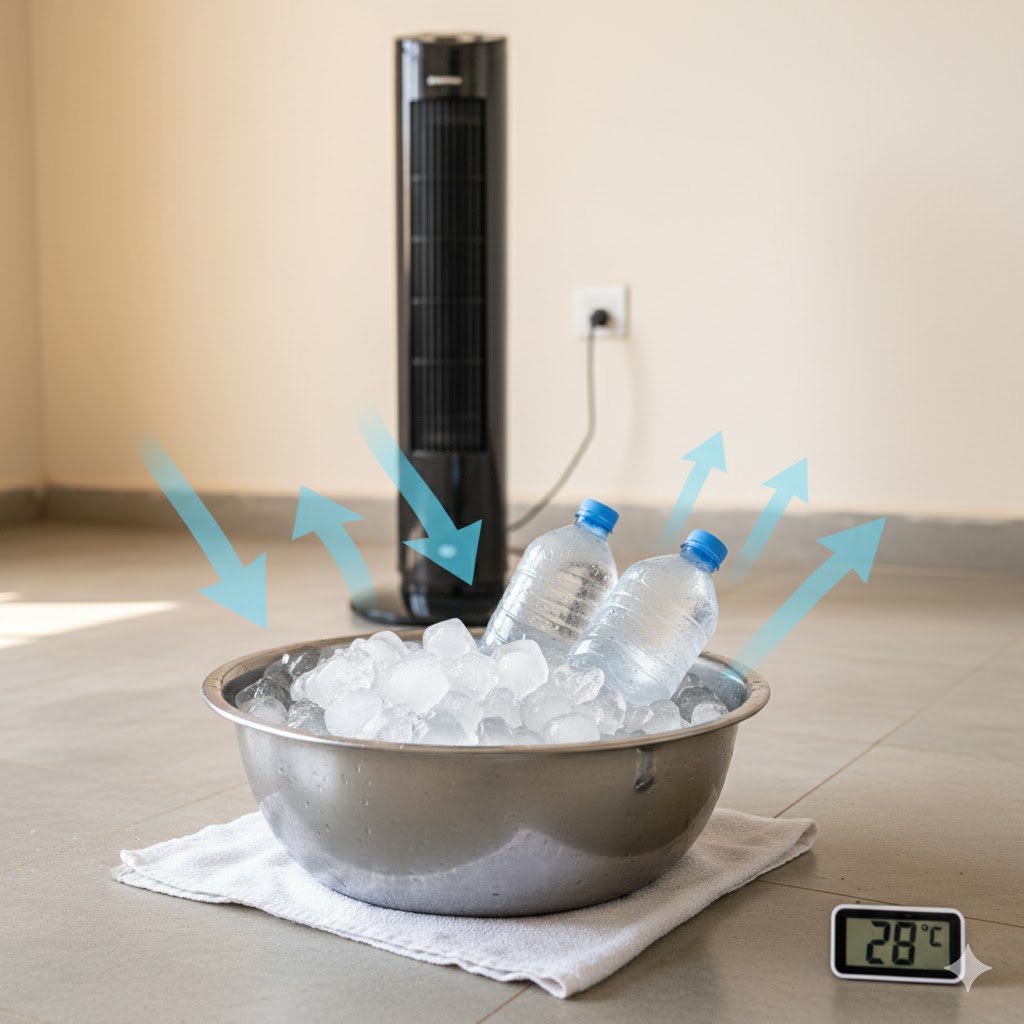
The Ice Bowl Fan Trick (Evaporative Cooling)
When I first tried the ice bowl method during a 12-hour outage in Surulere, I was skeptical. But within 20 minutes, my bedroom went from unbearable to tolerable. This is a classic and one of the best natural cooling methods.
| Element | Detail |
|---|---|
| What It Is | A simple setup that uses melting ice and a fan to create a localized, cool mist. |
| Why It Works | As the ice melts, it absorbs heat from the air (evaporative cooling). The fan then blows the newly chilled air across the room, which, combined with the evaporative effect, is known to improve thermal comfort. |
| How to Do It | 1. Fill a large, shallow basin (preferably metal) with ice cubes or frozen water bottles. 2. Place the bowl on a towel (to catch condensation). 3. Position your standing fan about 40 cm behind the bowl. 4. Turn the fan on medium speed. |
| What You Need | Ice or frozen bottles (₦200-500 for a bag of ice blocks), a bowl, a towel, and a fan. |
| Nigerian Consideration | This method is most effective in dry northern climates (refer to the Climate section) and should be used cautiously in high humidity. |
| Realistic Expectations | Expect a 3-5°C temperature reduction within a 2-meter radius, lasting approximately 3-4 hours per ice refill. |
Emergency Cooling: How to Cool Your House Without Electricity During Extended Outages
This section focuses on non-electric strategies for when you need to cool your house without electricity during extended NEPA/PHCN outages.
The Wet Sheet Method
- Dampen a large bedsheet or cotton sheets with water. Do not soak it—it should be damp, not dripping.
- Hang the damp sheet in a doorway or in front of an open window (if the wind is blowing in).
- As the water evaporates from the sheet, it pulls heat from the air, instantly dropping the room temperature regulation slightly.
- Caution: DO NOT use this during the rainy season or in humid coastal cities. See the Humidity Management section for alternatives.
No-Power Cooling Techniques
- Go Low Tech: Use handheld fans, take frequent cool showers, and wear light, loose-fitting cotton clothing.
- Unplug Electronics: Even when off, electronics like TVs, chargers, and decoders generate heat. Unplug everything you aren’t using to reduce heat reduction in the room.
These no-electricity cooling methods become essential during the frequent NEPA outages many Nigerians experience daily. While managing your home’s temperature, you may also want to explore our guide on how to stay focused during power outages to maintain productivity even when the heat and lack of power seem overwhelming.
Managing Humidity During Rainy Season
Humidity, or the amount of water vapor in the air, is your enemy in coastal areas like Lagos and Port Harcourt. When humidity is high, your sweat can’t evaporate, making you feel much hotter even if the air temperature drops.
Why Evaporative Methods Backfire
Methods like the Wet Sheet Method and using misting fans rely on evaporation to cool. If the relative humidity is already above 70%, the air can’t hold any more water, evaporation stops, and all you achieve is a muggy, sticky, and still hot room.
Practical Humidity Reduction Strategies
- Seal and Ventilate Smartly: During heavy rains or peak humidity, keep windows and doors closed to block the moisture-laden outside air. Open them only briefly when there is a strong, dry cross-breeze.
- Use Moisture Absorbers: Buy commercial moisture absorbers (calcium chloride crystals in plastic containers, often sold as dehumidifiers) available in major supermarkets or household shops. Place these in closets and near exterior walls to pull moisture out of the air. While small, they can help manage high humidity in enclosed spaces.
- Vent During Cooking: Always run a fan or exhaust hood while cooking or taking hot showers. This vents the steam (humidity) directly outside before it can spread to your living areas.
- Prioritize Airflow: Focus on moving the existing air rapidly with a strong fan (like a ceiling fan) to break up the layer of moist air around your body, which helps sweat evaporate even in high humidity.
How to Sleep When It’s Hot With No AC: Cooling for the Night
If you struggle with how to sleep when it’s hot with no AC, you’re dealing with the most frustrating part of the dry season. Why does my room stay hot at night? Because your walls and roof release the heat they absorbed all day.
When planning or redesigning your space, consider our tips for one-bedroom apartment design in Nigeria that prioritize natural cooling and airflow optimization.
Best Sleeping Positions and Bedding Materials
- Go Low: Hot air rises (convection). If you live in a multi-story home, the ground floor is always cooler. If you’re in a single flat, sleep as low as possible (maybe on a simple sleeping mat on the floor).
- Ditch Synthetic: Use only cotton sheets or bamboo bedding. Avoid heavy blankets.
- The Cold Water Trick: Take a lukewarm shower 30 minutes before bed. As the water evaporates from your skin, it tricks your body into cooling down its core temperature.
Sleeping in excessive heat doesn’t just make rest difficult—it prevents your body from properly recovering overnight. You wake up already exhausted, facing another hot day with depleted energy reserves. If you’re experiencing persistent fatigue even after implementing these cooling strategies, explore our article on why you’re always tired and have no energy to identify other potential factors affecting your vitality.
Night Ventilation Strategies That Work in Nigeria
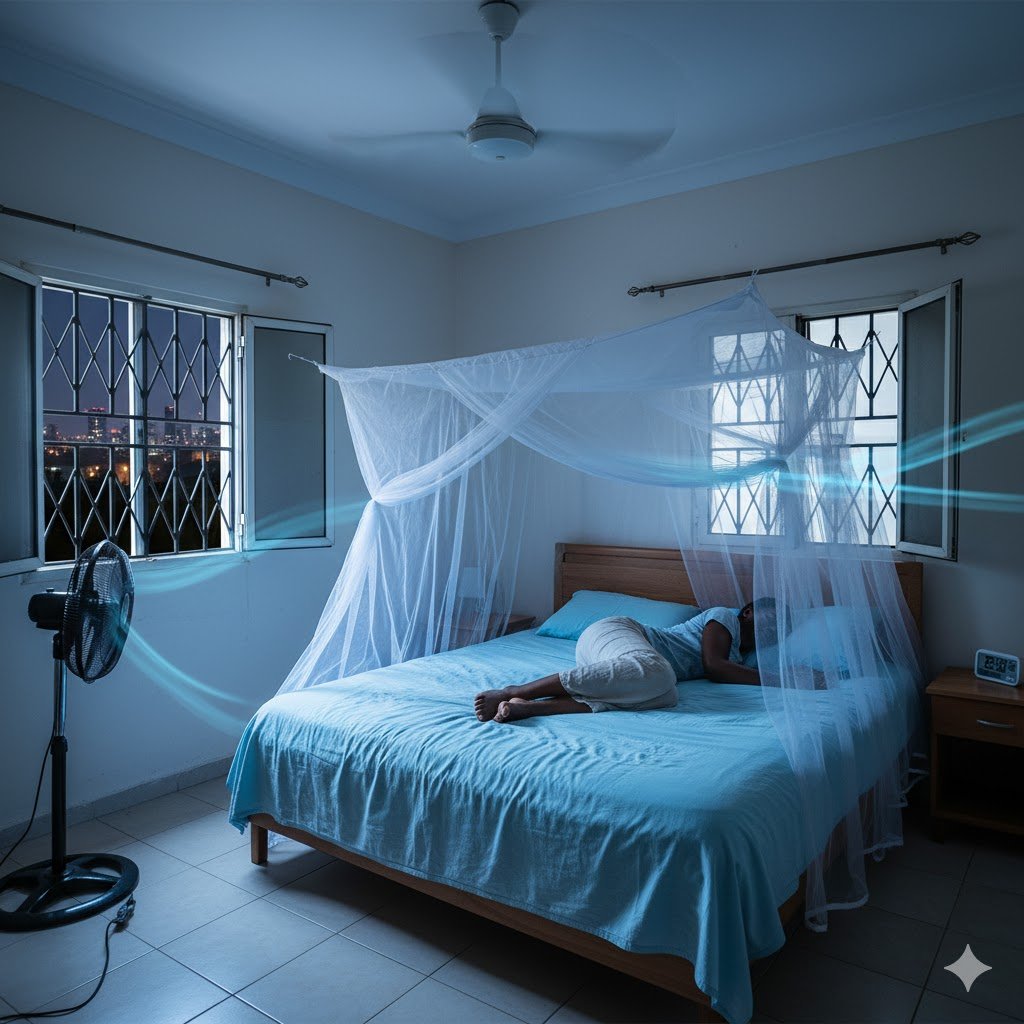
- The Single Fan Strategy: Place your standing fan or ceiling fan so it blows air out of your window, not in. This draws the hot air out and forces cool air to be pulled in from other small openings, creating a better current.
- Managing Mosquitoes, Pests, and Security (Critical Nigerian Consideration):
- If you have burglar-proof bars, ensure they have enough space for air to pass. Always use a well-arranged mosquito net or window screens.
- Ground Floor Security: If you’re in a ground floor flat in high-density neighborhoods like Mushin, Ajegunle, or Agege, window security becomes paramount. Consider installing removable window grilles that allow you to safely open the window slightly for ventilation but prevent intrusion. These cost approximately ₦8,000-₦15,000 per window at local welding shops.
Defense Strategies: Keeping Your House Cool During Extreme Heat
These are passive cooling techniques for keeping house cool in extreme heat without AC—focusing on heat mitigation through preparation, shade, and heat blocking before the hot air enters.
Interior Window Films and Heat Reduction
Window glass is a major source of radiant heat and solar heat gain. Reflective window films offer a middle-ground solution between curtains and awnings.
- Solar Window Film: This reflective film is designed to block up to 80% of solar heat gain. These thin, adhesive films (similar to phone screen protectors but for windows) can block up to 60-70% of solar heat while still allowing visibility.
- Where to Buy: Available at electronics markets or online (Jumia, Konga), they cost ₦3,000-8,000 per square meter.
- Installation: Installation is DIY-friendly: clean the window thoroughly, spray with soapy water, apply the film, and squeegee out bubbles. Most importantly for renters: they’re completely removable without damage when you move.
- The DIY Foil Method: Create a clean-fitting cardboard insert wrapped tightly in aluminum foil and place it snugly into the window frame during peak hours.
- Where to Buy: Available at Shoprite, Spar, or any local supermarket (₦500-₦800/roll).
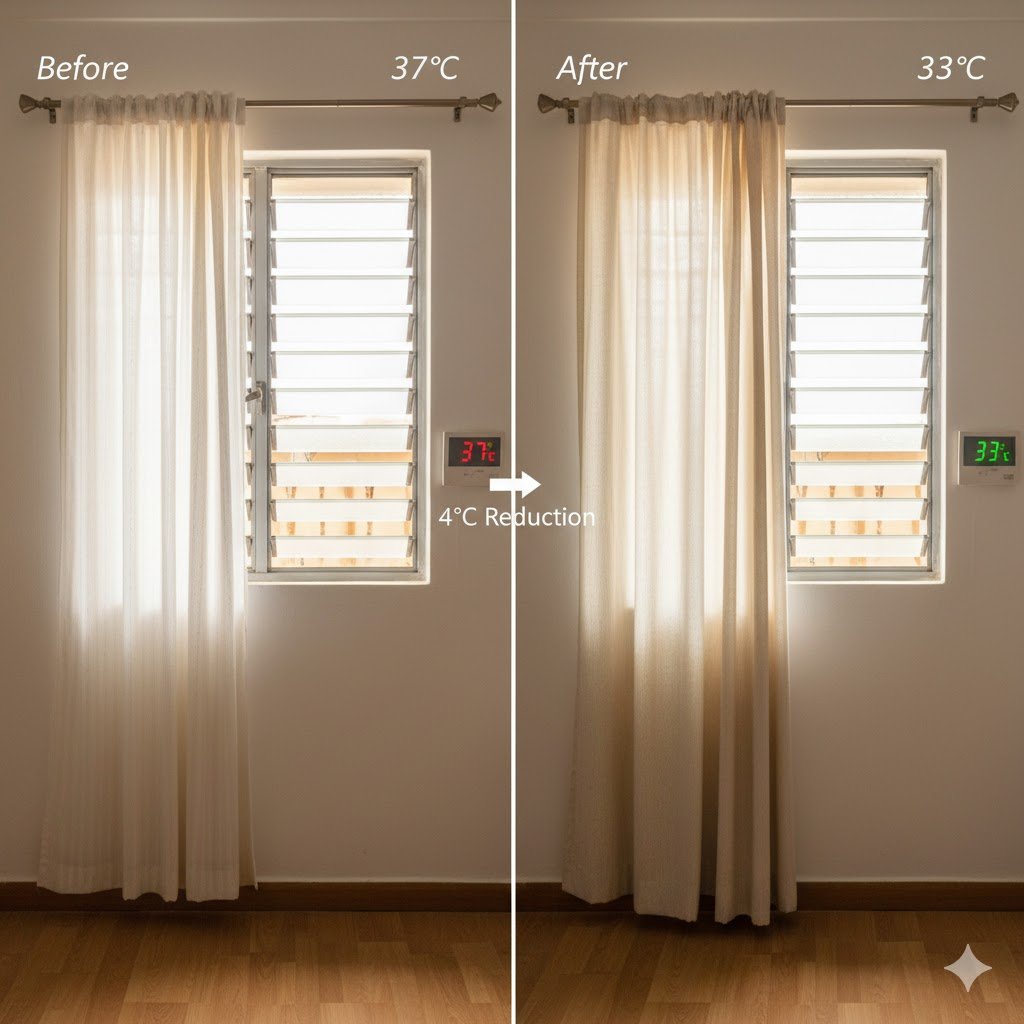
- Thermal Curtain Strategies: Install heavy, light-colored, or thermal-backed curtains (like thick cotton or local fabric bought from Balogun Market or Ariaria Market). Draw these curtains completely closed on the sunny side of the house from 9 AM to 5 PM.
- In my Surulere flat, which faced west, I tested five different curtain materials. Heavy cotton bought from Balogun Market (₦2,800 per yard) reduced afternoon temperature by 4°C compared to thin synthetic curtains.
- I measured temperature differences using a simple thermometer (₦800 at any pharmacy). Before implementing window treatments: 37°C at 3 PM. After: 33°C. That 4-degree difference meant the difference between unbearable and manageable comfort.
Timing Activities Away From Hot Rooms
If your bedroom faces west and receives afternoon sun, plan your day accordingly. Use this room for sleeping only—do work, cooking, and daytime activities in north-facing or shaded rooms. The west-facing room will be coolest from midnight to noon. If you must use it during hot hours, implement all the shade strategies simultaneously: external awning + reflective film + thick curtains = maximum protection.
- Move Cooking Times: Try to cook heavy meals only in the early morning or late evening. If cooking in the afternoon, use a low-power appliance and run an exhaust fan (if available) to vent the hot, steamy air outside immediately.
- Relocate Electronics: The room with your desktop computer and large TV is likely the hottest room. Plan to use your sun-facing rooms for storage during the day, and reserve your cooler, shaded rooms for work and relaxation.
In small spaces like one-room apartments, strategic furniture placement can block or enhance airflow. Avoid pushing furniture directly against walls where heat conducts through—leave a few inches of space for air circulation. For more tips on optimizing small Nigerian living spaces, check our guide on how to decorate a one-room apartment in Nigeria with comfort and functionality in mind.
Night Purging for Sun-Facing Rooms
Night purging is a passive cooling strategy where you use the cool night air to flush out heat absorbed during the day. This resets your thermal mass daily, preventing cumulative heat buildup that makes rooms progressively hotter throughout the week.
For maximum effectiveness in sun-facing rooms:
- Keep the room completely sealed during the day (7 AM – 7 PM) to block heat entry.
- At 7 PM (or sunset), open windows wide on multiple walls to create aggressive cross-ventilation.
- Use fans to force hot air out and cool air in for the first 30 minutes.
- By 9-10 PM, the room temperature should match the outdoor temperature.
- Continue ventilation all night to maximize heat release from the walls.
How to Stay Cool Without AC in Your Car During Lagos Traffic
While this guide focuses on homes, many Nigerians spend hours in heavy traffic where AC either doesn’t work or is too expensive (fuel). Applying passive cooling strategies to your car can make your commute significantly more bearable.
Before Entering and Immediate Relief
- Park in Shade: Whenever possible, park in the shade. If no shade is available, use a reflective windshield cover (₦1,500-3,000 at car accessory shops). This blocks up to 80% of solar energy entering through your windshield.
- Immediate Relief: Before entering, open all doors for 30-60 seconds. Hot air trapped inside can be 10-15°C hotter than outside. Let this super-heated air escape first.
While Driving (In Slow Traffic)
- Smart Ventilation: Lower the front windows about 3-4 inches and the rear windows about 1-2 inches. This creates a powerful negative pressure air current that efficiently pulls hot air out while the car is moving.
- Evaporative Assist: Wet a small towel and place it over the dashboard AC vents (even with the AC off)—the airflow created by the car’s fan will pick up coolness from the evaporating water.
- Targeted Airflow: If you have only one fan in your car, angle it toward your face and neck rather than your feet. Cooling pulse points is the most effective way to lower the perceived temperature.
Stuck in Standstill Traffic
- Engine Off: If safe and traffic is stopped for an extended period, turn off the engine and open doors slightly (be aware of motorcycles).
- Handheld Fan: Use a battery-powered handheld fan (₦1,500-3,000, available at electronics shops) for focused personal cooling.
- Frozen Water Bottle: Keep a frozen water bottle or a small ice pack handy to hold against your wrists and neck (major pulse points).
Long-Term Car Investment
- Window Tinting: Consider installing professional window tinting (₦25,000-45,000 for a full car at auto shops in areas like Berger or Oshodi). Dark tinting blocks heat significantly, but ensure it complies with Nigerian road regulations—front windshield tinting above certain levels is often prohibited.
Long-Term Solutions for Natural Cooling (Structural and Building Decisions)
These methods require some investment but offer the best cooling strategies for keeping house cool in summer naturally for years to come.
Understanding Thermal Mass for Natural Cooling
Thermal mass is the ability of a material (like concrete, brick, or water) to absorb and store heat energy. Most Nigerian houses, built with thick concrete blocks and masonry, are high-thermal-mass structures.
- When Thermal Mass Helps: Thermal mass is beneficial when the day-night temperature swing is large (e.g., in drier northern regions). The walls and floors absorb heat during the day, keeping the interior cooler. Then, at night, when the outside air is cool, you open the windows for night purging, releasing the stored heat.
- When Thermal Mass Hurts: In hot, humid, and constantly warm coastal climates (like Lagos), the walls absorb heat all day but the night air isn’t cool enough to pull that heat out. Instead, the walls continue to radiate the heat into the room until the next morning, meaning your room is still hot at 10 PM. This phenomenon is called thermal lag.
- Actionable Tip: If you have high thermal mass (concrete/brick), you must prioritize blocking heat entry (insulation/window film) and aggressively practice night purging (opening windows after sunset) to release the heat stored in the structure.
Roof and Ceiling Improvements
- Insulation is Key: For metal roofs, the single most valuable investment is ceiling insulation (like rock wool or fiberglass) installed between the metal sheet and the ceiling board. Research on passive cooling techniques in tropical climates shows that adding ceiling insulation (such as rock wool or fiberglass) between metal roofing and ceiling boards can dramatically reduce conducted heat transfer, often by 70-90% depending on the insulation quality and R-value.
- Reflective Roof Coatings: Consider painting your metal roof with a specialized white reflective surface coating (available at large building material distributors). Studies on cool roof technologies in tropical regions have documented interior temperature reductions ranging from 3-6°C using reflective roof coatings, though results vary depending on roof type, coating quality, and local climate conditions.
Improving Your Home’s Natural Ventilation
- Install an Exhaust Fan: In the ceiling of your kitchen or bathroom, install an exhaust fan. This utilizes the principle of stack ventilation, actively pulling hot air out of your house and forcing cooler air to be drawn in from lower windows on the shady side.
- Where to Buy: Alaba International Market, Ikeja Computer Village, or major building material shops (₦4,500-₦12,000).
- Installation Guidance: Installing a ceiling exhaust fan typically costs ₦8,000-₦15,000 for labor if you hire a local electrician. If you’re renting, get written landlord permission first as this requires ceiling modification.
- Ceiling Fans: Install ceiling fans in your living room and bedroom. They are far more efficient than standing fans at circulating air in large spaces.
- Where to Buy: Apo Spare Parts Market (Abuja), Kurmi Market (Kano), or electronics sections of major malls nationwide.
Fan Strategies vs Air Conditioning Costs
A typical 1HP air conditioning unit consumes approximately 750-1,000 watts of electricity, while a ceiling fan uses only 60-80 watts—roughly 12-15 times less power. This means running AC for one hour uses similar electricity to running a ceiling fan for 12-15 hours.
| Method | Average Monthly Cost (₦) | Cooling Effectiveness | Best For | Renter-Friendly? |
|---|---|---|---|---|
| Ceiling Fan | ₦3,500 – ₦6,500 | Good | Whole room circulation, nighttime | No* |
| Standing Fan | ₦2,500 – ₦4,500 | Moderate | Small rooms, quick relief | Yes |
| Small Window AC (1hp) | ₦25,000 – ₦40,000+ | Excellent | Single room cooling, stable power | No* |
Solar Panel Optimization:
If you have a solar panel setup (increasingly common in Nigeria), prioritize running ceiling fans over standing fans. Ceiling fans are more power-efficient for whole-room circulation, often drawing 60-80W compared to 100-150W for some standing fans. A small 300W solar setup can often run two ceiling fans throughout the day without draining the battery excessively.
Creating Your Personal Cooling Strategy (The Three-Phase Plan)
The secret to success is combining multiple cooling methods based on the time of day and the availability of power.
Phase 1: Morning Routine (Heat Prevention)
- Maximize Morning Cool: Before 7:30 AM, open every window and door possible to let the freshest, coolest air of the day flush out any stagnant night air.
- Close Everything Tightly (The Lock Down): As soon as you notice the outdoor air starting to warm up (usually around 8:30 AM to 9:00 AM), close all windows and doors.
- Deploy Window Coverings: Draw all your light-colored curtains/blinds on the east and south sides of the house to block the early morning sun’s radiant energy.
Phase 2: Afternoon Heat Management (Heat Blocking)
This phase, typically from 11 AM to 5 PM, is about defense against the most powerful sun.
- Lock Down: Keep all sun-facing windows and curtains closed.
- Use Water for Personal Cooling: Dampen your face and wrists with a cold cloth—cooling your pulse points gives instant, effective thermal relief.
- Use the Ice Bowl Trick: Deploy the Ice Bowl Fan Trick (most effective in dry climates) in your primary living area. Aim the fan directly at yourself.
Phase 3: Evening and Night Cooling Strategies (Night Purging)
Once the sun sets, the fight shifts to getting rid of the heat stored in your walls and furniture.
- Cross-Ventilate Aggressively: Open windows on opposite sides to create a powerful breeze as soon soon as the outdoor temperature drops below the indoor temperature (around 6:30 PM).
- Run Fans for Circulation: Use your ceiling fan or standing fan for constant air circulation while you sleep.
Common Mistakes to Avoid
- Opening all windows during peak heat: This is the quickest way to turn your house into an oven. Only open windows if the outdoor temperature is lower than the indoor temperature.
- Running fans in empty rooms: Fans cool you by moving air over your skin. Running a fan in an empty room is just wasting electricity.
- Ignoring humidity management: If the air is already thick, avoid the wet sheet or evaporating water methods.
- Using too many electronics that generate heat: Use energy-efficient lightbulbs (LED) and minimize computer use during peak heat hours.
Community and Cooperative Solutions
If you live in a compound or shared building, working with your neighbors can dramatically reduce the cost and improve the effectiveness of cooling:
- Shared Generator Runs: In some compounds, neighbors share the generator fuel costs to run common area fans or lights during peak heat hours (2 PM – 5 PM). This cooperative approach significantly reduces individual fuel expenses while providing relief for everyone.
- Mutual Shading: Discuss planting shade trees or installing shared outdoor awnings that can block the sun’s path across multiple buildings.
Cost-Benefit Analysis: Which Methods Pay for Themselves Fastest?
The non-electric passive cooling methods outlined above offer the fastest and highest Return on Investment (ROI) because they reduce your reliance on expensive generator fuel or electricity, leading to quick break-even points.
| Investment | Estimated Cost (₦) | Estimated Monthly Savings (₦) | Approximate Break-Even Time |
|---|---|---|---|
| Solar Window Film (3 average windows) | ₦9,000 | ₦2,000 – ₦4,000 (Reduced fan use) | 2 to 4.5 months |
| Thick Thermal Curtains (2 large windows) | ₦15,000 | ₦3,000 – ₦5,000 (Reduced fan/gen use) | 3 to 5 months |
| Weather Stripping/Sealing (Whole house) | ₦2,500 | ₦500 – ₦1,000 (Improved efficiency) | 2.5 to 5 months |
| Ceiling Fan Installation | ₦20,000 (Fan + Labor) | ₦1,500 – ₦3,000 (More efficient than standing fan) | 7 to 13 months |
Conclusion on ROI: If you spend ₦15,000 on thick curtains and solar window film for all sun-facing windows, you will save approximately ₦8,000-₦12,000 monthly on electricity or generator fuel, depending on your habits. This investment pays for itself in 2 to 3 months by simply blocking the sun’s heat and lowering your reliance on active cooling.
Quick Reference Guide
When You Need to Cool Down Right Now:
- Close curtains on sun-facing windows immediately.
- Open windows on shaded sides to create cross-ventilation.
- Use the ice bowl fan method (best in dry climates).
- Wear a damp cloth on your neck/wrists.
For Sleeping in Heat:
- Take a cool shower 30 minutes before bed.
- Use light cotton sheets only.
- Position fan strategically to draw hot air out or circulate air over your body.
- Ensure your mosquito net allows maximum airflow and your window is secured.
Frequently Asked Questions
Q: What is the cheapest way to cool a room in Nigeria? A: The cheapest method with zero ongoing cost is strategic window management—keep windows closed during peak heat (9 AM – 6 PM) and open during cool hours for aggressive cross-ventilation (Night Purging). For a slight daily investment, the Ice Bowl Fan Trick costs only ₦200-500 per day in ice, offering immediate, localized cooling.
Q: Can a fan cool a room as well as AC? A: No. Fans do not lower the air temperature; they cool you by moving air over your skin, which boosts the evaporation of sweat. However, a properly positioned fan combined with methods like sun-blocking and night purging can make a room feel 5-6°C cooler, which is often enough for comfort in Nigerian conditions without the high electricity cost.
Q: Why is my house so hot even with windows open? A: If you’re opening windows during peak sun hours (9 AM – 5 PM), you’re letting in air that’s often hotter than your indoor air, especially if the air is also humid. You’re losing the cooling effect of the thermal mass (stored coolness) in your walls. Only open windows when the outside temperature is definitively lower than inside—typically after 6:30 PM.
Conclusion
Dealing with a hot house isn’t just physically uncomfortable—it’s mentally exhausting. The frustration of sleepless nights and constant discomfort takes a toll on your well-being. While these cooling methods address the temperature issue, you might also benefit from our guide on 15 ways to relieve stress quickly at home which covers additional strategies for maintaining peace and comfort in challenging Nigerian living conditions.
Learning how to cool down a hot house without air conditioning isn’t just about survival—it’s about regaining control over your comfort, saving money, and reducing reliance on unstable power sources. This comprehensive guide has shown you how to fight heat with science, smart material choices, and strategic timing.
To start seeing results today, focus on these Top 3 Immediate Methods:
- Block the Sun (The Lock Down): Close all thermal curtains and apply window film (if installed) on sun-facing windows between 9 AM and 5 PM to stop up to 80% of radiant heat entry.
- Night Purging: Aggressively cross-ventilate your home immediately after sunset to release the heat stored in your walls (Thermal Lag).
- Use The Ice Bowl Trick: For localized, personal cooling during the hottest part of the afternoon (especially effective in dry northern regions).
For Lasting, Long-Term Comfort, focus on these Top 3 Investments:
- Ceiling Insulation: The single best investment to stop conducted heat through metal roofs, offering the highest long-term return on comfort.
- Solar Window Film/Thick Thermal Curtains: High-ROI passive defense against radiant solar heat gain that pays for itself in just 2-3 months.
- Exhaust Fan Installation: Actively pulls hot, stale air out through the roof or ceiling, forcing cooler air in from shaded areas and dramatically improving air circulation.
Remember, cooling your home is a battle won in stages. Combining passive methods (blocking heat) with active methods (moving air) is the only way to achieve consistent results and truly tackle the Nigerian climate. Start with one method today—even just closing your curtains at the right time can drop your indoor temperature by 2-3 degrees. Then add another next week. Small changes compound into real, lasting comfort.
This guide will be updated regularly as new cooling technologies and affordable, localized methods become available. Bookmark it for future reference!
Additional Resources
For further reading on cooling strategies and climate data:
- Nigerian Meteorological Agency (NiMet) – Official weather and climate data for Nigeria
- World Bank Climate Knowledge Portal – Nigeria – Comprehensive climate statistics
- Weather Spark – Lagos Climate – Detailed temperature and humidity patterns

Oladepo Babatunde (Prince Babatee Tunde) is a Computer Scientist, researcher, and professional content writer with a Higher National Diploma in Computer Science from Kwara State Polytechnic, Nigeria.
With a background in technology and a passion for clear communication, Babatunde specializes in creating thoroughly researched, reader-focused content on productivity, personal development, home living, and technology. Every article he writes is backed by extensive research and fact-checking to ensure readers receive accurate, actionable information.
As a freelance writer, he has helped brands and publications deliver content that educates, engages, and empowers their audiences. His mission at Vibena is simple: make complex topics easy to understand and help Nigerians live smarter, more productive lives.