
After battling Lagos traffic for two hours on a Friday evening, or rushing home from a late meeting in Abuja, the last thing you want to see is a cluttered living room and a pile of dirty dishes. If you are a busy Nigerian professional wondering how to keep a house clean with a busy schedule, you are not alone. Between demanding work hours, family commitments, church programs, and social obligations, finding time for thorough house cleaning often feels impossible.
For many working mothers returning home at 9 PM after picking up children from school and sitting in traffic, the thought of facing dirty dishes and dusty floors can be overwhelming. But what if there was a smarter way?
For many of us, the weekend is the only time we have. But who wants to spend their entire Saturday scrubbing floors when they could be resting or attending a wedding? The struggle is real. You want a clean, welcoming home, but you also need your sanity.
The good news? You don’t need to spend your entire weekend scrubbing floors or dusting every single corner. According to cleaning professionals at Clean Corp Atlanta, just 20 percent of your cleaning efforts can deliver 80 percent of visible results. This guide reveals practical, time-efficient strategies specifically designed for busy Nigerians who want spotless homes without sacrificing their weekends.
Whether you live in a self-contain in Yaba, a duplex in Lekki, or are managing small apartment living in Nigeria, these strategies adapt to your space and schedule to help you reclaim your time.
Why You Can’t Keep Up With Traditional Cleaning Methods
Many of us grew up with the idea that Saturday morning is strictly for “environmental sanitation.” You know the drill: wake up at 6 AM, bring out all the furniture, and scrub everything with heavy detergent until noon. While that worked when our parents had more help or simpler schedules, it doesn’t work for the modern Nigerian lifestyle.
The Myth of the “Perfect” Weekend Clean
Trying to deep clean your entire house every single weekend is a recipe for burnout. When you set a goal to clean everything, you often end up overwhelmed before you even start. This leads to procrastination. Suddenly, three weekends have passed, and the dust has piled up.
First Bank of Nigeria’s consumer research found that most Nigerian professionals struggle with maintaining work-life balance, often abandoning cleaning routines entirely when they become overwhelming.
Nigerian-Specific Challenges
Let’s be honest about the unique challenges we face here:
- The Environment: If you live in a dusty area or it’s Harmattan season, dust accumulates hours after you wipe a surface.
- Infrastructure: Power outages (when NEPA/PHCN “takes light”) can render your vacuum cleaner useless right when you need it.
- Water Supply: In some areas, hauling water makes mopping a physically exhausting task.
According to professional cleaning protocols documented by JDI Cleaning Systems, attempting to clean every surface thoroughly leads to inconsistency, as people become overwhelmed and abandon routines entirely. The solution isn’t working harder; it’s working smarter by focusing on high-impact areas.
What is the 80/20 Rule for Cleaning? (And Why It Changes Everything)
You might have heard of the Pareto Principle in business, created by economist Vilfredo Pareto. But did you know it applies perfectly to your housework? The rule states that 80% of your results come from just 20% of your efforts.
How the 80/20 Rule Works in Nigerian Homes
In the context of cleaning, this means that cleaning a few specific areas (the 20%) makes your house look 80% clean. You don’t need to scrub the grout behind the toilet every week. You just need to handle the visible mess. According to First Bank of Nigeria’s research on work-life balance, allocating 10-20 minutes to quick cleaning tasks, if followed diligently, will decrease the rate of accumulation of chores or pile up of dirt.
Think about it this way: If a friend from church calls to say they are dropping by in 15 minutes, what do you do? You don’t reorganize your wardrobe. You focus on where they will sit and what they will see.
- Living Room: Clearing the center table and arranging the throw pillows (High Impact).
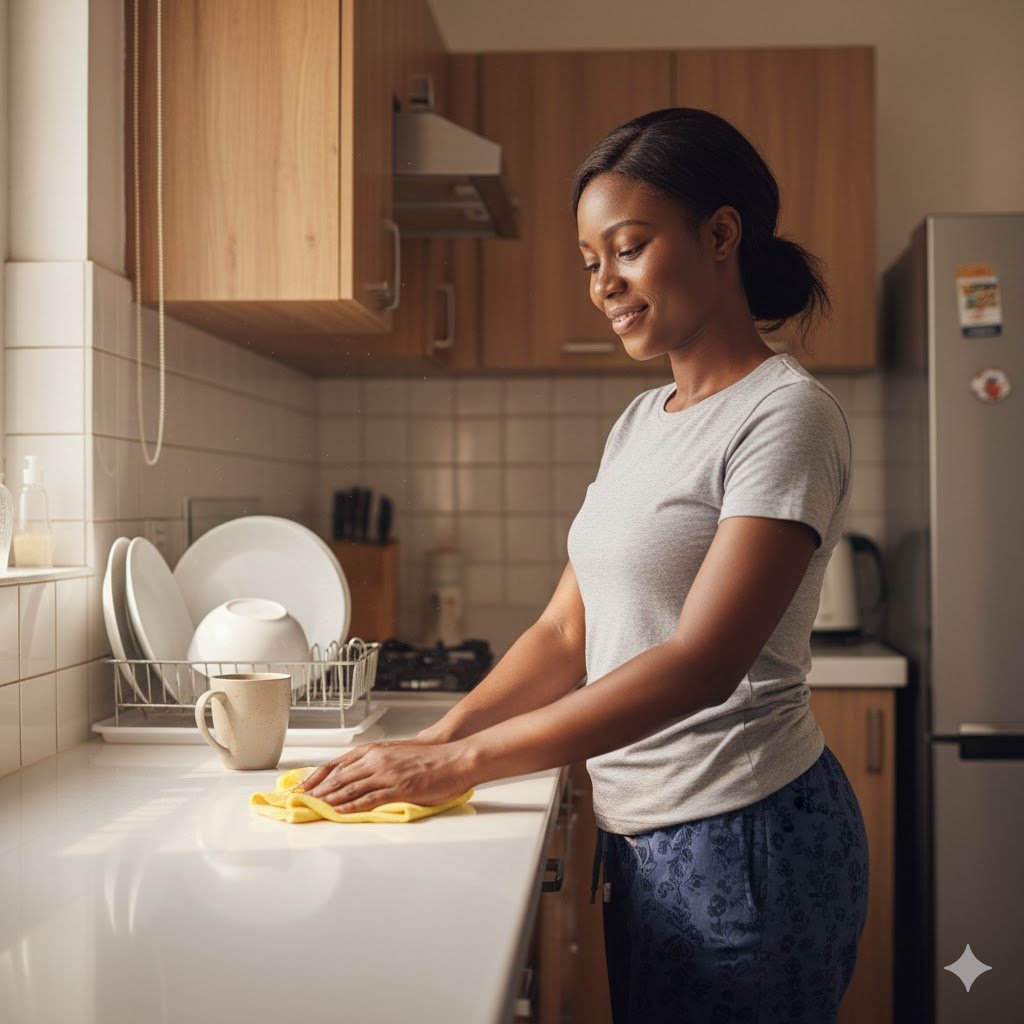
- Kitchen: Wiping the counters and clearing the sink (High Impact).
- Bathroom: Wiping the toilet seat and the mirror (High Impact).
- Bedroom: Making the bed (High Impact).
These tasks take about 30 minutes total but make the house look spotless to the naked eye. According to cleaning efficiency research documented by Clean Corp, focusing on visible high-traffic areas first creates the perception of a completely clean home, even when detailed cleaning hasn’t been done.
Identifying Your 20% High-Impact Tasks
To make this work for you, you need to identify the “20%” in your specific home. Here is a simple guide:
- List every room in your house.
- Circle the areas a guest sees immediately upon entering.
- Identify large flat surfaces (beds, tables, counters).
- Mark tasks that take less than 10 minutes.
Your 80/20 High-Impact Cleaning Table:
| Room | 20% High-Impact Tasks | Time Required | Frequency |
|---|---|---|---|
| Kitchen | Wipe counters, sweep floor, wash dishes | 15 minutes | Daily |
| Living Room | Clear clutter, arrange cushions, quick dust | 10 minutes | Daily |
| Guest Toilet | Wipe sink, toilet rim, mirror | 5 minutes | Daily |
| Bedroom | Make bed, fold visible clothes | 5 minutes | Daily |
| Floors | Sweep main walkways (high traffic areas) | 10 minutes | Daily |
These high-impact tasks are what First Bank of Nigeria identifies as the “important and urgent tasks” that should never be postponed, unlike deep cleaning which can be scheduled strategically.
What are the 7 Stages of Cleaning? (Professional Method Simplified)
If you do want to do a deeper clean on a Saturday, don’t just run around randomly. Professional cleaners use a system to be fast. This is often called the 7 Stages of Cleaning, adapted from professional and healthcare cleaning protocols.
I remember when I first tried the 7-stage method in my Surulere flat. I was skeptical—seven stages sounded like too much work. But once I followed the order, I finished in half the time I usually spent running around confused. The key is not skipping the sequence.
According to professional cleaning protocols documented by commercial cleaning organizations, following these stages sequentially prevents cross-contamination and maximizes efficiency.
Stage 1: Remove Rubbish
Walk through every room with a large trash bag. Empty all the small bins from the bathrooms, bedrooms, and kitchen.
- Nigerian Context: If you separate recyclables for LAWMA or local collectors, do that now. Don’t wipe anything yet—just get the trash out.
- Time: 10 minutes.
Stage 2: Dust High Surfaces First
Gravity is real. Dust falls downward. If you sweep the floor and then clean your ceiling fan, you just dirtied your floor again.
- Nigerian Challenge: Ceiling fans and AC units collect heavy dust here. Use a damp microfiber cloth or a pillowcase over the fan blade to trap the dust so it doesn’t fly everywhere.
- Time: 15-20 minutes per room.
Stage 3: Clean High-Touch Surfaces
These are the spots everyone touches but nobody thinks to clean: light switches, door handles, TV remotes, fridge handles, and the area around the keyhole.
Healthcare cleaning research from the Centers for Disease Control and Prevention emphasizes that cleaning high-touch surfaces prevents disease spread in healthcare settings. This same principle applies to homes, especially in Nigerian households where multiple family members and visitors touch common surfaces daily.
- Time: 10 minutes.
Stage 4: Restock Supplies
Go through the house and replace what is missing. Put a new roll of toilet paper in the bathroom. Refill the hand soap. Put a fresh liner in the bin.
- Nigerian Reality: It’s always good to check your “store” or cupboard to make sure you have backup supplies before Sunday, as shops might be closed or far.
- Time: 5 minutes.
Stage 5: Clean Glass and Mirrors
Wipe down mirrors, glass tables, and windows.
- Best Technique: You don’t need expensive blue liquid. A mixture of water and vinegar with old newspaper is a classic, affordable Nigerian method that leaves glass streak-free.
- Time: 10 minutes.
Stage 6: Dust-Mop or Vacuum Floors
Now that all the dust from the fans and tables has fallen to the floor, it’s time to remove it.
- Nigerian Floors: Most of us have tiles, terrazzo, or concrete. A good soft broom is often better than a vacuum for fine dust. Sweep every room, moving furniture slightly to get the corners.
- Time: 15 minutes.
Stage 7: Damp-Mop Floor Surfaces
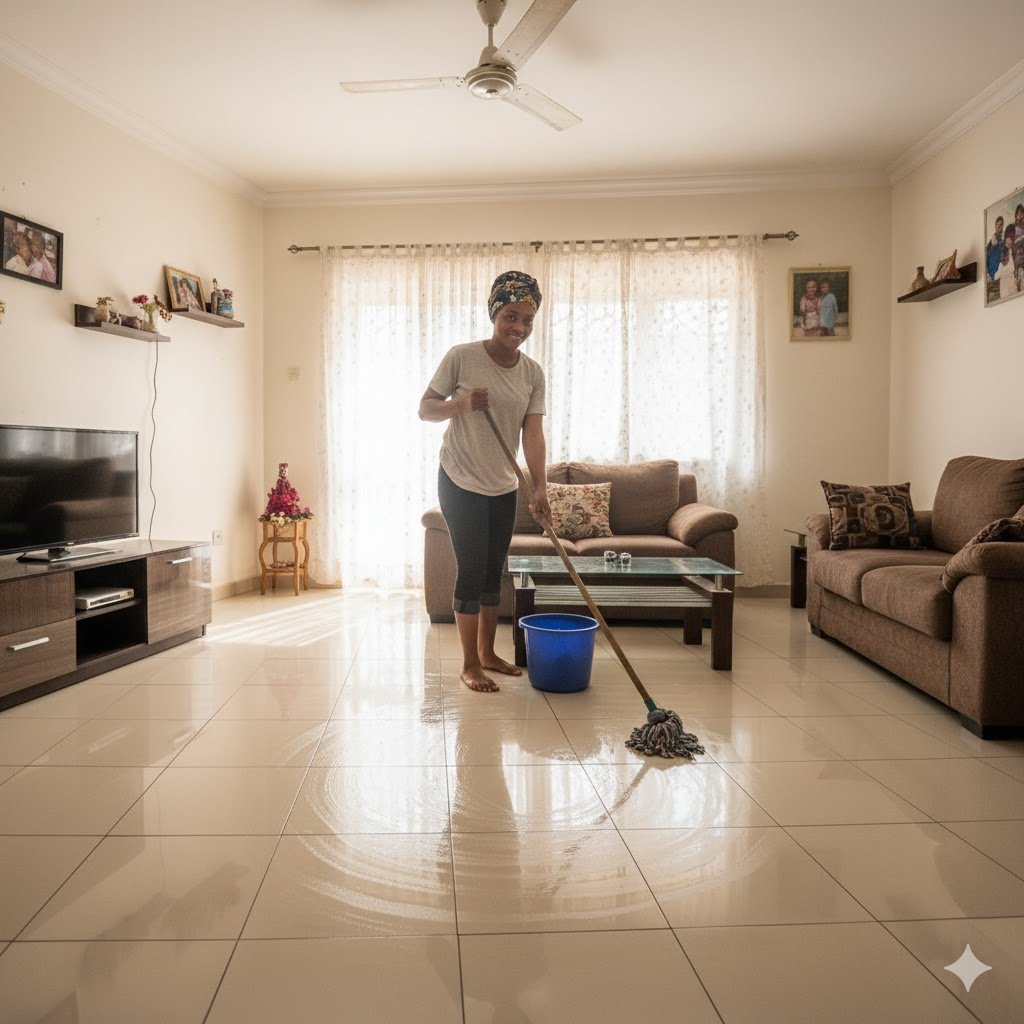
Finally, use a wet mop.
- Technique: Dip the mop, wring it out well (don’t flood the floor), and mop in a figure-8 pattern moving toward the door.
- Tip: If water is scarce, use two buckets—one with soapy water (or water with disinfectant) and one for rinsing the mop.
- Time: 15-20 minutes.
Time-Saving Cleaning Rules Every Busy Nigerian Should Know
When you are trying to figure out how to keep a house clean with a busy schedule, you need rules that prevent thinking. Decisions take energy. Rules are automatic.
What is the 20 Minute Rule in Cleaning?
This is a game-changer for preventing weekend exhaustion.
- The Rule: You dedicate exactly 20 minutes a day to cleaning or organizing—no more, no less.
- Why it works: It’s short enough that you won’t dread it, but long enough to get something done.
- How to use it: Set a timer on your phone. Pick one task (e.g., “Fold the laundry” or “Clean the kitchen”). Go hard for 20 minutes. When the alarm rings, stop.
- Citation: According to cleaning efficiency experts at Sophia’s Cleaning Service, consistent short cleaning sessions prevent the overwhelming accumulation that makes weekend cleaning feel impossible. Their research shows clients who adopted daily 20-minute cleaning sessions reported 80% higher satisfaction with home cleanliness compared to those doing occasional deep cleans.
The 12-12-12 Rule for Decluttering
This is perfect when your house feels “full” of stuff.
- Find 12 items to throw away: Old receipts, empty pure water sachets, broken pens.
- Find 12 items to donate: Clothes your kids outgrew, duplicate kitchen utensils, shoes you haven’t worn in a year.
- Find 12 items to return to their proper place: A book on the dining table, shoes in the parlor, a cup in the bedroom.
- Nigerian Context: We often hold onto things “just in case.” Use the donation pile to bless someone in your community or church.
What is the 1% Rule of Cleaning?
This is about gradual improvement. If you improve your home’s cleanliness by just 1% every day, the compound effect is massive.
- Today: Wipe one window sill.
- Tomorrow: Organize one drawer.
- The Result: You build a habit without feeling the weight of a “big clean.” It’s like saving money; small amounts add up.
The 10-10-10 Rule for Decluttering
This is a faster, lighter version of the 12-12-12 rule.
- 10 items to trash.
- 10 items to donate.
- 10 items to put away.
- Use this when you only have 10 minutes before heading out to work or church.
What is the 6-10 Rule?
Note: While various cleaning rules exist online, the “6-10 rule” isn’t widely documented in professional cleaning research with a specific definition. However, you can adapt this concept for your home:
- The Concept: Focus on 6 main cleaning tasks that must be done, and do them before 10 AM. Or, pick 6 days of maintenance and 10 minutes of deep cleaning daily. Find a rhythm that fits your life in Lagos or Abuja.
The 1/3/5 Decluttering Rule
If you can’t find a strict source for this, here is a practical adaptation for Nigerian homes:
- 1 Major Task: Once a week (e.g., Scrub the shower).
- 3 Medium Tasks: Once a week (e.g., Laundry, mop floors, change sheets).
- 5 Quick Tasks: Daily (e.g., Make bed, wash dishes, wipe counters, sweep kitchen, take out trash).
Your Practical Weekend Cleaning Schedule (Total Time: 3-4 Hours)
According to Nigerian property management experts at Private Property Nigeria, creating structured cleaning schedules and tackling one room at a time to prevent overwhelm—strategies particularly effective for busy professionals.
This schedule aligns with practices recommended by Nigerian professional cleaning services like Squeaky Clean Nigeria, which operates Monday through Saturday and emphasizes that Sunday should remain a rest day for Nigerian families.
Saturday Morning Routine (90 Minutes)

- 7:00 AM – 7:30 AM: The 80/20 Quick Clean
- Open windows for fresh air.
- Make all beds.
- Clear all visible clutter from the living room and dining table.
- Result: The house looks organized immediately.
- 7:30 AM – 9:00 AM: The 7-Stage Deep Clean (Focus Area)
- Don’t deep clean the whole house. Pick one zone (e.g., just the bathrooms and kitchen).
- Follow the 7 stages: Trash, Dust, High-touch, Restock, Glass, Sweep, Mop.
Saturday Afternoon Options
- Option A (Energy High): Do laundry while watching a movie or listening to music.
- Option B (Energy Low): Set a timer for 20 minutes to organize one drawer, then stop and relax.
Sunday Routine (Minimal – 30 Minutes)
Sunday is for rest, church, or family time. Keep it light.
- Evening: Quick 20-minute tidy. Put away the shoes from church.
- Prep: Iron your work clothes for the week so Monday morning isn’t stressful.
Weekly Rotation Calendar: To avoid doing everything at once, rotate your “Deep Clean” focus:
| Week | Saturday Deep Clean Focus | Sunday Prep Focus |
|---|---|---|
| Week 1 | Master Bedroom + Bathrooms | Iron work clothes |
| Week 2 | Kitchen + Dining Area | Meal prep/Clean fridge |
| Week 3 | Living Room + Guest Areas | Organize kids’ school bags |
| Week 4 | Spare Rooms + Storage | 12-12-12 Declutter session |
How Can I Keep My House Clean If I Work Full Time? (Realistic Strategies for Nigerian Professionals)
Working 9-to-5 (which is often 6-to-8 with commute) makes home maintenance tough. Balancing a full-time job with household responsibilities requires effective time management strategies that protect your energy while accomplishing essential tasks.
Nigerian financial services research from First Bank emphasizes that spreading chores over the entire week, rather than piling everything into the weekend, preserves work-life balance and ensures adequate rest time.
Daily Micro-Habits That Prevent Weekend Chaos
- Make the Bed: It takes 2 minutes but sets a productive tone for the day. Learn how to incorporate cleaning into your morning routine to start each day with clarity and order.
- The “One-Touch” Rule: When you take off your work clothes, don’t drop them on the chair. Put them in the hamper or hang them up immediately. Handle it once.
- Evening Reset: Spend 10 minutes before bed resetting the living room. Fold the throw blanket, stack the magazines, and put remote controls away.
The “Clean As You Go” Nigerian Method
This is vital in the kitchen. According to Nigerian cleaning professionals at Palm Cedar Cleaning, cleaning as you go, particularly in the kitchen where wiping countertops and rinsing dishes while cooking prevents overwhelming mess accumulation. Nigerian cooking (stews, soups, frying) can be messy. Having an organized kitchen system makes the ‘clean as you go’ method much easier to maintain during meal preparation.
- Wash the blender immediately after grinding pepper.
- Wash pots while the soup is boiling on low heat.
- Wipe oil splashes immediately before they harden.
- By the time the food is ready, the kitchen should be 90% clean.
Time-Saving Tools for Nigerian Homes
You don’t need a robot vacuum if it’s not in your budget.
- Microfiber Cloths: Palm Cedar Cleaning advises that microfiber cloths are highly effective at trapping dust and dirt, making them essential time-saving tools for Nigerian homes.
- Spray Bottles: Keep one in the bathroom and one in the kitchen.
- Squeegee: If you have a glass shower enclosure, use this after every bath to prevent hard water stains.
Getting Help: The Nigerian Reality
If you can afford it, there is no shame in getting help. It supports the economy and saves your sanity.
Professional cleaning services in Nigeria, such as VisCorner, offer flexible scheduling options including standard routine cleaning, deep cleaning for move-ins, and specialized kitchen sanitation. These services allow busy professionals to outsource heavy cleaning while maintaining daily tidiness themselves.
- Part-time Help: Hiring someone to come in once a week or once a month for the heavy scrubbing (floors, bathrooms) allows you to focus on just the daily maintenance.
- Tech-Enabled Help: Nigerian domestic service providers like Hibil Maid offer laundry pick-up services and reminder systems via Google Calendar or WhatsApp, making professional cleaning support accessible for busy Nigerian professionals.
- Important Note: If you hire help, use the 80/20 rule to direct them. Tell them exactly which areas are most important to you so they don’t spend 3 hours washing the balcony while the kitchen is dirty.
5 Cleaning Mistakes That Waste Your Weekend Time
1. Trying to Deep Clean Everything Every Weekend This is the fastest way to hate cleaning. Use the rotation system we discussed above.
2. Buying Too Many Cleaning Products You don’t need 15 different bottles. In Nigeria, simple solutions work. Bleach (for toilets), a good dish soap (for almost everything else), and a glass cleaner are usually enough.
3. Cleaning Without a System Running from the kitchen to the bedroom and back to the kitchen wastes time. Follow the 7 Stages: finish one task type (like dusting) for the whole house before starting the next (like sweeping).
4. Perfectionism Waiting for the “perfect time” to clean means you never will. A 10-minute clean is better than no clean. Learn science-backed strategies to overcome procrastination and start taking action today.
5. Ignoring Daily Maintenance Leaving everything for Saturday is a mistake. If you skip the daily 15-minute tidy, Saturday becomes a 6-hour punishment.
Special Cleaning Considerations for Nigerian Homes
Professional home cleaners at Kleenol Nigeria emphasize the importance of staying focused on cleaning tasks while eliminating distractions, ensuring maximum efficiency during your designated cleaning time.
Dealing with Harmattan Dust From November to March, dust is the enemy.
- Strategy: Keep windows closed during high-wind times.
- Tip: Don’t dry dust; it just pushes dust into the air. Use a damp cloth to trap the particles.
Rainy Season Challenges
- Strategy: Mud is the issue here. Place a good doormat outside AND inside your main door.
- Tip: Adopt a “no shoes inside” policy. Keep a shoe rack near the door. This cuts down floor cleaning by 50%.
Power Outage Adaptations Don’t rely solely on electric gadgets. Nigerian cleaning professionals like Kleenol recommend scheduling cleaning during afternoon hours when natural light is strongest, particularly important during harmattan season when dust visibility is crucial and power outages may occur.
Affordable Nigerian Cleaning Solutions
- All-Purpose Cleaner: Mix water and vinegar (50/50).
- Disinfectant: Water and bleach (careful with the ratio, follow the bottle instructions).
- Scrubbing: Baking soda is great for scrubbing sinks and baths.
After completing your cleaning routine, discover natural ways to keep your home smelling fresh without expensive air fresheners or harsh chemicals.
How to Stay Consistent (The Real Secret)
Consistency beats intensity. It is better to clean for 20 minutes every day than to clean for 10 hours once a month.
Build Habits Gradually Start with just one rule. Maybe this week, you only try the 20 Minute Rule. Once that feels normal, add the Morning Bed Making habit.
Create Accountability Tell your spouse or roommate about your plan. “Hey, let’s set a timer for 20 minutes and clean up before we watch Netflix.”
Nigerian Motivation Remember, a clean home supports your success. A clean, organized space is one of the most effective ways to reduce stress at home after a demanding work week. You deserve a peaceful environment to rest in.
Frequently Asked Questions
Q: Can the 80/20 rule work in a small one-room self-contain? A: Absolutely! In fact, it works even better because your high-impact 20% is just one space—keeping the bed made, the floor swept, and the kitchenette counter clear.
Q: What if I don’t have help and work until 8 PM daily? A: That’s exactly who this system is for. The 20-minute evening rule and weekend rotation prevent overwhelming Sunday cleaning marathons.
Q: Is it okay to skip cleaning during very busy work weeks? A: Yes! The beauty of the rotation system is that if you miss Week 2’s kitchen deep clean, just maintain the 80/20 daily quick cleans. You can do the kitchen deep clean next month.
Q: How do I clean during rainy season when floors get muddy quickly? A: Place double doormats (one outside, one inside your entrance). Adopt a strict no-shoes policy. Keep a dedicated “wet season” mop near the door for quick spot cleaning. Mop high-traffic areas twice daily during heavy rains.
Q: What if my spouse/roommate doesn’t follow the cleaning routine? A: Start by focusing only on shared spaces. Lead by example for 2-3 weeks. Once they see how manageable the system is, invite them to choose just ONE task they’ll handle (like taking out trash). Build from there gradually.
Q: How much should I pay for part-time cleaning help in Nigeria? A: Rates vary by location. In Lagos, expect ₦15,000-25,000/month for 2-3 days weekly. In Abuja, ₦12,000-20,000. In smaller cities, ₦8,000-15,000. Always discuss expectations clearly and provide cleaning supplies.
Conclusion: Your Action Plan Starting This Weekend
You don’t need to be a superhero to have a clean house. You just need a plan.
Whether you are in a busy Lagos flat, an Abuja duplex, or a Port Harcourt home, keeping a house clean with a busy schedule is absolutely achievable. The secret isn’t working harder—it’s working smarter.
Your Immediate Action Steps:
- Choose ONE rule to start with (I recommend the 20-minute daily rule).
- Identify your 20% high-impact areas (usually the living room and kitchen).
- Try the 7-Stage method this Saturday for just 90 minutes.
Which cleaning rule will you try first? Start with just the 20-minute rule this evening after work. Set your phone timer, pick one room, and experience how much you can accomplish when you focus. Then come back this Saturday morning and try the 7-stage method for just 90 minutes. You’ll be amazed at how your home transforms without consuming your entire weekend.
Remember: A clean home isn’t about perfection—it’s about having a peaceful space where you can rest after conquering Lagos traffic, work deadlines, and life’s daily demands. You deserve that peace.
Progress over perfection. Start small. Stay consistent. Your future self will thank you.

Oladepo Babatunde (Prince Babatee Tunde) is a Computer Scientist, researcher, and professional content writer with a Higher National Diploma in Computer Science from Kwara State Polytechnic, Nigeria.
With a background in technology and a passion for clear communication, Babatunde specializes in creating thoroughly researched, reader-focused content on productivity, personal development, home living, and technology. Every article he writes is backed by extensive research and fact-checking to ensure readers receive accurate, actionable information.
As a freelance writer, he has helped brands and publications deliver content that educates, engages, and empowers their audiences. His mission at Vibena is simple: make complex topics easy to understand and help Nigerians live smarter, more productive lives.