When I moved to a new apartment in Surulere last year, my first electricity bill was ₦47,000 for just three weeks. I knew something was wrong because we barely had 8 hours of light daily, yet I was being charged Band A rates. That moment when you check your prepaid meter and realize your units are just disappearing like water in harmattan? I have been there.
After 3 weeks of follow-ups and submitting my 2-week outage log showing I only received 8-10 hours daily while being charged Band A rates, Ikeja Electric reclassified my account to Band C and credited me ₦12,000 in energy units as compensation for the overbilling.
That experience taught me that knowing how to check your electricity band and how to dispute wrong billing can save you thousands of naira every month. The problem is that most Nigerians do not even know what band they are on, let alone that they can actually challenge incorrect charges.
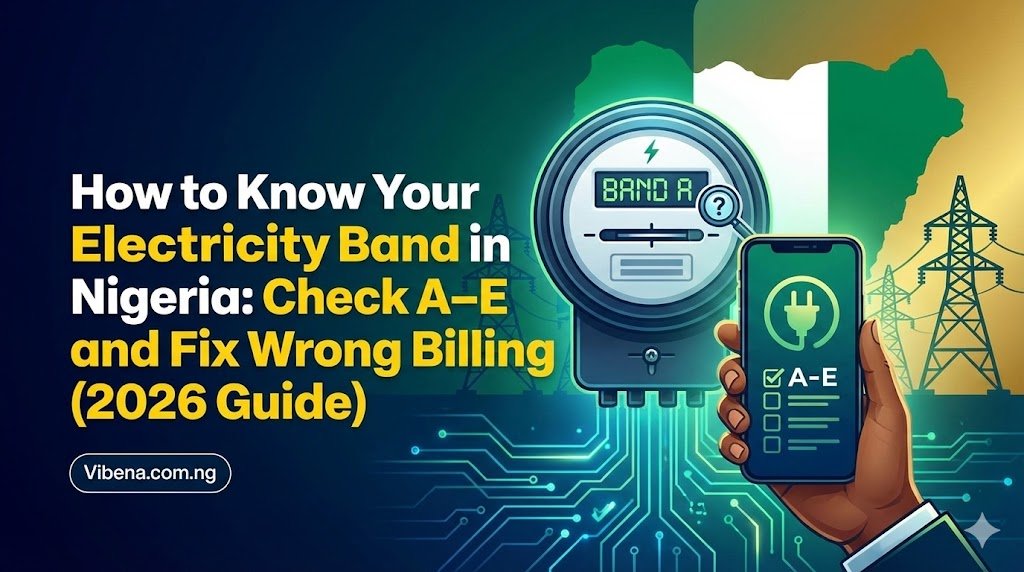
If you have ever wondered “how do I know my electricity band?” or suspected you are being overcharged, this guide covers everything. I will show you exactly how to check your band for every major DisCo in Nigeria, what each band means for your bill, and the step-by-step process to fix wrong billing when your DisCo is charging you more than they should.
Important January 2026 Updates You Should Know
Before we dive in, there are two major developments affecting electricity tariffs in Nigeria right now.
Enugu State: Lower Band A Rates (August 2025)
If you live in Enugu State under MainPower Electricity Distribution Limited, your Band A rate is ₦160/kWh, not the national ₦209.5/kWh. According to Premium Times, the Enugu State Electricity Regulatory Commission (EERC) approved this 23% reduction in August 2025, making Enugu the first state to set independent tariffs under the 2023 Electricity Act.
The EERC Chairperson, Chijioke Okonkwo, explained that the reduction followed a comprehensive review using their Tariff Methodology Regulations 2024. He noted that federal government subsidies on electricity generation costs helped bring the average tariff down. Bands B, C, D, and E rates in Enugu remain frozen at previous levels.
This is significant because other states are watching Enugu’s model. If you live in Enugu, you should be paying less than customers in other states for the same Band A service.
Band B to Band A Migrations in Abuja (January 2026)
According to a recent Arise News report from January 2026, some Band B consumers in Abuja and surrounding areas have been migrated to Band A by AEDC. This migration happens when feeder performance improves to meet Band A standards of 20+ hours daily supply.
If you are an AEDC customer and noticed you are suddenly paying more for electricity units, this migration might be why. AEDC confirmed that any change in tariff regime should be communicated to consumers, though they acknowledged they need to improve how they notify customers of band changes.
The key thing to understand: band changes are feeder-based, not individual. As AEDC explained, “It is a feeder band review, a feeder band improvement, not a customer band improvement. You are tied to the feeder, and when the feeder improves, everybody there enjoys the improved power supply.”
Grid Instability Affects Band Service Delivery (December 2025)
The national grid collapsed on December 29, 2025, at 14:01 hours, causing widespread power disruption across the country. According to the Nigerian Independent System Operator (NISO), power generation dropped from approximately 4,800 megawatts earlier that day to just 139 MW by 3:00 p.m.
The collapse was triggered by the tripping of several generating units and critical 330kV transmission lines. NISO attributed the grid’s fragility to the vandalism of the Lagos-Escravos gas pipeline on December 10, 2025, which had already reduced gas availability to thermal power plants.
Why this matters for your electricity band:
Grid instability directly affects whether your DisCo can deliver the minimum hours promised for your band classification. When the national grid collapses, even Band A customers receiving premium service experience complete blackouts. According to Guardian Nigeria, the power sector crisis has persisted with generation averaging just 3,000 MW despite an installed capacity of over 13,000 MW.
If your DisCo consistently fails to deliver your band’s minimum hours due to grid-level failures, you may have grounds to request reclassification or dispute charges for periods when service was not delivered.
What Are Electricity Bands A, B, C, D, and E in Nigeria?
Before you can check your band, you need to understand what these classifications actually mean. According to the official NERC FAQ page, the Service-Based Tariff (SBT) is a scheme introduced by the Commission on the 1st of November 2020 to improve service delivery to end-user customers and ensure that electricity tariffs paid by end-user customers are a reflection of the services delivered by the Distribution Companies.
In simple terms: you should only pay for the quality of electricity you actually receive.
Here is how the band system works according to NERC:
| Band | Minimum Hours of Light | Maximum Hours | What This Means |
|---|---|---|---|
| Band A | 20 hours | 24 hours | Premium supply, highest tariff |
| Band B | 16 hours | 20 hours | Very good supply |
| Band C | 12 hours | 16 hours | Average supply |
| Band D | 8 hours | 12 hours | Limited supply |
| Band E | 4 hours | 8 hours | Lowest supply, lowest tariff |
The logic is straightforward: if you are getting only 4-8 hours of electricity daily, you should not be paying the same rate as someone enjoying 20+ hours. Yet many Nigerians are being charged Band A rates while receiving Band D or Band E service. This is exactly what happened to me, and it is more common than you think.
Why Your Band Classification Matters
Your electricity band directly affects how much you pay per kilowatt-hour (kWh). According to an official announcement from Ikeja Electric, Band A customers pay ₦209.5 per kWh effective July 1, 2024. That is significantly higher than what Band B through E customers pay.
Here is a breakdown of what different bands cost:
| Band | Rate per kWh | Estimated Monthly Bill (Average Home) |
|---|---|---|
| Band A | ₦209.5 (₦160 in Enugu) | ₦25,000 – ₦45,000 |
| Band B | ~₦68 | ₦10,000 – ₦18,000 |
| Band C | ~₦59 | ₦7,000 – ₦14,000 |
| Band D | ~₦55 | ₦6,000 – ₦11,000 |
| Band E | ~₦51 | ₦5,000 – ₦9,000 |
See the difference? If you are on Band A but only receiving Band C level service, you could be overpaying by ₦15,000 or more every month. Over a year, that is ₦180,000 you should not be spending.
If you are trying to manage your household budget better, understanding your electricity costs is just as important as knowing the cost of living in Lagos.
How to Know Your Electricity Band in Nigeria: All Methods
There are several ways to check which band you are classified under. According to VTpass and official DisCo guidelines, here are the methods available to you.
Method 1: Check Your Prepaid Meter Vending Receipt
This is the easiest method if you have a prepaid meter. Every time you buy electricity units (tokens), the receipt shows your tariff information.
Here is what to look for:
- Buy your electricity units as normal through any vending platform
- Check the receipt or SMS confirmation you receive
- Look for “Tariff” or “Band” information
- The rate per kWh will also indicate your band
If you are paying around ₦209.5 per unit, you are on Band A. If you are paying significantly less (₦50-70 per unit), you are likely on Band B through E.
To be honest, I did not know this until my neighbor pointed it out. I had been buying units for months without ever looking at the tariff details on my receipt.
Method 2: Check Your Monthly Bill or Electricity Statement
According to the NERC FAQ, your electricity tariff is indicated on your electricity bills issued by the DisCo or electricity vending receipts for customers on prepaid meters.
For postpaid meter customers, your monthly bill contains your band classification. Look for:
- The tariff class section
- Rate per kWh charged
- Band designation (sometimes listed as “Customer Class”)
If you cannot find this information clearly stated, that itself is a problem. DisCos are required to display your tariff information on bills.
Method 3: Check Online Through Your DisCo Portal
Most Distribution Companies now have online portals where you can verify your feeder and band information. This is the most reliable method because it shows you the official classification in their system.
I will cover the specific steps for each major DisCo below.
How to Know My Electricity Band on Ikeja Electric (Lagos)
If you live in areas covered by Ikeja Electric, including Ikeja, Ogba, Agege, Ikorodu, Shomolu, and surrounding areas, here is how to check your band according to the VTpass guide:
Step-by-step process:
- Visit the official Ikeja Electric website at www.ikejaelectric.com
- Click on “Customer Service” in the menu
- Select “Customer Feeder Information”
- Click on “Customer Feeder Verification”
- Enter your account number or meter number
- Your band information will display instantly
What you need:
- Your 13-digit account number (found on your bill or meter)
- OR your meter number
What the results show:
- Your feeder name
- Current band classification
- Tariff rate applicable to your area
When I first did this for my Surulere apartment, I discovered I was classified under a Band A feeder even though our area was clearly not receiving 20 hours of electricity. That information gave me the ammunition I needed to file a complaint.
Ikeja Electric Band Check: Common Issues
Some customers report that the online portal does not always work or shows outdated information. If you encounter this:
- Try during off-peak hours (early morning or late evening)
- Clear your browser cache and try again
- Call Ikeja Electric customer service if the portal fails
- Visit a physical customer service center with your meter details
AEDC Band Check: How to Know Your Electricity Band in Abuja
For customers in Abuja, Niger State, Kogi State, and Nasarawa State covered by Abuja Electricity Distribution Company (AEDC), the process is slightly different.
Important January 2026 Update: According to Arise News, AEDC has been migrating some Band B customers to Band A where feeder performance has improved. If you notice you are suddenly paying more for units, this migration might be why. AEDC confirmed that tariffs remain at ₦209.50 per unit for Band A customers, with no unauthorized increases.
Online method:
- Visit the AEDC customer portal
- Log in with your account credentials or register if you have not
- Navigate to “Account Information” or “Tariff Details”
- Your band classification should be displayed
Alternative method for AEDC:
To confirm your current band:
- Check your most recent vending receipt
- Compare the rate per kWh with the official Band A rate of ₦209.5
- If the rate is significantly lower, you are on Band B through E
AEDC has committed to improving customer communication about band changes. They stated they will try to put customers into clusters of their feeders and send text messages to inform them of any changes.
AEDC Band Check for Prepaid Meter Users
If you have a prepaid meter under AEDC:
- Look at your last token purchase receipt
- Divide the total amount paid (minus VAT) by the number of units received
- This gives you your effective rate per kWh
- Compare with band rates to identify your classification
For example: If you paid ₦20,000 and received about 95 units, you are paying roughly ₦210 per unit, which means Band A. If you received 300+ units for the same amount, you are on a lower band.
How to Know Your Electricity Band in Lagos (EKEDC Areas)
Eko Electricity Distribution Company (EKEDC) covers Lagos Island, Victoria Island, Lekki, Ikoyi, Apapa, Festac, and parts of Ogun State.
How to check your EKEDC band:
According to VTpass, EKEDC customers should:
- Visit feederinfo.ekedp.com
- Enter your account number or meter number
- View your feeder classification and band
Recent EKEDC Band Changes:
EKEDC recently downgraded several feeders from Band A to lower bands. Areas affected include:
- Palace Road (Lagos Island): Band A to Band E
- Army Resettlement (Mushin): Band A to Band E
- Badore (Ajah): Band A to Band C
- Chevy View (Lekki): Band A to Band C
- New Yaba (Akoka): Band A to Band C
- NAFDAC Isolo: Band A to Band C
- Beecham (Agbara): Band A to Band C
- Old Niger (Ajele District): Band A to Band C
If you live in any of these areas, your band may have changed and you should now be paying lower rates. However, some customers report still being charged at the old Band A rate even after downgrades. If this is happening to you, you have grounds for a billing dispute.
The power situation in Lagos can be unpredictable, which is why many residents are also exploring backup options like those covered in our solar inverter setup guide for Nigerian flats.
How to Check Electricity Band for Other DisCos
According to VTpass, here is how to check your band for other major Distribution Companies across Nigeria:
PHEDC (Port Harcourt)
Covers Rivers, Bayelsa, Cross River, and Akwa Ibom States.
- Visit the PHEDC customer portal
- Use your account or meter number to check feeder information
- Contact customer service at their official numbers if online check fails
BEDC (Benin)
Covers Edo, Delta, Ondo, and Ekiti States.
- Check through the BEDC online portal
- Visit any BEDC customer service center with your meter details
- Request feeder verification in writing if needed
KEDCO (Kano)
Covers Kano, Katsina, and Jigawa States.
- Use the KEDCO customer portal
- Check your prepaid meter receipt for tariff information
- Visit district offices for in-person verification
IBEDC (Ibadan)
Covers Oyo, Ogun, Osun, and Kwara States.
- Access the IBEDC customer portal
- Enter meter or account number for band verification
- Check vending receipts for current tariff rates
JEDC (Jos)
Covers Plateau, Benue, Bauchi, and Gombe States.
- JEDC has improved their online systems recently
- Check through their customer portal
- Receipt verification remains the most reliable method
YEDC (Yola)
Covers Adamawa, Taraba, and Borno States.
- Online verification may be limited
- Receipt checking and customer service visits are recommended
- Request written confirmation of your band classification
MainPower (Enugu State)
If you are in Enugu State, your electricity is now provided by MainPower Electricity Distribution Limited, which replaced EEDC in October 2024.
Important: MainPower is required by the Enugu State Electricity Regulatory Commission (EERC) to publish daily on its website a rolling seven-day average daily hours of supply on each Band A feeder no later than 9 a.m. of the next day. You can use this information to verify if your band classification matches actual service delivery.
How Many Hours of Light Does Each Band Get?
This is one of the most searched questions, and the answer comes directly from NERC’s Service-Based Tariff order:
Band A: 20 to 24 hours daily This is premium service. If you are classified as Band A, your DisCo is supposed to provide at least 20 hours of electricity every single day. Anything less, and you have grounds to request reclassification or refund.
Band B: 16 to 20 hours daily Still very good service. Band B customers should expect consistent power for most of the day with only brief outages.
Band C: 12 to 16 hours daily This is where most Nigerian urban areas realistically fall. If you are getting about half a day of electricity, Band C is likely your actual service level.
Band D: 8 to 12 hours daily Limited service. Many suburban and semi-rural areas fall into this category.
Band E: 4 to 8 hours daily Lowest tier. If you are only getting a few hours of light each day, you should be on Band E and paying the lowest rates.
The key question you need to ask yourself: Does the number of hours I actually receive match my band classification? If not, you are being overcharged.
For those dealing with unreliable power, having a backup plan is essential. Our guide on how to stay focused during power outages offers practical strategies for staying productive when NEPA takes light.
Current Electricity Tariff Rates by Band (January 2026)
Let me give you the most current tariff information so you can verify if you are being charged correctly.
Band A Rate (National): ₦209.5 per kWh (effective since July 1, 2024)
This rate increased from ₦206.80 to ₦209.5 in July 2024. According to Ikeja Electric’s official announcement, the tariffs for Bands B, C, D, and E remained unchanged during this review.
Band A Rate (Enugu State Only): ₦160 per kWh (effective since August 1, 2025)
If you are in Enugu State under MainPower, you should be paying this lower rate, not the national ₦209.5 rate.
How to calculate if you are being charged correctly:
According to the NERC FAQ, when you divide the amount you vended for your prepaid meter (in Naira) by the number of kWh units indicated on the receipt, you can calculate your tariff. However, the VAT payable as tax should be deducted first.
For prepaid meters:
- Note the amount you paid (e.g., ₦10,000)
- Subtract VAT (7.5%) to get the base amount
- Check the number of units received
- Divide the base amount by units to get your rate per kWh
- Compare with your band’s official rate
Example calculation:
- Amount paid: ₦10,000
- VAT (7.5%): ₦750
- Base amount: ₦9,250
- Units received: 44 units
- Your rate: ₦9,250 ÷ 44 = ₦210.2 per kWh
- This confirms Band A pricing
If your calculation shows you are paying Band A rates but your actual service is Band C level (12-16 hours), you are being overcharged.
What to Do If You Are Billed Wrongly or Overcharged
This is where things get practical. If you have confirmed you are being charged the wrong band rate, here is exactly how to dispute it.
Step 1: Document Everything
Before you contact anyone, gather evidence:
- Screenshot or photograph your meter showing current reading
- Keep all recent vending receipts or bills
- Document actual hours of electricity received (keep a log for at least one week)
- Take photos of any unusual charges
- Note your account number, meter number, and feeder information
I cannot stress this enough: documentation is everything. When I disputed my billing, having two weeks of written records showing I only received 8-10 hours of light daily while being charged Band A rates made my case undeniable.
Step 2: Report to Your DisCo Customer Service
According to VTpass guidelines, you should report supply issues to your DisCo’s customer service immediately and request a meter readjustment or investigation.
Start with your Distribution Company:
- Visit the nearest customer service center OR
- Call their customer service hotline OR
- Submit a complaint through their online portal OR
- Send a formal letter detailing your complaint
What to include in your complaint:
- Your full name and contact details
- Account number and meter number
- Specific dates and amounts of disputed charges
- Evidence that your actual service does not match your band
- Request for investigation and adjustment
Important: Get a complaint reference number or ticket. This proves you reported the issue and helps with escalation if needed.
Step 3: Escalate to NERC If DisCo Does Not Resolve
According to the NERC FAQ, if your DisCo fails to deliver on the approved minimum hours of supply, the Commission will evaluate the DisCo’s performance over a period of 60 days. Upon verification by the Commission, the rates payable by all customers in that cluster (area) will be adjusted in line with the quality of service delivered over the period.
How to report to NERC:
- Visit NERC’s website and use their complaint portal
- Email your complaint with all documentation
- Call NERC’s consumer affairs helpline
- Visit NERC’s office in Abuja if necessary
NERC has the power to:
- Order DisCos to refund overcharges
- Mandate band reclassification
- Fine DisCos for consistent service failures
- Adjust rates for entire feeders if service does not match classification
Step 4: Request Band Reclassification
According to the NERC FAQ, if your community wants better service under SBT, you should write a formal letter to the DisCo detailing the challenge of service quality in the area and follow up with engagement on the issue. The Commission may be copied in the letter with a view to facilitating the service objectives of the community.
To request reclassification:
- Write a formal letter to your DisCo
- Copy NERC in the letter
- Include evidence of actual supply hours vs band classification
- Request investigation and reclassification
- Follow up regularly until you get a response
Special Protection for Enugu Customers
If you are in Enugu State, you have additional protections. According to Premium Times, the EERC has put strict monitoring requirements on MainPower:
- Where MainPower fails to deliver on the committed level of service on a Band A feeder for two consecutive days, MainPower must report this to the commission within 24 hours
- Where MainPower fails to meet the committed service level to a Band A feeder for seven consecutive days, the feeder shall be automatically downgraded to the recorded level of supply
This automatic downgrade provision is stronger than what exists at the federal level and gives Enugu customers more protection against paying for service they do not receive.
How to Know If Your Meter Is Working Correctly
Sometimes the problem is not your band but your meter itself. A faulty meter can record usage incorrectly, leading to inflated bills.
Signs Your Meter Might Be Faulty
- Units depleting unusually fast even with minimal appliance use
- Meter display showing errors or unusual codes
- Reading increasing even when no appliances are on
- Significant discrepancy between estimated usage and actual billing
Common Meter Error Codes
88888 on display: This typically indicates a meter fault or communication error. Contact your DisCo immediately for inspection.
Blank screen: Could indicate power supply issue to the meter or complete meter failure.
Stuck numbers: If the display is not changing despite electricity usage, the meter may be faulty.
How to Request a Meter Test
You have the right to request that your DisCo test your meter. Here is the process:
- Submit a written request for meter testing
- The DisCo should schedule an inspection within a reasonable timeframe
- If the meter is found faulty, it should be replaced at no cost to you
- If your meter was over-recording, you may be entitled to a refund or credit
Why Units Seem to Finish Faster
According to AEDC’s explanation in a recent Arise News interview, there are several reasons why your units might seem to deplete faster than expected:
- Seasonal changes in weather leading to more load usage
- Holiday periods when children are home from school and using more electricity
- Appliances left on unknowingly (heaters, TVs, fans)
- Increased activity in the home
Before assuming your meter is faulty, consider whether your actual electricity usage has increased. However, if you are confident your usage has not changed significantly, request a meter inspection.
Prepaid vs Postpaid Meter Differences
Prepaid meters:
- You buy units in advance
- Easier to track consumption
- No estimated billing surprises
- You control your spending
Postpaid meters:
- Billed based on consumption after the fact
- Subject to estimated billing if meter is not read
- Can lead to billing disputes more easily
- Recommended to switch to prepaid if possible
If you are still on estimated billing without a proper meter, you are more vulnerable to overcharging. According to the NERC FAQ, the Commission has issued a Capping order since 2020 that ensures unmetered customers will be billed in a transparent manner that puts them at par with their metered counterparts in their area.
2026 Free Meter Program: What You Need to Know
NERC has approved funds for free meters under the Meter Acquisition Fund (MAF) program. This is part of efforts to eliminate estimated billing across Nigeria.
Who Qualifies for Free Meters
Priority is given to:
- Band A customers who are currently unmetered
- Band B customers in urban areas
- Customers who have been on estimated billing for extended periods
How to Apply
- Contact your DisCo and express interest in the metering program
- Register through your DisCo’s customer portal if available
- Provide required documentation (ID, proof of address, account details)
- Wait for installation scheduling
10 Working Days Rule
According to the NERC FAQ, if you have paid for a meter under the MAP regulation and you are not metered within 10 working days, you should report the matter directly to NERC. This gives you leverage if your DisCo delays meter installation.
Reality check: While the program exists, meter distribution has been slow. Many Nigerians have waited months or even years for promised meters. However, having your application on file strengthens your position if you need to dispute estimated billing.
Managing your home efficiently goes beyond just electricity. If you are looking to optimize your living space, our guide on how to furnish a mini flat in Nigeria for under 500k can help you make smart choices.
How to Read Your Electric Meter Yourself
Understanding how to read your own meter helps you verify DisCo readings and catch errors early.
Reading a Digital Prepaid Meter
- Look at the display screen
- The main number shows your current credit balance (in kWh or Naira)
- Press the display button to cycle through readings
- Note the total units consumed (kWh)
- Compare with your purchase records
Reading an Analog Meter
- Read the dials from left to right
- Note each dial’s position (some rotate clockwise, others counterclockwise)
- If a dial is between numbers, use the lower number
- Record the full reading
- Subtract previous reading from current reading to get consumption
Keeping Your Own Records
I strongly recommend keeping a simple log:
- Date
- Meter reading
- Hours of electricity that day (estimate)
- Any unusual events (power surges, extended outages)
This log becomes invaluable evidence if you ever need to dispute billing or request band reclassification.
How to Check Your Electricity Token Balance
If you have a prepaid meter and want to check your remaining balance without buying new units:
- Press the designated button on your meter (usually marked “Balance” or a specific key sequence)
- The display will show your remaining units
- Some meters also show estimated days remaining based on usage patterns
Different meter brands have different key sequences for checking balance. Consult your meter’s manual or ask your DisCo for specific instructions for your meter model.
Why DisCos Might Classify You Wrongly
Understanding why classification errors happen can help you spot and address them.
Common Reasons for Wrong Band Classification
Feeder-level classification: According to AEDC, your band is tied to your feeder, not your individual meter. As they explained, “You are tied to a transformer that is tied to the feeder that is tied to either the injection substation or the transmitting station. It is all about the feeder.”
Delayed updates: When infrastructure changes happen, it can take months for billing systems to reflect new realities.
System errors: Database mistakes can put customers on wrong tariffs.
Deliberate migration without notice: As seen with the recent Band B to Band A migrations in Abuja, DisCos sometimes migrate customers without proper notification.
Recent Band Changes (January 2026)
Based on recent developments:
EKEDC downgrades:
- Palace Road (Lagos Island): Band A to Band E
- Army Resettlement (Mushin): Band A to Band E
- Badore (Ajah): Band A to Band C
- Chevy View (Lekki): Band A to Band C
- New Yaba (Akoka): Band A to Band C
- NAFDAC Isolo: Band A to Band C
- Beecham (Agbara): Band A to Band C
- Old Niger (Ajele District): Band A to Band C
AEDC upgrades:
- Some Band B areas in Abuja have been migrated to Band A where feeder performance improved
If you live in any of these areas, check your recent bills to ensure the rate change has been applied correctly.
Protecting Yourself From Future Billing Problems
Prevention is better than cure. Here are strategies to avoid billing headaches:
Get a Prepaid Meter
If you are still on postpaid or estimated billing, request a prepaid meter. Yes, the wait can be long, but prepaid meters give you control and eliminate estimated billing surprises.
Check Every Receipt
Make it a habit to review your vending receipt or bill every single time. According to AEDC, details like Value Added Tax should be scrutinized in your calculations. Look for:
- Rate per kWh
- Total units received
- Any unusual charges
- VAT calculation
Know Your Feeder
Find out which feeder serves your area and monitor its official classification. If your feeder gets downgraded, your rates should decrease.
Join Community Groups
Many areas have WhatsApp or Facebook groups where residents share electricity information. These groups often catch classification errors quickly because multiple residents notice the same issues.
Document Outages
Keep a log of electricity outages in your area. This documentation can support reclassification requests if your service quality does not match your band.
For those working from home, unreliable power can seriously impact productivity. Consider checking our remote work in Nigeria essential gadgets guide for backup power solutions.
Frequently Asked Questions
How many units is ₦20,000 on a prepaid meter?
This depends entirely on your band. For Band A at ₦209.5/kWh, ₦20,000 gives you approximately 95 units (after VAT deduction). For Band B at around ₦68/kWh, the same amount would give you roughly 280 units. For Band C at around ₦59/kWh, you would get approximately 320 units. This is why knowing your band matters so much for budgeting.
Can my electricity band change?
According to VTpass, your band typically does not change unless there is an official declaration from the government. However, as seen with recent AEDC migrations, your band can change if your feeder’s performance improves or declines. You should be notified of any changes, though DisCos have acknowledged they need to improve communication on this.
What does 88888 mean on my electric meter?
The display code 88888 usually indicates a meter error or fault. This could mean communication failure, hardware malfunction, or tampering detection. Contact your DisCo immediately for inspection. Do not attempt to fix it yourself as this could be interpreted as tampering.
How can I read my electric meter myself?
For digital meters, press the display button to cycle through readings and note the kWh consumed. For analog meters, read the dials from left to right, using the lower number when a dial is between two numbers. Keep regular records to verify DisCo readings.
Is my electric meter broken if units disappear fast?
Not necessarily. According to AEDC, fast unit depletion could be due to seasonal changes (weather requiring more cooling/heating), children home from school using more electricity, appliances left on unknowingly, or increased household activity. However, if you are confident your usage has not changed significantly, request a meter test to rule out faults.
How do I check my electricity meter number?
Your meter number is usually printed on the meter itself, on a label or plate. It is also on your vending receipts, bills, and account documentation from your DisCo. If you cannot find it, contact your DisCo with your address and account details.
Can I be billed more than my neighbors on the same transformer?
According to NERC’s Capping Order, unmetered customers should not be billed more than metered customers on the same feeder. The Commission has published the caps for all feeders to ensure transparency. If you suspect this is happening, gather evidence (compare bills with neighbors) and file a complaint with your DisCo, copying NERC.
Why am I getting fewer units than before for the same amount?
If you are a Band B customer who was migrated to Band A (as has happened recently in Abuja), you would now be paying ₦209.5/kWh instead of approximately ₦68/kWh, resulting in significantly fewer units for the same money. Check your vending receipt for your current tariff rate. If you were migrated but are not receiving Band A level service (20+ hours daily), you can dispute this with your DisCo.
Final Thoughts
Knowing how to check your electricity band in Nigeria is not just about curiosity. It is about protecting yourself from overcharges that can drain your finances month after month. The band system exists to ensure you only pay for the service you actually receive, but it only works if you understand it and hold your DisCo accountable.
Start by checking your band today using the methods I have outlined. If you discover you are being charged the wrong rate, do not accept it. Document everything, report to your DisCo, and escalate to NERC if necessary. Many Nigerians have successfully gotten refunds and reclassifications by following this process.
The electricity situation in Nigeria is challenging enough without paying more than you should. Take control of your electricity costs by knowing your band, monitoring your consumption, and speaking up when something is wrong.
For more tips on managing your Nigerian home efficiently, check out our guides on generator room organization and how to cool down a hot house without AC.

Oladepo Babatunde (Prince Babatee Tunde) is a Computer Scientist, researcher, and professional content writer with a Higher National Diploma in Computer Science from Kwara State Polytechnic, Nigeria.
With a background in technology and a passion for clear communication, Babatunde specializes in creating thoroughly researched, reader-focused content on productivity, personal development, home living, and technology. Every article he writes is backed by extensive research and fact-checking to ensure readers receive accurate, actionable information.
As a freelance writer, he has helped brands and publications deliver content that educates, engages, and empowers their audiences. His mission at Vibena is simple: make complex topics easy to understand and help Nigerians live smarter, more productive lives.