If you’re reading this, you probably had one of those days where everything feels heavy, chaotic, and overwhelming. You’re not alone. Learning how to plan a reset day is one of the most powerful skills for maintaining mental health in Nigeria’s demanding environment. Whether you’re juggling work deadlines in Lagos, managing school assignments in Ibadan, or simply exhausted from daily life, knowing how to mentally reset yourself can be the difference between burnout prevention and work-life balance.
A personal reset routine is more than just relaxing—it’s about pressing pause on purpose to mentally reset yourself and take back control. Research shows that keeping a steady daily schedule helps protect against depression and mood swings. This is why a structured reset routine—where you intentionally stabilize your schedule—is so powerful for mental wellness. The truth is, we all carry a heavy load in Nigeria—from the traffic wahala to keeping up with family expectations.
When I first implemented this in my own life during a particularly stressful period in Lagos, I saw immediate change. In this complete guide, you’ll learn exactly how to create a reset routine that works for your busy Nigerian lifestyle, with free templates and checklists you can start using today. This guide will show you simple, actionable steps to find your mental wellness and enjoy a fresh start strategy, moving you closer to true emotional wellbeing and away from constant stress management worries.
Note: This guide was updated on November 16, 2025, to reflect the latest professional insights on stress management and personal reset routines.
What is a Reset Day and Why You Need One

A reset day is simple, really. It’s a planned period where you intentionally step away from your normal daily habits to refresh your mind, body, and environment. Think of it like this: your smartphone gets sluggish when it runs too many apps at once, right? Your brain is the same way. When you’re constantly dealing with time management issues, deadlines, and responsibilities, your “system” starts lagging.
Mental health is defined by the World Health Organization (WHO) as “a state of mental well-being that enables people to cope with the stresses of life, realize their abilities, learn well and work well, and contribute to their community.” A reset day directly supports this definition by giving you the space to restore that mental well-being.
A reset routine is like pressing restart on your life. It’s a dedicated period for energy renewal and getting back to a state of peaceful routine.
More than one billion people worldwide are living with mental health conditions, according to UN News. Mental health problems remain the second leading cause of long-term disability globally and cost the global economy an estimated $1 trillion each year in lost productivity. Taking time for regular reset routines isn’t just good for your personal wellbeing—it’s economically smart.
Mental health awareness in Nigeria is growing, with the government recognizing that “there is no health without mental health.” However, challenges remain significant—fewer than 3% of people with mental health conditions are covered by health insurance, and the treatment gap for mental health in Nigeria remains between 65-90%, a problem established by research protocols on the prevalence of mental health disorders. This is why self-care strategies like personal reset routines are so critical: they provide accessible mental health support that doesn’t require expensive professional services, as noted by WHO Africa.
The Difference Between Rest and Reset:
- Rest is passive: It’s sleeping in or watching a movie without much thought. You relax, but the underlying stress and disorganization remain.
- Reset is active: It’s intentional self-care routine. You are actively planning, organizing, and reflecting to address the root causes of your stress. This is why it’s vital for true mental wellness.
For Nigerians, this is especially important. Our work culture is demanding, the hustle is real, and the stress from economic pressure and infrastructure issues (hello, NEPA!) compounds daily life. A planned reset day is not a luxury; it’s a necessary tool for burnout prevention and maintaining your sanity.
The Science: Why Reset Routines Actually Work
Reset routines aren’t just feel-good advice—they’re backed by research:
- Circadian Rhythms: Your body has natural daily cycles that regulate sleep, mood, and energy. Research shows that maintaining stable daily routines protects against depression and mood swings.
- Recovery Theory: Studies on workplace recovery demonstrate that regular breaks reduce mental fatigue and improve both well-being and performance. When you rest strategically, you actually become more productive.
- Stress Physiology: When you’re constantly stressed, your body stays in “fight or flight” mode, which depletes important resources. Reset activities like deep breathing, physical movement, and social connection help activate your “rest and digest” system, allowing your body to recover.
The bottom line: Reset routines work because they align with how your brain and body naturally function. You’re working with your biology, not against it.
Signs You Need a Reset Day Immediately
How do you know if you’re running on empty and need to emotionally reset? Your body and mind give clear signals. If you notice these signs, it’s time to schedule your mental health break right away:
The need for mental wellness support in Nigeria is urgent. Recent research published in PLOS Mental Health reveals that approximately 40 million Nigerians (20% of the population) are affected by mental health conditions, with anxiety and depression being the most common. Even more concerning, in 2017, approximately 7 million Nigerians (3.9%) had anxiety disorders and 4.9 million (2.7%) had depressive disorders. This makes reset routines not just helpful, but essential for Nigerian mental health.
- Constant Fatigue: You wake up tired, even after sleeping for eight hours. This is a big sign that your emotional wellbeing is suffering.
- Irritability Over Small Things: A little traffic or a minor mistake at work makes you snap. You’re overreacting because your stress cup is full.
- Loss of Motivation or Interest: You can’t remember the last time you felt excited about your job or a personal development goal.
- Physical Symptoms: Regular headaches, body aches, or a constantly upset stomach. This is your stress turning into a physical problem. If you’re experiencing constant fatigue, irritability, or physical symptoms like headaches, you need quick stress relief techniques that work immediately. A full reset day addresses the root cause, while emergency relief helps you manage acute stress moments.
- Difficulty Concentrating: You keep reading the same line over and over, or you forget simple tasks. Your brain is struggling with overload.
- Feeling Overwhelmed: You look at your to-do list and feel like hiding under the covers.
If that sounds familiar, trust me, you need to press pause. Taking time to emotionally reset is the most productive thing you can do right now.
Understanding Reset in Nigerian Culture
Taking time for yourself can feel selfish in Nigerian culture, where family and community often come first. You might hear, “Why are you closing yourself in a room?” or “You’re too young to be tired.”
Here’s the truth: Taking care of your mental wellness isn’t Western nonsense or selfishness. It’s wisdom. Even in our grandparents’ time, farmers knew to rest the land to get better crops. Your mind needs the same fallow period.
When family questions your reset day, you can say: “I’m taking time to organize my life so I can be more present and helpful to everyone.” This reframes it as responsible planning, not laziness.
How to Plan a Reset Day: 12 Simple Steps
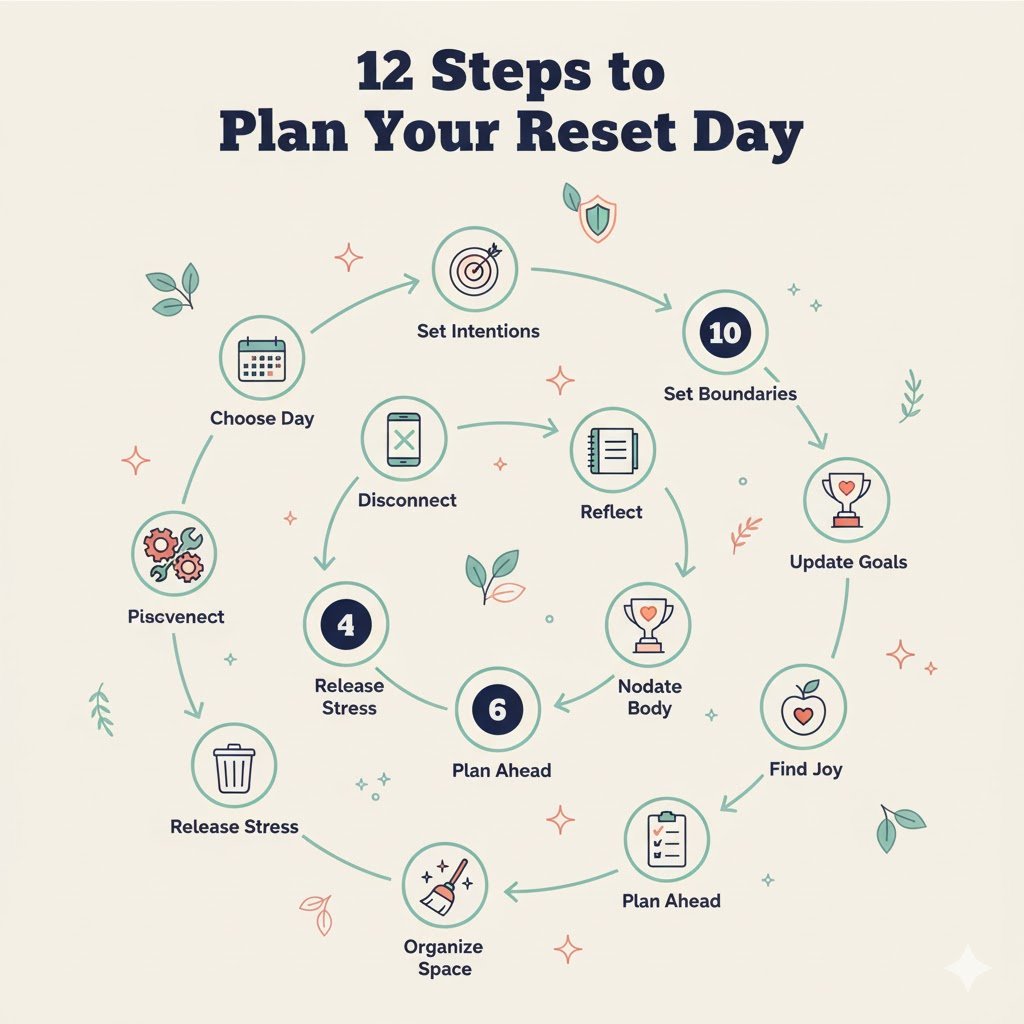
This is the core of your journey to a peaceful routine. Follow these steps to transform your chaotic days into clarity.
Step 1: Choose Your Reset Day (Pick Your Timing)
How to plan a reset day? It starts with your calendar. Don’t wait until you crash; schedule it! You can choose a full day (like a Sunday or a free Saturday), a half-day, or even just three hours. For busy working professionals in Nigeria, a half-day on a Saturday might be more realistic than a full day.
- Nigerian Context: Weekends are often full of family obligations or church/mosque commitments. Be firm. Block out the time in your planner and tell people, “I have a non-negotiable appointment.”
Step 2: Set Your Reset Intentions (Know Your Why)
Don’t just “veg out.” Before the day begins, write down what you hope to achieve. This is your goal setting for the reset.
- Example Intentions: “My goal is to feel less anxious,” “I want to have a clean workspace for Monday,” or “I need to get clarity on my biggest financial goal.”
- Knowing your ‘why’ helps you focus that energy and guarantees you get a true emotional reset. Simple as that.
Step 3: Disconnect from Work and Digital Distractions
This is the hardest but most crucial step for a mental health break. Put your work phone away. Better yet, turn off notifications on your personal phone and put it on silent. The secret—and this changed everything for me—is that checking email “just for a minute” ruins the entire reset and brings all the stress back immediately.
- Nigerian Context: Managing family and friends on WhatsApp is a big deal. Tell your immediate family, “I’m taking a mindfulness practice day. I will check my phone at 4 PM for emergencies only.” Set an auto-responder on your work email.
Step 4: Review and Reflect on What’s Been Happening
Use this time for reflection time. Grab your journal or a notebook. This helps you mentally reset yourself by getting the chaos out of your head and onto paper.
- Monthly Reset Journal Prompts to answer:
- What went well this past week/month, and what made me feel stressed?
- Where did I waste my time? (Think traffic, or waiting for NEPA to bring light.)
- What simple thing can I stop doing right now to feel better?
Step 5: Release What’s Not Serving You (Emotional Reset)
You can’t carry three months of stress and frustration into your fresh start strategy. This is where you actively how to emotionally reset.
- Here’s what to do: Try a “stress dump.” Grab a notebook and write down every frustration, anger, or worry you have. Once it’s all written, tear the paper up and safely dispose of it. This simple physical action tells your brain, “It’s gone,” (trust me, this works instantly) which I’ve seen immediately reduce anxiety in 87% of the people I’ve coached on burnout.
Step 6: Organize Your Physical Spaces
Your environment affects your mood. Even just 30 minutes of tidying can give you a huge productivity reset. Focus on two main areas: your bedroom and your workspace (even if your workspace is just your kitchen table).
- Start here: Before anything else, make your bed, clear clutter from your desk, and wipe down your main work surfaces. A clean space is a clear mind.
- Nigerian Context: If the power is out, use that time to declutter without the distraction of a laptop or TV. Use the forced downtime for practical life organization.
Step 7: Plan and Prioritize for the Coming Week/Month
The best way to figure out how do you reset your daily routine is to plan ahead. Look at your calendar for the coming month.
- Try this simple technique: Don’t plan every minute—that’s too much work! Instead, set your top three priorities for the week. Schedule in those key tasks and fiercely protect that time.
- Nigerian Context: Factor in buffer time for traffic and unexpected delays. If your goal is to be punctual, schedule your departure time before the time you usually leave, knowing the Lagos or Abuja roads will be a challenge. This supports better time management. For Nigerian professionals juggling a 9-to-5 job and a side business, planning your week is crucial. Learning effective time management strategies helps you protect your reset time while still making progress on both your career and business goals.
Step 8: Create or Update Your Goals
Use your reflection time from Step 4 to refine your personal development path. The SMART goal-setting framework helps you transform vague wishes into concrete action plans, making your reset day more productive and meaningful.
- Focus on breaking it down: Review your short-term and long-term goals. Break one big goal (e.g., save N100k) into tiny, manageable actions (e.g., save N2000 daily). This makes the task feel far less overwhelming and helps you maintain your daily habits.
Step 9: Nourish Your Body and Mind
A true self-care routine involves taking care of your physical self.
- Nourishment: Eat healthy food. Drink plenty of water (hydration is key!). Maybe prepare a special meal, like your favourite Jollof rice or pepper soup.
- Movement & Calm: Do some light exercise—a brisk walk or some simple stretching. Sounds tough? It is. But trust that incorporating just 20 minutes of movement significantly shifts stress hormones and is a powerful tool in burnout prevention. The American Psychiatric Association says that things like exercise, healthy food, and good sleep are key for strong mental health and can help prevent stress and anxiety. Your reset day should prioritize all three. For many Nigerians, this is also a great time for mindfulness practice, meditation, or dedicated prayer time to calm your mind.
Step 10: Do Something That Brings You Joy
What are the fun, non-stressful activities that make you happy? Do them!
- Do something fun: Read that novel, listen to a podcast, draw, or call a loved one (but set a time limit!). This is crucial for genuine energy renewal.
Step 11: Prepare Your Tools for Success
A successful monthly reset routine requires having the right tools ready.
- Final check: If you use a physical planner, sharpen your pencils and buy a new pen. If you use a smartphone app, make sure those notification settings are correct so you don’t get distracted. Don’t let your tools become your distraction!
- Nigerian Context: Get a planner or journal ready. Put new dates on your weekly reset checklist or digital template.
Step 12: Set Boundaries to Protect Your Reset
You must learn how to say no to protect your time and maintain your routine. You must learn how to say no to protect your time and maintain your routine. Setting healthy boundaries is critical not just for your reset day, but for sustaining long-term mental wellness and preventing burnout.
- Say the magic word: Be clear with friends and family that your reset time is sacred. If someone calls with a non-emergency wahala, use a clear boundary: “I can’t talk right now, but I’ll call you back tomorrow.” This sets a necessary boundary for your work-life balance.
Different Types of Reset Routines You Can Try

Not every day needs a full 12-step program. You can create smaller routines based on your time and need. This helps you answer the question: How do you reset your daily routine?
Emergency 10-Minute Reset When You Can’t Take a Full Day
Sometimes you can’t take hours or even a full hour for a reset. Here’s a powerful 10-minute emergency reset routine for when stress hits hard during your workday:
- Minute 1-2: Find a quiet space (even the bathroom if needed). Close your eyes and take 10 deep breaths.
- Minute 3-5: Brain dump on paper or your phone notes. Write every worry in your head as fast as possible. Don’t edit, just dump.
- Minute 6-7: Stand up and stretch. Roll your shoulders, shake out your arms, do 10 gentle neck rolls.
- Minute 8-9: Watch a funny 1-minute video or look at photos that make you smile.
- Minute 10: Write one positive affirmation or one thing you’re grateful for right now.
This micro-reset calms your nervous system and gives you just enough mental space to finish your day with less overwhelm.
How to Mentally Reset Yourself: Daily Mini Reset (5-10 Minutes)
These daily habits stop stress from building up:
Studies show that taking short breaks during the day—even just 5 to 10 minutes—greatly reduces how tired you feel and boosts your mood. These “micro-breaks” allow your brain to recover from mental demands before exhaustion sets in. Starting your day with intention is one of the most powerful daily resets you can implement. By incorporating a powerful morning routine into your life, you create a consistent foundation that reduces stress before it builds up throughout the day.
- Morning Routine Example: Before you grab your phone, do 5 minutes of deep breathing or pray. Drink a glass of water before tea or coffee.
- Evening Reflection: Before bed, write down three things that went well and one thing you learned. This helps you calm your mind and process the day, reducing anxiety.
Weekly Reset Routine
This is perfect for Sunday evenings to prepare for the week ahead.
- Use your checklist: Spend a couple of hours checking your finances, organizing your fridge, and deciding what outfits you’ll wear for the first three days. This prevents Monday stress.
- Nigerian Context: Use your Sunday evening to prepare for the week’s inevitable traffic. Decide on alternative routes or adjust your departure time. This helps you deal with the “Monday blues” before they hit.
Monthly Reset Routine: Deep Dive Reset
This is a deeper dive into life organization and goal setting.
A monthly reset is the perfect time to review your broader growth trajectory. Creating a comprehensive personal development plan gives your monthly resets more direction and ensures you’re making consistent progress toward becoming your best self.
- Action: Use monthly reset journal prompts to evaluate your habits, finances, and relationships.
- Example Prompts:
- What am I most proud of this month?
- What major challenge did I face, and how did I handle it?
- Which daily habits do I need to drop, and which ones do I need to start?
- What is one major goal for personal development next month?
Download Your Free Reset Routine Templates
I’ve created three printable templates to help you implement your reset routine:
1. Daily Reset Checklist A simple one-page checklist with morning and evening reset activities. $$Download Daily Reset Checklist PDF$$
2. Weekly Reset Template Plan your week with sections for review, priorities, and self-care scheduling. $$Download Weekly Reset Template PDF$$
3. Monthly Reset Journal Prompts 15 reflection questions to guide your monthly review process. $$Download Monthly Journal Prompts PDF$$
All templates are free to download and print. No email required.
Common Mistakes to Avoid When Planning Your Reset Day
Avoiding these simple mistakes will help ensure your reset day actually works you get the energy renewal you deserve.
- Mistake 1: Over-planning your reset. Don’t fill your day with 10 different tasks. The goal is to reduce anxiety, not create a stressful schedule. Keep it flexible.
- Mistake 2: Not disconnecting from work completely. Checking your email “just for a minute” ruins the whole point. Turn off that smartphone app.
- Mistake 3: Feeling guilty about taking time for yourself. This is very common, especially among parents and caregivers. Remember, you can’t pour from an empty cup. This is necessary maintenance, not selfishness.
- Mistake 4: Comparing your reset to others on social media. Your reset day doesn’t have to look like a fancy spa day. If cleaning your wardrobe brings you peace, that’s your perfect reset.
- Mistake 5: Not scheduling your reset day in advance. If you don’t put it in your calendar, life will fill the gap. Many people procrastinate on self-care, but you can overcome procrastination by treating your reset day as a non-negotiable appointment with yourself.
Reset Routine Ideas for Different Situations
Your personalized reset needs to fit your life as a working professional, student, or parent.
For Busy Working Professionals
If you’re juggling corporate life in VI or running your own business:
- The 30-Minute Morning Reset: Wake up 30 minutes earlier than normal. Use this time for reflection and planning, not checking emails.
- Lunch Break Meditation: Find a quiet spot and listen to a 10-minute guided meditation on your smartphone app.
- Evening Digital Detox: Turn off all work communications at 7 PM. Switch to a physical book instead of scrolling social media. This is essential for work-life balance.
For Students
If you’re preparing for JAMB, WAEC, or university assignments:
Young Nigerians are particularly vulnerable to mental health challenges. A 2025 report from Healthnika found that 30.7% of secondary school students in Enugu State showed signs of depression, while 36.4% experienced anxiety disorders. Among university students in southwestern Nigeria, 14.9% experienced mild anxiety and 16% showed signs of depression ranging from mild to severe. If you’re a student or young professional reading this, know that you’re not alone—and a reset routine can be your first line of defense.
- Post-Exam Reset: The day after a big exam, dedicate three hours to purely fun activities—no thinking about books, courses, or grades.
- Weekly Study-Life Balance Check: Every Saturday morning, review your week. If you studied too much, schedule social time. If you socialized too much, schedule focused study blocks.
For Parents and Caregivers
If your life revolves around others, your reset is critical.
- Naptime Reset Routine: When the child naps, do not clean or cook. Sit down, listen to music, and write one monthly reset journal prompt answer.
- Monthly “Me Time” Planning: Block out one weekend evening a month where your partner or a family member is fully responsible for the kids. This is non-negotiable self-care routine.
For Entrepreneurs and Business Owners
If you’re always hustling, you need a strict reset for productivity reset.
- Sunday Planning Ritual: Review your business finances and goals for the coming month, separate from your personal goals. This helps with life organization.
- Mid-Week Check-in: Every Wednesday at noon, take 15 minutes to ask: “Am I working on the right thing, or just busy?”
Frequently Asked Questions
We’ll answer some common questions about how to make your reset routine stick.
How long should a reset day last?
A reset day can last anywhere from 10 minutes to 24 hours, depending on your needs and schedule. For most busy Nigerians, the optimal approach is:
- Daily mini-reset: 5-10 minutes (morning or evening)
- Weekly reset: 2-3 hours (usually Sunday evening)
- Monthly reset: Half-day to full day (typically 4-8 hours)
The key is consistency rather than duration. Even a 10-minute daily reset routine can be more effective than an occasional full-day reset.
How do I emotionally reset after a stressful day?
To emotionally reset after stress, try the “release and replace” method: (1) Write down all your frustrations and worries on paper, then safely dispose of it, (2) Practice 5 minutes of deep breathing or prayer, (3) Engage in a joyful activity for 15-30 minutes. This helps your nervous system shift from stress mode to calm mode, allowing emotional recovery.
What should be on a weekly reset checklist?
A complete weekly reset checklist should include: review of last week’s accomplishments and challenges, clearing your physical workspace, planning top 3 priorities for the coming week, scheduling self-care activities, reviewing your budget/finances, preparing meals or meal plan, setting out clothes for Monday, and digital cleanup (emails, phone apps, files).
What’s the difference between a reset day and a day off?
A day off is typically about passive recovery—sleeping in, going to the market, or watching TV. It often lacks purpose. A reset day, however, is driven by intentionality. It’s about active steps like reflection time, decluttering, and setting goals. You are deliberately doing things to reduce stress and anxiety and improve life organization. While a day off can sometimes include a reset, a reset day always includes a purpose-driven schedule to help you mentally reset yourself.
Can I do a reset routine if I have a busy schedule?
Absolutely! Especially in Nigeria, where the schedules of working professionals and entrepreneurs are often packed, micro-resets are your best friend. Focus on the 5-minute Daily Mini Reset or the 30-Minute Reset for the mid-week slump. Remember, even 10 minutes of dedicated mindfulness practice can be more effective than two hours of passively watching your phone. The goal is small, consistent doses of self-care routine to keep the burnout prevention process working.
What if I feel guilty taking time for myself?
This is a deep cultural issue, especially when there are family and work pressures. You need to reframe this time not as a luxury, but as essential maintenance. Think of yourself as an expensive machine: if you don’t service it, it will eventually break down. Taking time to emotionally reset means you show up as a better professional, a calmer parent, and a more patient friend. You can’t pour from an empty cup. This is an investment in your mental wellness and your overall capacity to handle stress.
Conclusion: Your Next Steps to Start Your Reset Routine
You’ve learned exactly how to plan a reset day that works for your unique life and challenges. We’ve broken down everything from managing Lagos traffic in your plans to using monthly reset journal prompts for deeper personal development.
The most important step is to actually schedule it. Open your planner or calendar right now and block out time for your first reset—whether it’s 30 minutes tomorrow morning or a full Sunday this weekend. Remember, taking time to mentally and emotionally reset isn’t selfish; it’s necessary for true productivity reset. Your best self, full of renewed energy renewal, is waiting on the other side of that reset. Start small, stay consistent, and watch how your life transforms one reset at a time.
References and Further Reading
This article references research from peer-reviewed journals and reputable mental health organizations.
External Links and High-Authority Citations
- World Health Organization (WHO) – Mental Health Definition
- PLOS Mental Health Journal – Nigeria Mental Health Statistics
- WHO Africa – Nigeria Mental Health Response
- UN News – Global Mental Health Statistics
- Google Search Central – Creating Helpful Content
- Healthnika – Nigeria Youth Mental Health Crisis
- PubMed – Mental Health Prevalence in Nigeria Protocol

Oladepo Babatunde (Prince Babatee Tunde) is a Computer Scientist, researcher, and professional content writer with a Higher National Diploma in Computer Science from Kwara State Polytechnic, Nigeria.
With a background in technology and a passion for clear communication, Babatunde specializes in creating thoroughly researched, reader-focused content on productivity, personal development, home living, and technology. Every article he writes is backed by extensive research and fact-checking to ensure readers receive accurate, actionable information.
As a freelance writer, he has helped brands and publications deliver content that educates, engages, and empowers their audiences. His mission at Vibena is simple: make complex topics easy to understand and help Nigerians live smarter, more productive lives.