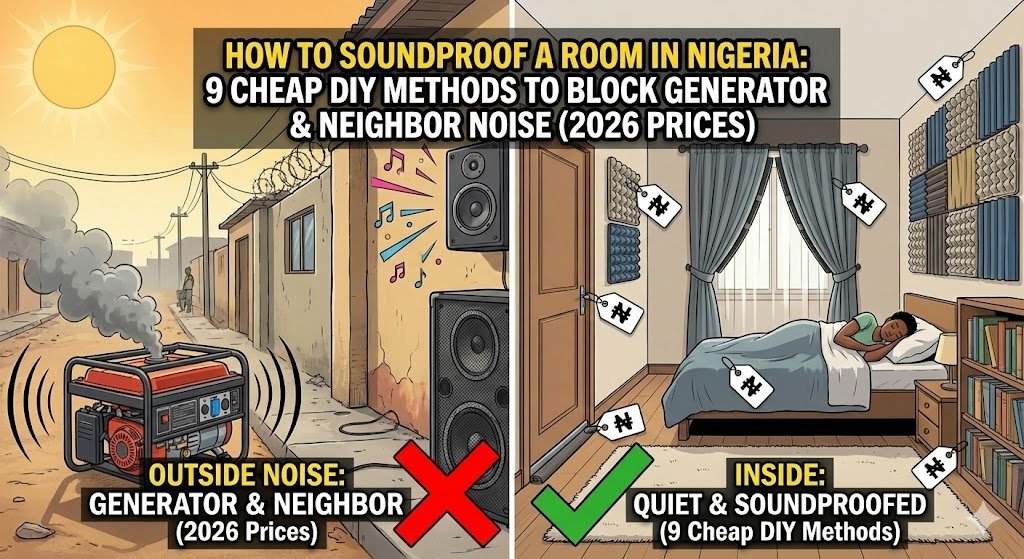
I live in a Lagos compound where my neighbor runs a “I better pass my neighbor” generator from 6 PM until midnight every single day. If you live in Nigeria, you know exactly what that sounds like—a constant, rattling headache that makes it impossible to sleep or study.
For two years, I tried everything. I stuffed old clothes under my door. I bought expensive “soundproof” curtains from an online vendor that promised silence but did absolutely nothing. After spending over ₦100,000 on solutions that failed, I finally sat down to research the science of sound. (For a long-term solution, you might also consider switching to solar power to eliminate generator noise entirely.)
I realized I was doing it all wrong. I was trying to absorb sound when I needed to block it.
As a Computer Scientist and researcher, I decided to test local materials found right here in our markets—from Ladipo to Alaba. In this guide, I will show you what actually works to soundproof a room in Nigeria without wasting money. If you are currently looking for a new place, sound is one of those hidden costs when apartment hunting in Lagos you don’t realize until you move in. Whether you are asking, “How do I stop noise coming through my walls?” or just want a peaceful night’s sleep, these 9 cheap DIY methods will help you reclaim your quiet.
My Testing Results: The Numbers Don’t Lie
I didn’t just guess—I measured. Using a standard Decibel Meter app on my phone, here is the difference these methods made in my room:
- Before: 78 dB (Loud street traffic level / Shouting conversation)
- After (Method 1 + 2): 52 dB (Quiet office / Moderate rainfall)
- The Result: The noise didn’t disappear completely, but it went from “unbearable” to “background hum” that I could easily sleep through.
Know Your Rights: Is your neighbor breaking the law? According to NESREA’s National Environmental (Noise Standards and Control) Regulations, residential areas in Nigeria should not exceed 55 dB during the day and 45 dB at night.
Lagos State has intensified enforcement on this, with LASEPA receiving over 1,600 noise complaints in 18 months alone, according to reports. Construction hours are also restricted to 7 AM – 6 PM to reduce daytime disturbance.
This isn’t just Lagos—Edo State is now requiring religious centers and event halls to soundproof or face closure within 90 days. Ogun State sanctioned 175 noise polluters in 2024 alone. If your neighbor refuses to cooperate, you have legal options: under Nigerian tort law, you can sue for nuisance and potentially obtain an injunction or compensation.
Why Soundproofing a Room in Nigeria Is Different from Western Methods
Most of the advice you find on Google is written for people in the UK or US. They’re usually trying to block out distant traffic or loud music.
The Nigerian reality is different.
We’re dealing with generators and high-decibel religious activities. In fact, LASEPA reports that nearly 66% of noise pollution in Lagos comes from religious organizations, followed closely by generators and clubs. Generator noise is specifically tricky because it produces two types of sound:
- Airborne Noise: The loud “racket” you hear through the air.
- Structure-Borne Noise (Vibration): The vibration that travels through the ground and up your walls, especially if the generator is sitting on the concrete floor of your compound.
When choosing a generator, NESREA regulations typically limit urban daytime noise to 60-70 dBA, with stricter nighttime limits (see compliance guide). But since many neighbors use older models, the noise levels are often much higher.
Western solutions like “double-glazed windows” are fantastic. But let’s be honest, they cost hundreds of thousands of Naira. Also, in our tropical climate, we need ventilation. When I first tried the standard “close your windows tight” advice without a plan, my room became an oven within 30 minutes. If ventilation is your concern, check out our guide on how to cool down a hot house without AC.
You need solutions that handle the heat, block the vibration, and fit a Nigerian budget.
Sound Absorption vs. Sound Blocking: What Actually Works?
Before you buy a single sheet of foam, you need to understand this rule. It’s the number one reason people fail at soundproofing.
- Sound Absorption (Soft materials like foam, rugs, curtains) reduces echo INSIDE the room. It makes the audio inside your room sound better, but it does not stop noise from entering.
- Sound Blocking (Heavy, dense materials like wood, brick, rubber) prevents noise from passing through walls.
The Hard Truth: Don’t try to substitute acoustic foam for actual soundproofing materials. Foam panels are not a noise-blocking product—they only reduce echo inside a room. If your neighbor is playing loud Afrobeats, foam might help a little. If they are running a diesel generator, foam alone is useless.
To effectively reduce generator noise in room environments, you need a mix of both.
Quick Comparison: What Should You Buy?
| Method | What It Does | Best For | Cost Range (2026) |
|---|---|---|---|
| Acoustic Foam (Professional) | Absorbs echo | Recording, studying | ₦66,931 (5-piece set) |
| Acoustic Underlay | Dampens vibration | Floor/Carpet padding | ₦8,500 (20m²) |
| Mass (Plywood/Wood) | Blocks noise | Generator/Neighbor noise | ₦6,000 – ₦25,000 |
| Sealing Gaps | Stops air leaks | All noise types | ₦500 – ₦2,000 |
| Soft Surfaces | Reduces echo | General comfort | ₦0 – ₦5,000 |
How to Soundproof a Room in Nigeria: 9 Cheapest Ways
Here are the practical steps I used to quiet my room, ranked from cheapest to most advanced.
Method 1: Seal Gaps to Soundproof a Room in Nigeria (₦500 – ₦2,000)
Best for: Immediate noise reduction on a tight budget.
“How do I stop noise coming through my door?” If air can get in, sound can get in. The bottom of the door is almost always the number one weak spot in Nigerian homes.
How to do it:
- The Light Test: Close your door and turn off your room light. Ask someone to shine a torch from the outside. Anywhere you see light, sound is leaking in.
- Get Rubber Seals: Go to a market like Ladipo (or any hardware store) and ask for “rubber weatherstripping” or car door rubber seals.
- Clean and Stick: Clean your door frame and stick the rubber seal around the edges where the door closes.
- The Door Sweep: For the big gap at the bottom, buy a “door sweep” or attach a thick strip of rubber that drags slightly on the floor when the door closes.
My Experience: I bought a pack of rubber door seal from Ladipo for ₦800. It took 20 minutes to install and immediately reduced the generator noise by about 30%. It also keeps mosquitoes out!
Method 2: Create a DIY Window Plug (₦3,000 – ₦8,000)
Best for: Sleeping hours when you have a fan/AC.
“How can I soundproof my window cheaply?” Glass is thin and lets sound through easily. A window plug is a removable panel that covers your window opening.
Materials Needed:
- 2-inch thick foam (or scraps from a foam mattress).
- A piece of plywood or hard cardboard.
- Handles (optional).
How to do it:
- Measure your window frame exactly.
- Cut the plywood to fit snugly inside the frame.
- Glue the foam onto the plywood.
- Push it into the window frame when the noise starts (like at night).
- Important: Remove it when the generator stops so you can get fresh air. A good rechargeable fan inside the room helps maintain airflow while the plug is in.
Method 3: The “Soft Surfaces” Rule for Immediate Results
Best for: Reducing that “hollow” room sound.
“Why does my room echo so much?” A room with tiled floors and cement walls echoes, making every noise louder. You need to “deaden” the room. This is a key part of smart one-bedroom apartment design where comfort is everything.
What to use:
- Thick Curtains: Forget blinds. Use heavy fabric.
- Rugs: Cover those tiles with a center rug.
- Nigerian Tip: I use Ankara fabric layered over my curtain rods. I folded the Ankara three times to make it thick. It adds mass without looking like I’m trying to build a bunker.
Method 4: DIY Acoustic Panels Lagos: How to Make Soundproof Panels from Foam Scraps (₦2,000-₦5,000)
Best for: YouTubers, Podcasters, and Students.
Real acoustic panels are expensive. You can make your own DIY acoustic panels in Lagos easily.
Sounds complicated? It’s actually easier than you think.
Step-by-Step:
- Go to a foam seller (Ojota or Alaba have plenty). Buy “mattress scraps” or high-density foam. Ensure it is at least 2 inches thick.
- Cut them into 2ft x 2ft squares.
- Wrap them in breathable fabric (Ankara or cotton works great) using glue or staples.
- Hang them on the wall opposite where the noise is coming from.
Method 5: Reduce Generator Vibration with Anti-Vibration Mats
Best for: Stopping the floor from shaking.
“How do I stop my floor from vibrating?” If the generator is in your compound, the vibration travels through the concrete. You need to “decouple” the generator from the ground. If the generator is in your compound, proper generator room organization can also help reduce noise transmission.
The Solution:
- Old Tyres: The cheapest method. Put the generator on top of an old car tyre.
- Rubber Mats: Buy thick industrial rubber mats from tyre sellers.
- Sand Bag: Place the generator on a flat bag of sand.
Note: You might need to convince your neighbor to do this. I told my neighbor, “Oga, this will help your generator last longer because it won’t shake so much.” He agreed, and my room instantly felt calmer. This is one of the most effective ways to reduce generator noise in room settings located on the ground floor.
Method 6: Strategic Furniture Placement
Best for: Shared walls with noisy neighbors.
“Can furniture block sound?” Yes! If you share a wall with a noisy neighbor, use your furniture as a shield. Need furniture ideas? Our guide on how to furnish a mini flat for under ₦500k includes budget-friendly options that double as sound barriers. If you are working from home, this is crucial when trying to set up a home office in a bedroom.
How to do it:
- Identify the wall the noise is coming from.
- Move your heaviest wardrobe or bookshelf against that wall.
- Fill the wardrobe with clothes and the bookshelf with books.
- The mass of the furniture + the contents will help block noise coming through walls.
How Do I Block Noise on a Shared Wall?
If moving furniture isn’t enough to block noise on a shared wall, you need to add more mass directly to it.
- Double Drywall: If you can, add a layer of drywall over the existing wall using “Green Glue” (or a generic damping compound) in between.
- The Bookshelf Trick: As mentioned, a floor-to-ceiling bookshelf filled completely with books acts like a second thick wall. It captures sound before it reaches your ears.
Method 7: Seal Electrical Outlets and Switches
Best for: Finishing touches.
In many Nigerian buildings, the hole cut for the electrical socket is bigger than the socket itself, leaving gaps inside the wall.
- Unscrew the faceplate of your socket (safely!).
- If you see gaps around the box, fill them with caulk or even candle wax if you are on a strict budget.
- Screw the cover back on.
Method 8: The Plywood Barrier Method (For Extreme Cases)
Best for: Dealing with a generator right outside your window.
If the generator is directly facing your window, you need to deflect the sound waves.
- Buy a sheet of plywood (approx ₦6,000 – ₦12,000).
- Lean it against the wall or build a simple stand outside your window.
- The wood acts as a shield, bouncing the sound away from your glass.
Method 9: The Generator Enclosure Solution
Best for: Compounds that cooperate.
This is the most effective method but requires effort. Building a box for the generator can reduce noise by over 50%. If building a box seems too stressful, this might be the sign to look into a solar inverter setup to stop using the generator altogether.
Warning: You MUST allow for ventilation.
- Build a box using plywood and line the inside with foam.
- Leave a large vent for the exhaust and an intake for fresh air.
- If possible, add a small fan to push hot air out.
- Do not close the generator in completely, or it will overheat and spoil.
How to Soundproof a Room That Is Already Built (Without Construction)
A common question I get is, “Prince, my house is already built and painted, I can’t break walls.” If you are renting or just want to avoid construction work, you have options.
The key here is focusing on weak points rather than the walls themselves. In a finished Nigerian house, noise rarely comes through the concrete blocks; it comes through the “holes” we leave for doors, windows, and AC units.
Temporary vs. Permanent Solutions Comparison
| Feature | Temporary Solutions (Renters) | Permanent Solutions (Owners) |
|---|---|---|
| Installation | Non-invasive, hangs on hooks or uses velcro | requires drilling, gluing, or construction |
| Cost | Low (₦2,000 – ₦15,000) | High (₦50,000+) |
| Best For | Students, Tenants, Temporary Offices | Home Owners, Recording Studios |
| Examples | Window plugs, Heavy curtains, Door sweeps | Mass Loaded Vinyl in walls, Acoustic plaster, Double glazing |
| Removal | Takes 5 minutes, leaves no marks | Difficult, requires repairs |
If you are in a rented apartment, stick to Method 1 (Sealing), Method 2 (Window Plugs), and Method 6 (Furniture). These give you the best results without angering your landlord.
Want Professional Solutions? (Commercial Options)
If DIY isn’t cutting it and you have the budget, you might be asking, “Are there professional soundproofing products in Nigeria?” The answer is yes.
Professional soundproofing involves installing acoustic insulation materials within wall cavities, such as mineral wool or foam panels, to absorb sound vibrations, while mass-loaded vinyl (MLV) sheets block sound transmission (see details at MMT Acoustix).
For those who want guaranteed results, brands like MMT Acoustix offer specialized products now available in the Nigerian market:
- SoundBlanket®: These are heavy-duty mass loaded vinyl (MLV) sound isolators perfect for hanging over windows or doors to block airborne noise.
- BassBloc®: Low-frequency absorbers that help trap the deep “boom-boom” noise from diesel generators that standard foam misses.
- Wall Soundproofing Pads: With NRC (Noise Reduction Coefficient) ratings up to 3.20, these are far superior to standard foam for critical studio work.
While these cost significantly more than the DIY methods above, they offer commercial-grade silence for home offices or studios.
Soundproof Foam Price Nigeria 2026 & Where to Buy
Knowing what to buy is half the battle; knowing where to buy it saves you money.
Prices for acoustic foam in Nigeria vary widely—studio-grade sound isolation pads can retail for around ₦75,573 on platforms like Jumia, though DIY alternatives cost significantly less.
Here is the current soundproof foam price Nigeria market breakdown:
| Material | Location | Estimated Price (2026) |
|---|---|---|
| Rubber Door Seals | Ladipo Market / Auto Parts Stores | ₦500 – ₦1,500 |
| Acoustic Polyolefin Foam | Construction Markets (Floors Nigeria) | ₦8,500 (20m²) |
| Acoustic Foam Panels (Professional) | Specialized Audio Stores / MMT Acoustix | ₦66,931 (5-piece set) |
| Plywood (4x8ft) | Local Timber Markets | ₦6,000 – ₦12,000 |
| Rubber Mats | Roadside Tyre Sellers | ₦1,000 – ₦3,000 |
| Thick Curtains | Balogun Market / Tejuosho | ₦5,000 – ₦15,000 |
Personal Tip: When buying foam in Ojota, always negotiate. The first price is never the final price.
What Are Common Soundproofing Mistakes Nigerians Make?
I made these mistakes so you don’t have to.
- Using Egg Cartons: Please, stop collecting egg crates. They are flammable, attract cockroaches, and do zero work for sound blocking. They barely even help with echo.
- Blocking Ventilation: Never seal your room so tight that you have no air, especially if you use a gas cooker or kerosene stove nearby. Safety first.
- Buying Thin Foam: If the foam is light and you can see through it, it won’t stop a generator. You need density.
- Expecting 100% Silence: Unless you build a concrete bunker, you won’t get total silence. The goal is to reduce the noise from “unbearable” to “background hum.”
How Much Does It Cost to Soundproof a Room in Nigeria?
Here is a realistic budget breakdown for 2026:
- The “Student” Budget (₦3,000 – ₦8,000): Door seals, window gaps, moving furniture, hanging thick blankets/curtains.
- The “Standard” Budget (₦20,000 – ₦40,000): All the above + DIY mattress foam panels, plywood window plug, and rubber mats for the generator.
- The “Oga” Budget (₦150,000+): Professional MMT Acoustix SoundBlankets, heavy barrier curtains, and paying a carpenter to build a custom generator enclosure.
Quiet Room Tips for Students: How to Study in Peace
If you are preparing for JAMB or WAEC in a noisy compound, here are my quiet room tips for students:
- Double Protection: Wear noise-canceling earbuds (or cheap foam earplugs from a pharmacy) AND treat your room.
- The Study Corner: Create a “bunker” in the corner of the room furthest from the window.
- White Noise: Download a “White Noise” app on your phone. Playing the sound of rain or a fan can actually mask the inconsistent noise of a generator/neighbors, helping you focus.
If you’re preparing for JAMB or WAEC, you’ll also want to read our guide on how to stay focused during power outages and discover productivity apps that work offline.
Frequently Asked Questions (FAQ)
Q: How do I cheaply soundproof my room?
Start with the free and low-cost methods: seal all door and window gaps with rubber strips (₦500-1,500), rearrange furniture so heavy pieces face the noisy wall, and add soft surfaces like thick curtains and rugs. These three steps alone can reduce noise by 20-40% without buying any specialized materials. Finally, remember that a quiet room is essential to relieve stress quickly at home, so even small changes matter.
Q: What materials block sound the best?
If you are asking what materials block sound, the answer is always mass and density.
Mass Loaded Vinyl (MLV): The gold standard. Heavy, flexible, and thin.
Drywall (Plasterboard): Multiple layers of 5/8-inch drywall work wonders.
Concrete/Brick: The reason Nigerian houses are better than American wooden houses for sound—if the windows are sealed!
Solid Wood: Heavy plywood is better than MDF.
Q: How to make a room 100% soundproof?
I will be honest: You cannot make a room 100% soundproof without spending millions to build a “room within a room” floating on rubber isolators with zero air supply (which would suffocate you). Even professional recording studios costing ₦50 million+ are not literally 100% soundproof against a jet engine. Your goal should be “sound reduction” to a comfortable level, not total silence.
Q: How can I reduce generator noise in room environments specifically?
Focus on the path of the noise. If the generator is on the ground, use anti-vibration mats (Method 5). If it’s airborne noise coming through the window, use a window plug (Method 2). Addressing both vibration and air leaks is the only way to effectively reduce generator noise in room spaces.
Did you find this guide helpful? Have you tried using egg crates and realized they didn’t work? Let me know in the comments below!

Oladepo Babatunde (Prince Babatee Tunde) is a Computer Scientist, researcher, and professional content writer with a Higher National Diploma in Computer Science from Kwara State Polytechnic, Nigeria.
With a background in technology and a passion for clear communication, Babatunde specializes in creating thoroughly researched, reader-focused content on productivity, personal development, home living, and technology. Every article he writes is backed by extensive research and fact-checking to ensure readers receive accurate, actionable information.
As a freelance writer, he has helped brands and publications deliver content that educates, engages, and empowers their audiences. His mission at Vibena is simple: make complex topics easy to understand and help Nigerians live smarter, more productive lives.