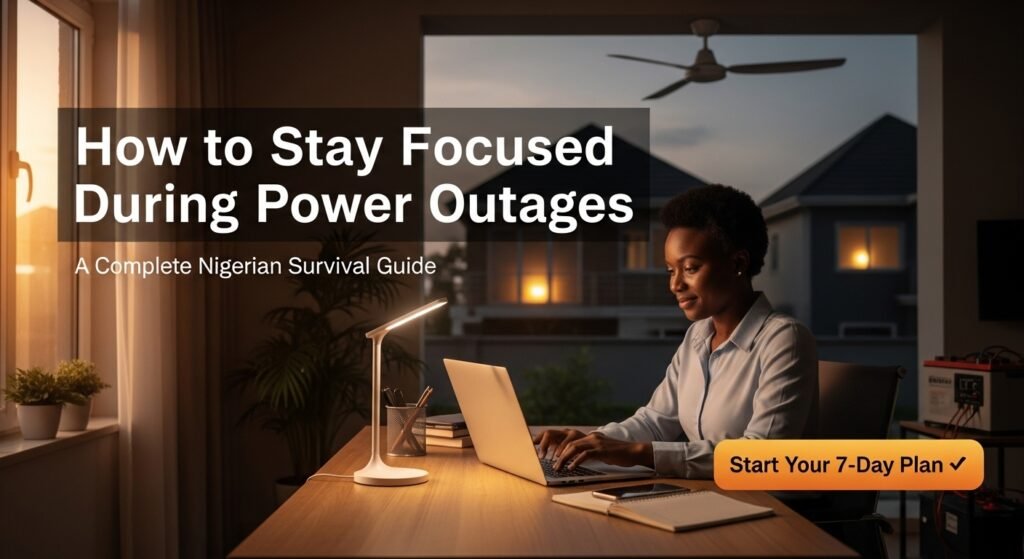
You are deep in work, maybe on an important video call or rushing to meet a deadline. Suddenly, your laptop screen goes black, the fan stops spinning, and the sudden silence is broken only by the sound of your neighbour’s generator starting. NEPA has struck again, and that all-too-familiar frustration sets in.
This is a daily reality for us in Nigeria. Power outages, or “NEPA wahala,” are more than just an inconvenience; they are a major block to our productivity, our work, and our studies. Nigeria’s national grid collapsed to just 50 megawatts on December 29, 2025, leaving nine out of eleven Distribution Companies with zero electricity allocation according to The Guardian Nigeria.
But what if you could change how you respond to this reality? What if you could learn how to stay focused during power outages and get your work done anyway?
This guide is your complete plan. It is not just about “managing”; it is about thriving. My name is Babatunde Oladepo, and as someone who has managed a remote team across Lagos and Abuja for years, I have personally tested every strategy in this guide. We will show you practical steps and smart solutions to keep your focus and stay productive, even when the power is gone.
Latest Power Sector Developments (January 2026)
The Nigerian power sector enters 2026 with government promises of transformation amid continued infrastructure challenges.
December 2025 Grid Collapse
The most recent catastrophic failure occurred on December 29, 2025:
- National grid collapsed to just 50MW total distribution
- Nine of eleven DisCos received zero allocation
- Only Ibadan (30MW) and Abuja (20MW) maintained supply
- Full restoration took nearly four hours
January 2026 Government Commitments
According to AllAfrica’s report, Power Minister Chief Adebayo Adelabu assured Nigerians in his New Year message that “2026 will be dedicated to consolidating gains made in the power sector in 2025 and delivering more reliable, accessible, and sustainable electricity nationwide.”
The minister outlined key priorities for 2026:
- Deepening efforts to enhance grid stability
- Expanding transmission infrastructure
- Strengthening collaboration with distribution companies
- Accelerating metering initiatives across communities
- Continuing the ‘Light Up Nigeria’ initiative focusing on industrial clusters and agricultural hubs
- Advancing renewable energy development (solar and hydropower) for underserved and rural areas
Private Sector Investment Signals
In a significant development, Sahara Power Group announced plans to increase dispatched generation capacity to between 6,500 MW and 7,000 MW. Sahara Power Group Managing Director Kola Adesina stated that Nigeria’s power sector is “entering a more stable and investable phase” driven by Federal Government reforms.
Key indicators from the Sahara Power announcement:
- Over 2.3 million meters deployed under the National Mass Metering Programme since 2020
- Sahara Power accounts for approximately 19% of Nigeria’s total power generation
- The company has repaid $438 million (73%) of its original $600 million loan obligation
- Plans to invest heavily in gas-fired and renewable energy projects over the next 3-5 years
The Revenue-Service Paradox
Despite these optimistic projections, a troubling pattern persists. Nigeria’s electricity distribution companies recorded combined income of ₦570.25 billion in Q3 2025, representing a 22% increase compared to the same period in 2024. However, this revenue growth occurred while customers experienced more outages and less energy actually being billed (6,158 GWh versus 6,449 GWh the previous quarter). Higher tariffs, not improved service delivery, drove the revenue increase.
Key Statistics at a Glance
| Metric | Current Status |
|---|---|
| Installed Generation Capacity | 13,000+ MW |
| Actual Average Output | 3,000-6,000 MW |
| Grid Technical/Commercial Losses | ~40% |
| Metered Customers | 55% (approximately 6.6 million of 12 million) |
| Meter Gap | 7 million customers |
| Meters Deployed (NMMP since 2020) | 2.3+ million |
| DisCo Collection Efficiency | 80.7% |
| DisCo Q3 2025 Revenue | ₦570.25 billion (+22% YoY) |
Understanding Power Outages in Nigeria: Why NEPA Wahala Continues
To solve a problem, you must first understand it. The “NEPA blackout” is a complex issue rooted in aging infrastructure, insufficient generation, and systemic vulnerabilities that have plagued the sector for decades.
According to The Electricity Hub’s analysis, only 55% of Nigeria’s 12 million registered electricity customers currently have meters. This means nearly half of all customers rely on estimated billing, while over 80 million Nigerians have no grid connection at all.
The December 2025 Collapse: What Happened
The most recent grid collapse occurred on December 29, 2025, plunging most of the country into darkness. According to Arise TV’s coverage, distribution load data showed power distribution at just 50MW at 3:12 PM.
The breakdown was stark:
| Distribution Company | Power Allocation |
|---|---|
| Ibadan DisCo | 30 MW |
| Abuja DisCo | 20 MW |
| Benin DisCo | 0 MW |
| Eko DisCo | 0 MW |
| Enugu DisCo | 0 MW |
| Ikeja DisCo | 0 MW |
| Jos DisCo | 0 MW |
| Kaduna DisCo | 0 MW |
| Kano DisCo | 0 MW |
| Port Harcourt DisCo | 0 MW |
| Yola DisCo | 0 MW |
Recovery was painfully slow. By 3:50 PM, total load had crawled to 120MW. By 4:44 PM, it reached 305MW with six DisCos receiving power. By 5:49 PM, distribution had recovered to 415MW. That represents nearly four hours of nationwide disruption affecting millions of homes and businesses.
Understanding Service Bands
The service band system, set by the Nigerian Electricity Regulatory Commission (NERC), determines your expected hours of power and corresponding tariff.
Band A: Should receive 20+ hours of power daily Band B: 16-20 hours Band C: 12-16 hours Band D: 8-12 hours Band E: 4-8 hours
Knowing your band helps you plan, but as the December collapse demonstrated, grid failures affect everyone regardless of classification. When the system collapses, band classifications become meaningless.
Why Nigeria’s Grid Keeps Collapsing: The Technical Reality
Understanding why blackouts happen helps you better prepare for them. Nigeria’s grid failures stem from interconnected problems that require years of sustained investment to resolve.
The Missing “Brain”: No Functional SCADA System
The most critical gap in Nigeria’s power infrastructure is the absence of a fully functioning Supervisory Control and Data Acquisition (SCADA) system. This digital “brain” is what modern grids need to stay stable, automatically detecting and correcting power imbalances within seconds.
In Nigeria, much of the grid still operates manually. Grid operators cannot monitor frequency, voltage, or load conditions in real-time across all facilities, meaning small disturbances can cascade into complete system failures. Minister Adelabu acknowledged that the Presidential Power Initiative (Siemens Deal) has “played a critical role in strengthening the grid and reducing the frequency of grid collapses experienced in previous years,” with Phase One expected to further enhance resilience.
Outdated Radial Transmission Structure
Nigeria’s transmission system, particularly in the northern regions, operates on a “radial” structure, essentially one long branch without redundancy. When a single transmission line fails, entire regions like the North-East and North-West go dark simultaneously. Modern resilient grids feature loops and multiple pathways, but Nigeria’s aging infrastructure lacks these safeguards.
Primary Causes of Grid Failures
Analysis of outage data reveals these leading causes:
| Cause | Percentage |
|---|---|
| Equipment failure | 32% |
| Inadequate generation capacity | 24% |
| Severe weather events | 18% |
| Transmission constraints | 15% |
| Vandalism and theft | 11% |
The Stranded Power Problem
Beyond visible outages lies another crisis: stranded power. Despite installed capacity exceeding 13,000MW, actual output averages just 3,000-6,000MW because gas shortages and unpaid obligations continue to idle power plants. The grid loses nearly 40% of its energy to technical and commercial losses, power that is generated but never reaches paying customers.
Tax Reform Implications for 2026
According to KPMG’s analysis, four key tax reform Acts came into effect on January 1, 2026, with potential implications for the power sector:
- Power supply moved from VAT-exempt to zero-rated, allowing GenCos and TCN to claim input VAT
- Power classified as a “priority sector” with ₦100 billion minimum investment threshold and 20-year sunset period
- 5% surcharge introduced on fossil fuels, potentially affecting generation costs
These reforms aim to encourage investment but their practical impact remains to be seen.
How Your Location Affects Your Power Experience
Power reliability varies dramatically across Nigeria based on your location and Distribution Company. Understanding these differences helps you plan more effectively.
Regional Performance Differences
Best Performing Areas: Lagos regions served by Ikeja Electric and Eko Electricity Distribution Company show relatively better performance with lower outage frequencies and shorter durations. However, even these areas received zero allocation during the December 29 collapse.
Most Challenged Areas: Kaduna Electricity Distribution Company exhibits the highest average outage frequency and duration. Northern regions are particularly affected by the radial transmission structure that causes entire zones to go dark when single lines fail.
Rural Reality: Millions of Nigerians in rural areas remain completely without electricity access. For these communities, power outages are not disruptions but a permanent state of existence.
Standard Procedures During Power Outages: A Quick Reference
The moment the light goes, your actions in the first five minutes can save your work, your food, and your electronics. Here is a step-by-step response plan.
Step 1: Check Your Devices Immediately
The biggest danger when power returns is a power surge, a sudden rush of electricity that can damage your TV, fridge, or laptop. Unplug all sensitive electronics immediately. This is the most important step for protecting your equipment.
Step 2: Determine the Scope
Is it just your house or the whole street? A quick look out the window or a WhatsApp message to your street group can tell you. If it is just your home, check your prepaid meter or circuit breaker first.
Step 3: Activate Your Backup Power
If you have backup power, now is the time to use it. Switch on your inverter (it should switch automatically) or safely start your generator outside. Grab your charged power banks for phones and small devices.
Step 4: Preserve What You Can
Work: If your laptop is still running on battery, save all open documents immediately.
Food: Do NOT open the fridge or freezer. A closed refrigerator keeps food safe for approximately 4 hours. A full, unopened freezer maintains temperature for 24-48 hours. Every time you open the door, you release cold air.
Battery: Enable power-saving or low-power mode on your phone and laptop to extend runtime.
Step 5: Secure Your Environment
Turn on your rechargeable lamp or torch. Avoid candles unless absolutely necessary as they present significant fire risks. If you must use candles, never leave them unattended and keep them away from flammable materials.
Step 6: Adjust Your Plans
Review your to-do list. What tasks can you complete without electricity? If you have important meetings scheduled, send a quick message: “Power outage in my area. Switching to offline tasks. Will update when restored.”
How to Prepare Before Power Outages Strike
The secret to staying productive is not what you do during the outage but what you prepare before it happens. These practices have been tested extensively across my team during multiple grid failures.
Mental Preparation
Accept the Reality: In Nigeria, power will go out. Accept this as a normal part of daily life rather than a personal affront each time it happens. This mental shift reduces frustration and conserves energy for productive responses.
Create an “Offline List”: Maintain a separate list of important tasks you can complete without power or internet. This might include writing reports, brainstorming ideas on paper, reading printed documents, planning your week, or organizing physical files.
Physical Preparation
Charge Everything, Always: Make it a non-negotiable habit. Before sleeping, ensure your laptop, phone, power banks, and rechargeable fans are all charging. Never waste a good hour of electricity.
Get a UPS System: An Uninterruptible Power Supply sits between your computer and the wall outlet. When power cuts, it provides 10-30 minutes of battery, not for extended work but for saving your documents and shutting down safely. Prices range from ₦25,000 to ₦100,000.
Invest in Quality Rechargeable Lamps: Buy 2-3 bright LED rechargeable lamps. They are safer and cheaper than running a generator just for lighting. Position them strategically: living room, bedroom, kitchen.
Enable Offline Modes: Applications like Google Docs and Microsoft OneDrive offer offline functionality. Enable this feature so your work saves locally and syncs automatically when connectivity returns.
Workspace Optimization
Find Natural Light: Position your desk near a window for natural lighting. It costs nothing and benefits your mood and productivity.
Keep Physical Notebooks: Sometimes analog solutions work best. A quality notebook and pen require no charging and never crash.
If you work from home, our guide on setting up a home office in a bedroom covers optimal workspace arrangements that account for power reliability challenges.
During the Outage: Maintaining Focus and Productivity
The power is gone. You are prepared. Now what?
Psychological Strategies
Reframe the Situation: Instead of thinking “I cannot work,” try “This is time for deep work without internet distractions.” Some of the most focused work happens when notifications stop and email becomes inaccessible.
Use Timer Techniques: Your phone timer uses minimal battery. Apply the Pomodoro Technique: work intensely for 25 minutes, then take a 5-minute break. This structure maintains focus even without external deadlines.
Manage Frustration Actively: Acknowledge annoyance without letting it dominate your emotional state. Stand up, stretch, drink water. Physical movement helps reset your mental state. For additional coping strategies during stressful situations, our guide on 15 ways to relieve stress quickly at home offers practical techniques.
Practical Strategies
Prioritize Offline Tasks: Retrieve that offline task list you created. Start with items that benefit from uninterrupted focus.
Conserve Battery Ruthlessly:
- Reduce screen brightness to the lowest comfortable level
- Disable Wi-Fi and Bluetooth when not actively needed
- Close all applications and browser tabs not currently in use
- Enable airplane mode if you do not need to receive calls
Manage the Heat: Nigerian heat intensifies when fans stop. Open windows for cross-ventilation if safe, use a battery-powered fan, wear light clothing, and stay hydrated. For comprehensive cooling strategies, see our guide on how to cool down a hot house without AC.
Address the Noise: Generator sounds from neighbours create a challenging audio environment.
- Noise-cancelling headphones are worth the investment if affordable
- Simple foam earplugs provide surprising relief
- Playing soft white noise (rain sounds) at low volume can mask the generator rhythm
What Our Team Actually Does
During the December 2025 grid collapse, my team maintained 87% productivity by implementing offline task rotation we had prepared in advance. We kept pre-prepared document templates and downloaded reference materials ready at all times. What could have been lost work days became opportunities for focused, uninterrupted work on projects that normally get delayed by meetings and emails.
Backup Power Solutions for Every Budget
Having backup power is the most effective response to unreliable grid supply. Here is a breakdown for every Nigerian budget based on current market prices.
| Solution | Initial Cost (Approx.) | Monthly Cost | Power Duration | Best For | Noise Level |
|---|---|---|---|---|---|
| Power Bank | ₦8,000 – ₦35,000 | ₦0 | 2-6 phone charges | Phones, tablets, small fans | Silent |
| UPS System | ₦25,000 – ₦100,000 | ₦0 | 30 mins – 2 hours | Saving work safely | Silent |
| Petrol Generator | ₦50,000 – ₦300,000 | ₦30,000 – ₦50,000+ fuel | Unlimited with fuel | High power needs | Very Loud |
| Inverter System | ₦80,000 – ₦250,000+ | ₦0 | 4 – 12 hours | Home/office essentials | Silent |
| Solar System | ₦150,000 – ₦600,000+ | ₦0 | 6 – 24 hours | Medium to high usage | Silent |
Inverter Battery Systems
This is often the best all-around solution for Nigerian conditions. An inverter box connected to one or more large batteries charges when NEPA provides power and automatically switches to battery operation during outages.
Advantages: Silent operation, no fuel costs, automatic switching, environmentally friendly.
Limitations: Runtime depends on battery capacity, batteries need replacement every 2-3 years, cannot power heavy appliances like air conditioners unless significantly oversized.
Real Experience: The day I installed my inverter changed my relationship with power outages completely. When electricity cuts now, my laptop does not even flicker. While neighbours shout about NEPA, I continue working uninterrupted. My Lagos office installation (2.5kVA system with four 200Ah batteries) eliminated our monthly ₦42,000 generator fuel costs and paid for itself in five months.
For detailed guidance on inverter installations, see our comprehensive guide on solar inverter setup for Nigerian 2-bedroom flats.
Solar Solutions
Solar power is increasingly viable in Nigeria given abundant sunshine throughout most of the year. The government’s commitment to renewable energy development, particularly solar and hydropower for underserved areas, suggests growing support for this option.
Advantages: Free power from sunlight, silent operation, no fuel required, minimal maintenance.
Limitations: Higher initial cost (though prices are declining), performance depends on sunlight availability, requires roof space for panels.
For comprehensive cost breakdowns, see our guide on cost of solar power for 3-bedroom flats in Nigeria.
Traditional Generators
Generators remain common but come with significant ongoing costs. If you have a generator, proper organization of your equipment matters. Our guide on generator room organization covers safe setup and maintenance practices.
When Generators Make Sense: If you need to power heavy appliances like air conditioners, large freezers, or business machinery regularly.
The Reality: Monthly fuel costs are substantial and unpredictable with petrol prices. Generators require regular maintenance (oil changes, servicing), create noise pollution, and contribute to air quality problems.
Budget-Friendly Options
If you cannot invest ₦100,000+ immediately, you can still improve your situation significantly.
Power Banks: A quality 20,000mAh power bank (₦8,000 – ₦20,000) is non-negotiable. It can charge your phone 4-5 times and power small rechargeable fans or lamps. See our guide on best power banks for laptops in Nigeria for detailed recommendations.
Rechargeable Lamps: Eliminate candle dependence. A good LED lamp (₦5,000 – ₦10,000) lights a room for an entire night safely.
Buy Now Pay Later: Many Nigerian companies now offer payment plans for inverters and solar systems, making larger investments accessible through monthly payments.
What Never to Do During a Power Outage: Critical Safety Mistakes
Being productive means nothing if you are not safe. These safety points are essential.
Generator Safety (Critical)
NEVER run a generator indoors. This includes garages, car ports, or anywhere with limited ventilation. Generators produce carbon monoxide, a deadly odorless gas that kills silently. Always position generators at least 10 feet from any window, door, or vent.
Fire Hazards
Minimize candle use. If you must use candles:
- Never leave them unattended
- Keep away from curtains, papers, and flammable materials
- Use stable holders on flat surfaces
- Extinguish before sleeping
Electrical Safety
Do not touch downed power lines. After storms or grid events, fallen lines may still be energized even if no power is flowing to homes.
Do not use electrical appliances in wet conditions. Water and electricity create lethal combinations.
Food Safety
Avoid eating spoiled food. After extended outages, when in doubt, throw it out. Food poisoning is a genuine health risk that outweighs financial concerns about wasted food.
Carbon Monoxide Prevention
Know the symptoms: Headache, dizziness, weakness, nausea, confusion. If you experience these while a generator is running nearby, get to fresh air immediately and seek medical attention.
The 10-Item Nigerian Power Outage Survival Kit
Want to be ready for anything? Assemble this essential kit.
- Rechargeable LED Torches/Lamps (2-3): Position in living room, bedroom, and kitchen
- Multiple Power Banks (20,000mAh+): Maintain rotation so one is always charged
- Quality Rechargeable Fan: Models lasting 6-12 hours make sleep possible during outages. See our rechargeable fan buyers guide for tested recommendations
- Water Storage (20-50 Liters): Electric pumps stop during outages, affecting water supply
- Non-Perishable Food (3-day supply): Garri, biscuits, canned goods, dried fruit. For strategies on maintaining nutrition during unpredictable power, see our meal prep timetable for busy Nigerians
- First Aid Kit: Include anti-malaria medication if prescribed, rehydration salts, basic wound care
- Battery-Powered Radio: When extended outages affect internet, radio provides information
- Manual Can Opener: Essential for accessing canned food supplies
- Cash Reserve (₦20,000-₦50,000): ATMs and POS machines fail during outages
- Important Documents: Keep identification, property papers, and medical records in a waterproof container
How to Survive 3 Days Without Electricity
Extended outages require systematic resource management. Here is a protocol for worst-case scenarios.
Day 1: Immediate Response (0-24 Hours)
Hours 1-6: Execute all immediate response steps. Unplug electronics, activate backup power, save work. Fill bathtub and spare containers with water while pressure remains. Inform employers or clients about the situation.
Hours 6-12: Prioritize battery conservation. Use laptop only for essential tasks. Eat perishable food from the refrigerator first since it will spoil soonest.
Evening: Have a meal requiring no cooking. Use rechargeable lamps. Consider sleeping earlier than usual to conserve resources.
Day 2: Resource Management (24-48 Hours)
Morning: Check on neighbours and share information. A street WhatsApp group facilitates coordination. Food in the freezer should still be frozen if the door remained closed.
Afternoon: Conserve water for essential uses only. Focus on work and activities that require no power. Maintain routines to preserve mental wellbeing.
Evening: Power banks are likely depleting. Use phones only for essential communication. If neighbours have generators, coordinate brief charging sessions.
Day 3: Adaptation (48-72 Hours)
Critical Concerns: Phone batteries are exhausted. Freezer contents are thawing (cook immediately if possible). Water supplies are running low.
Survival Strategies:
- Phone Rationing: Keep phones powered off. Turn on briefly every 3 hours to check for vital messages only
- Community Resources: Pool neighbourhood resources. If one household runs a generator for 2 hours, multiple families can charge devices
- Food Management: Cook all thawing meat immediately. Purchase fresh food daily if markets are operating
- Mental Wellbeing: Maintain routines. Talk to people. Nigerian resilience is built on community support
Food and Water Management
Two questions arise consistently during outages. Here are definitive answers.
Should You Open the Refrigerator During an Outage?
The short answer is NO unless absolutely necessary.
The Science: An unopened refrigerator maintains safe temperatures for approximately 4 hours. A full, unopened freezer stays frozen for 24-48 hours. Each door opening releases cold air and accelerates temperature rise.
The Protocol: If you must open the refrigerator:
- Decide what you need before touching the door
- Open, retrieve everything needed for the next few hours at once
- Close immediately
- Avoid repeated opening
Priority Order: Consume dairy products, cooked foods, and meats first. These spoil fastest.
Why Fill the Bathtub with Water?
This is essential survival preparation in Nigeria where most homes rely on electric pumps.
Reason 1: Electric water pumps stop when power cuts. No electricity means no water pressure for filling tanks.
Reason 2: A full bathtub holds 150-200 liters. This reserve serves for toilet flushing (the most common need), basic bathing, and cleaning.
How to Prepare: When power fails and you still have water pressure, immediately fill the bathtub. Clean it first if possible. Cover with a sheet to prevent contamination. Keep this water for non-drinking purposes only. Store drinking water separately in sealed containers.
Preventing Power Surge Damage
We all know the sound: power returns, a “pop” occurs, and the television is dead. Power surges cause significant financial losses, but prevention is straightforward.
Before Outages (Prevention)
Buy Surge Protectors: Do not use cheap extension cords for valuable electronics. Proper surge protectors specify their protection level in “joules.” Connect televisions, computers, and entertainment systems through these devices.
Install Voltage Stabilizers: For major appliances like refrigerators, freezers, and air conditioners, voltage stabilizers are essential investments. They regulate incoming power before it reaches your appliance.
During Outages (Active Protection)
UNPLUG EVERYTHING. This is the simplest, cheapest, and most effective protection method. Unplug televisions, computers, decoders, microwaves, and other sensitive electronics.
Leave One Light On: Leave a single inexpensive light bulb switched on as your indicator. When it illuminates, you know power has returned.
When Power Returns (Critical Moment)
Do Not Rush. When your indicator light comes on, resist the urge to immediately reconnect everything. Wait 10-15 minutes.
Why Wait? The first few minutes after power restoration are the most unstable. Voltage can spike dangerously high or drop too low. Allow the supply to stabilize before reconnecting valuable equipment.
Reconnection Sequence:
- Connect voltage stabilizer and refrigerator first. Wait 5 minutes
- Connect surge protector (with electronics already plugged into it)
- Connect computers and other devices last
This process may seem slow but protects investments worth hundreds of thousands of naira.
Work and Business Continuity
Maintaining income and meeting obligations during outages requires specific strategies for different situations.
For Remote Workers
Communicate Proactively: Your employer and clients likely know Nigerian power realities. Send brief updates: “Power outage in my area. Working on offline tasks. Will update when restored.” Transparency maintains trust.
Prioritize Offline Work: Use outage time for writing, planning, strategy development, and document review. These tasks often get delayed during normal connected hours.
Battery Discipline: Your laptop battery is your work lifeline. Implement all conservation measures: low brightness, disabled wireless when unused, minimal applications open.
For Small Business Owners
Customer Communication: Send WhatsApp broadcast to customers: “We have a power outage but remain OPEN. POS is temporarily unavailable, please bring cash. Thank you for your understanding.”
Manual Operations: Maintain paper ledgers for sales records. Keep a calculator handy. Document everything for later entry into electronic systems.
Service Adaptation: If you run a service business, focus on offerings that do not require electricity. Salons might prioritize braiding and manicures over electric styling tools.
For Students
Natural Light Study: Position study materials near windows. Complete reading and note-taking during daylight hours.
Pre-Download Content: When power is available, download all lecture materials, PDFs, and videos. Never rely on streaming during study sessions.
Study Groups: Meet with classmates to study together. Shared resources (like one person’s lamp or power bank) extend everyone’s productivity.
For more productivity strategies that work regardless of power availability, see our guide on productivity apps that work offline. Students exploring income options should also check our guide on student side hustles.
Building Community Resilience
The “NEPA wahala” is a shared challenge, and community coordination multiplies individual preparedness. As Power Minister Adelabu emphasized in his New Year message, “Protecting power infrastructure and adopting energy-efficient practices are vital contributions every Nigerian can make.”
Neighbourhood Cooperation
WhatsApp Groups: Create a street or compound group for sharing updates. “Light is back on our street!” “Does anyone know what happened to the transformer?” “I’m running my generator 6-8pm, come charge phones.”
Resource Sharing: “I have extra freezer space if anyone needs to store meat.” “My solar system has extra capacity, bring devices to charge.”
Collective Security: Extended blackouts can increase security risks. Coordinate with estate security and neighbours for mutual watchfulness.
Mental Health and Connection
Manage Frustration Collectively: Shared frustration is easier to bear than isolated frustration. But also help each other find humor and perspective.
Find Silver Linings: Power outages create opportunities for family bonding that busy connected life often crowds out. Board games, storytelling, and conversation flourish when screens go dark.
Nigerian Resilience: Our collective ability to find humor in adversity and support each other through challenges is genuinely remarkable. These are not just survival skills but cultural strengths.
For additional stress management during challenging times, our guide on how to plan a reset day for stress relief offers structured approaches to mental recovery.
Looking Ahead: What 2026 May Bring
The government has made significant promises for 2026. According to Sahara Power Group, Nigeria’s power sector is “entering a more stable and investable phase” with plans to raise dispatched capacity to 6,500-7,000 MW. The ‘Light Up Nigeria’ initiative promises continued focus on industrial clusters and agricultural hubs.
However, experienced Nigerians know to prepare for realities rather than promises. The structural challenges—outdated transmission infrastructure, the metering gap affecting 7 million customers, and 40% technical losses—require years of sustained investment to resolve.
The Bottom Line: Government efforts may gradually improve average supply, but grid collapses will likely continue occurring. Your personal preparedness remains the most reliable factor in maintaining productivity and comfort during outages.
Frequently Asked Questions
What should I do first when the power goes out?
Immediately unplug sensitive electronics (television, computer, refrigerator) to prevent surge damage when power returns. Then determine whether the outage affects only your home or the broader area.
How long can food stay safe in a refrigerator without power?
An unopened refrigerator keeps food safe for approximately 4 hours. A full, unopened freezer maintains safe temperatures for 24-48 hours. Avoid opening doors to preserve cold air.
Is it safe to use a generator indoors?
No. Never. Generators produce carbon monoxide, a deadly odorless gas. Position generators outside, at least 10 feet from any window, door, or vent.
Should I turn off the circuit breaker during an outage?
For maximum protection, yes. However, simply unplugging sensitive electronics provides adequate protection for most situations without requiring you to locate and operate your breaker.
How do I know my service band classification?
Check your electricity bill for “Tariff Class” or “Service Band” designation, or contact your Distribution Company directly. Band A should receive 20+ hours daily, while Band E receives 4-8 hours.
What is the cheapest backup power solution?
The most affordable essential combination is a high-capacity power bank (₦8,000-₦20,000) plus a rechargeable LED lamp (₦3,000-₦8,000). This ₦11,000-₦28,000 investment keeps you connected and provides lighting.
Why did Nigeria’s grid collapse on December 29, 2025?
The collapse resulted from the combination of aging infrastructure, gas supply constraints, and the grid’s vulnerabilities in automated monitoring systems. Only Ibadan (30MW) and Abuja (20MW) received any power during the collapse, with all other Distribution Companies at zero allocation.
Is power supply actually improving in Nigeria?
Government officials report progress, with Sahara Power Group targeting 6,500-7,000 MW dispatched capacity. Over 2.3 million meters have been deployed since 2020. However, DisCo revenues rose 22% in Q3 2025 while actual energy delivered decreased, suggesting tariff increases rather than service improvements drove growth. Individual preparedness remains essential.
Your 7-Day Action Plan to Beat NEPA Wahala
Power outages will remain part of Nigerian life while infrastructure improvements progress. Your personal preparedness determines whether blackouts disrupt your life or become minor inconveniences.
This Week (Days 1-7)
Today: Purchase a 20,000mAh power bank (₦8,000-₦20,000) and one rechargeable LED lamp (₦3,000-₦8,000). This ₦11,000-₦28,000 investment provides immediate protection.
Day 2: Create your “offline task list” identifying 10 important tasks completable without power or internet.
Day 3: Fill water containers. Maintain 20-50 liters stored at all times.
Day 4: Unplug electronics and verify your service band classification on your electricity bill.
Day 5: Create a household power outage plan. Review generator safety rules with all family members.
Day 6: Assemble your 10-item survival kit using the checklist above.
Day 7: Test your preparation during the next outage. Note what worked and what needs improvement.
This Month (Weeks 2-4)
Research backup power solutions (inverter, solar, UPS) matching your budget and needs. Collect quotes from 3-5 suppliers for comparison. Investigate whether BNPL (Buy Now Pay Later) options make larger investments accessible. Join your neighborhood WhatsApp group for power updates and resource coordination.
This Quarter (Months 2-3)
Install your chosen backup power solution. Document your electricity consumption patterns to optimize your system. Build emergency fund for ongoing fuel or maintenance costs. Share this guide with family, friends, and colleagues.
Your Productivity Commitment
Implement even one section of this guide and you will notice immediate improvements during your next outage. Implement the complete system and NEPA blackouts will no longer dictate your schedule, income, or peace of mind.
The grid collapsed to 50MW on December 29, 2025. Government promises improvements in 2026, but history suggests preparedness matters more than promises. You can be ready either way.
Every Nigerian who takes control of their power situation inspires others to do the same. Be that inspiration for your family, your street, your community.
The question is not whether NEPA will strike again. The question is: when it happens, will you be asking “Wetin I go do now?” or will you already be prepared?
Start with your power bank today. Your future productive self will thank you.
This comprehensive guide was researched and written by Babatunde Oladepo, a Computer Scientist and professional content writer who has managed remote teams across Nigeria through countless power outages. For additional productivity resources, explore our guides on how to set up a home office in a bedroom, time management for side hustlers, stopping procrastination, and our Sunday reset routine checklist for weekly planning.

Oladepo Babatunde (Prince Babatee Tunde) is a Computer Scientist, researcher, and professional content writer with a Higher National Diploma in Computer Science from Kwara State Polytechnic, Nigeria.
With a background in technology and a passion for clear communication, Babatunde specializes in creating thoroughly researched, reader-focused content on productivity, personal development, home living, and technology. Every article he writes is backed by extensive research and fact-checking to ensure readers receive accurate, actionable information.
As a freelance writer, he has helped brands and publications deliver content that educates, engages, and empowers their audiences. His mission at Vibena is simple: make complex topics easy to understand and help Nigerians live smarter, more productive lives.