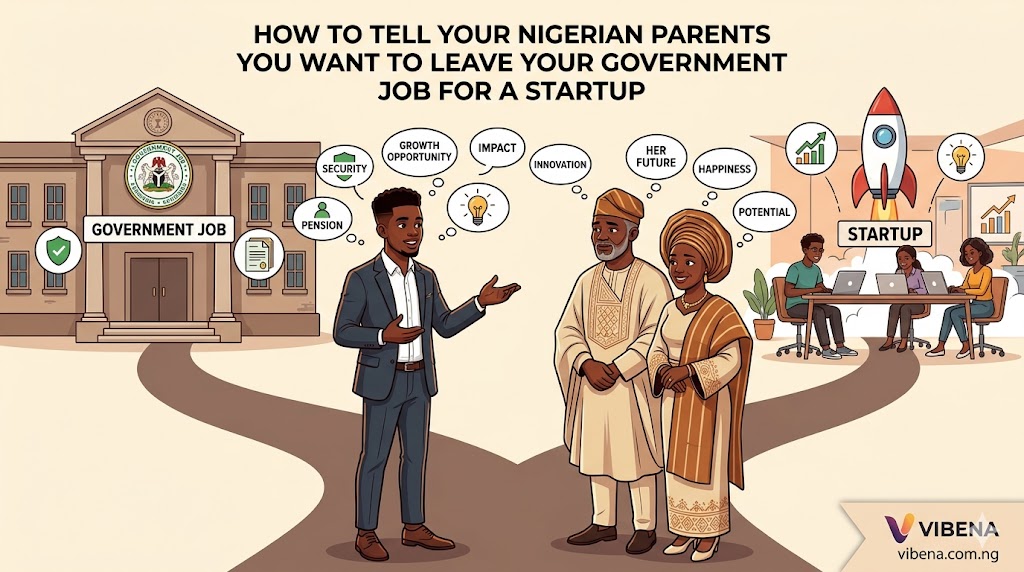
I sat in my parents’ living room in Surulere for 45 minutes one Sunday afternoon in 2023, rehearsing the words in my head while my mum served jollof rice and my dad watched Channels TV. I had been working as an electrical engineer with a federal agency for three years, installing and inspecting power systems across government buildings. The pay was stable. The pension was guaranteed. And my parents told every relative and church member about their son “working with the federal government.” This guide explains leave Your Government Job in simple, practical terms.
But I was miserable.
I had started a small inverter installation side business on weekends, and it was growing faster than I expected. Clients were calling during work hours. I was turning down ₦200,000 installation jobs because I could not take time off. The startup I wanted to build around affordable solar and inverter solutions for Nigerian apartments was sitting in a Google Doc, untouched for months.
I knew I had to quit. But telling my Nigerian parents I wanted to leave a government job felt harder than any electrical wiring I had ever done.
If you are in a similar position in Nigeria 2026, whether you want to leave for a tech startup, content creation, freelancing, or any business idea, this guide is for you. Not from a career coach. From someone who actually had the conversation, survived it, and came out the other side with both a thriving business and parents who eventually came around.
Why This Conversation Feels So Heavy for Nigerian Families
You already know this, but it helps to name it clearly.
In many Nigerian households, a government job is not just employment. It is a symbol. It means your parents’ investment in school fees, JAMB lessons, university runs, and NYSC logistics finally paid off. It is proof of stability in a country where stability feels rare. It is something your mother can announce at the women’s meeting without anyone raising an eyebrow.
According to a behavioural health perspective shared by Stephanie Pozuelos, a counsellor at Providence Portland Medical Center who works with first-generation families, immigrant and traditional parents sometimes build their own sense of identity around their child’s accomplishments. When you threaten to leave a “prestigious” career, it can feel to them like you are dismantling something they helped build.
This does not make your parents villains. It makes them human. They sacrificed so you could have what they did not. And now you are telling them you want to walk away from the very thing they sacrificed for.
Understanding this dynamic is the first step. Not to change your mind. But to approach the conversation with empathy instead of frustration.
Before You Talk to Your Parents, Get Clear With Yourself
The worst version of this conversation goes like this: “Mummy, Daddy, I want to quit my job.” Full stop. No plan. No numbers. No alternative. Just emotion.
That approach will trigger every fear your parents have ever had about financial instability in Nigeria. And honestly, it should. A vague declaration without a plan is not courage. It is recklessness.
Before you sit down with your parents, answer these questions for yourself:
Do You Have Income Coming In?
You do not need to match your government salary immediately. But you need to show that money is flowing. Whether it is freelance clients, a side hustle revenue, or early startup income, having proof of earnings changes the conversation from “I want to chase a dream” to “I am already building something that works.”
If you are still in the early stages of building income, our guide on student side hustles covers several options that work for Nigerians at various stages, and many of them scale into full businesses.
Do You Have Savings?
Career and burnout expert Rachel Montañez, who coaches employees at Fortune 500 companies, recommends considering whether you have enough money, professional relationships, and emotional support to undergo the transition before you quit. In the Nigerian context, this means having at least 3 to 6 months of living expenses saved. If you live in Lagos, that could be ₦300,000 to ₦900,000 depending on your lifestyle.
Our breakdown of cost of living in Lagos Nigeria gives you realistic monthly figures to calculate your personal number.
Do You Have a Written Plan?
Not a mental plan. A written one. With specific numbers, timelines, and milestones. Nigerian parents respond to evidence, not enthusiasm. When I finally had the conversation with my dad, I brought a one-page document showing my side business revenue for the past 6 months, my projected earnings for the next 12 months, and a list of clients I had already secured.
He still was not happy. But he could not say I had not thought it through.
How to Actually Have the Conversation
Choose the Right Setting
Do not bring this up during a family argument, at a relative’s burial, during Christmas when everyone is visiting, or over the phone. Choose a calm, private moment when both parents are present and relaxed.
Sunday afternoon after church works for many Nigerian families. Or a quiet weekday evening when the house is calm.
Avoid having this conversation in front of extended family. Your uncle who works at the LGA office does not need to be part of this discussion. This is between you and your parents.
Start With Gratitude, Not Complaints
According to Rachel Montañez, parents are more likely to accept career decisions when their children convey gratitude first. She recommends talking about the characteristics and traits your parents instilled in you that you value.
This is not manipulation. This is genuine acknowledgement. Your parents did sacrifice for you. Starting from that place of appreciation makes them feel seen before you deliver news that might unsettle them.
“Daddy, the discipline you taught me is the reason I can manage clients and projects on my own. Mummy, the way you managed this household on a tight budget taught me how to run a lean business. I want to talk to you about something I have been thinking about.”
That opening feels very different from “I hate my government job and I want to quit.”
Explain the Why, Not Just the What
Do not just announce the decision. Explain why you are no longer able to be the best version of yourself in your current role. Nigerian parents understand struggle. They understand being stuck. What they fear is their child making a reckless decision based on feelings.
Talk about specifics:
- The growth ceiling you have hit at your government position
- The income potential of your startup or new career path, with actual numbers
- The skills you have developed that prepare you for this transition
- What you have already accomplished outside your 9 to 5
According to career transition guidance from Exceptional Futures, a professional development platform, it helps to name the factors that were hindering your success in your previous role and explain why the career change will help you flourish. This shifts the conversation from abandonment to progression.
Use Language They Understand
Pozuelos, the behavioural health counsellor, notes that in many traditional families, job titles and career prestige are viewed differently across generations. What you see as an exciting startup opportunity, your parents might see as “trading something real for something risky.”
Bridge the gap by simplifying your new career into terms that resonate with them. If you are going into tech, explain it as “I am building a company that helps small businesses manage their money using phone apps.” If you are going into content creation, frame it as “I produce educational videos that companies pay me to make.”
Do not use jargon. Do not mention “Series A funding” or “content monetization” or “SaaS.” Speak in outcomes: money earned, clients served, problems solved.
My dad did not care about “solar energy consulting.” He cared when I said, “I installed a system for a man in Lekki last month and he paid me ₦850,000. That is more than my government salary for 4 months.”
Numbers speak louder than buzzwords in a Nigerian living room.
Expect Resistance and Plan for It
According to Pozuelos, you should expect misunderstanding to occur. “Our dreams aren’t meant for everybody to understand. They’re meant for us to make sense to ourselves.”
Your parents might say:
- “So all the money we spent on your education is wasted?”
- “Do you know how many people are begging for government jobs?”
- “What will I tell people at church?”
- “What about your pension?”
These responses come from fear and love, not malice. Do not get defensive. Do not argue. Acknowledge their feelings and calmly restate your plan.
“I understand why you feel that way, and I respect it. But I have thought about this carefully, and here is what I have already put in place.”
You are not asking for permission. You are informing people you love and respect about a decision you have made. There is a difference.
What to Do If the Conversation Goes Badly
It might. And that is okay.
Montañez advises that if the initial reaction is negative, you should counter it with positive internal reinforcement. Remind yourself why you are making this decision. Do not absorb their fear as your own.
Pozuelos adds that you should remember: “We’re not in charge of people’s reactions. We have to be in charge of our own emotions and reactions to what we’re going through.”
Give Them Time
Nigerian parents often come around, but it takes time. They need to process. They need to see you take action. They need to see results.
According to Montañez, “When people see you happy and doing well and making traction in your career, oftentimes, their perceptions change.” This has been true in my experience. My father did not support my decision for nearly 8 months. Then I bought a generator for the family house using startup income, and his tone shifted overnight.
Results do not lie. Time plus results equals acceptance in most Nigerian families.
Lean on Your Support System
Both experts stress the importance of having people to lean on outside your family during this transition. Whether it is friends who understand your vision, a mentor in your new industry, or a community of other Nigerian professionals making similar moves, you need people in your corner.
If you feel isolated in this process, our post on building confidence in your career as a young Nigerian professional has practical strategies for developing self-assurance even when the people closest to you are not yet on board.
The Pension Question: Address It Directly
The number one concern most Nigerian parents raise about leaving a government job is the pension. And it is a legitimate concern. The Contributory Pension Scheme managed by the National Pension Commission (PenCom) means you have been building retirement savings through your Pension Fund Administrator (PFA).
Here is what you need to know and what to tell your parents:
Your pension contributions do not disappear when you leave government. According to information from PenCom, your Retirement Savings Account (RSA) remains yours. If you move to a private sector job, your new employer continues contributions to the same RSA. If you become self-employed, you can make voluntary contributions.
If you leave employment entirely, you can access 25% of your RSA balance after 4 months of documented unemployment, according to the Pension Reform Act 2014 (as amended).
Tell your parents: “My pension is safe. It does not go away because I changed jobs. I will either continue contributing through my new business or access part of it if I need to.”
This single piece of information has defused the pension argument in every conversation I have witnessed.
What Not to Do During This Conversation
Do Not Trash Your Current Job
Saying “government work is useless” or “civil servants are lazy” will not endear you to parents who likely know dozens of people in government and may see the insult as directed at their generation’s choices.
Instead, acknowledge what the job gave you and explain that you have reached a natural point of transition.
Do Not Compare Yourself to Other People’s Children
“Tunde left his banking job and now he makes millions from YouTube” is not a convincing argument. Your parents will simply say “You are not Tunde.” And they will be right. Your plan needs to stand on its own merits, not someone else’s success story.
Do Not Give an Ultimatum
“I’m quitting whether you like it or not” might feel empowering in your head, but it slams the door on dialogue. You want your parents to feel included in your life, even if they cannot control your decisions. Ultimatums create resentment, and in Nigerian families, resentment lingers for years.
Do Not Lie About Your Plans
If you have already resigned, do not pretend you are “thinking about it” just to soften the blow. If your startup is not yet profitable, do not inflate your numbers. Nigerian parents have a remarkable ability to detect dishonesty, and getting caught in a lie destroys the trust you need during this transition.
A Realistic Timeline for the Transition
If you have not resigned yet and you are reading this in Nigeria 2026, here is a phased approach that protects your finances and your family relationships:
Month 1 to 3: Build Your Safety Net
- Save aggressively. Cut non-essential spending. Our guide on time management for side hustlers balancing a 9 to 5 and business dreams in Nigeria will help you structure your time.
- Grow your side income to at least 50% of your government salary before making any moves.
- Document everything: revenue, clients, growth metrics. This becomes your evidence folder.
Month 3 to 4: Have the Conversation
- Choose your moment carefully.
- Present your plan with gratitude, numbers, and clarity.
- Allow your parents to react. Do not force immediate acceptance.
Month 4 to 6: Execute Your Exit
- Give proper notice at your government job. According to information from FederalPay.org, a minimum of 2 weeks notice is standard, though 1 to 3 months is more appropriate for critical roles.
- Write a clear, respectful resignation letter. Keep it simple: your current position, your last day, your willingness to help during the transition, and a thank you. Do not express frustration or anger, as this letter may follow you if you ever return to government employment.
- Transition your responsibilities professionally. The goal is to leave with your reputation intact.
Month 6 and Beyond: Prove It With Results
- Focus entirely on growing your business or new career.
- Share small wins with your parents. Not to prove them wrong, but to include them in your progress.
- Keep reducing expenses where possible. Our article on how to reduce your generator fuel consumption by 30% without buying new equipment is one example of small practical savings that add up when you are bootstrapping a business.
My Parents Now
It took about a year. My mum came around first, somewhere around the seventh month when I mentioned I was hiring my first assistant. My dad took longer. But the day I installed a 5kVA solar inverter system at their house in Surulere, using money entirely from my business, he said something I will never forget:
“You are doing well. Your mother and I are proud of you.”
He did not say he was wrong to worry. And he was not wrong to worry. He was a father protecting his child from a decision that looked risky. The fact that it worked out does not mean his fears were irrational. It means I prepared well enough to overcome them.
Your parents are not the enemy. The conversation is not a battle. It is a bridge. Build it with empathy, preparation, and patience, and eventually, most Nigerian parents will cross it.
And if they never fully come around? According to Pozuelos: “Get comfortable with solitude. Being in a career that you find happy, that often can be enough to fuel you and energize you to deal with everything else.”
You only get one life. Make sure you are living yours.
Leave Your Government Job: Quick Recap
That is the full picture on leave Your Government Job. Save this guide, share it with someone who needs it, and check back, because we update our Nigerian guides when things change.
For official information and updates, visit the Lagos State Government.

Oladepo Babatunde (Prince Babatee Tunde) is a Computer Scientist, researcher, and professional content writer with a Higher National Diploma in Computer Science from Kwara State Polytechnic, Nigeria.
With a background in technology and a passion for clear communication, Babatunde specializes in creating thoroughly researched, reader-focused content on productivity, personal development, home living, and technology. Every article he writes is backed by extensive research and fact-checking to ensure readers receive accurate, actionable information.
As a freelance writer, he has helped brands and publications deliver content that educates, engages, and empowers their audiences. His mission at Vibena is simple: make complex topics easy to understand and help Nigerians live smarter, more productive lives.