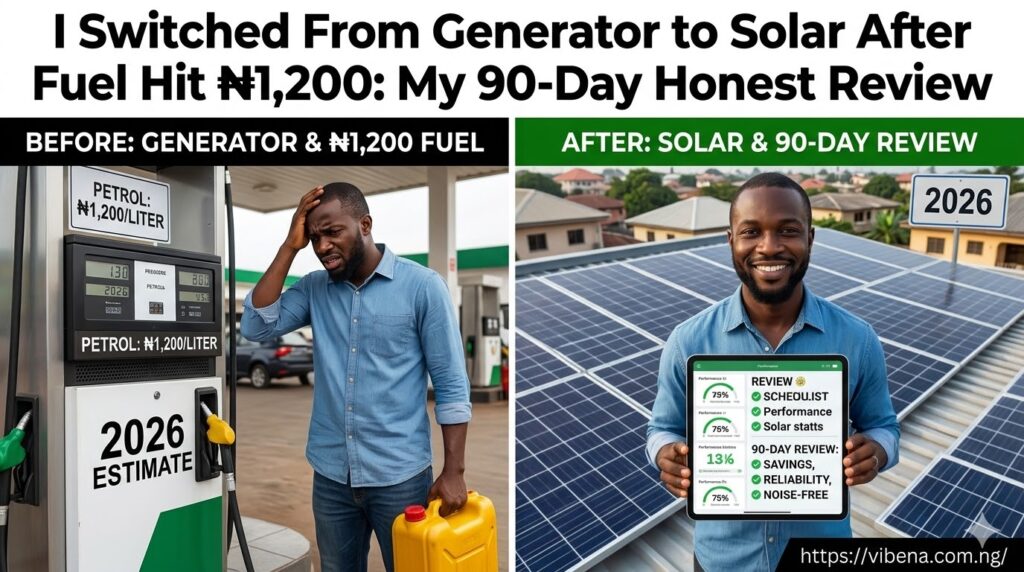
I spent ₦1,847,000 on a complete solar power system for my apartment in December 2025 after calculating that my 2.5kVA generator had consumed over ₦1,200,000 in fuel costs across the previous 12 months. Three months later, my generator has not burned a single litre of petrol, the noise and fumes are gone, and the solar panel cost has already recovered roughly 35% of itself in saved fuel alone. But I will be honest: the switch was not without frustration, miscalculations, and a few expensive lessons.
The breaking point came on a Tuesday evening in October 2025. I had just paid ₦7,800 to fill a 6-litre jerry can at a filling station where petrol price had climbed to ₦1,300 per litre. Standing in that queue, doing mental math, I realized I was spending more on generator fuel every month than what some of my friends pay for rent in smaller Nigerian cities. The generator was eating my income quietly, one litre at a time, and I had been too caught up in the daily routine of “buy fuel, start gen, repeat” to truly confront the numbers.
This article is not a sales pitch for solar. It is a detailed, transparent account of what the transition actually looks like financially, practically, and emotionally for a regular Nigerian who works remotely, creates content, and needed reliable power without bleeding money. If you are debating whether solar is worth it in Nigeria, the numbers and experiences here will help you decide based on reality rather than marketing promises. For the technical specifications of what a proper installation involves, our guide on solar inverter setup for Nigerian 2-bedroom flat covers the engineering side in detail.
The Fuel Price Journey That Broke Me
To understand why I finally switched, you need to see the petrol price trajectory that pushed me over the edge. According to data tracked by Intelpoint, petrol prices in Nigeria rose by 52% between August 2024 and March 2025 alone.
Here is the price timeline I lived through:
| Period | Average Petrol Price | My Monthly Generator Fuel Cost (2.5kVA, ~6hrs/day) |
|---|---|---|
| Pre-subsidy removal (early 2023) | ₦185 to ₦195/litre | ~₦19,500 |
| Post-subsidy June 2023 | ₦550 to ₦620/litre | ~₦58,000 |
| January 2024 | ₦630 to ₦680/litre | ~₦68,000 |
| August 2024 | ₦830/litre (NBS average) | ~₦89,640 |
| October 2024 | ₦1,185/litre (NBS average) | ~₦127,980 |
| March 2025 (peak) | ₦1,262/litre (national average) | ~₦136,296 |
| July 2025 (dip) | ₦1,025/litre | ~₦110,700 |
| December 2025 (my switch) | ₦1,100 to ₦1,300/litre | ~₦129,600 |
| March 2026 (current) | ₦1,120/litre (GlobalPetrolPrices average) | ₦0 (solar now) |
Look at that first row. I was paying under ₦20,000 monthly for fuel at pre-subsidy prices. By the time petrol crossed ₦1,200, that same generator habit cost me over ₦130,000 per month. That is a 560% increase in running cost for the exact same electricity output. The generator did not get more efficient. The fuel just got astronomically more expensive.
According to the National Bureau of Statistics, the average retail price of petrol hit ₦1,184.83 in October 2024, representing an 87.88% year-on-year increase. And according to Intelpoint’s analysis, the sharpest single-month jump was September 2024 at 24.1%.
For anyone tracking household expenses carefully, our guide on cost of living in Lagos puts these fuel costs in the context of total monthly spending.
What My Generator Was Actually Costing Me
Before the switch, I did what every Nigerian considering solar should do: I tracked every generator-related expense for three full months with obsessive detail. Not just fuel, everything.
My 3-Month Generator Cost Audit (September to November 2025)
| Expense Category | September | October | November | 3-Month Total |
|---|---|---|---|---|
| Petrol (avg 3.6L/day × 30 days) | ₦118,800 | ₦140,400 | ₦129,600 | ₦388,800 |
| Engine oil changes (2 per month) | ₦7,000 | ₦7,000 | ₦7,000 | ₦21,000 |
| Spark plug replacement | ₦1,500 | ₦0 | ₦1,500 | ₦3,000 |
| Air filter cleaning/replacement | ₦500 | ₦500 | ₦800 | ₦1,800 |
| Mechanic servicing | ₦0 | ₦8,000 | ₦0 | ₦8,000 |
| Monthly Total | ₦127,800 | ₦155,900 | ₦138,900 | ₦422,600 |
Average monthly generator cost: ₦140,867.
That three-month audit became the foundation for my solar investment decision. If my generator was consuming ₦140,867 per month on average, a solar system would need to cost less than 12 months of that figure (₦1,690,404) to pay for itself within a year.
The Petroleum Products Retail Outlets Owners Association of Nigeria (PETROAN) has warned that petrol could reach ₦2,000 per litre if the Middle East crisis persists. At that price, my old generator habit would cost roughly ₦216,000 per month in fuel alone. That projection alone justified spending the money now rather than waiting.
My Solar System: What I Installed and What It Cost
After three weeks of research, getting quotes from four different installers across Lagos, and watching every Nigerian solar installation video I could find on YouTube, I settled on a system sized specifically for my apartment’s actual power needs.
My Complete System Specification
| Component | Specification | Cost |
|---|---|---|
| Solar panels | 4 × 450W monocrystalline (Jinko) | ₦520,000 |
| Hybrid inverter | 3.5kVA pure sine wave | ₦285,000 |
| Battery | 5kWh LiFePO4 lithium | ₦690,000 |
| Charge controller | MPPT 60A | ₦85,000 |
| Mounting, cables, accessories | Full kit | ₦117,000 |
| Installation labour | Professional team | ₦150,000 |
| Total Investment | ₦1,847,000 |
According to a February 2026 report from Nairametrics, small solar systems (1kW to 3kW) currently cost between ₦800,000 and ₦2.5 million in Nigeria, while medium systems (3.5kW to 5kW) range from ₦2.5 million to ₦8 million depending on battery capacity and component quality. My system falls at the higher end of the small category because I prioritized lithium over lead-acid batteries.
Why I Chose Lithium Over Lead-Acid Batteries
This decision added roughly ₦350,000 to my total cost compared to using traditional deep-cycle gel batteries. Here is why I made that choice:
Lifespan: LiFePO4 lithium batteries offer up to 6,000 charge cycles compared to roughly 1,500 to 2,000 for quality lead-acid batteries. According to information from JS BESS, lithium batteries provide 90-95% usable capacity versus only about 50% for lead-acid, meaning you need fewer batteries for the same actual power.
Maintenance: Zero maintenance required. No topping up with distilled water, no equalization charging. Coming from a generator that needed oil changes every two weeks, this freedom felt luxurious.
Weight and space: My lithium battery weighs roughly 45kg. An equivalent lead-acid setup would weigh 120kg or more and take up significantly more space in my apartment.
Heat tolerance: Nigeria’s climate punishes batteries. LiFePO4 chemistry handles high temperatures better than alternatives, which matters during those brutal March and April heat waves.
My 90-Day Solar Power Diary
Rather than generalizing, here is what each month actually looked like.
Month 1 (December 2025): The Learning Curve
The installation took a full day. The team arrived at 8am and finished by 5pm. Mounting the panels on my roof went smoothly, but the wiring from rooftop to my indoor setup required drilling through a wall, which I had not anticipated. The installer charged an extra ₦15,000 for the additional work (already included in my total above).
The first week felt miraculous. Silence. No generator noise at 6am. No exhaust fumes seeping through windows. No neighbours knocking to complain about noise. I could take video calls without muting every five minutes to mask the generator rumble. As someone who writes and creates content from home, the quiet was productivity gold.
The reality check came in week two. December in Lagos brings harmattan haze, which reduces solar panel efficiency. My 4 × 450W panels were generating roughly 70-75% of their rated output during the haziest days. The system that comfortably powered everything during clear weather started requiring more careful load management.
What I powered comfortably: LED lights (10 bulbs), two ceiling fans, laptop charger, phone chargers, WiFi router, and a small television. My energy-efficient fridge ran without issues during daytime solar hours but drew noticeably from the battery at night.
What I could NOT run: Air conditioning. My 1HP split AC draws roughly 1,200W, which the system could technically handle during peak solar hours but would drain the battery dangerously fast. I accepted this limitation going in.
Total electricity cost for December: ₦0 (solar covered everything within my managed load).
Month 2 (January 2026): Finding the Rhythm
January brought clearer skies after harmattan peaked, and my panels started performing at closer to 85-90% of rated capacity. The 5kWh battery provided comfortable overnight power for my essential loads (fridge, security lights, router, phone charging) with roughly 30% battery remaining by morning.
I developed a daily routine:
- 6am to 9am: Battery powers essentials while panels charge
- 9am to 4pm: Panels generate excess power, battery fully charges by noon on clear days
- 4pm to 10pm: Mixed solar and battery power during evening use
- 10pm to 6am: Battery only (lights, fridge, router)
The discipline of understanding my power generation and consumption became almost enjoyable. I installed a simple energy monitor (₦15,000 extra, bought separately) that showed real-time generation and consumption. Watching the numbers helped me optimize which appliances I ran during peak solar hours versus evening.
One important discovery: Cloudy days in January reduced my daily solar harvest by 40-50%. On those days, the battery barely made it through the night with reduced loads. This is the honest limitation of solar in Nigeria that marketing materials gloss over.
Generator usage in January: Zero. Not once. That old 2.5kVA generator sat in my generator room gathering dust.
Month 3 (February 2026): Confidence and Savings
By February, I understood my system intimately. I knew which appliances I could run simultaneously, when to shift heavy loads to peak solar hours, and how to manage cloudy day power budgets. The system felt like a natural extension of my daily routine rather than something requiring constant attention.
February also brought the highest irradiance levels since installation. Clear skies meant my panels generated maximum output most days, and the battery reached full charge by 11am regularly. I even had excess generation capacity that I could not use because I had no additional battery storage.
Total fuel purchased in 90 days: ₦0 Total maintenance cost for solar system in 90 days: ₦0 (panels cleaned twice with water and soft cloth, took 15 minutes each time) Total generator fuel I would have spent: Approximately ₦390,000 to ₦420,000
The Real Math: Solar vs Generator Cost Comparison
Here is the comparison that matters, laid out with verified numbers:
12-Month Projection: Solar vs Generator
| Cost Category | Generator (annual) | Solar (annual) |
|---|---|---|
| Fuel/Electricity cost | ₦1,440,000 to ₦1,560,000 | ₦0 |
| Engine oil/maintenance | ₦90,000 to ₦120,000 | ₦0 |
| Spark plugs/servicing | ₦24,000 to ₦36,000 | ₦0 |
| Equipment depreciation | ₦37,500 (₦150K gen / 4 years) | ₦73,880 (₦1.847M / 25 years) |
| Battery replacement fund | N/A | ₦46,000 (₦690K / 15 years) |
| Annual Total | ₦1,591,500 to ₦1,753,500 | ₦119,880 |
| Monthly Average | ₦132,625 to ₦146,125 | ₦9,990 |
Payback Period Calculation
At my average monthly generator savings of ₦140,867:
₦1,847,000 ÷ ₦140,867 = 13.1 months to full payback.
According to information from Boyls Engineering Services, most Nigerian families recover their solar installation cost within 18 to 36 months with the right system design. My projected payback of just over 13 months falls well below that range because my generator usage was heavy (6 hours daily) and fuel prices are exceptionally high in 2026.
After payback, the savings compound. If fuel stays at current prices, I save approximately ₦1,570,000 per year compared to running the generator. Over the 25-year lifespan of the solar panels, even accounting for one battery replacement (roughly ₦700,000 at current prices after 10-15 years), the total lifetime savings exceed ₦35 million.
Those numbers are not theoretical. They are basic arithmetic using verified fuel prices and a real installation cost.
What I Miss About the Generator (Honest Admission)
Transparency matters, so here are the genuine drawbacks of my solar switch:
No air conditioning. My system cannot handle the AC. During hot February nights, I genuinely missed the ability to turn on the generator, connect the AC, and sleep in cool comfort. A system capable of running AC would have cost ₦3.5 million to ₦5 million, which was beyond my budget. Our guide on how to cool down a hot house without AC covers alternatives I now rely on.
Cloudy day anxiety. When Lagos gets overcast for two consecutive days, I watch my battery percentage like a hawk. The generator provided unlimited power as long as I had fuel. Solar requires weather cooperation. This anxiety has lessened with experience, but it has not disappeared.
The upfront cost barrier is real. ₦1,847,000 is a massive amount of money for most Nigerians. I saved for months and still had to sacrifice other planned purchases. The math says it pays back in 13 months, but those 13 months of waiting feel long when you have already spent the money.
Heavy rain events. Lagos rain can be brutal. My panels survived without issue, but generation drops to nearly zero during heavy downpour. A proper monsoon day means battery management becomes critical.
What Solar Gave Me That Money Cannot Measure
Silence. After years of generator noise, the quiet felt surreal. I sleep better. I concentrate better during work hours. Video calls no longer require apologies for background noise.
Clean air. No more exhaust fumes inside my apartment. No more waking up to that petrol smell that never quite leaves your clothes and furniture. The improvement in air quality was immediate and noticeable.
Predictability. My electricity cost is now ₦0 per month (after initial investment). No more price shock when fuel jumps ₦100 overnight. No more queue anxiety at filling stations. No more “Will there be fuel today?” stress.
Time. I estimate I spent 4 to 6 hours per week on generator-related activities: buying fuel, changing oil, starting/stopping the machine, taking it for servicing. That time now goes to actual work and rest. For someone focused on staying focused during power outages, solar eliminates the outage entirely.
Practical Guide: How to Size Your Own Solar System
Based on my experience and the mistakes I nearly made, here is how to approach the decision:
Step 1: Calculate Your Actual Daily Power Consumption
Do not guess. List every appliance you plan to run, its wattage, and how many hours daily you use it.
| Appliance | Wattage | Hours/Day | Daily Consumption (Wh) |
|---|---|---|---|
| LED bulbs (10 × 9W) | 90W | 8 hours | 720Wh |
| Ceiling fans (2 × 60W) | 120W | 10 hours | 1,200Wh |
| Laptop charger | 65W | 6 hours | 390Wh |
| Wifi router | 15W | 24 hours | 360Wh |
| Phone chargers (2 × 20W) | 40W | 3 hours | 120Wh |
| Small fridge | 100W (avg) | 12 hours (compressor cycles) | 1,200Wh |
| Television | 80W | 4 hours | 320Wh |
| Total Daily Consumption | 4,310Wh (4.31kWh) |
Step 2: Size Your Solar Panels
Nigeria gets approximately 5 to 7 peak sun hours daily depending on location and season. According to data from Solar Depot Nigeria, the average is roughly 6 hours in southern Nigeria.
For my 4.31kWh daily need: 4,310Wh ÷ 5 peak hours (conservative) = 862W minimum panel capacity.
I installed 4 × 450W = 1,800W total, which is over double the minimum. This overhead accounts for cloudy days, harmattan haze, panel degradation over time, and the fact that real-world output never matches laboratory ratings. Over-sizing panels is one of the smartest decisions you can make.
Step 3: Size Your Battery Storage
Your battery needs to cover nighttime usage plus a buffer for cloudy mornings. My nighttime consumption (10pm to 9am, roughly 11 hours) totals approximately 2.2kWh. My 5kWh battery at 90% depth of discharge gives me 4.5kWh of usable capacity, meaning I have a comfortable 2.3kWh buffer.
Step 4: Get Multiple Quotes
I received four quotes ranging from ₦1.4 million to ₦2.8 million for virtually the same system specification. The cheapest quote used unknown Chinese battery brands with no local warranty. The most expensive included a brand premium I could not justify. The ₦1.847 million I paid sat comfortably in the middle with quality components and local warranty support.
For a more detailed breakdown on larger systems, our guide on cost of solar power for 3-bedroom flat in Nigeria covers sizing and pricing for bigger installations.
Solar System Prices in Nigeria: What to Expect in 2026
Based on my research and verified market data, here is what complete solar systems cost across different capacity levels:
| System Size | Best For | Price Range (2026) | Can Power |
|---|---|---|---|
| 1kW to 1.5kW | Single room, basics | ₦800,000 to ₦1,200,000 | Lights, fans, phone charging, laptop |
| 2kW to 3kW | Small apartment | ₦1,200,000 to ₦2,500,000 | Above plus fridge, TV |
| 3.5kW to 5kW | 2-3 bedroom flat | ₦2,500,000 to ₦8,000,000 | Above plus AC (1HP), washing machine |
| 10kW+ | Large home or business | ₦10,000,000+ | Full household including multiple ACs |
Battery choice dramatically affects total cost. According to information from Maypatronic Nigeria, lithium-ion battery options range from ₦1,150,000 to ₦6,000,000 depending on capacity and brand. A 5kWh lithium battery costs ₦1.8 million to ₦3 million, while a 10kWh unit costs ₦3.5 million to ₦6 million or more according to JS BESS.
The brands I encountered most frequently in the Nigerian market include Jinko and Canadian Solar for panels (both Tier-1 manufacturers with strong heat tolerance), Felicity Solar and Blue Carbon for lithium batteries, and Growatt and Deye for hybrid inverters.
Common Mistakes to Avoid (Including Mine)
Mistake 1: Undersizing the battery. I almost bought a 3.5kWh battery to save money. My installer convinced me to stretch for the 5kWh, and it made the difference between comfortable overnight power and 3am rationing. If your budget is tight, cut somewhere else but not the battery.
Mistake 2: Ignoring panel orientation. My roof faces east-west rather than the ideal north-south orientation for Nigeria. The installer tilted the panels at approximately 7 degrees (matching my latitude) and angled them to maximize afternoon sun exposure. Wrong orientation can reduce output by 15 to 25%.
Mistake 3: Buying from unverified dealers. The Nigerian solar market has counterfeit panels that look identical to genuine ones but deliver 30 to 40% less power. Buy only from authorized dealers who can provide manufacturer warranty certificates. As noted by Kara Nigeria, the removal of fuel subsidies has skyrocketed solar demand, and unfortunately, that demand has attracted low-quality products into the market.
Mistake 4: Not accounting for installation costs. Many people compare solar “system costs” that exclude installation. Labour, mounting hardware, cables, conduit, and circuit protection add 15 to 25% to the component cost. Budget for the full package.
Mistake 5: Expecting air conditioning on a small system. Running a 1HP AC on solar requires a minimum 3.5kW system with significant battery capacity. Be realistic about what your budget can power.
Is Solar Worth It in Nigeria in 2026?
After 90 days of living entirely on solar power, here is my honest verdict:
Yes, solar is absolutely worth it if:
- You currently spend ₦80,000 or more monthly on generator fuel
- You can afford the upfront investment or have access to financing
- Your roof receives adequate sunlight (most Nigerian locations qualify)
- You are willing to manage your load (no AC on small systems)
- You plan to stay in your current location for at least 2 to 3 years
It may not be worth it yet if:
- Your generator costs are low because you rarely use it
- You rent and might move within 12 months (though portable systems exist)
- You absolutely need AC and cannot afford a ₦3.5M+ system
- Your location has severe and prolonged rainy seasons with minimal sun
For those exploring portable alternatives before committing to a full installation, our guide on portable solar generators in Nigeria covers smaller, movable options.
Frequently Asked Questions
How much does a solar panel cost in Nigeria in 2026?
Individual solar panel prices in Nigeria range from ₦20,000 for a 100W entry-level panel to ₦250,000 for a high-efficiency 500W+ monocrystalline panel. According to information from GVE Projects, monocrystalline panels range from ₦60,000 to ₦250,000 while polycrystalline panels cost ₦25,000 to ₦150,000. Complete systems including inverter, batteries, and installation start at ₦800,000 for basic setups.
How long does it take for solar to pay for itself in Nigeria?
Based on my experience, a properly sized solar system replacing a heavily used generator pays for itself in 12 to 18 months at current fuel prices. According to Solar Depot Nigeria, the typical payback period is 3 to 5 years for moderate users, but with petrol above ₦1,100 per litre in 2026, heavy generator users see payback much faster.
Can solar power run AC in Nigeria?
Yes, but it requires a larger system. A 1HP air conditioner needs at minimum a 3.5kW to 5kW solar system with 10kWh or more battery storage, costing ₦2.5 million to ₦8 million. Smaller systems like mine (1.8kW panels, 5kWh battery) cannot sustainably power air conditioning.
What is the best solar panel brand in Nigeria?
Jinko Solar is currently the most popular brand in Nigeria due to high efficiency in various light conditions. Canadian Solar and Trina Solar are also considered Tier-1 manufacturers. For batteries, Felicity Solar and Blue Carbon are the top-rated local options for LiFePO4 lithium storage. According to information from Kara Nigeria, monocrystalline PERC and N-Type panels now dominate the market as polycrystalline panels are phased out.
Is generator or solar cheaper in Nigeria?
At current petrol prices of ₦1,100 to ₦1,300 per litre, generator power costs ₦600 to ₦800 per kWh when you factor in fuel and maintenance. Solar power costs ₦0 per kWh after the initial investment is recovered. Even accounting for the upfront cost amortized over 25 years, solar works out to roughly ₦30 to ₦50 per kWh, making it 12 to 20 times cheaper than generator power over its lifetime.
Switching from generator to solar was the single best financial decision I have made since moving into my apartment. The upfront cost felt painful. The first cloudy day felt scary. But 90 days later, with zero naira spent on fuel and a level of comfort and quiet I had forgotten was possible, I only regret not making the switch sooner. Every month that passes with petrol above ₦1,000 per litre is another month where the generator burns money that could fund your solar investment. If you are already exploring ways to make your home more comfortable and efficient, our guide on how to know your electricity band in Nigeria helps you understand what you are currently paying for grid power and where solar fits into your overall energy strategy.
Written by Babatunde Oladepo, a Computer Scientist and professional content writer based in Nigeria. Every price and figure in this article reflects verified market data and personal financial records from my own solar installation and generator cost tracking.

Oladepo Babatunde (Prince Babatee Tunde) is a Computer Scientist, researcher, and professional content writer with a Higher National Diploma in Computer Science from Kwara State Polytechnic, Nigeria.
With a background in technology and a passion for clear communication, Babatunde specializes in creating thoroughly researched, reader-focused content on productivity, personal development, home living, and technology. Every article he writes is backed by extensive research and fact-checking to ensure readers receive accurate, actionable information.
As a freelance writer, he has helped brands and publications deliver content that educates, engages, and empowers their audiences. His mission at Vibena is simple: make complex topics easy to understand and help Nigerians live smarter, more productive lives.