My phone thermometer app read 36.4°C inside my bedroom at 2:17 PM last Tuesday. I was sitting at my desk in Yaba, Lagos, trying to edit a client’s blog post, and the sweat was literally dripping from my forehead onto my keyboard.
That was the moment I decided something had to change.
The Nigeria heat wave 2026 is not a joke. It is not regular hot season. According to the Nigerian Meteorological Agency (NiMet), an official Heat Stress Warning was issued in March 2026 covering multiple states including Lagos, Ogun, Oyo, Benue, Cross River, the Federal Capital Territory, and several other regions across the country. NiMet classified the south-west and parts of north-central Nigeria as high-risk zones under the “Take Action” category.
And for anyone working from home, freelancing, or studying in a room without air conditioning, this heat is not just uncomfortable. It is destroying your productivity, your sleep, and your health.
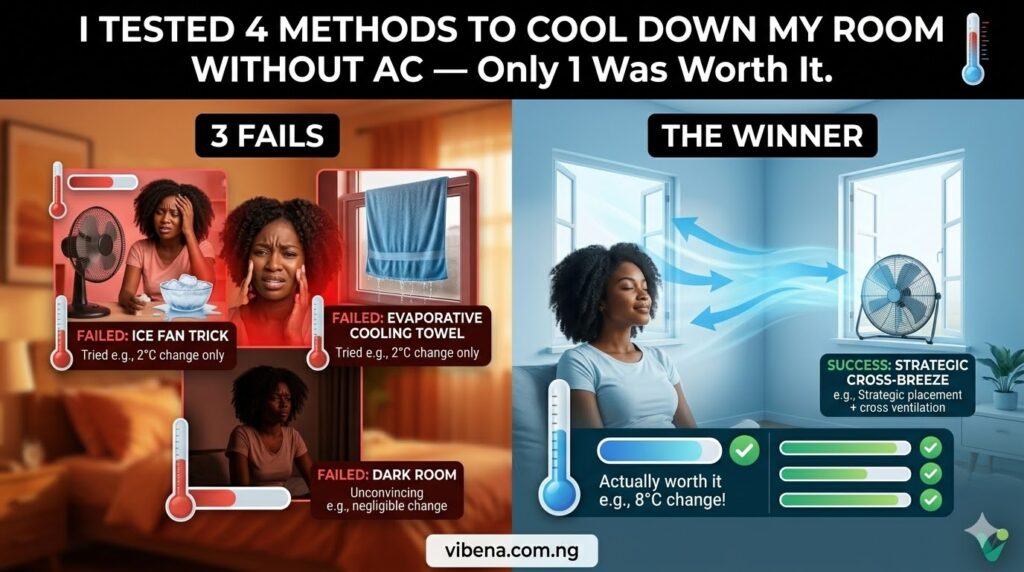
So I ran a real experiment. Over 10 days, I tested four different methods to cool my room without AC and tracked the temperature before and after each method using a thermometer app on my phone and a small ₦2,500 digital room thermometer I bought from Computer Village.
Here is exactly what happened, what worked, what failed, and why only one method was actually worth the money and effort.
Why This Heat Wave Feels Different From Every Other Year
Before I get into the test results, let me explain why this March feels significantly worse than previous years.
According to NiMet’s 2026 Seasonal Climate Prediction, both daytime and nighttime temperatures were forecasted to be warmer than the long-term average across most of Nigeria in January, February, March, April, and May 2026. This is not a guess. This is NiMet’s official prediction released earlier this year through their seasonal forecast document.
According to a report on NiMet’s official X account, air temperatures hit 41°C over the North and 39°C over the South, with projections indicating temperatures would remain high for several more days. That is not outdoor shade temperature. That is the kind of heat that turns a room with a zinc roof into an oven.
As reported by BizWatch Nigeria, residents across several communities in Lagos described the combination of the heat wave and erratic electricity supply as unbearable. People in areas like Ijaye, Agege, Ikorodu, and Ogba reported receiving power for only about 8 hours a day, often missing supply during the hottest peak hours.
Mr. Suleiman Arigbabu of the HEDA Resource Centre explained to PM News that while air temperatures are between 27°C and 30°C on some days, the 80% humidity makes the heat feel significantly more intense. And that is the key thing people miss. It is not just heat. It is heat plus humidity that makes Lagos specifically so brutal.
According to climate data, Lagos typically records average highs of about 31°C to 33°C in March, with humidity levels ranging from 74% to 80%. But in this current heat wave, indoor temperatures in poorly ventilated rooms are regularly hitting 35°C to 38°C during afternoon hours. I know because I measured mine.
The National Emergency Management Agency (NEMA) also issued a public advisory in March 2026 warning that the ongoing heat wave could lead to fire outbreaks and serious health emergencies if people do not take precautions. According to Nigeria Info FM, NEMA stressed that hot and dry weather conditions make household materials easier to ignite, especially during this dry season.
This is real. This is documented. And this is exactly why I needed to find a way to cool down my room without AC before I either collapsed from heat exhaustion or gave up trying to work entirely.
If you have been feeling unusually exhausted lately, by the way, the heat might be the reason. I wrote about why you are always tired and have no energy and the connection between heat, sleep quality, and daily fatigue is much stronger than most people realize.
My Room Setup: What I Was Working With
Before I share the results, you need to understand my testing environment because your results will depend on similar factors.
Room details:
- Location: Yaba, Lagos (mainland)
- Room type: Single room in a self-contained apartment, second floor
- Room size: Approximately 3.5m × 4m (about 14 square metres)
- Roof type: Zinc roofing with no ceiling insulation
- Windows: Two jalousie windows on the same wall (not opposite walls)
- Floor: Concrete with tiles
- Electricity band: Band B (you can check yours using this guide on how to know your electricity band in Nigeria)
- Power supply: Roughly 6 to 10 hours daily, mostly at night
This is a very typical room setup for Lagos. If you are a freelancer, remote worker, or student living in a one-bedroom or self-contained apartment, you probably have something similar. I described a lot of common Nigerian apartment layouts in my guide on how to decorate a one-room apartment in Nigeria.
Baseline temperature readings (no cooling method, windows closed, fan off):
| Time of Day | Indoor Temperature | Outdoor Temperature | Humidity |
|---|---|---|---|
| 7:00 AM | 29.8°C | 28.5°C | 78% |
| 12:00 PM | 34.2°C | 32.6°C | 72% |
| 2:00 PM | 36.4°C | 33.8°C | 68% |
| 5:00 PM | 34.7°C | 31.2°C | 74% |
| 9:00 PM | 31.5°C | 28.1°C | 80% |
Notice how the indoor temperature at 2 PM was 2.6°C higher than the outdoor temperature. That is the zinc roof effect. The sun bakes the roof, the heat radiates downward, and your room becomes a hot box. This is extremely common in Nigerian buildings, especially on upper floors.
If you are interested in long-term solutions for this, I explored the cost of solar power for a 3-bedroom flat in Nigeria which also addresses the electricity problem that makes this heat unbearable.
Method 1: The DIY Ice Fan Trick
You have probably seen this all over TikTok and YouTube. The idea is simple: put a bowl of ice or frozen water bottles in front of a standing fan, and the fan will blow cool air across the room. It sounds clever. It looks cool on video. And almost everyone recommends it.
So I tried it.
What I Used
- 1 large plastic basin (the kind you buy at Mile 12 for ₦1,500)
- 6 frozen 75cl water bottles (I froze them overnight in my neighbour’s deep freezer because NEPA decided to give me power only at night)
- 1 standard 18-inch standing fan (Binatone, the one in basically every Nigerian home)
How I Set It Up
I placed the basin of frozen bottles directly in front of the fan on a low stool, about 30cm from the fan cage. I set the fan to speed 3 (maximum) and positioned it to blow across the ice toward my desk where I work.
My Temperature Readings
| Time | Before | After 30 Minutes | After 1 Hour | After 2 Hours |
|---|---|---|---|---|
| 1:00 PM | 35.8°C | 35.1°C | 35.4°C | 35.7°C |
What Actually Happened
For the first 15 to 20 minutes, I could feel a slight coolness in the air directly in front of the fan. Not across the room. Just right in front of it. If I leaned forward and put my face about 50cm from the basin, yes, the air felt cooler.
But here is the problem. The ice melted completely within about 90 minutes. And as it melted, it added moisture to the air. In a city with 74% to 80% humidity already, this actually made the room feel muggier after the ice was gone.
The temperature drop was only 0.7°C after 30 minutes, and by the 2-hour mark, the room was essentially back to its original temperature. The frozen bottles were now just bottles of warm water sitting in a basin.
My Verdict on the Ice Fan Method
Rating: 2/10
This method is essentially useless in Lagos humidity. According to passive cooling research, evaporative cooling methods work best in low humidity environments where the evaporating water can actually absorb heat from the air. In places with 74% or higher humidity, the air is already saturated with moisture, so the cooling effect is minimal.
For anyone living in northern Nigeria where the air is drier, this might actually work better. But for Lagos, Ibadan, Port Harcourt, Benin, Calabar, or any coastal or high-humidity city, save your ice for your drinking water.
Total cost: ₦1,500 for the basin (you probably already have one) plus the cost of freezing water overnight.
Would I recommend it? No. Not in Lagos. Not during this humidity.
Method 2: Cross Ventilation With Strategic Fan Placement
This is the method your grandmother would recommend, and honestly, I was sceptical because my room has a big problem: both my windows are on the same wall. True cross-ventilation requires openings on opposite sides of a room to create airflow from one end to the other.
But according to Australia’s YourHome design guidelines on passive cooling, you can simulate cross-ventilation even with windows on one wall by using fans strategically and opening your room door to create an airflow path through the apartment.
What I Did
I created a DIY ventilation path through my apartment:
Step 1: Opened both jalousie windows in my room fully.
Step 2: Opened my room door and the kitchen window on the opposite side of the apartment (about 6 metres away).
Step 3: Placed my standing fan facing outward in one of my room windows to push hot air out.
Step 4: This created a slight negative pressure in my room, pulling slightly cooler air from the kitchen side through the apartment and into my room.
I did this test starting at 12:30 PM on a day when the outdoor temperature was 32.4°C.
My Temperature Readings
| Time | Before | After 30 Minutes | After 1 Hour | After 2 Hours |
|---|---|---|---|---|
| 12:30 PM | 34.8°C | 33.1°C | 32.6°C | 32.5°C |
What Actually Happened
This is where things got interesting. Within 30 minutes, the room temperature dropped by 1.7°C. Within an hour, it had dropped by 2.2°C and stabilised around 32.5°C, which was actually slightly below the outdoor temperature.
The key insight? The room was hotter than outside because of heat trapped by the zinc roof. By actively pushing that trapped hot air out, I allowed the comparatively cooler outdoor air to flow in.
I also noticed something else. Even though 32.5°C is still warm, the air movement across my skin made it feel significantly more comfortable. According to passive cooling research referenced on YourHome Australia, at 50% relative humidity, air moving at just 0.5 metres per second can reduce the perceived temperature by about 3°C. At Lagos humidity levels, the effect is slightly less, but still noticeable.
The Problem
This method only works when the outdoor temperature is lower than your indoor temperature, which in my case is typically between 11 AM and 4 PM when the zinc roof is superheating the room. After sunset, when outdoor and indoor temperatures equalise, the effect drops significantly.
It also means your door must stay open, which creates privacy and security concerns, especially if you are in a shared apartment. And it requires constant electricity to run the fan.
My Verdict on Cross Ventilation
Rating: 5/10
Effective but limited. It brought down the temperature more than the ice method, and it is free (assuming you already have a fan). But the dependency on room layout, open doors, and electricity makes it impractical as your only cooling method.
If you are setting up your home office for remote work, think carefully about which room you choose. I wrote about how to set up a home office in a bedroom and the placement of your desk relative to your windows matters more than you think.
I also wrote a more comprehensive guide on how to cool down a hot house without AC that covers additional passive cooling strategies, if you want to combine methods.
Method 3: The Wet Curtain and Damp Towel Method
This method came from my aunt in Ilorin who swears it works. The idea is based on evaporative cooling: you hang a damp towel or wet cloth over your window, and as hot air blows through it, the evaporating water absorbs heat and cools the air.
What I Used
- 2 large bath towels soaked in cold water
- Clothespins to hang them over my jalousie windows
- A bucket of water for re-soaking every 45 minutes to 1 hour
How I Set It Up
I hung the wet towels over both jalousie windows using clothespins and a piece of rope strung across the window frame. I positioned my standing fan behind the towels (between the towels and my desk) to pull air through the wet fabric and into the room.
My Temperature Readings
| Time | Before | After 30 Minutes | After 1 Hour | After 2 Hours |
|---|---|---|---|---|
| 1:30 PM | 35.2°C | 34.3°C | 34.6°C | 35.0°C |
What Actually Happened
The first 30 minutes showed a 0.9°C drop, which is better than the ice fan method. There was a noticeable coolness to the air passing through the wet towels. It smelled fresher too, which was a nice bonus.
But by the one-hour mark, the towels were already mostly dry. Lagos heat at 35°C with a breeze blowing through the fabric dried those towels fast. When I re-soaked them and hung them back up, the cooling effect resumed, but it meant I was getting up every 45 minutes to soak and re-hang towels.
As a remote worker trying to be productive, getting up every 45 minutes to tend to wet towels is not a viable workflow. I missed a Zoom call because I was in the bathroom wringing out towels. That is not a joke.
Also, just like the ice method, this added moisture to an already humid room. By the end of the afternoon, my room felt damp and sticky, and I noticed condensation forming on my laptop screen. That is not good for electronics.
My Verdict on Wet Curtains
Rating: 3/10
Slightly better than ice, but the maintenance is ridiculous, and the added humidity makes it counterproductive in Lagos. If you live in Maiduguri, Sokoto, or Kano where the air is dry, this method would probably score a solid 6 or 7 out of 10. But in high humidity environments like Lagos, Calabar, or Port Harcourt, it creates more problems than it solves.
Method 4: The Water Cooling Fan (Evaporative Air Cooler)
This is the one that actually worked. And I want to be very specific about what I bought, how I tested it, and what the limitations are, because there is a lot of misleading information online about water cooling fans in Nigeria.
What I Bought
After researching on Jumia, Kara, and visiting two shops in Computer Village, I bought a Maxi Air Cooler (60W, 12-litre water tank model) for ₦62,000.
I specifically chose this model because:
- It has a 12-litre water tank (larger tank means less frequent refilling)
- It consumes only 60 watts of power (compared to 800W or more for even the smallest AC unit)
- It has castor wheels so I can move it between my bedroom and living area
- It has 3 speed settings and an oscillation function
- It comes with honeycomb cooling pads which are more effective than basic fibre pads
According to Kara.com.ng, air coolers use the natural process of water evaporation to lower indoor temperatures. They are described as the perfect middle ground between a standard fan and an air conditioner. They consume significantly less electricity than ACs and are ideal for homes running on inverters, solar power, or small generators.
I also checked out my own best water cooling fans in Nigeria guide to compare specs before buying.
How I Set It Up
The setup was straightforward. I filled the 12-litre tank with cold water (I added a few ice cubes from a sachet water pack I froze, but this is optional). I placed the unit about 2 metres from my desk, pointing toward my work area, and set it to speed 2 with oscillation off (to direct the cool air at me rather than distributing it across the room).
One important thing: according to the product guidelines and confirmed by Kara, air coolers work best with fresh air flow. So I kept one window open while using it. This is the opposite of AC, which requires a sealed room. The open window allows dry outside air to enter the cooler’s system, where it passes through the wet honeycomb pads and comes out cooler.
My Temperature Readings
| Time | Before | After 30 Minutes | After 1 Hour | After 2 Hours | After 4 Hours |
|---|---|---|---|---|---|
| 12:00 PM | 35.6°C (room) | 33.1°C (room) / 29.8°C (at desk) | 32.4°C (room) / 28.6°C (at desk) | 32.2°C (room) / 28.4°C (at desk) | 32.5°C (room) / 28.9°C (at desk) |
What Actually Happened
Now we are talking.
Within 30 minutes, the room temperature dropped by 2.5°C from 35.6°C to 33.1°C. But more importantly, the temperature at my desk (about 2 metres from the cooler) dropped to 29.8°C. That is a 5.8°C difference from the starting room temperature at my actual work position.
By the one-hour mark, the desk temperature had stabilised at about 28.6°C, which is genuinely comfortable for working. I could actually concentrate. My hands were not sweating on my laptop trackpad. I was not reaching for water every five minutes.
The cooler ran for 4 straight hours before the 12-litre tank needed refilling. That is four uninterrupted hours of work. No getting up to soak towels. No melting ice. Just consistent, reliable cooling.
The Electricity Factor
This is where the 60W power consumption becomes crucial. At 60 watts, the Maxi Air Cooler uses roughly the same electricity as a standard ceiling fan. Compare that to:
- Standing fan: 50 to 75 watts
- Air cooler (my model): 60 watts
- Small 1HP AC: 800 to 1,000 watts
- 1.5HP AC: 1,200 to 1,500 watts
When you are on Band B electricity getting maybe 8 hours of power a day, or running a solar inverter setup, every watt counts. The air cooler gives you real cooling at a fraction of the power draw.
If you are running a generator (and at ₦1,200 per litre petrol, generator fuel is now extremely expensive), the low power consumption of an air cooler makes it infinitely more affordable to operate. I did the maths in my generator fuel cost calculator and the difference is staggering.
Some of my readers recently switched from generator to solar specifically because of the fuel cost crisis, and an air cooler is one of the best appliances to pair with a solar setup because of how little power it draws.
The Honest Limitations
I will not pretend the air cooler is perfect. Here is what you need to know:
It does not cool the entire room evenly. The strongest cooling effect is within about 2 to 3 metres of the unit. Beyond that, you feel more of a general freshness than direct cool air. This is fine if you are sitting at a desk working, but if you want an entire 14-square-metre room at 25°C, this is not going to do that. Only AC can do that.
Humidity matters. On days when Lagos humidity was above 80%, the cooling effect was weaker. The cooler works by evaporating water into the air, and when the air is already saturated with moisture, there is less evaporation and less cooling. The best results were on days with humidity around 68% to 74%, which, fortunately, is most afternoons in Lagos during this heat wave.
You need to keep a window open. This is not optional. If you seal the room shut like you would with AC, the air cooler will eventually saturate the room with moisture and stop cooling effectively. The open window provides fresh dry air for the evaporation cycle. According to Kara, air coolers “work best with fresh air flow” and can be used in “well-ventilated rooms, shops, or even on open balconies.”
You need to refill the water tank. The 12-litre tank on my model lasts about 4 hours on medium speed. Smaller models with 5 or 7-litre tanks will need refilling more often. This is mildly inconvenient but nothing compared to re-soaking wet towels every 45 minutes.
The cooling pads need monthly cleaning. Dust builds up on the honeycomb pads over time, reducing their efficiency. Kara recommends draining and refilling the water tank daily and cleaning the cooling pads once a month. I set a reminder on my phone for this.
My Verdict on the Water Cooling Fan
Rating: 8/10
This is the only method that gave me real, sustained, measurable cooling during this heat wave. It dropped the temperature at my desk by nearly 6°C, ran for 4 hours on a single tank of water, consumed only 60W of electricity, and cost ₦62,000 to buy.
For a remote worker, freelancer, or student who needs to actually sit at a desk and get work done during this heat, the evaporative air cooler is the best investment you can make short of installing AC (which most of us cannot afford to buy and power right now).
The Complete Test Results Side by Side
Here is everything in one table so you can compare:
| Method | Cost | Temp Drop (Room) | Temp Drop (At Desk) | Duration | Maintenance | Electricity | My Rating |
|---|---|---|---|---|---|---|---|
| Ice Fan | ₦1,500 | 0.7°C | ~1°C | 90 min before ice melts | Freeze new bottles daily | 65W (fan) | 2/10 |
| Cross Ventilation | Free | 2.2°C | 2.2°C | Only during peak afternoon | Keep door open | 65W (fan) | 5/10 |
| Wet Curtain | ₦500 | 0.9°C | ~1.2°C | 45 min before re-soaking | Re-soak every 45 min | 65W (fan) | 3/10 |
| Water Cooling Fan | ₦62,000 | 3.2°C | 5.8°C | 4 hours per tank | Refill tank, monthly pad cleaning | 60W | 8/10 |
The water cooling fan is not even close. It outperformed every other method by a massive margin.
What About a Rechargeable Fan for Power Outages?
Good question. I know many of you are thinking about what happens when NEPA takes light. The air cooler needs electricity to run, so what do you do during the hours without power?
I have a rechargeable fan that I use as backup. It does not cool the room, but it keeps air moving across my skin, which reduces the perceived temperature even if the actual temperature stays the same.
If you are also running your laptop on a power bank during outages, combining a rechargeable fan with a 50,000mAh power bank creates a workable setup for getting through those dead hours when the grid is down.
I wrote extensively about how to stay focused during power outages and also reviewed productivity apps that work offline so you can keep working even when the internet goes down with the power.
Bonus: Other Things I Changed in My Room That Helped
Beyond the four methods I formally tested, I also made some smaller adjustments that collectively made a noticeable difference.
I Covered My Window With Light-Coloured Curtains
I replaced my dark blue curtains with white cotton curtains from the Yaba market. Light colours reflect sunlight rather than absorbing it. According to passive cooling design principles, light-coloured window coverings can reduce heat gain through windows by reflecting solar radiation rather than absorbing it.
This is a ₦3,000 change that I should have made years ago.
I Moved My Desk Away From the Window
My desk used to sit right next to the window where direct sunlight hit it between 1 PM and 4 PM. I moved it to the opposite wall, closer to the room door. The difference was immediate. No more direct sun on my laptop screen and keyboard, and the air from the water cooler reaches me better in this position.
If you are rethinking your room layout, my guide on one-bedroom apartment design in Nigeria has specific tips on furniture placement for Nigerian apartments.
I Added Two Indoor Plants
This sounds small, but plants lose water through transpiration, which creates a localised cooling effect. I put an Aloe Vera and a Snake Plant (both very common in Lagos nurseries and extremely low-maintenance) near my window. They will not drop your room temperature by 3°C, but they improve air quality and add a bit of moisture regulation.
I covered indoor plant options in my houseplant styling guide for Nigeria. Snake plants in particular are excellent for bedrooms because they release oxygen at night.
I Stopped Cooking Inside During Peak Heat Hours
My kitchen is connected to my main room with only a curtain separating them. Cooking jollof rice at 2 PM was adding significant heat to an already hot apartment. I shifted my cooking to early morning (before 8 AM) or evening (after 7 PM), and the difference was noticeable.
If you are looking for a way to reduce how often you cook, my meal prep timetable for busy 9-to-5 workers helps you cook once and eat all week, which means less heat generation in your kitchen.
I Made Sure My Room Was Properly Cleaned and Decluttered
Clutter absorbs and retains heat. A room packed with clothes, bags, and boxes has more surfaces holding onto thermal energy. I did a proper declutter and noticed the room felt slightly more open and less stuffy.
Keeping your space clean during this heat is also a sanity issue. I shared my routine for how to keep a house clean with a busy schedule, which is especially relevant when you are spending more time working from home.
Your Health During This Heat Wave: Do Not Ignore the Warning Signs
I want to take this section seriously because the heat wave in Nigeria is not just an inconvenience. According to the Slum and Rural Health Initiative (SRHIN), heat stress is a medical condition that builds quietly in the body before any visible symptoms appear. The risk is particularly high for anyone spending long hours indoors without proper ventilation.
According to The Punch, NiMet’s advisory warned that prolonged exposure to the current weather conditions could lead to thermal discomfort, dehydration, fatigue, headaches, and reduced productivity. States expected to experience the most severe conditions include Kebbi, Niger, Kwara, Oyo, Kogi, Nasarawa, Anambra, Abia, Ebonyi, Cross River, and the FCT.
Common heat stress symptoms include heavy sweating, dizziness, weakness, nausea, headache, and rapid heartbeat. If sweating stops, that is a dangerous sign. According to SRHIN, confusion, hot dry skin, and loss of consciousness indicate heat stroke, which requires emergency medical attention.
As a remote worker or student sitting in a hot room for hours, you are at risk without even realising it. Here is what I do every day now:
- Drink at least 3 litres of water daily, even before I feel thirsty
- Take cold showers at least twice during the day (once around noon, once around 5 PM)
- Avoid working between 2 PM and 3:30 PM on the worst days and use that time for a proper break
- Wear only light, breathable clothing at home (cotton T-shirts, shorts)
- Keep my phone’s weather app set to alert me when the heat index crosses 38°C
If you want more ideas for managing stress during this period, I have guides on self-care ideas for Nigerians, stress-free weekend ideas, and quick stress relief methods you can do at home.
Your health matters more than your deadlines. Please take breaks.
The Bigger Picture: Why Working From Home Is Harder Than Ever in Nigeria Right Now
This article is about cooling your room, but let me connect the dots because everything is linked.
Petrol is at ₦1,200 per litre. That means generator fuel costs have skyrocketed, making it impossible for many people to run AC or even fans for extended periods on generator power. As reported by PM News, Lagos residents lamented that they were spending too much on fuel to power their generators during this heat wave.
As one Lagos resident, Mrs. Gladys Okpara of FESTAC, explained to BizWatch Nigeria, the increase in petrol prices has made fans and air conditioners a luxury even for those who own generators.
Meanwhile, the cost of living in Lagos continues to climb across the board. Rent, food, transport, data, everything is going up while salaries stay flat. I have a full breakdown in my cost of living in Lagos guide, and the reality is that most Nigerian freelancers, remote workers, and students simply cannot afford a ₦350,000 split-unit AC plus the electricity to run it.
That is exactly why affordable cooling solutions like air coolers, strategic ventilation, and power-efficient gadgets matter so much right now. These are not luxury purchases. They are survival tools for anyone trying to work from home in Nigeria in 2026.
If you are thinking about the long-term economics, my articles on Band A versus Band B electricity and rent prices across 10 Lagos neighbourhoods might help you plan better.
My Final Recommendation: What You Should Actually Buy
If you are a freelancer, remote worker, student, or content creator working from home during this heat wave, here is what I would recommend based on my 10-day test:
If You Have ₦50,000 to ₦80,000 to Spend
Buy a water cooling fan (evaporative air cooler) with at least a 10-litre water tank and honeycomb cooling pads. The Maxi 60W model I tested costs around ₦62,000 and is available on Jumia, Kara, and at Computer Village in Lagos. Pair it with your standing fan for backup and make sure to keep a window open when using it.
If You Have Less Than ₦10,000
Use the cross-ventilation method I described above. It is free if you already own a fan. Position the fan facing outward in your window and create an airflow path through your apartment by opening doors and windows on opposite sides. Combine this with light-coloured curtains and avoid generating heat indoors during afternoon hours.
If You Are Investing in Your Home Setup Long Term
Look into solar inverter setups or portable solar generators to ensure you have power during outages. Pair a solar setup with an air cooler and a rechargeable fan, and you will have a cooling system that works even when the grid fails.
Also check my full guide on essential gadgets for remote work in Nigeria for a complete list of what I use daily.
Closing Thoughts
I started this experiment because I was miserable. My room was 36°C, I could not focus, and I was seriously considering just giving up work for the day and going to a shopping mall to sit in their AC.
But after 10 days of testing, I found a solution that actually works. The water cooling fan is not perfect. It is not AC. It will not turn your room into a cold room. But it brought my working temperature down from an unbearable 35.6��C to a manageable 28.6°C at my desk, and it did it for 60 watts of electricity and ₦62,000 invested.
That is the difference between a productive workday and lying on your tiles staring at the ceiling.
The heat wave is not going away. As environmental experts told PM News, this is the result of years of environmental neglect, climate change, and the conversion of urban green spaces into concrete structures. According to SRHIN, the extreme alerts we are seeing in March 2026 reflect a climate pattern that is becoming the new baseline, not just a seasonal anomaly.
We need to adapt. And sometimes adapting means running a careful experiment, tracking the numbers, and finding the solution that actually works for your specific situation.
Stay cool. Stay hydrated. And if this article helped you, share it with someone who is melting at their desk right now. They need it.
Want to make your home more comfortable overall? Explore my guides on eco-friendly ways to make your house smell good, how to soundproof a room in Nigeria, and sitting room interior design ideas for Nigerian homes.

Oladepo Babatunde (Prince Babatee Tunde) is a Computer Scientist, researcher, and professional content writer with a Higher National Diploma in Computer Science from Kwara State Polytechnic, Nigeria.
With a background in technology and a passion for clear communication, Babatunde specializes in creating thoroughly researched, reader-focused content on productivity, personal development, home living, and technology. Every article he writes is backed by extensive research and fact-checking to ensure readers receive accurate, actionable information.
As a freelance writer, he has helped brands and publications deliver content that educates, engages, and empowers their audiences. His mission at Vibena is simple: make complex topics easy to understand and help Nigerians live smarter, more productive lives.