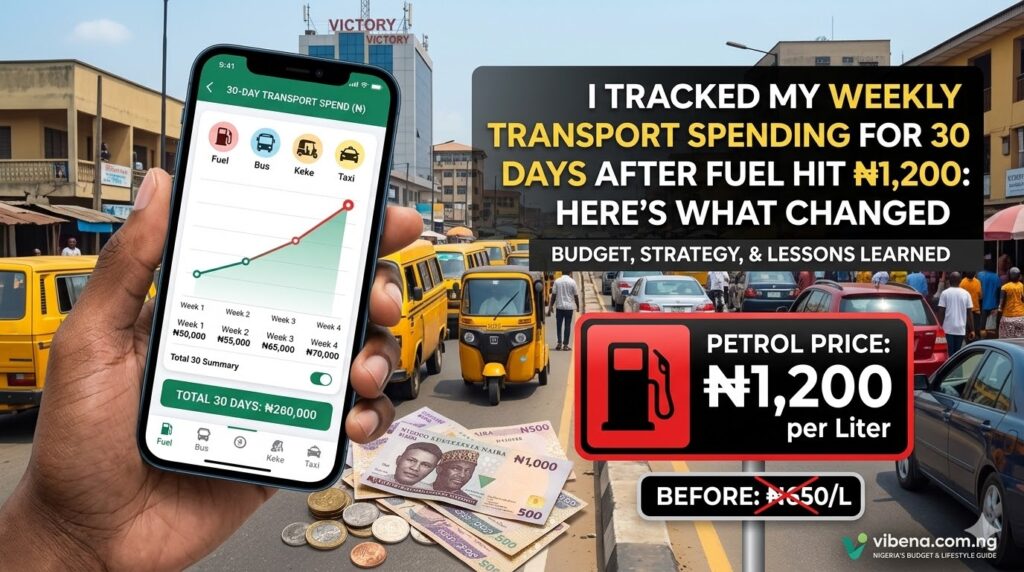
In four weeks of tracking every single transport transaction on my OPay and Bolt apps, I discovered that I was spending ₦78,400 monthly on transportation alone. That is more than some Nigerians pay for rent outside Lagos. The breakdown shocked me: ₦31,200 on ride-hailing apps, ₦22,800 on danfo and BRT buses, ₦14,400 on keke and okada for last-mile connections, and ₦10,000 on two intercity trips I had planned months before fuel prices crossed ₦1,200 per litre.
I did not start this experiment because I am financially disciplined. Quite the opposite. I started because my OPay transaction history for November 2025 showed an alarming pattern I could no longer ignore. Every few days, small transport charges of ₦500 here, ₦1,200 there, ₦2,800 for a Bolt ride across town, accumulated into a number that genuinely frightened me when I tallied them up at month-end. These were not luxury expenses. They were basic commutes to meetings, coworking spaces, markets, and the occasional social gathering.
The fuel price in Nigeria has been on a relentless upward trajectory since the subsidy removal in 2023, and every increase ripples directly into what you and I pay to move from point A to point B. As of mid-March 2026, petrol sells for approximately ₦1,100 to ₦1,300 per litre depending on your location, with reports from Vanguard newspaper documenting prices as high as ₦1,400 in some Abuja filling stations after Dangote Petroleum Refinery raised its gantry price to ₦1,175 per litre. Whether you take BRT, danfo, okada, keke, Bolt, or Uber, you are paying for that fuel through higher fares. This guide documents exactly what that costs in real numbers, and the strategies I developed to cut my transport bill by 40% without becoming a hermit. For anyone managing household budgets carefully, our guide on cost of living in Lagos puts these transport costs into broader context.
Why I Started Tracking: The Fuel Price Timeline
To understand why transport cost in Lagos has become so painful, you need to see how quickly fuel prices escalated and how directly those increases hit commuter wallets.
According to data from GlobalPetrolPrices.com, the average price of petrol in Nigeria stands at approximately ₦1,120 per litre as of the second week of March 2026. But the journey to get here involved several brutal jumps:
| Period | Average Petrol Price | What Happened |
|---|---|---|
| Pre-subsidy (May 2023) | ₦185 to ₦195/litre | Subsidized era, stable prices |
| Post-subsidy (June 2023) | ₦550 to ₦620/litre | Immediate shock, fares doubled overnight |
| Early 2024 | ₦630 to ₦750/litre | Gradual climb, danfo fares adjusted upward |
| August 2024 | ₦830/litre (NBS average) | Another jump, BRT fare review discussions began |
| October 2024 | ₦1,185/litre (NBS average) | Breaking ₦1,000 barrier, transport chaos |
| March 2025 (peak) | ₦1,262/litre (national average) | Highest ever, commuters cut non-essential trips |
| Mid-2025 (dip) | ₦950 to ₦1,050/litre | Brief relief, fares barely dropped |
| March 2026 (current) | ₦1,100 to ₦1,300/litre | Middle East crisis pushes crude above $100/barrel |
As reported by The Punch newspaper, petrol prices jumped to approximately ₦1,300 per litre in various parts of Nigeria after Dangote Refinery hiked its gantry price three times within a single week in early March 2026. The Petroleum Products Retail Outlets Owners Association of Nigeria (PETROAN) has warned prices could reach ₦2,000 per litre if the Middle East crisis persists.
Every one of those fuel price increases translated directly into higher transport fares. Danfo conductors do not absorb fuel costs. BRT operators do not absorb them either. And ride-hailing apps adjust their fare algorithms within days of pump price changes.
My 30-Day Transport Spending Diary
I tracked every transport transaction from December 1 to December 30, 2025. Here is the raw data, organized by week.
Week 1: December 1 to 7 (Normal Routine)
This week reflected my pre-awareness spending pattern. I moved around Lagos without thinking about transport costs because I had not yet started analyzing the numbers.
| Day | Transport Mode | Route | Amount | Payment Method |
|---|---|---|---|---|
| Mon | Bolt | Home to VI (client meeting) | ₦3,200 | OPay |
| Mon | BRT | VI to Oshodi | ₦700 | Cowry Card |
| Mon | Danfo | Oshodi to home | ₦400 | Cash |
| Tue | Keke | Home to main road | ₦300 | Cash |
| Tue | BRT | Oshodi to CMS | ₦800 | Cowry Card |
| Tue | Bolt | CMS to home (tired, late evening) | ₦2,800 | OPay |
| Wed | Remote work day | No transport | ₦0 | N/A |
| Thu | Danfo × 2 | Home to Ikeja return | ₦1,200 | Cash |
| Fri | Bolt | Home to Lekki (meeting) | ₦4,500 | OPay |
| Fri | Bolt | Lekki to home | ₦3,800 | OPay |
| Sat | Keke + Danfo | Errands | ₦900 | Cash |
| Sun | No movement | Rest day | ₦0 | N/A |
Week 1 Total: ₦18,600
Looking at this week’s data, two things jumped out immediately. First, the Bolt rides to and from Lekki on Friday cost ₦8,300 alone, which is more than what some people budget for an entire week of transport. Second, the “tired, late evening” Bolt ride on Tuesday was pure convenience spending. I could have taken BRT and danfo home for under ₦1,200 but chose comfort.
Week 2: December 8 to 14 (Awareness Phase)
After tallying Week 1, I started making conscious choices. I replaced two planned Bolt rides with BRT and danfo combinations.
| Day | Transport Mode | Route | Amount | Payment Method |
|---|---|---|---|---|
| Mon | BRT + Danfo | Home to VI return | ₦2,200 | Cowry/Cash |
| Tue | Remote work | No transport | ₦0 | N/A |
| Wed | Keke + BRT | Home to Yaba | ₦1,100 | Cash/Cowry |
| Wed | BRT + Keke | Yaba to home | ₦1,000 | Cowry/Cash |
| Thu | Danfo × 2 | Home to Ikeja return | ₦1,200 | Cash |
| Fri | Bolt (shared) | Home to VI | ₦2,100 | OPay |
| Fri | BRT | VI to Oshodi | ₦700 | Cowry Card |
| Fri | Danfo | Oshodi to home | ₦400 | Cash |
| Sat | Okada + Danfo | Market run | ₦800 | Cash |
| Sun | No movement | Rest day | ₦0 | N/A |
Week 2 Total: ₦9,500
The difference between Week 1 (₦18,600) and Week 2 (₦9,500) was ₦9,100, a 49% reduction simply from making deliberate transport choices. I did not reduce my movement. I went to the same number of places. I just chose cheaper modes of transport and scheduled one additional remote work day.
Week 3: December 15 to 21 (Optimization Phase)
By week three, I had developed a system. I combined errands to reduce individual trips, used BRT for all routes it covers, and reserved Bolt strictly for situations involving client meetings where arriving sweaty or late would cost more than the ride.
| Day | Transport Mode | Route | Amount | Payment Method |
|---|---|---|---|---|
| Mon | BRT + Keke | Home to VI return | ₦2,400 | Cowry/Cash |
| Tue | Remote work | No transport | ₦0 | N/A |
| Wed | BRT + Danfo | Home to Ikeja return | ₦1,400 | Cowry/Cash |
| Thu | Remote work | No transport | ₦0 | N/A |
| Fri | Bolt | Home to Lekki (client) | ₦4,200 | OPay |
| Fri | BRT + Keke | Return home | ₦1,300 | Cowry/Cash |
| Sat | Danfo | Market errands | ₦600 | Cash |
| Sun | No movement | Rest day | ₦0 | N/A |
Week 3 Total: ₦9,900
Week 4: December 22 to 30 (Holiday Period + Intercity Trip)
This week included Christmas travel, which inflated the numbers. The intercity component would not be a regular monthly expense.
| Category | Amount |
|---|---|
| Regular Lagos transport | ₦8,400 |
| Intercity bus (Lagos to Ilorin return) | ₦10,000 |
| Local transport in Ilorin | ₦2,000 |
Week 4 Total: ₦20,400 (₦10,400 excluding intercity)
Full 30-Day Summary
| Week | Total Spent | Notes |
|---|---|---|
| Week 1 | ₦18,600 | Pre-awareness, heavy Bolt usage |
| Week 2 | ₦9,500 | Conscious choices began |
| Week 3 | ₦9,900 | Optimized routine |
| Week 4 | ₦20,400 | Includes ₦10,000 intercity travel |
| 30-Day Total | ₦58,400 | |
| Monthly Average (excluding intercity) | ₦48,400 |
If I project my Week 1 spending pattern across a full month (which roughly reflects my October and November habits before tracking), the number reaches approximately ₦78,400 per month. By optimizing in Weeks 2 and 3, I brought my regular transport spending down to roughly ₦9,500 to ₦10,000 per week, or about ₦40,000 to ₦42,000 per month.
That is a savings of roughly ₦36,000 to ₦38,000 per month, or over ₦430,000 per year, just from paying attention.
The Real Cost of Each Transport Mode in Lagos (March 2026)
Based on my tracking data and current fare structures, here is what each transport mode actually costs in Lagos right now.
BRT (Bus Rapid Transit)
As reported by Channels Television, LAMATA announced a 13% fare increase for all BRT and BRI routes effective March 2, 2026, citing rising inflation and operational costs. According to Vanguard newspaper, Governor Babajide Sanwo-Olu approved the increase after operators raised concerns over mounting economic pressures.
BRT fares now range from approximately ₦170 to ₦1,350 depending on route distance after the 13% adjustment. Before this increase, fares ranged from ₦150 to ₦1,200. The system uses the Cowry Card primarily, though some terminals still accept cash.
My honest BRT experience: The BRT remains the cheapest way to cover long distances in Lagos. My regular route from Oshodi to CMS costs roughly ₦700 to ₦800 after the increase. The dedicated lanes mean you bypass the worst traffic. The downsides are overcrowding during rush hours (7 to 9am, 5 to 7pm), limited route coverage that does not reach every neighborhood, and occasional long waits for buses during off-peak hours.
Danfo (Yellow Minibuses)
Danfo fares have increased dramatically since fuel crossed ₦1,000. Based on what I paid during my tracking period:
| Route Example | Pre-₦1,000 Fuel | Current Fare (March 2026) |
|---|---|---|
| Short route (Ojuelegba to Yaba) | ₦100 to ₦150 | ₦300 to ₦400 |
| Medium route (Oshodi to Ikeja) | ₦150 to ₦200 | ₦400 to ₦600 |
| Long route (Oshodi to CMS) | ₦250 to ₦300 | ₦600 to ₦800 |
According to a report from NaijaScene, routes that previously cost ₦200 to ₦300 now regularly cost ₦400 to ₦600, with prices doubling during peak hours in busy cities like Lagos and Abuja. Danfo fares also vary wildly depending on traffic, time of day, and how many passengers are waiting. Conductors raise prices when they see large crowds waiting, a practice every Lagos commuter knows too well.
Keke Napep (Tricycles) and Okada (Motorcycles)
Keke and okada serve as last-mile connectors between main roads and residential areas where buses do not reach. My tracking data shows I spent ₦300 to ₦500 per keke trip and ₦200 to ₦400 per okada trip within short distances.
These modes are essential but increasingly expensive. Okada riders in particular adjust prices almost weekly based on fuel costs. The convenience of beating traffic makes okada tempting, but the safety risks remain real.
Ride-Hailing Apps (Bolt, Uber, InDrive)
Ride-hailing represents the most expensive transport mode but also the most comfortable. My tracking showed:
| Trip Type | Typical Bolt Fare | Typical Uber Fare |
|---|---|---|
| Short (under 5km) | ₦1,500 to ₦2,500 | ₦1,800 to ₦2,800 |
| Medium (5 to 15km) | ₦2,500 to ₦4,500 | ₦3,000 to ₦5,000 |
| Long (15km+, e.g., Mainland to Lekki) | ₦4,000 to ₦8,000 | ₦4,500 to ₦9,000 |
According to a recent report from TechCabal, some ride-hailing drivers spend ₦180,000 per week on fuel alone. Those costs inevitably get passed to riders through fare adjustments. Both Uber and Bolt implemented 13% fare increases in late 2025 to account for rising operational costs, and as reported by Nairametrics, drivers continue to lament that even adjusted fares remain unsustainable given current fuel prices.
My biggest spending leak during Week 1 came from defaulting to Bolt for convenience when cheaper alternatives existed. The Friday Lekki round trip cost ₦8,300 on Bolt versus an estimated ₦2,600 via BRT and keke combinations.
My Transport Spending by Category: The Visual Breakdown
After 30 days of tracking (excluding the intercity trip), here is where my money went:
| Transport Mode | Monthly Amount | Percentage of Total |
|---|---|---|
| Bolt/Uber rides | ₦20,600 | 42.6% |
| BRT bus | ₦10,800 | 22.3% |
| Danfo bus | ₦8,400 | 17.4% |
| Keke Napep | ₦5,600 | 11.6% |
| Okada | ₦3,000 | 6.2% |
| Total | ₦48,400 | 100% |
The revelation: ride-hailing apps consumed 42.6% of my transport budget while accounting for only about 20% of my total trips. The cost per trip on Bolt averaged ₦3,440 compared to ₦750 for BRT and ₦600 for danfo. Knowing these numbers changes how you make transport decisions.
7 Strategies That Cut My Transport Cost by 40%
These are not theoretical tips. I tested each one during my tracking period and measured the actual savings.
Strategy 1: Schedule 2 to 3 Remote Work Days Per Week
This single change saved more money than all other strategies combined. Each day I worked from home eliminated ₦1,500 to ₦4,000 in transport costs. Over a month, two remote work days per week saved approximately ₦12,000 to ₦32,000.
Not everyone can work remotely, but if your job allows it even partially, negotiate for it. The math justifies the conversation with your employer. If you work from home, our guide on how to set up a home office in a bedroom covers creating a productive workspace that makes remote days genuinely effective.
Strategy 2: Replace Bolt with BRT on Covered Routes
Every time I replaced a Bolt ride with a BRT trip on the same route, I saved ₦1,500 to ₦5,000. The BRT covers major corridors including Ikorodu to CMS, Mile 12 to TBS, Oshodi to various Island locations, and several mainland routes.
Yes, BRT is less comfortable. Yes, you might stand for part of the journey during rush hour. But the fare difference is often 70 to 80% cheaper than ride-hailing. Reserve Bolt for situations where time sensitivity, appearance, or safety (late night travel) justifies the premium.
Strategy 3: Batch Your Errands
Instead of making three separate trips to different locations across the week, I started grouping errands geographically. Monday became my “Island day” where I scheduled all Victoria Island and Lekki meetings together. Thursday became my “Ikeja day” for anything on the mainland. This reduced my weekly trip count from roughly 10 to 12 individual journeys down to 6 to 8, saving both fare money and time.
Strategy 4: Use Cowry Card Instead of Cash for BRT
The Cowry Card system on BRT ensures you pay the correct, regulated fare. Cash payments at some terminals sometimes attract slightly different pricing, and having a funded card eliminates the scramble for exact change. Load ₦5,000 onto your Cowry Card at the start of each month and track how quickly it depletes to understand your BRT spending pattern.
Strategy 5: Compare Bolt, Uber, and InDrive Before Every Ride
I stopped defaulting to one app. Before every ride-hailing trip, I opened Bolt, Uber, and InDrive simultaneously and compared fares. The difference between apps for the same route at the same time regularly ranged from ₦500 to ₦2,000. InDrive’s negotiation model sometimes yielded the lowest fare, though driver availability can be inconsistent. As noted by SimpliRide’s Lagos commuter test, surge pricing on Uber and Bolt can raise fares by 30 to 80% during peak hours and rain events.
Strategy 6: Walk Short Distances
This sounds obvious, but I was genuinely taking keke for distances under one kilometer purely out of habit. Walking 10 to 15 minutes instead of paying ₦300 to ₦500 for a keke adds up to ₦3,000 to ₦5,000 saved monthly. It also improves your health. For someone who spends most days sitting at a laptop, the forced exercise became a welcome side benefit. If stress from long commutes affects you, our guide on 15 ways to relieve stress quickly at home offers recovery strategies.
Strategy 7: Track Every Transaction
The act of tracking itself changed my behavior. When you know you will write down every ₦300 keke ride and every ₦3,000 Bolt trip, you unconsciously start questioning whether each trip is necessary and whether a cheaper alternative exists. I recommend using your OPay, PalmPay, or bank app transaction history as your tracking tool. Most digital payment platforms automatically categorize transport spending.
What ₦2,000 Per Litre Fuel Would Mean for Transport
PETROAN’s warning about petrol potentially hitting ₦2,000 per litre is not fearmongering. Crude oil briefly touched $120 per barrel in March 2026 according to Dangote Refinery’s CEO David Bird, and if Middle East disruptions continue, Nigerian pump prices will follow.
Here is my projection of what transport fares would look like:
| Transport Mode | Current Fare Range | Projected at ₦2,000/Litre |
|---|---|---|
| BRT (medium distance) | ₦500 to ₦900 | ₦700 to ₦1,200 |
| Danfo (medium route) | ₦400 to ₦600 | ₦600 to ₦900 |
| Keke (short distance) | ₦300 to ₦500 | ₦450 to ₦750 |
| Bolt (medium trip) | ₦2,500 to ₦4,500 | ₦3,500 to ₦6,500 |
My current optimized monthly transport budget of ₦42,000 would jump to approximately ₦60,000 to ₦65,000 without changing any habits. For workers spending ₦78,000 or more (like my pre-tracking habit), the projection exceeds ₦110,000 monthly.
These numbers make remote work, relocation closer to your workplace, and alternative transport investments genuinely worth considering. If exploring remote work options interests you, our guide on start freelance writing in Nigeria without experience covers building location-independent income.
The CNG Bus Alternative: What is Coming
One development worth watching is the push toward Compressed Natural Gas (CNG) buses. Several state governments including Lagos have begun introducing CNG-powered public transit vehicles that operate on significantly cheaper fuel. CNG costs roughly 60 to 70% less than petrol per equivalent energy unit, which could eventually translate into lower fares on routes served by these buses.
The rollout is still early in 2026, and most Lagosians cannot rely on CNG buses yet. But as fleet numbers grow, this represents a genuine path to cheaper urban transport. Watch for CNG route announcements from LAMATA over the coming months.
How to Start Tracking Your Own Transport Spending
If my experience convinced you to track your own spending, here is the simple system I used:
Step 1: Open your OPay, PalmPay, or primary payment app. Go to transaction history and filter for the past 30 days. Tag every transport-related payment.
Step 2: Create categories. I used five: BRT/government bus, danfo, keke/okada, ride-hailing apps, and intercity travel.
Step 3: Record cash payments manually. Bus conductors and keke riders do not generate digital receipts. Keep a simple note on your phone. I used my notes app with a running tally each evening, taking about 30 seconds to log the day’s cash transport expenses.
Step 4: Review weekly. Every Sunday evening, I totaled the week and compared it to the previous week. Seeing the numbers weekly rather than monthly creates urgency around reducing waste.
Step 5: Identify your biggest leak. For me, it was ride-hailing convenience. For you, it might be daily okada rides that could become weekly BRT trips, or unnecessary trips that could be combined.
For anyone managing tight finances alongside work and personal development, our guide on NYSC allowance budgeting demonstrates similar tracking principles applied to a fixed monthly income.
Frequently Asked Questions
How much does transport cost per month in Lagos?
Based on my tracking data and current March 2026 fares, a typical Lagos worker relying on public transport spends ₦35,000 to ₦50,000 monthly on commuting. Heavy ride-hailing users can spend ₦70,000 to ₦100,000 or more. The exact amount depends on your route distance, transport mode preferences, and how many days per week you commute.
How much is BRT fare in Lagos in 2026?
Lagos BRT fares range from approximately ₦170 to ₦1,350 after the 13% increase that took effect on March 2, 2026. According to Channels Television, LAMATA implemented the adjustment across all BRT and BRI corridors citing rising operational costs and inflation that closed 2025 at 15.2%.
How can I save on transport in Nigeria?
The most effective strategies based on my 30-day experiment: work remotely 2 to 3 days per week if possible, replace ride-hailing with BRT on covered routes, batch errands by location to reduce trip count, compare fares across multiple apps before booking, walk short distances instead of taking keke, and track every naira you spend on transport to identify wasteful patterns.
What is the current fuel price in Nigeria in March 2026?
According to GlobalPetrolPrices.com, the average petrol price stands at approximately ₦1,120 per litre. However, prices vary significantly by location. As reported by Vanguard, some filling stations in Abuja sell at ₦1,300 to ₦1,400 per litre following Dangote Refinery’s gantry price increase to ₦1,175 per litre, though the refinery subsequently reduced this to ₦1,075 according to BusinessDay.
Is Bolt or Uber cheaper in Lagos?
Based on my tracking, Bolt tends to offer lower base fares for most routes, though this varies with surge pricing. According to TechCabal, the lowest fare on Uber is 26% less than Bolt in some cases, making direct comparison complex. The best approach is to check both apps simultaneously before every ride, as fares fluctuate based on demand, time, and driver availability.
Tracking your transport spending reveals patterns you never notice when money leaves your wallet in small, scattered amounts. My ₦78,400 monthly habit dropped to ₦42,000 through awareness alone, not sacrifice. I still go everywhere I need to go. I still take Bolt when the situation demands it. I just stopped bleeding money on convenience rides that a ₦700 BRT trip could handle equally well. Whatever your transport situation looks like, the first step is knowing the actual number. Open your payment app right now, scroll through last month’s transactions, and do the math. The result might surprise you as much as it surprised me.
Written by Babatunde Oladepo, a Computer Scientist and professional content writer based in Nigeria. Every figure in this article comes from actual tracked transport expenses and verified fare data from official sources and Nigerian news outlets.

Oladepo Babatunde (Prince Babatee Tunde) is a Computer Scientist, researcher, and professional content writer with a Higher National Diploma in Computer Science from Kwara State Polytechnic, Nigeria.
With a background in technology and a passion for clear communication, Babatunde specializes in creating thoroughly researched, reader-focused content on productivity, personal development, home living, and technology. Every article he writes is backed by extensive research and fact-checking to ensure readers receive accurate, actionable information.
As a freelance writer, he has helped brands and publications deliver content that educates, engages, and empowers their audiences. His mission at Vibena is simple: make complex topics easy to understand and help Nigerians live smarter, more productive lives.