I spent 3 hours and 47 minutes in a BRT bus from Yaba to Ajah on a Wednesday afternoon in February. Three hours. Forty-seven minutes. To travel roughly 28 kilometres.
I know the exact time because I started a timer on my phone when I boarded and stopped it when I finally stepped off. I also know that somewhere around the two-hour mark, stuck on the Lekki-Epe Expressway with no air conditioning and the sun turning the bus into a mobile oven, my chest started tightening. My breathing went shallow. My hands got clammy. And a voice in my head kept repeating: “You are going to be late. You are going to lose this client. You are going to be stuck here forever.”
That was a panic attack. Not my first one in traffic. Not my last.
I am a freelance writer living in Yaba, Lagos. I work from home most days, but at least two or three times a week, I have to go somewhere. A client meeting in Lekki. A content shoot in Ikeja. A friend’s event in Surulere. And every time I step into Lagos traffic, I am entering a mental health minefield that no amount of “just breathe” advice from wellness influencers (who have never sat in a danfo for two hours) can prepare you for.
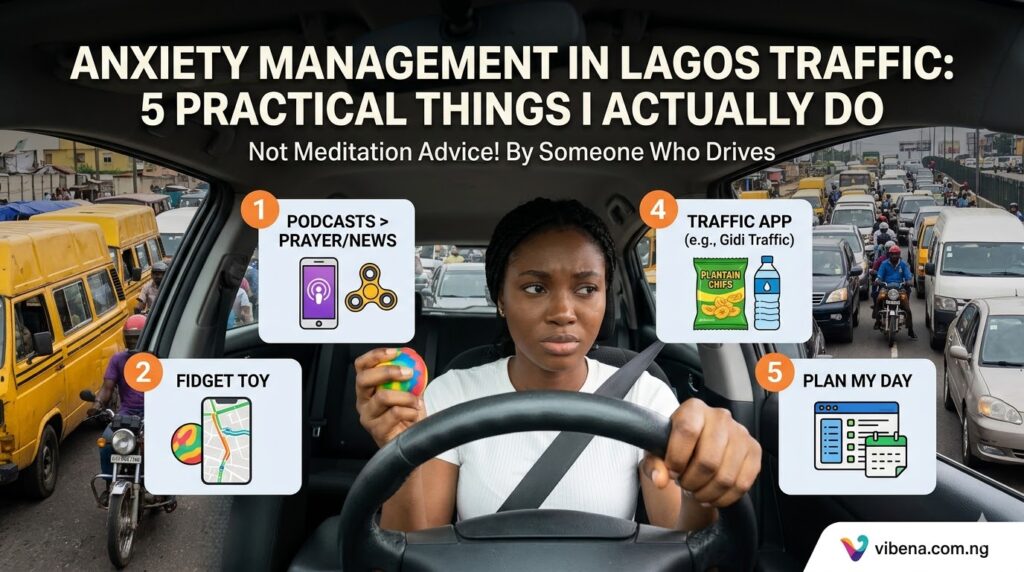
This article is not that kind of advice. I am not going to tell you to meditate on the Third Mainland Bridge. I am not going to suggest aromatherapy in a Marwa bus. I am going to share the five specific strategies I actually use to manage my anxiety during Lagos traffic, with real data from my commutes, honest assessments of what works, and practical tips you can use starting tomorrow.
If you are a remote worker, freelancer, or student dealing with the mental health toll of navigating Lagos, this is one person’s honest survival guide.
Why Lagos Traffic Is a Mental Health Issue, Not Just an Inconvenience
Before I get into my strategies, I want to be direct about something. Lagos traffic stress is not a minor complaint. It is a documented health risk.
According to a study published in the International Journal of Environmental Research and Public Health, commuters in Lagos experience significantly elevated levels of cortisol (the stress hormone) during peak traffic periods compared to non-commuting hours. The researchers noted that prolonged daily exposure to traffic congestion was associated with anxiety symptoms, irritability, and elevated blood pressure.
A separate study conducted by the University of Lagos Department of Psychology found that a significant percentage of Lagos commuters reported symptoms consistent with chronic stress disorder, including persistent anxiety, sleep disturbances, and difficulty concentrating at work. The study highlighted that the average Lagos commuter spends between 3 to 4 hours daily in transit, which ranks among the highest in the world.
According to the World Health Organization, mental health is a state of well-being in which an individual realizes their own abilities, can cope with the normal stresses of life, can work productively, and is able to make a contribution to their community. By that definition, traffic that leaves you exhausted, anxious, and unable to work effectively is a direct threat to your mental health.
This is not about being weak. This is not about “Lagos is not for everybody.” This is a real, measurable health impact that affects millions of people every single day.
I have lived in Lagos for seven years. I have experienced traffic on practically every major route. And I have learned, through years of trial and error, that managing the mental impact is just as important as managing the physical commute itself.
My Actual Commute Data: The Numbers Behind the Stress
I tracked my commute times for every trip I took outside my apartment during January and February 2026. Twenty-three trips total. Here is the raw data:
My Most Frequent Routes
| Route | Distance | Best Time | Worst Time | Average Time |
|---|---|---|---|---|
| Yaba to Ikeja (via Oshodi) | ~14 km | 35 minutes | 2h 12m | 1h 18m |
| Yaba to Victoria Island | ~15 km | 40 minutes | 2h 45m | 1h 32m |
| Yaba to Ajah (via Lekki) | ~28 km | 55 minutes | 3h 47m | 2h 15m |
| Yaba to Surulere | ~6 km | 15 minutes | 52 minutes | 28 minutes |
| Yaba to Gbagada | ~8 km | 18 minutes | 1h 05m | 35 minutes |
The Yaba to Ajah route is the worst offender. That 3 hour 47 minute nightmare was an outlier, but even the average of 2 hours 15 minutes for a 28-kilometre trip is absurd. For context, that same distance in a city with functioning infrastructure would take about 25 to 30 minutes.
The Yaba to Surulere route, which is only 6 kilometres, averaged 28 minutes. That is walking speed. I have literally walked it faster on a good day.
The Time I Lose Every Month
Based on my data, I spend an average of 18 to 22 hours per month in transit. That is roughly 2.5 to 3 full working days. Gone. Sitting in traffic. Every single month.
For a freelancer whose income depends on billable hours, those lost hours translate directly to lost income. At my average billing rate, I lose roughly ₦80,000 to ₦100,000 per month in potential earnings to traffic. That realisation alone is enough to trigger anxiety.
But it is not just the time. It is the quality of the time. You cannot do deep work in a danfo. You cannot take a client call on a BRT bus with 60 other passengers. You cannot focus on anything productive when your body is braced against every sudden stop and your mind is calculating whether you will make it to your appointment.
Traffic does not just steal time. It steals mental energy. And if you are already dealing with the stresses of freelancing, the rising cost of living in Lagos, power outages, and financial pressure, traffic becomes the straw that breaks the camel’s back.
Strategy 1: The Pre-Trip Anxiety Map
This is the strategy that made the single biggest difference for me, and it has nothing to do with what happens during the commute. It is about what happens before.
What I Used to Do
I used to leave for trips with a vague sense of how long it would take. “Ajah? Maybe an hour, maybe two. Let me just go.” This uncertainty was a breeding ground for anxiety because every red light, every unexpected jam, felt like a threat. I had no mental anchor.
What I Do Now
Before any trip, I spend 5 minutes creating what I call an anxiety map. This is not a Google Maps route (although that is part of it). It is a mental preparation exercise.
Step 1: Check real-time traffic. I open Google Maps at least 30 minutes before departure and check the actual traffic conditions on my planned route. The app shows red (heavy), orange (moderate), and green (clear) sections. I also check LASTMA’s official X account for any reported accidents or closures.
Step 2: Set realistic expectations. If Google Maps says 1 hour 45 minutes, I mentally prepare for 2 hours 30 minutes. Not 1:45. Not 2:00. I pad the estimate by 30 to 45 minutes. This single adjustment eliminates 80% of my in-traffic anxiety because I am no longer fighting against an unrealistic timeline.
Step 3: Identify my anxiety triggers. I ask myself: “What am I afraid will happen if this trip takes longer than expected?” Usually, the answer is: being late, missing an appointment, or wasting time. Then I address each trigger before leaving. If I might be late, I send a message to whoever I am meeting: “Traffic is looking heavy. I may arrive 20 to 30 minutes late. I will keep you updated.” Done. The anxiety trigger is defused before I even step outside.
Step 4: Pack my survival kit. More on this in Strategy 3.
Why This Works
According to research published in the Journal of Anxiety Disorders, anticipatory anxiety (anxiety about something that has not happened yet) often causes more distress than the event itself. By addressing the uncertainty before the trip, you remove the fuel that powers the anxiety during the trip.
Since adopting this pre-trip routine, my in-traffic panic attacks have dropped from roughly once every two weeks to once in the last three months.
Strategy 2: The Curated Audio Library (Not Just “Listen to Music”)
Every article about managing stress in traffic says “listen to music.” That advice is too vague to be useful. I tried it. I put on Burna Boy. The bass was thumping. The traffic was not moving. And my anxiety was still climbing because the upbeat music clashed with my internal state.
Here is what actually works for me.
My Three Audio Modes
I have three different audio playlists on my phone, each designed for a different emotional state. The key is matching the audio to how I am actually feeling, not how I wish I was feeling.
Mode 1: The Slow Down Playlist (For High Anxiety Moments)
This is for when my chest is tight and my thoughts are racing. The playlist is 90 minutes of slow instrumental music. No vocals. No lyrics. Just piano, acoustic guitar, and ambient sounds. Think Ludovico Einaudi, Nils Frahm, and some Afrobeats instrumentals without the vocals.
I found that vocals, even in songs I love, compete with my internal monologue and make anxiety worse. Instrumental music provides a sonic cushion without adding more words to an already overcrowded mind.
Mode 2: The Podcast Playlist (For Moderate Frustration)
When I am frustrated but not full-blown anxious, I switch to podcasts. Specifically, I listen to conversational podcasts where the topics are interesting but not stressful. Nigerian comedy podcasts, tech podcasts, interview shows. The key is that these podcasts give my brain something to chew on instead of spiralling.
I download episodes ahead of time so they are available offline. My data is too precious to waste on streaming in traffic. I talked about managing data costs in my best data plans for streamers guide, and the same principle applies here: download when you have Wi-Fi, consume when you do not.
Mode 3: The Hype Playlist (For When I am Almost There)
This is for the last 15 to 20 minutes of a trip when I can see my destination approaching. This is where Burna Boy, Wizkid, Asake, and Rema live. The upbeat energy helps me transition from “surviving traffic” to “I made it, time to perform.” It is a psychological gear shift.
I built a specific morning playlist that boosts mood during Lagos traffic that follows a similar logic. The article has more details on how to structure playlists for emotional regulation.
The Critical Rule: Earphones Are Non-Negotiable
I never leave for a trip without charged earphones. Dead earphones in Lagos traffic means being fully exposed to the honking, the shouting conductors, the diesel fumes, and every sensory trigger that feeds anxiety. My earphones are a portable boundary between my internal state and the external chaos.
Strategy 3: The Physical Survival Kit
This one sounds basic, but it has prevented at least a dozen anxiety spirals over the past year.
What I Carry on Every Trip
A 1-litre bottle of frozen water. I freeze a bottle the night before any trip. It starts as ice and slowly melts over the journey, giving me cold water for hours. Dehydration in Lagos heat amplifies every anxiety symptom: headaches, dizziness, irritability, racing heart. Staying hydrated is not just comfort. It is anxiety prevention.
Two cabin biscuits or a small pack of chin-chin. Blood sugar drops are real. If you are stuck in traffic for 3 hours and you have not eaten, your body goes into stress mode regardless of your mental state. A small snack at the 90-minute mark keeps my blood sugar stable and my brain functional.
A small towel or handkerchief. Lagos heat plus traffic anxiety equals sweat. Having something to wipe my face and hands with sounds trivial, but physical discomfort feeds mental discomfort. Reducing one reduces the other.
A fully charged phone with a small power bank. A dead phone in Lagos traffic is an isolation tank. No maps. No music. No communication. No sense of how much longer the journey will take. I always carry a small power bank that can give me at least one full phone charge.
₦2,000 in small bills. Even though mobile payments exist, having physical cash means I can switch transport modes if needed. If the BRT is impossibly slow, I can switch to an okada for the last stretch (where it is still available and legal). Options reduce the feeling of being trapped, which is a core trigger for traffic anxiety.
Why Physical Comfort Matters for Mental Health
This is something most “anxiety management” articles skip because they are written by people who have never experienced 35°C heat inside a public bus with broken windows. In Lagos, physical discomfort is not separate from mental distress. They are the same continuum.
When your body is hot, thirsty, hungry, and cramped, your nervous system is already primed for a fight-or-flight response. Adding the frustration and helplessness of gridlock traffic tips you over the edge. By keeping my body as comfortable as possible (hydrated, fed, cool), I keep my nervous system below the threshold where anxiety takes over.
According to the WHO, physical health and mental health are deeply interconnected, and addressing basic physical needs is a foundational component of mental well-being. It is not a luxury to carry water and snacks into Lagos traffic. It is self-preservation.
Strategy 4: The Reframe Technique (Making Traffic Productive)
This strategy took the longest to develop and the most discipline to maintain. But it has fundamentally changed my relationship with Lagos traffic.
The Old Story
My old internal narrative during traffic was: “I am wasting time. I am losing money. I should be working. This is pointless.” That narrative is a loop. It feeds itself. The more I told myself I was wasting time, the more anxious I became about the wasted time, which made the time feel even more wasted.
The New Story
I now use traffic time as dedicated input time. Let me explain.
As a freelancer, my work has two modes: output (writing articles, designing content, sending pitches) and input (learning, reading, listening, absorbing ideas). Output requires a desk, a laptop, and focus. Input can happen anywhere, including a BRT bus on the Third Mainland Bridge.
I now treat every commute as a scheduled learning session. Before each trip, I queue up specific content to consume:
Podcasts about my industry. Marketing trends, freelancing tips, Nigerian business news. This is professional development that I would otherwise struggle to fit into my workday.
Audiobooks. I download audiobooks from free sources like LibriVox (public domain books) or borrow audio titles from apps that offer free trials. One trip to Ajah is long enough to get through 3 to 4 chapters.
Voice-recorded article outlines. When an idea hits me in traffic, I open my phone’s voice recorder and talk through the outline. Some of my best articles started as rambling voice memos recorded on a bus. This article’s outline was recorded during a 1 hour 40 minute trip to Ikeja.
Language learning. I have been learning basic Yoruba (I grew up in Ilorin speaking mostly Hausa and English) using a free app. Traffic is perfect for 15-minute language sessions.
The Mindset Shift
The reframe is not about pretending traffic is fun. It is about assigning the time a purpose so that it stops feeling purposeless. When I am actively learning something, the same 2-hour trip that used to feel like torture feels like a long podcast episode that happens to include some bumpy roads.
On average, I now consume about 8 to 12 hours of educational content per month during commutes. That is the equivalent of a short online course. Every month. For free. In traffic.
I have been applying digital skills I learned partly through traffic-time podcasts and audio lessons. The irony is not lost on me: Lagos traffic, the thing that was destroying my mental health, has become one of my most consistent learning environments.
Strategy 5: The Strategic Avoidance Plan
This is the most practical strategy and the one that has saved me the most money, time, and mental energy. It is also the one most people resist because it requires changing habits.
The Core Principle: If You Can Avoid Traffic, Avoid Traffic
Not every trip is necessary. Not every meeting needs to be in person. And not every errand needs to happen during peak hours.
Since tracking my commute data, I have made three structural changes to my life:
Change 1: I Shifted to 85% Remote Work
I used to accept every in-person meeting request. Client wants to meet in Lekki? Sure. Collaborator wants to brainstorm in Ikeja? I will be there. Now, I default to virtual meetings and only travel for things that genuinely cannot be done online.
When I started pitching clients, I made clear in my proposals that I work remotely. I described how I built this into my workflow in my article on how I got my first 3 clients as a social media manager. Most clients do not care where you are physically sitting, as long as the work gets done.
This single change eliminated about 60% of my monthly commutes. That is 60% fewer anxiety triggers, 60% fewer lost hours, and 60% less transport spending.
Change 2: I Travel Only During Off-Peak Hours
When I must travel, I time it carefully based on my data:
Best departure times from Yaba:
- Before 6:30 AM: Roads are relatively clear. A trip to Ikeja that takes 1 hour 18 minutes on average takes about 35 minutes at 6:15 AM.
- Between 10:00 AM and 12:00 PM: The morning rush has cleared. The afternoon buildup has not started.
- After 8:00 PM: Evening traffic has mostly dissipated.
Worst departure times (avoid at all costs):
- 7:00 AM to 9:30 AM: Morning rush. Everything is gridlocked.
- 4:30 PM to 8:00 PM: Evening rush. Even worse than morning because fatigue amplifies frustration.
According to data from Google Maps and consistent with LASTMA advisories, Lagos peak traffic hours are approximately 6:30 to 10:00 AM and 4:00 to 8:00 PM on weekdays. By simply refusing to travel during these windows, I have cut my average commute times by roughly 40%.
Change 3: I Batch My Outside Errands
Instead of making three separate trips during the week (each one a potential 2-hour ordeal), I batch everything into one trip. Client meeting in Ikeja on Wednesday? I schedule the computer Village errand and the friend meetup for the same day, same area, back to back.
This batching approach comes from the same time management principles for side hustlers I use for my work. Treat your trips like appointments. Consolidate. Minimise.
The Financial Impact of Strategic Avoidance
By reducing my monthly trips from roughly 23 to about 9, I save approximately ₦12,000 to ₦18,000 per month in transport costs (BRT fares, danfo fares, occasional Bolt rides). That is ₦144,000 to ₦216,000 per year. Not insignificant when the cost of everything in Lagos keeps rising.
But the bigger savings are in mental energy. The trips I do not take are the panic attacks I do not have. The anxiety spirals that never start. The productive hours I keep.
What I Do When a Panic Attack Happens Anyway
Despite all my strategies, sometimes the anxiety wins. Sometimes the traffic is so bad, the heat so intense, and the bus so packed that my body overrides my brain.
Here is what I do when I feel a panic attack building in traffic.
The 5-4-3-2-1 Grounding Technique
This is the only “technique” from conventional anxiety management that actually works for me in a Lagos traffic setting. It is simple and requires no equipment.
I identify:
5 things I can see (the bus seat fabric, the window, a woman’s handbag, a billboard outside, my phone screen)
4 things I can touch (the seat handle, my backpack strap, the water bottle in my bag, my own knee)
3 things I can hear (the engine, the conductor shouting, someone’s phone ringing)
2 things I can smell (exhaust fumes, the person next to me’s perfume)
1 thing I can taste (the cabin biscuit I just ate)
This exercise takes about 60 to 90 seconds and forces my brain out of the spiral and back into the present moment. It does not make the traffic disappear. But it interrupts the anxiety loop long enough for my breathing to normalise.
Controlled Breathing (Modified for a Packed Bus)
Most breathing exercises tell you to close your eyes and breathe deeply for 10 minutes. Try doing that on a danfo with 18 people pressed against you. Not practical.
My modified version: I breathe in through my nose for a count of 4, hold for a count of 4, and breathe out through my mouth for a count of 6. I do this 5 times. The longer exhale activates the parasympathetic nervous system, which counteracts the fight-or-flight response.
I do this with my eyes open, looking at my phone screen (pretending to read something), so nobody notices. Discretion matters. I do not want the person next to me asking if I am okay.
The “Worst Case” Reality Check
When anxiety tells me “you are going to be stuck here forever,” I counter with facts:
“What is the longest I have ever been in traffic? 3 hours 47 minutes. I survived that. I will survive this.”
“If I am 30 minutes late, what actually happens? I apologise. The meeting starts late. Nobody dies.”
“Am I in physical danger right now? No. I am uncomfortable. Discomfort is not danger.”
These reality checks do not eliminate anxiety, but they lower the volume. They take the catastrophic thoughts and shrink them back to their actual size.
The Bigger Picture: Why This Matters for Remote Workers
If you are reading this as a freelancer or remote worker, you have an advantage that most Lagos residents do not: the option to stay home.
Every article I have written about working from home in Nigeria, from soundproofing against generator noise to staying focused during power outages, is ultimately about making your home workspace good enough that you rarely need to leave.
The more functional your home office is, the fewer trips you take. The fewer trips you take, the less traffic anxiety you experience. The less anxiety you experience, the more productive and creative you are. It is a virtuous cycle that starts with your environment.
I invested in my home setup precisely because of traffic anxiety. The ₦90,000 I spent on a budget inverter, the ₦30,000 on room soundproofing, and the ₦20,000 on a fibre internet connection were all investments in not having to leave. And they have paid for themselves many times over in saved transport costs, saved time, and preserved mental health.
When to Seek Professional Help
I want to end on this note because it is important.
If your anxiety during traffic is persistent, if it happens every single trip regardless of conditions, if it is spreading into other areas of your life (difficulty sleeping, constant worry, inability to concentrate even at home), you may be dealing with a generalised anxiety disorder or a phobic anxiety disorder that goes beyond normal traffic stress.
According to the WHO, anxiety disorders are among the most common mental health conditions globally, affecting hundreds of millions of people. They are treatable. And seeking help is not weakness.
In Lagos, there are several options:
Federal Neuropsychiatric Hospital, Yaba: This is the largest public mental health facility in Lagos. It offers outpatient consultations at subsidised rates.
Lagos State Government Free Mental Health Helpline: The Lagos State Ministry of Health operates mental health support services that can provide guidance and referrals.
Private therapists: Several platforms now connect Nigerians with licensed therapists for online sessions, making therapy accessible even if you cannot physically get to a clinic (which, given Lagos traffic, is its own ironic barrier).
If you are not ready for professional help, start with the strategies in this article and observe whether they make a meaningful difference over 2 to 4 weeks. If they do not, please consider talking to someone qualified. Your mental health is not a side issue. It is the foundation everything else in your life is built on.
I explored the connection between chronic stress, exhaustion, and mental health more deeply in my article on why you are always tired and have no energy. If traffic anxiety is one piece of a larger pattern of burnout, that article might help you see the full picture.
Frequently Asked Questions
Is it normal to feel anxious in Lagos traffic?
Yes. Research conducted across multiple Nigerian universities confirms that Lagos commuters experience elevated stress and anxiety levels compared to their non-commuting baselines. The combination of unpredictable journey times, extreme heat, overcrowding, poor road conditions, and noise creates a uniquely stressful environment. Your anxiety is a normal response to an abnormal situation.
How long does the average Lagos commuter spend in traffic?
According to multiple studies on Lagos transportation, the average commuter spends approximately 3 to 4 hours daily in transit. My personal data shows an average of 18 to 22 hours per month for trips taken 2 to 3 times per week. Full-time daily commuters experience significantly more.
Can working from home reduce traffic anxiety?
Yes, dramatically. Switching to remote work eliminated roughly 60% of my commutes and correspondingly reduced my traffic-related anxiety episodes. If your work can be done remotely, negotiating even 2 to 3 work-from-home days per week can make a meaningful difference.
What is the best time to travel in Lagos to avoid traffic?
Based on my data and consistent with LASTMA advisories, the best windows are before 6:30 AM, between 10:00 AM and 12:00 PM, and after 8:00 PM on weekdays. Saturdays are generally better than weekdays, though Lekki and Victoria Island routes can still be congested on Saturday afternoons.
Does listening to music actually help with traffic anxiety?
It depends on the music and your emotional state. In my experience, instrumental music without vocals works best during high anxiety moments. Upbeat music with lyrics can make anxiety worse if it clashes with your internal state. The key is matching the audio to your current mood, not the mood you wish you had.
Final Thoughts
Lagos traffic is not going to get better anytime soon. The infrastructure is decades behind the population. The roads are overloaded. The public transport system is improving but still insufficient. These are structural problems that no individual can solve.
What you can control is how you respond.
You can prepare before each trip. You can build an audio library that turns wasted time into learning time. You can pack water, snacks, and a power bank so your body does not betray your mind. You can reframe commutes as input sessions instead of lost hours. And you can strategically avoid unnecessary trips entirely.
None of these strategies are revolutionary. None of them require money you do not have. They just require the decision to stop treating traffic as something that happens to you and start treating it as something you manage.
I still get anxious in traffic sometimes. Last week, a trip to Victoria Island took 2 hours and 38 minutes and I felt my chest tighten around the 90-minute mark. But I had my water. I had my podcast queued. I had already messaged my client about being late. And I had my 5-4-3-2-1 grounding technique ready.
The anxiety came. It stayed for about 5 minutes. Then it passed.
That is not perfection. But it is progress. And in Lagos, progress is everything.
Want more strategies for protecting your wellbeing? Check out my guides on self-care ideas for Nigerians, quick stress relief methods you can do at home, and how to plan a reset day for stress relief.

Oladepo Babatunde (Prince Babatee Tunde) is a Computer Scientist, researcher, and professional content writer with a Higher National Diploma in Computer Science from Kwara State Polytechnic, Nigeria.
With a background in technology and a passion for clear communication, Babatunde specializes in creating thoroughly researched, reader-focused content on productivity, personal development, home living, and technology. Every article he writes is backed by extensive research and fact-checking to ensure readers receive accurate, actionable information.
As a freelance writer, he has helped brands and publications deliver content that educates, engages, and empowers their audiences. His mission at Vibena is simple: make complex topics easy to understand and help Nigerians live smarter, more productive lives.