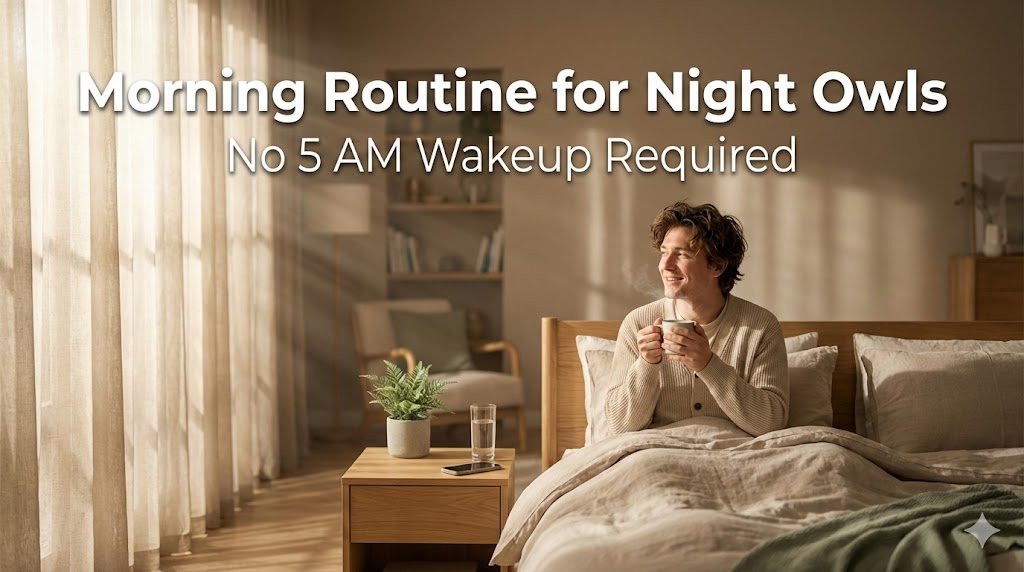
Let’s be honest: The alarm goes off, and it feels like a personal attack. While the rest of the world seems to be happily jogging at sunrise, you are hitting the snooze button for the third time.
I’ve been there. For years, I thought I was just lazy. I would stare at the ceiling at 1:00 AM, my brain suddenly alive with my best ideas, only to pay the price the next morning. My partner and I would often find ourselves solving the world’s problems past midnight, while our “morning person” friends were long asleep. I realized I wasn’t broken or unmotivated. I was just fighting my biology.
This isn’t another article telling you to wake up at 5 AM. If you’re naturally an early riser, you might benefit more from our morning routine guide for Nigerian professionals. But if mornings feel like a battle, keep reading.
This is a realistic Morning Routine for Night Owls designed to help you succeed on your own terms.
In this guide, we will cover how to build a routine that works with your body, not against it. We’ll look at the science, practical hacks I’ve tested personally, and the best ways to get things done without losing sleep. For years, I thought I was lazy. This is a common limiting belief. Learn how to develop a growth mindset that drives real success instead of beating yourself up.
Why Traditional Morning Routines Fail Night Owls
Have you ever tried a “millionaire morning routine” and failed by day two? You are not alone. Most productivity advice assumes everyone has the same body clock.
Morning person vs night person psychology is very different. According to sleep researcher Dr. Michael Breus, approximately 30% of the population are “wolves” (classic night owls), while 15% are “lions” (early risers), 40% are “bears” (aligned with the sun), and 15% are “dolphins” (irregular sleepers prone to insomnia). Research suggests that night owls often demonstrate enhanced creativity and problem-solving abilities during their peak evening hours. The University of Madrid found that evening types tend to score higher on certain cognitive measures, particularly in creative thinking.
The problem isn’t you; it’s the schedule. Traditional routines demand peak energy when your body is still ramping up. Trying to force a 5 AM start when your biology says “sleep” is a recipe for burnout, not success.
Understanding Your Night Owl Chronotype
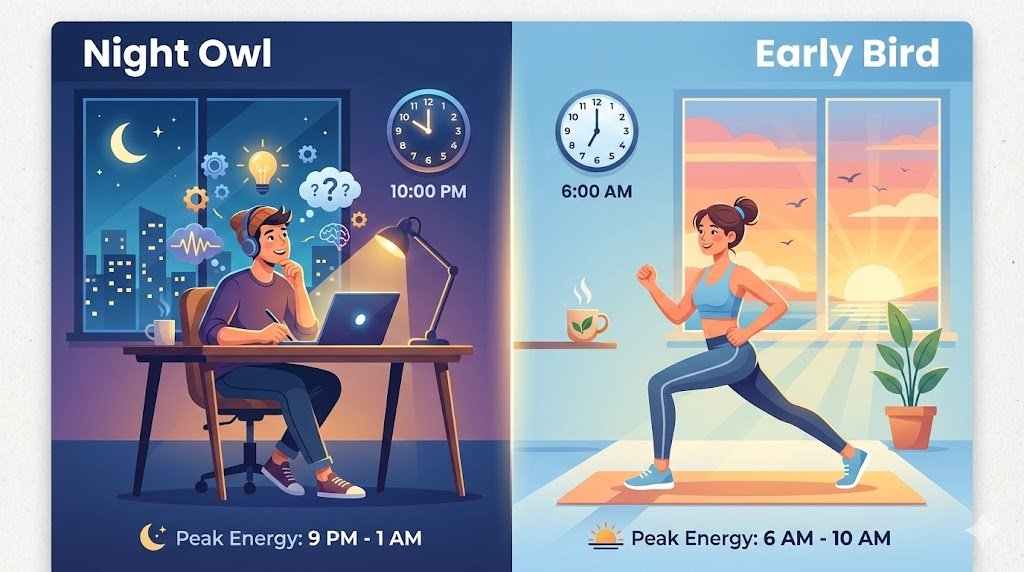
To fix your mornings, you need to understand something called chronobiology. This is the science of your internal body clock.
Your chronotype—which is largely determined by genetics—controls your natural sleep-wake cycle. According to the Sleep Foundation, if you have a “delayed sleep phase,” your body releases melatonin (the sleep hormone) much later in the evening than early birds.
UCLA Health explains that your chronotype depends on several factors including age (children have earlier chronotypes that shift later in adolescence before moving earlier again in adulthood), genetics (researchers have identified several associated genes), and outside influences like light exposure and lifestyle choices. The NIH confirms this, noting that using genome-wide data from nearly 700,000 participants, researchers identified hundreds of gene variations connected to sleep timing.
Signs you are a true night owl:
- You feel most alert and creative after 9 PM.
- You experience heavy sleep inertia (grogginess) if you wake up early.
- You rely heavily on caffeine to function before noon.
Studies have shown that night owls who try to live like early birds often suffer from “social jetlag.”
This isn’t just feeling tired. Social jetlag is a specific pattern where your sleep schedule varies wildly between work days and free days. For example, waking up at 7 AM on weekdays but sleeping until 10 AM or 11 AM on weekends creates a 2-3 hour “weekend recovery” shift. This constant shifting disrupts your circadian timing as much as flying across time zones every single week.
The consequences are real. Many epidemiological studies have shown strong associations between social jetlag and the prevalence of diverse pathologies, ranging from depression and cardiovascular risks to metabolic dysfunction. This is why fighting your biology backfires—it’s not just about willpower; it’s about your long-term health. If you’re following a routine that fights your biology, you might constantly feel drained. Learn more about why you’re always tired and have no energy and how to fix it.
Interestingly, research suggests that while enforced social jetlag (waking early for work when your body wants to sleep) disrupts health, voluntary sleep extension on weekends might actually protect it. Longer sleep is protective against metabolic dysfunction even on free days, so don’t feel guilty about catching up on rest when you can.
A Note for Teens and Parents
If you are a teenager (or raising one), know that biology is playing a huge role here. Melatonin release is naturally delayed during adolescence, which shifts the internal clock later. This makes teenagers biologically prone to being evening chronotypes. When you combine this natural shift with increased screen time and social pressures, adolescents face a very high risk for social jetlag.
The Best Schedule for Night Owls
So, what is the best schedule for night owls? It is one that prioritizes sleep duration over wake-up time.
If you have a flexible job, stop apologizing for waking up at 8:30 AM or 9:00 AM. Here is how to structure your day for peak performance hours:
- 8:30 AM – 9:30 AM: Wake up, hydrate, get light exposure.
- 9:30 AM – 11:00 AM: Low-energy tasks (emails, planning).
- 11:00 AM – 1:00 PM: Moderate work.
- 1:00 PM – 2:00 PM: Break/Nap.
- 3:00 PM – 8:00 PM: Deep work (This is your superpower time).
How to function as a night owl is about matching your hardest tasks to your highest energy. Don’t do your taxes at 8 AM. Save the complex work for the afternoon or evening.
How to Survive as a Night Owl in a 9 to 5 World
Not everyone works from home. If you have a strict boss, you need to know how to survive as a night owl in a 9 to 5 world.
- Negotiate Flex Time: Even shifting your hours from 8-5 to 10-7 can save your life. Negotiating flex hours requires confidence. Understanding why setting boundaries is important for work-life balance can help you make that conversation easier.
- Front-Load Easy Tasks: Save your “brain power” tasks for the afternoon. Use the morning for meetings or admin work.
- Prepare the Night Before: Your evening self is smarter than your morning self. Pack your bag and prep your lunch at night. Night owls who run side businesses face unique scheduling challenges. Our guide on time management for side hustlers balancing a 9-5 covers this in detail.
The 3 Downs and 3 Ups Method for Night Owl Mornings
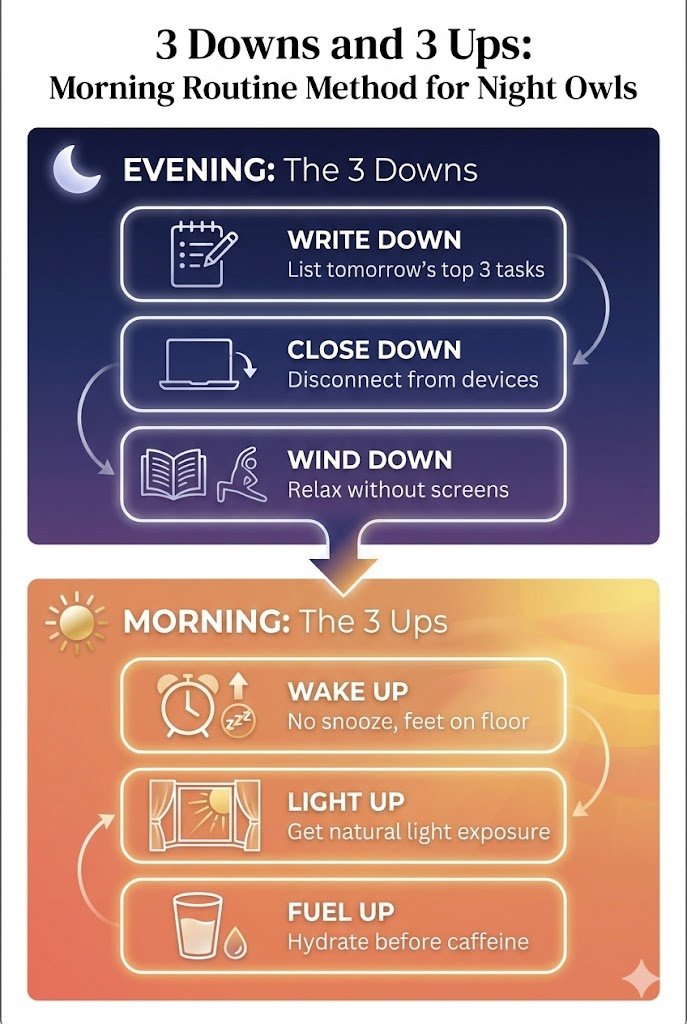
I adapted this framework, inspired by the Break the Twitch philosophy, because complex, multi-step routines didn’t work for me. This approach simplifies your routine into evening prep (Downs) and morning action (Ups). Your evening prep becomes even more powerful when combined with a Sunday reset routine checklist that sets up your entire week.
The 3 Downs (Evening)
- Write Down: Before bed, write down the top 3 tasks for tomorrow. This clears your mind so you don’t lay awake worrying. Writing down your top 3 tasks doesn’t have to take long. Try these 2-minute micro-journaling prompts to clear your mind before bed.
- Close Down: Shut down your laptop and put your phone away. Disconnect to reconnect with sleep.
- Wind Down: Do something relaxing. Read a book or stretch. No screens. For your Wind Down phase, try one of these quick stress relief techniques you can do at home.
The 3 Ups (Morning)
- Wake Up: Don’t snooze. Use an alarm across the room if you must.
- Light Up: Open the curtains immediately. Light exposure therapy resets your circadian rhythm.
- Fuel Up: Drink a big glass of water before anything else.
Popular Morning Routine Methods Explained
There are many “rules” out there. Let’s see how they fit a night owl’s life.
What Is the 5 5 5 30 Morning Routine?
The 5 5 5 30 morning routine breaks down as:
- 5 minutes of gratitude practice
- 5 minutes of stretching or light movement
- 5 minutes of meditation or mindfulness
- 30 minutes of reading or learning Total time: 45 minutes
- Night Owl Twist: You can do this! Just do it at 9 AM instead of 5 AM. It’s a gentle way to start the day without heavy lifting.
What Is the 20 20 20 Rule for Morning Routine?
The 20 20 20 rule splits the first hour of your day into three distinct blocks:
- 20 minutes of moving (sweat/exercise)
- 20 minutes of reflecting (journaling/meditation)
- 20 minutes of growing (reading/learning)
- Night Owl Twist: If 60 minutes is too long, try the “10/10/10” version. 10 minutes moving, 10 reflecting, 10 learning.
What Is the 5 4 3 2 1 Routine?
The 5 4 3 2 1 routine is a mental trick to beat hesitation:
- Acknowledge the instinct to snooze or delay
- Count backward from 5 (5-4-3-2-1)
- Physically move immediately when you hit 1
- Why it works: It interrupts your brain’s excuses. This is crucial for morning grogginess. The 5-4-3-2-1 method helps interrupt your brain’s excuses. For more techniques like this, check out these science-backed strategies to stop procrastinating.
What Is the Morning 1 Hour Rule?
This rule states: No phone for the first hour of the day.
- Why use it: Checking email in bed puts you in “reactive” mode. Stay in “proactive” mode by delaying the scroll.
Comparison of Morning Routine Methods
| Method | Time Required | Best For Night Owls? | Difficulty |
|---|---|---|---|
| 5 5 5 30 | 45 minutes | Yes (adjust timing) | Easy |
| 20 20 20 | 60 minutes | Moderate (try 10/10/10) | Medium |
| 5 4 3 2 1 | 5 seconds | Excellent | Easy |
| 1 Hour Rule | 60 minutes | Excellent | Medium |
| 3/2/1 Bedtime | Evening prep | Essential | Easy |
Night Preparation: The Secret to Easier Mornings
Your morning actually starts the night before.
What Is the 3/2/1 Bedtime Rule?
The 3/2/1 bedtime rule helps you structure your evening cutoff times:
- 3 hours before bed: No food (helps digestion)
- 2 hours before bed: No work (calms cortisol)
- 1 hour before bed: No screens (protects melatonin production)
Light Hygiene: The Critical Factor
Dr. Samer Hattar from the National Institutes of Mental Health warns that blue light exposure from screens between 10 p.m. and 4 a.m. decreases dopamine levels and negatively impacts feelings of depression and anxiety. Once in a while is fine, but regular late-night screen exposure will affect your health.
If you need light at night (to use the bathroom or check on children), try using amber or red light instead of bright white light. Red light minimally impacts melatonin levels. Inexpensive red “party light” bulbs work fine. Consider shifting to red lights around 9 p.m. to improve sleep quality.
What Is the Military Sleep Method?
Trouble falling asleep? Try this technique, often popularized as a “CIA trick” or military hack, designed to help pilots fall asleep in two minutes or less.
- Note: This technique is often attributed to US Navy Pre-Flight School training, though exact origins vary.
- Lie on your back.
- Relax your face muscles, including your tongue and jaw.
- Drop your shoulders as low as they go.
- Clear your mind for 10 seconds by imagining a calm lake.
- If you think, tell yourself “Don’t think, don’t think.”
8 Practical Morning Hacks for Night Owls

Here are evidence-based techniques I’ve used to make mornings less painful.
1. Hydrate Before Caffeine
You wake up dehydrated. Water wakes up your brain faster than coffee. I keep a full water bottle on my nightstand so I don’t even have to get out of bed to start hydrating.
2. Automate Your Coffee Brewing
Buy a coffee maker with a timer or use a smart plug. Waking up to the smell of coffee is a great motivator.
3. Embrace Morning Light Exposure
Neuroscientist Dr. Andrew Huberman recommends getting 5-10 minutes of sunlight in your eyes within the first hour of waking. This triggers a healthy cortisol spike (the energizing kind) and sets a biological timer for melatonin release approximately 14-16 hours later. For night owls, this is especially powerful because it gradually shifts your circadian rhythm earlier without the shock of a 5 AM alarm.
Dr. Huberman also recommends getting outside in the afternoon. The particular wavelengths of the sun when it is low in the sky (yellows and oranges) communicate to the brain’s circadian clock that it is evening and time to begin transitioning to sleep. This serves as a second “anchor point” for your circadian system—especially helpful if you missed morning sunlight.
- Pro Tip: If you live in a dark area, invest in a 10,000 lux light therapy lamp. I use mine for 10 minutes while checking emails.
4. Simplify Morning Decisions
Decision fatigue is real. Lay out your clothes the night before. Make your breakfast choice automatic.
5. Use the “1-Habit” Morning Routine
Don’t try to do yoga, journal, and run. Pick just one thing. Maybe it’s “Make the bed.” Start small. Music can transform your morning energy. Learn how to create a morning playlist that boosts your mood—even during traffic.
6. Plan Breakfast Wisely (Or Skip It)
If you aren’t hungry, don’t eat. Many night owls prefer intermittent fasting. If you do eat, choose protein over sugar to avoid a crash.
7. Create a “Morning Basket”
Keep your essentials (journal, pen, book, water) in one basket. You don’t have to search for things when you are tired.
8. Match Tasks to Energy Levels
Don’t schedule creative meetings at 8 AM. Save your brilliance for your natural body clock peak.
Can a Night Owl Become a Morning Person?
Many people ask, “How to stop being a night owl?” or “Can a night owl become a morning person?”
The honest answer? Maybe, but it is hard. You can shift your clock by getting light early and taking melatonin early (always consult your doctor before taking supplements). However, you will always naturally drift back to late nights. It is usually better to manage your energy than fight your genetics.
Are High IQ People Night Owls?
You might have heard the rumor: Are high IQ people night owls? Satoshi Kanazawa, researcher at the London School of Economics, published a study suggesting that intelligent people are more likely to be nocturnal. This evolutionary novelty theory suggests that staying up late is a “modern” trait.
- The Takeaway: Being a night owl might mean you are creative and intelligent. Don’t feel bad about it!
A Word of Caution: What Research Says About Late Nights
While being a night owl has perks, we must look at the full picture. A significant study from Stanford Medicine published in May 2024, analyzing data from more than 73,000 adults from the UK Biobank, offers a warning.
Researchers found that everyone benefits from going to bed earlier, even if they are natural night owls. The study showed that night owls who stayed up late were 20% to 40% more likely to have mental health struggles compared to those on an earlier schedule.
Jamie Zeitzer, PhD, a professor at Stanford, explained: “We found that alignment with your chronotype is not crucial here, and that really it’s being up late that is not good for your mental health.”
Why? Scientists call it the “Mind After Midnight” effect. Your brain’s frontal cortex (the part that makes good decisions) works less efficiently during biological night.
Dr. Zeitzer explains that when you’re awake during the “biological night”—the period when your body’s internal clock expects you to be asleep—your brain may not function as effectively. By late evening, you’ve often gone through 16+ hours of experiences, demands, and stressors from the day. That cumulative load can make it harder to manage thoughts or emotions as effectively as earlier in the day.
Additionally, with fewer people awake, social guardrails and support systems are not available, and late-night hours bring more isolation. Different late-night behaviors may have different effects on mental health—engaging socially with friends might be less harmful than spending those hours doomscrolling on your phone or ruminating alone.
Dr. Zeitzer notes: “If you’re up until two o’clock in the morning and you’re being social, that’s probably not so bad as if you’re up until two o’clock in the morning mindlessly binge-watching a show. So, people need to pay attention to what they’re doing in those late hours, because not all behaviors at 2 a.m. are created equal.”
The Balance: The study, published in Psychiatry Research, specifically recommends lights out by 1 a.m. as a practical threshold.
Dr. Zeitzer advises: “If you want to try going to sleep earlier, get morning light, avoid bright light in the evening, and start developing a consistent wind-down routine. Stick to it, and then gradually shift it earlier—little by little—to help establish a new pattern.”
Prioritizing Sleep Quality Over Wake Time
It doesn’t matter when you wake up if you sleep poorly. The CDC notes that more than one in three adults don’t get enough sleep, which impacts long-term health. To improve your sleep schedule for night owls:
- Keep your room cool (around 65°F or 18°C). Keeping your room around 18°C (65°F) helps sleep quality. Here’s how to cool down a hot house without AC.
- Use blackout curtains.
- Invest in a good mattress.
- Get 7-9 hours of sleep, regardless of when you start.
Creating Your Personalized Night Owl Morning Routine
Ready to build your own?
- Assess: What time do you naturally wake up?
- Adjust: Can you move work later?
- Plan: Use the 3 Downs and 3 Ups.
- Track: Try it for a week.
Sample Schedule Template:
- Night Before: 3/2/1 Rule.
- Wake Up: 5-4-3-2-1 Method.
- First 10 Mins: Hydrate + Sunlight.
- First Hour: No Phone + One Habit.
Your morning routine should support your bigger life goals. Use our SMART goals framework for young Nigerians to align your daily habits with what you want to achieve.
Frequently Asked Questions
Is it unhealthy to be a night owl? Not necessarily. It is only unhealthy if you don’t get enough sleep or if your schedule causes stress. However, recent research suggests staying up extremely late may impact mental health, so balance is key.
How do I fix my sleep schedule? Shift your wake-up time back by 15 minutes every day. Use morning sunlight and evening melatonin to help your body adjust gradually. If you are extremely stressed, you might even consider to plan a reset day for stress relief.
What if I have to wake up early? Preparation is key. Go to bed earlier, remove all light from your room, and put your alarm across the room so you have to walk to turn it off.
Is staying in bed all day okay? Sometimes rest is necessary. Read more about bed rotting as self-care to understand when it’s helpful and when it’s harmful.
Conclusion
Being a night owl isn’t a curse. In my view, it’s just a different way of existing. You don’t need a 5 AM wake-up call to be successful. You need a routine that respects your biology. Start with one change tomorrow—maybe just the water or the sunlight—and watch how your day changes.

Oladepo Babatunde (Prince Babatee Tunde) is a Computer Scientist, researcher, and professional content writer with a Higher National Diploma in Computer Science from Kwara State Polytechnic, Nigeria.
With a background in technology and a passion for clear communication, Babatunde specializes in creating thoroughly researched, reader-focused content on productivity, personal development, home living, and technology. Every article he writes is backed by extensive research and fact-checking to ensure readers receive accurate, actionable information.
As a freelance writer, he has helped brands and publications deliver content that educates, engages, and empowers their audiences. His mission at Vibena is simple: make complex topics easy to understand and help Nigerians live smarter, more productive lives.