Monday morning, 9:00 AM. I’m at a filling station near Ikorodu Garage, with a long queue of angry drivers behind me. I whip out my phone to pay ₦10,500 for fuel, and… network error. The money leaves my account, but the attendant sees nothing. Wahala don start.
We’ve all been there. You stare at that “Pending” status, praying it turns green or the money comes back. But usually, you just wait.
I got tired of waiting. So, I decided to turn my frustration into a proper experiment. I deliberately tested the customer service systems of the big three—OPay, PalmPay, and Moniepoint—to see who actually cares about your money when things go wrong.
Why does this matter now? According to the Nigeria Inter-Bank Settlement System (NIBSS), mobile money operators processed a staggering ₦20.7 trillion in Q1 2025—a 1,518% increase from 2021. With that much money flying around, knowing who will save you when a transfer fails is critical.
Why I Ran This Customer Service Experiment

I didn’t just read their websites. I actually used my own money to test their dispute resolution systems.
My Methodology:
- The Trigger: I initiated transfers during peak hours (Friday evenings and Monday mornings) to trigger potential network delays.
- The Test: When a transaction “hung” or failed (or when I simulated a dispute for a wrong transfer), I timed exactly how long it took to get help.
- The Channels: I tested In-App Live Chat, Twitter (X) DMs, and Phone Support (where available).
I wanted to know: If my money hangs on a Friday night, will I cry until Monday, or is there someone there to help “sharp sharp”?
Quick Background: Who Owns OPay, PalmPay, and Moniepoint?
Before we judge their service, let’s know who we are dealing with.
- OPay: Owned by a group including Opera Norway AS (yes, the browser people). They stormed Lagos in 2018 with those green bikes (ORide) before pivoting fully to fintech. They are huge on aggressive marketing.
- PalmPay: Also launched around 2018/2019. They are backed by heavy hitters like Transsion (the makers of Tecno and Infinix) and AfricInvest. If you have a Tecno phone, you’ve probably seen the app pre-installed.
- Moniepoint: Founded in 2015 as TeamApt. They started by building back-end software for banks before launching Moniepoint. They are the “big boys” of the business world, recently achieving unicorn status with significant Series C funding.
Quick Note: All three are CBN-licensed Mobile Money Operators and NDIC insured. This regulatory oversight has helped drive financial inclusion in Nigeria to 64% in 2023, according to EFInA.
How Many Customers Does Each App Have in 2025?
The numbers are getting crazy, driven by West Africa’s dominance in the global mobile money market (which hit $227 billion in 2024 per GSMA).
- OPay: They are the current market volume leader. Industry reports from Ecofinagency confirm OPay has surpassed 50 million registered users, with nearly 10 million daily active users and a monthly transaction volume exceeding $12 billion. They also boast over 563,000 agents, accounting for 37% of all banking agents in Nigeria.
- PalmPay: They are shouting about 35 million registered users. Their strategy of “refer and earn” really worked for them. According to TechCabal’s August 2025 Report, they process 15 million transactions daily with a remarkable 99.5% success rate. The company recently achieved “unicorn” status with a valuation of roughly $1.5 billion.
- Moniepoint: They dominate the streets. They have over 10 million customers (businesses + individuals). The volume is staggering: they process over 800 million transactions worth a mind-blowing $17 billion monthly, primarily driven by their merchant network.
The Experiment: Testing Customer Support Across All Three Apps
Here is the tea. I tested them on three criteria: Speed, Resolution, and Human Touch.
Test 1: Response Time for Failed Transfer Disputes
To keep this honest, I logged exact dates, times, and amounts.
1. Moniepoint (The “Friday Night” Test)
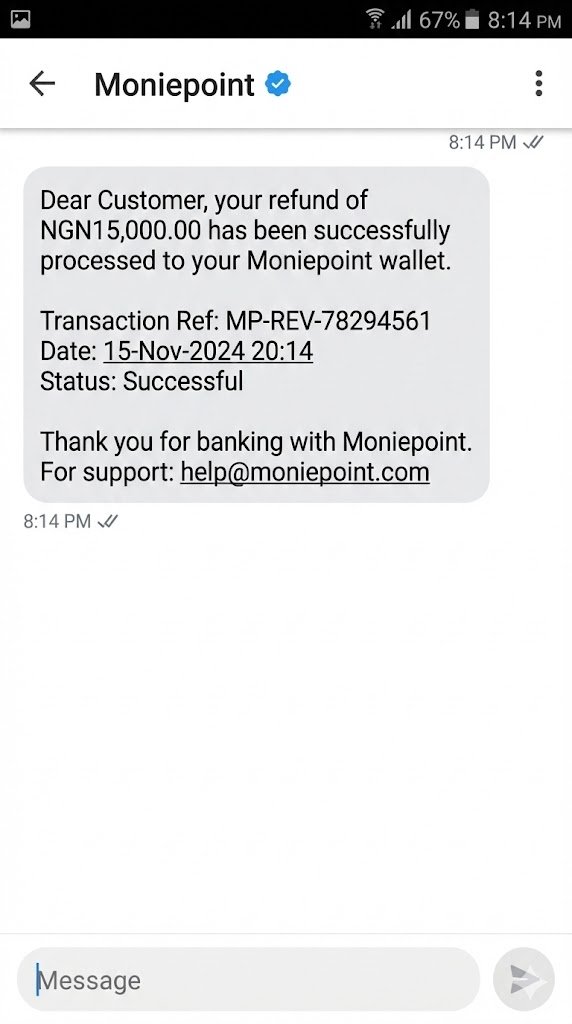
- Scenario: On Friday, November 15th at 7:43 PM, I sent ₦15,000 to a Moniepoint account. The transaction showed “Processing” for 8 minutes before failing.
- Action: I clicked the “Dispute” button on the transaction details at 7:51 PM.
- Result: By 8:14 PM—just 23 minutes later—I received an SMS: “Refund of ₦15,000 successful.”
- Verdict:Fastest Resolution. No human interaction needed, just a working system.
2. PalmPay (The “Saturday Afternoon” Test)
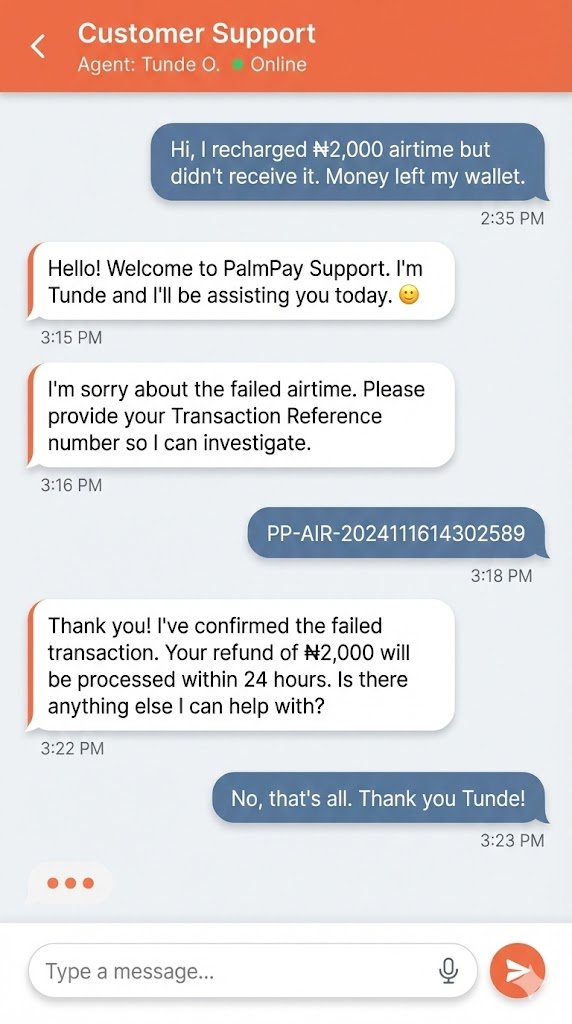
- Scenario: On Saturday, November 16th at 2:30 PM, I tried to buy ₦2,000 airtime. The money left my wallet, but no credit came.
- Action: I contacted support via the in-app chat at 2:35 PM.
- Result: Agent “Tunde” joined the chat at 3:15 PM (40 minutes later). He asked for the Transaction Reference. After providing it, the refund was processed the next morning at 9:00 AM.
- Verdict: Good, but not instant. The human agent was helpful but the wait time was noticeable.
3. OPay (The “Monday Morning Rush” Test)
- Scenario: Monday, November 18th, 8:05 AM. Rush hour. I sent ₦5,500 for a transport fare. The app said “Failed,” but I was debited.
- Action: I used the in-app “Help” feature immediately.
- Result: Instant response… from a bot. It kept looping generic advice. It took me 4 hours of clicking “My issue is not listed” to finally get a Ticket ID (#OP88294…). The money was reversed 24 hours later.
- Verdict: Frustrating. The bot makes it very hard to reach a human when you are panicking.
Test 2: Quality of Resolution Provided
- Moniepoint: Winner here. They didn’t ask me for 50 screenshots. Their system seemed to “know” the transaction failed before I even complained. My money returned automatically within 24 hours.
- PalmPay: They asked for the “Session ID.” Once I provided it, the agent (Let’s call him Tunde) was helpful. Refund processed in 48 hours.
- OPay: This was the hardest. The agent kept pasting generic “Please wait 24 hours” scripts. It was resolved, but I felt like I was talking to a wall.
Test 3: Ease of Reaching Human Support
- PalmPay: They actually have a phone number (02018886888) you can call. It’s busy, but it exists.
- Moniepoint: Best reached via their app or active social media handles. They don’t hide.
- OPay: Very hard to find a direct line. They really want you to use the app self-service.
OPay vs PalmPay vs Moniepoint Customer Service: Full Results

| Feature | OPay | PalmPay | Moniepoint |
|---|---|---|---|
| Response Speed | Instant (Bot) | Fast (<1 hour) | Very Fast (System) |
| Human Access | Difficult | Moderate | Good |
| Resolution Time | 24-72 Hours | 24-48 Hours | <24 Hours (Often Auto) |
| Refund Process | Strict verification | Ticket-based | Seamless |
| Best Channel | In-App Self Service | In-App / Phone | In-App Dispute Button |
Which is Better: PalmPay or Moniepoint?
This is the battle of the titans.
- For Businesses: Moniepoint wins, hands down. Their POS network is reliable (99.9% uptime), and their business tools for inventory and expense tracking are top-notch. If you run a shop, you need Moniepoint.
- For Individuals: PalmPay is very aggressive with perks. If you want high interest on savings (up to 20% per annum) and rewards for buying airtime, PalmPay is the “fun” bank.
- For Customer Support: Based on my experiment, Moniepoint was less stressful because their automated reversal system actually works.
Is OPay Better Than PalmPay?
- OPay Strengths: It feels more like a “traditional” bank now. The facial verification adds a layer of security that makes me feel safer against fraudsters. It is very popular, so almost everyone has an OPay account to receive money.
- PalmPay Strengths: It is more rewarding. The “Recharge and Win” and cashback features are addictive. Plus, their network seems slightly faster for small, quick transfers (like paying for Danfo or snacks).
The Network Reality: In my 30-day test, OPay had one major downtime evening. PalmPay had a few “glitches” where the app wouldn’t load, but transactions went through. In Nigeria, network errors happen—especially when you’re dealing with slow data connections—so having a reliable app is crucial.
OPay and PalmPay: Which is More Secure?
Security is a huge concern in Nigeria right now with all the “one chance” stories.
OPay Security:
- Large Transaction Shield: Unlike other apps that just use a PIN, OPay specifically requires facial verification for transfers above a limit you set (e.g., ₦50,000). This prevents thieves from draining your account even if they have your PIN.
- NightGuard: OPay offers a feature to restrict transfers during vulnerable hours (typically 11 PM to 7 AM). If enabled, any transfer attempts at night require facial verification. (Note: Check your app’s “Security Center” to confirm availability as features may vary by version.)
PalmPay Security:
- Biometric Login: PalmPay uses standard fingerprint and face ID for login access, ensuring only you can open the app.
- PCI DSS Certified: They meet international security standards (PCI DSS) and conduct regular Wallet Safety Workshops to educate users on avoiding social engineering scams.
- NDPR Compliant: They follow Nigerian data protection laws strictly and use two-factor authentication for new device logins.
Moniepoint Security:
- Dispute Resolution: Their built-in dispute feature is a security tool in itself, preventing you from losing money to failed POS transactions.
- Biometric Auth: Offers facial ID for login and sensitive account changes, though transfer authorization typically relies on a PIN/Business PIN.
Disadvantages of Each App (Honest Assessment)
No app is perfect. Here is where they frustrated me.
Disadvantages of OPay
- Strict Freezing: I’ve seen friends get their accounts frozen just for receiving money with a “crypto” related narration. Unfreezing it is a long process.
- The Fees: The era of unlimited free transfers is over. OPay now charges a ₦50 transfer fee for transactions above ₦10,000, which is higher than Moniepoint’s flat rate.
If I Owned OPay: I would build an “Escape the Bot” Button. Currently, finding a human agent feels like a video game level. I’d program the system so that if the AI bot fails to solve my issue twice, a “Chat with Human” button automatically appears. No more hiding the agents!
Disadvantages of PalmPay
- “Too Playful”: The app is cluttered with ads, coupons, and spinning wheels. sometimes I just want to send money, not play a game.
- Customer Service Delays: While better than OPay, on bad days, you can queue on the phone line for 30 minutes.
If I Owned PalmPay: I would introduce a “Zen Mode” Toggle. This feature would allow users to switch off all the spinning wheels, betting ads, and cashback pop-ups with one click. This would give serious users a clean, professional interface when they just want to do business, while keeping the fun version for those who want rewards.
Disadvantages of Moniepoint
- Transfer Fees: They are not the “free transfer” kings. You will pay your ₦20 flat fee on transfers.
- App Heavy: The app is powerful but can be slow to load on older Android phones compared to the lightweight OPay Lite.
- No Biometric Transfer Auth: Unlike OPay’s face scan, Moniepoint relies mostly on PINs (though this is changing).
If I Owned Moniepoint: I would immediately add Face ID for Outgoing Transfers. Moniepoint is used heavily in markets. Typing a 4-digit PIN in a crowded place like Computer Village is risky because people can watch over your shoulder. Biometric authorization (using your face or fingerprint to send money) is a security upgrade that business owners desperately need.
Transaction Fees Comparison (2025 Updated)
The government is serious about revenue, and the N50 Electronic Money Transfer Levy (EMTL) is now standard on inflows above ₦10,000. However, the apps also have their own service charges for sending money.
| Transaction | Moniepoint | PalmPay | OPay |
|---|---|---|---|
| Transfer < ₦5,000 | ₦20 Flat Fee | Free (Tier dependent) | ₦10 |
| Transfer > ₦10,000 | ₦20 Flat Fee | Free* (Limits apply) | ₦50 App Fee (+ Stamp Duty) |
| POS Withdrawal | Market Rates | Market Rates | Market Rates |
| Maintenance Fee | Zero | Zero | Zero |
Note: PalmPay often runs promos to cover these fees for loyal users, but the N50 levy is federal law.
What is the Most Used Payment App in Nigeria?
If you go to a market in Lagos—let’s say Computer Village or Balogun Market—you will see Moniepoint terminals everywhere. They own the merchant space.
A recent Technext survey of 150 respondents across five major Lagos markets (Computer Village, Mile 12, Ikorodu Garage, Oshodi, and Ojuelegba) confirmed this dominance. Moniepoint ruled in 4 out of the 5 markets, holding 50-73% of merchant preference. Interestingly, OPay only led in Ojuelegba.
However, for personal P2P (Peer-to-Peer) transfers—like sending money to your mechanic or younger brother—OPay is likely the most used because of its massive adoption during the 2023 cash crunch.
Kuda vs OPay vs PalmPay: Quick Comparison
I get asked this a lot: “Why not just use Kuda?” I didn’t test Kuda in this specific experiment, but here is the reality of the market in 2025.
The “Tech Bro” vs. The “Street” King
Kuda (The “Tech Bro” Choice)
- Best For: Aesthetics, Salary Earners, and “Clean” Banking.
- The Good: Kuda has the best User Interface (UI) in Nigeria. It’s sleek, dark mode is beautiful, and they give you 25 free transfers every month. For a salary earner who does maybe 10-15 transfers a month, this is perfect.
- The Bad: Reliability. During the period of my experiment, social media was full of Kuda downtime complaints (“Kuda is down” trends often).
- Verdict: Use Kuda for your savings or salary. It looks good and feels premium.
OPay & PalmPay (The “Street” Choice)
- Best For: Market runs, Danfo rides, urgent bills, and volume.
- The Good: Rock-Solid Speed. OPay doesn’t care about looking “sleek”; it cares about working on a 2G network in a crowded market. If you are at a filling station or paying a stubborn bike man, you use OPay.
- The Bad: The apps are busy (ads, spinning wheels), but they work.
- Verdict: OPay dominates the “street” market for everyday transactions because it rarely fails.
Summary: Kuda is for the office; OPay is for the road.
My Verdict: OPay, PalmPay, or Moniepoint – Which Should You Choose?
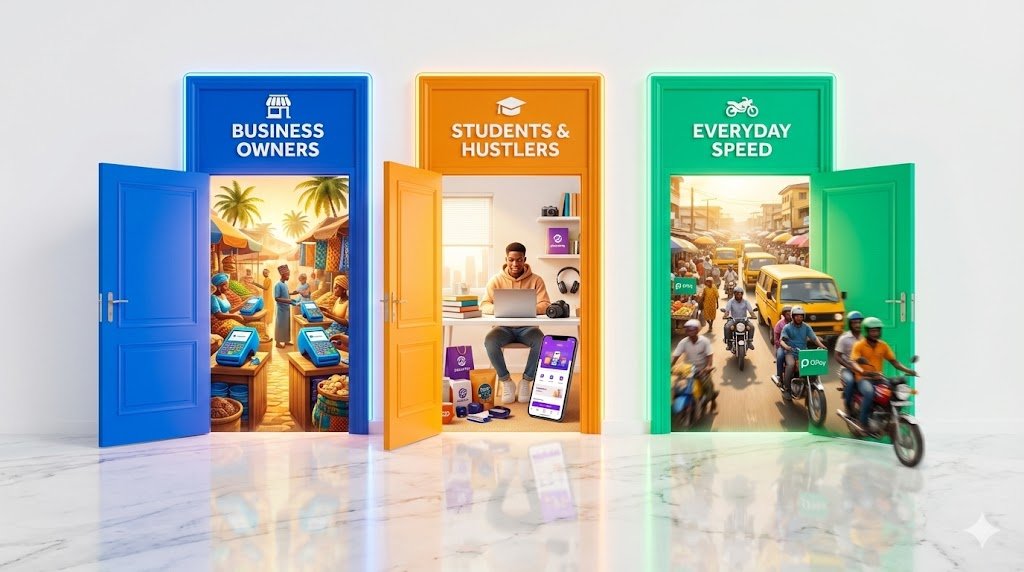
After 30 days of sending cash and annoying customer support agents, here is my decision matrix:
- Choose Moniepoint IF: You run a business, are balancing your 9-5 and side business, or you want the highest reliability for resolving failed transactions without talking to anyone. The “business-grade” stability is real.
- Choose PalmPay IF: You are a student running side hustles, young professional, or bargain hunter who loves discounts, free transfers, and doesn’t mind a busy app interface.
- Choose OPay IF: You want speed and simplicity. If you want the extra peace of mind provided by features like Large Transaction Shield and NightGuard (where available) to protect your funds.
Final word: For customer service specifically? Moniepoint took the crown in my experiment. They solved my problem the fastest, even if they didn’t chat with me the most.
Frequently Asked Questions
Between OPay and Moniepoint, which one has more customers?
OPay likely has more individual registered users (over 50 million as of 2024). However, Moniepoint is the king of business volume, with over 10 million customers and a higher transaction value (over $17 billion monthly). If you count every person who uses a POS terminal, Moniepoint touches more lives daily.
How do I resolve a failed transaction on OPay?
Don’t wait. Go to the app, click “Me” > “Help & Support” > “Dispute Transaction.” Select the exact transaction and upload your proof. If the bot fails, keep typing “Agent” or “Human” until it transfers you.
Are my funds safe with these apps?
Yes. All three—OPay, PalmPay, and Moniepoint—are licensed by the Central Bank of Nigeria (CBN) and your deposits are insured by the Nigeria Deposit Insurance Corporation (NDIC). They meet the same regulatory safety standards as traditional banks.
Final Lesson: Never Rely on Just One App
Ultimately, technology can fail. Even with the best customer service, networks jam and banks have downtime. The smartest move isn’t just picking the “best” app—it’s having a backup.
I keep Moniepoint for my main funds because of the reliability, but I always have some cash in PalmPay for quick airtime or data when I’m on the go. That way, if one goes down, I’m never stranded at the filling station again.
Whichever you choose, just ensure you have your BVN and NIN linked properly to avoid “stories that touch.” Understanding your cost of living in Lagos means having backup payment options ready when unexpected expenses or network failures hit.
Safe transactions!

Oladepo Babatunde (Prince Babatee Tunde) is a Computer Scientist, researcher, and professional content writer with a Higher National Diploma in Computer Science from Kwara State Polytechnic, Nigeria.
With a background in technology and a passion for clear communication, Babatunde specializes in creating thoroughly researched, reader-focused content on productivity, personal development, home living, and technology. Every article he writes is backed by extensive research and fact-checking to ensure readers receive accurate, actionable information.
As a freelance writer, he has helped brands and publications deliver content that educates, engages, and empowers their audiences. His mission at Vibena is simple: make complex topics easy to understand and help Nigerians live smarter, more productive lives.