The ceiling in my room collapsed on a Sunday morning in January. Not dramatically. Not all at once. A chunk of POP about the size of a large pillow detached from the corner near the window and crashed onto my desk, scattering plaster dust across my laptop, my notes, and the mug of coffee I had just poured.
I sat there staring at the mess, at the exposed concrete above where the POP had been, at the hairline cracks spreading across the rest of my ceiling, and I knew: it was time to replace the entire thing.
My landlord, after three days of back-and-forth on WhatsApp, agreed to split the cost with me 50/50 if I handled the contractor selection. That left me with a decision that every Nigerian renovating or building in 2026 faces: POP ceiling or PVC ceiling?
I had opinions. My neighbours had opinions. The man selling cement at Balogun Street had opinions. But nobody had actual data. Nobody had compared real quotes from real contractors for the same room. Nobody had broken down the true cost difference including materials, labour, finishing, and long-term maintenance.
So I did it myself. I contacted three ceiling contractors in Lagos, got detailed quotes for both POP and PVC ceiling installation for my room, and compared everything: price, installation time, durability, appearance, heat resistance, and maintenance.
If you are a freelancer, remote worker, or student setting up an apartment, renovating a room, or just trying to understand what ceiling option gives the best value in Nigeria right now, this is the most thorough comparison I could put together.
My Room Specifications (What the Contractors Quoted For)
Every quote was based on the same room to ensure a fair comparison:
- Room size: 3.5m × 4m (14 square metres of ceiling area)
- Location: Yaba, Lagos mainland
- Ceiling height: Approximately 3 metres (standard Nigerian residential)
- Current state: Partially collapsed POP ceiling needing full removal and replacement
- Requirements: Flat ceiling with a simple cornice (edge moulding), 2 recessed light points, painting (for POP)
I gave every contractor the exact same specifications and asked for a full breakdown of materials and labour. No hidden costs. No “we will see when we start.” Everything upfront.
Understanding the Two Options
Before diving into the quotes, let me explain what we are actually comparing.
What Is a POP Ceiling?
POP stands for Plaster of Paris, a building material made from gypsum that is mixed with water to form a paste, applied to a metal framework suspended from the ceiling, and allowed to harden into a smooth, solid surface. According to building industry data from PropertyPro, POP has been the dominant ceiling material in Nigerian residential construction for decades.
POP ceilings are valued for their smooth, seamless finish and design flexibility. Skilled POP installers can create curves, recesses, cove lighting channels, and intricate patterns that give rooms a premium, custom look.
The downsides? POP is heavy, prone to cracking (especially in buildings that settle or vibrate from generator usage), susceptible to water damage (a single roof leak can destroy an entire POP ceiling), and requires skilled labour that is increasingly expensive.
What Is a PVC Ceiling?
PVC ceiling panels are pre-manufactured polyvinyl chloride boards, typically 20cm to 30cm wide and 3 to 6 metres long, that interlock together on a framework. According to the CBI (Centre for the Promotion of Imports from developing countries, part of the Netherlands Ministry of Foreign Affairs), PVC panels are lightweight, waterproof, and resistant to termites and decay.
PVC ceilings are valued for their waterproof properties, quick installation, low maintenance, and affordability in many cases. They come in a range of colours and finishes, including wood-grain, marble-effect, and plain glossy white.
The downsides? PVC can look less premium than well-finished POP, it expands and contracts with heat (which can cause warping or gaps in extreme conditions), and the interlocking panel lines are visible, giving a segmented rather than seamless look.
The 3 Contractors Who Quoted Me
I contacted three contractors through different channels. All are based in Lagos and have been in business for at least 3 years. I am using first names only with their permission.
Contractor A: Emeka (Found through a referral from my neighbour) Based in Mushin. Specialises in POP ceiling work. Has been installing ceilings for 8 years. Came to my room on a Tuesday to take measurements.
Contractor B: Femi (Found through Instagram, has an active page showing his work) Based in Ikeja. Does both POP and PVC installations. 5 years experience. Visited on a Wednesday.
Contractor C: Ibrahim (Found through Jiji Nigeria listing) Based in Surulere. Primarily does PVC installations but also handles POP. 4 years experience. Visited on a Thursday.
All three physically visited my room, took measurements, inspected the existing ceiling condition, and submitted written quotes within 3 to 5 days.
The POP Ceiling Quotes
Contractor A (Emeka): POP Ceiling Quote
| Item | Description | Cost |
|---|---|---|
| POP material | 6 bags of Plaster of Paris (25kg each) | ₦27,000 |
| Cement | 1 bag (for bonding and patching) | ₦8,500 |
| Metal framework | Galvanised angle iron (1.5 inch), binding wire, nails | ₦32,000 |
| Cornice moulding | Simple cove cornice around room perimeter | ₦15,000 |
| Sandpaper and finishing | Assorted grits for smooth finish | ₦3,500 |
| Paint | 4 litres white emulsion ceiling paint | ₦12,000 |
| Light point preparation | 2 recessed points (electrical wiring separate) | ₦5,000 |
| Removal of old ceiling | Labour for stripping existing POP | ₦15,000 |
| Labour (installation) | 2 workers, estimated 3 days | ₦65,000 |
| Transport | Moving materials to site | ₦5,000 |
| TOTAL | ₦188,000 |
Emeka estimated the job would take 3 full days (Day 1: removal and framework, Day 2: POP application and initial drying, Day 3: sanding, cornicing, and painting). He warned that drying time between application and painting could extend to Day 4 in humid conditions.
Contractor B (Femi): POP Ceiling Quote
| Item | Description | Cost |
|---|---|---|
| POP material | 6 bags Plaster of Paris | ₦30,000 |
| Cement | 1 bag | ₦8,500 |
| Metal framework | Angle iron, wire, nails | ₦35,000 |
| Cornice | Simple cove design | ₦18,000 |
| Finishing materials | Sandpaper, filler, primer | ₦5,000 |
| Paint | 4 litres ceiling white (Dulux brand) | ₦16,000 |
| Light points | 2 recessed (prep only) | ₦6,000 |
| Old ceiling removal | Labour | ₦18,000 |
| Labour (installation) | 2 workers, 3 to 4 days | ₦75,000 |
| Transport | Materials delivery | ₦7,000 |
| TOTAL | ₦218,500 |
Femi’s quote was higher, which he explained was because he uses thicker angle iron (to prevent the ceiling from sagging over time) and specified Dulux paint rather than a generic brand. He estimated 3 to 4 days.
Contractor C (Ibrahim): POP Ceiling Quote
| Item | Description | Cost |
|---|---|---|
| POP material | 5 bags (he said 5 was sufficient for my room size) | ₦22,500 |
| Cement | 1 bag | ₦8,000 |
| Metal framework | Angle iron, wire, nails | ₦30,000 |
| Cornice | Simple flat band design | ₦12,000 |
| Finishing | Sandpaper, putty | ₦3,000 |
| Paint | 4 litres generic ceiling white | ₦9,000 |
| Light points | 2 recessed | ₦4,000 |
| Old ceiling removal | Included in labour | ₦0 |
| Labour | 2 workers, 2 to 3 days | ₦55,000 |
| Transport | Included | ₦0 |
| TOTAL | ₦143,500 |
Ibrahim’s quote was the lowest by a significant margin. He included removal and transport in his labour cost and used fewer bags of POP. I asked him about this and he said he mixes slightly differently and uses less material for the same coverage. Femi, when I mentioned this, cautioned that thinner POP application leads to earlier cracking.
POP Ceiling Price Summary
| Contractor | Total Quote | Timeline | Price per sq.m |
|---|---|---|---|
| Emeka | ₦188,000 | 3 days | ₦13,428/m² |
| Femi | ₦218,500 | 3 to 4 days | ₦15,607/m² |
| Ibrahim | ₦143,500 | 2 to 3 days | ₦10,250/m² |
| Average | ₦183,333 | 3 days | ₦13,095/m² |
According to pricing data from PropertyPro and confirmed by multiple contractor listings on Jiji Nigeria, the average POP ceiling cost in Nigeria in 2026 ranges from approximately ₦2,500 to ₦4,500 per square metre for materials alone, with total installed costs (including labour) ranging from ₦8,000 to ₦16,000 per square metre depending on location, design complexity, and contractor experience. My quotes fall within this range.
The PVC Ceiling Quotes
Contractor A (Emeka): PVC Ceiling Quote
Emeka was honest: “PVC is not my specialty, but I can do it.” His quote reflected that.
| Item | Description | Cost |
|---|---|---|
| PVC panels | 20 panels (30cm × 4m, plain white glossy) | ₦50,000 |
| PVC edge trim | Room perimeter trim | ₦8,000 |
| Wooden framework | 2×3 timber battens | ₦18,000 |
| Nails, screws, adhesive | Assorted | ₦5,000 |
| Light point preparation | 2 recessed (cut-outs in PVC) | ₦4,000 |
| Old ceiling removal | Labour | ₦15,000 |
| Labour (installation) | 2 workers, 1 to 2 days | ₦40,000 |
| Transport | Materials delivery | ₦5,000 |
| TOTAL | ₦145,000 |
Contractor B (Femi): PVC Ceiling Quote
Femi does a lot of PVC work and his quote showed more attention to detail.
| Item | Description | Cost |
|---|---|---|
| PVC panels | 20 panels (30cm × 4m, wood-grain finish) | ₦62,000 |
| PVC cornicing | Decorative PVC edge moulding | ₦12,000 |
| Metal framework | Light-gauge galvanised steel channels (not timber) | ₦25,000 |
| Screws, clips, adhesive | Stainless steel screws (to prevent rust) | ₦6,000 |
| Light points | 2 recessed cut-outs | ₦5,000 |
| Old ceiling removal | Labour | ₦18,000 |
| Labour | 2 workers, 1.5 days | ₦45,000 |
| Transport | Delivery | ₦5,000 |
| TOTAL | ₦178,000 |
Femi specified a metal framework instead of timber, which he said prevents the warping and termite damage that wooden battens are prone to in Lagos humidity. He also quoted for wood-grain finish panels rather than plain white, which cost more but look significantly more premium.
Contractor C (Ibrahim): PVC Ceiling Quote
Ibrahim is primarily a PVC installer and his quote was the most detailed.
| Item | Description | Cost |
|---|---|---|
| PVC panels | 18 panels (30cm × 4m, plain white glossy, 8mm thick) | ₦43,200 |
| PVC edge trim | Standard white trim | ₦6,000 |
| Timber framework | Treated 2×2 battens | ₦14,000 |
| Fasteners | Screws, nails, clips | ₦4,000 |
| Light points | 2 cut-outs | ₦3,000 |
| Old ceiling removal | Included in labour | ₦0 |
| Labour | 1 worker + helper, 1 day | ₦30,000 |
| Transport | Included | ₦0 |
| TOTAL | ₦100,200 |
Ibrahim quoted the lowest price and the fastest timeline: one day. He said an experienced PVC installer can complete a 14 square-metre room in about 5 to 6 hours once the old ceiling is removed and the framework is up.
PVC Ceiling Price Summary
| Contractor | Total Quote | Timeline | Price per sq.m | Panel Type |
|---|---|---|---|---|
| Emeka | ₦145,000 | 1 to 2 days | ₦10,357/m² | Plain white glossy |
| Femi | ₦178,000 | 1.5 days | ₦12,714/m² | Wood-grain finish |
| Ibrahim | ₦100,200 | 1 day | ₦7,157/m² | Plain white glossy |
| Average | ₦141,067 | 1.2 days | ₦10,076/m² |
According to data from NaijaTechGuide’s building resources section, PVC ceiling panel prices in Nigeria range from approximately ₦1,500 to ₦5,000 per piece depending on thickness, finish, and brand, with total installed costs typically lower than POP when labour is factored in.
The Head-to-Head Comparison: POP vs PVC
Now let me lay everything side by side using the average quotes from all three contractors.
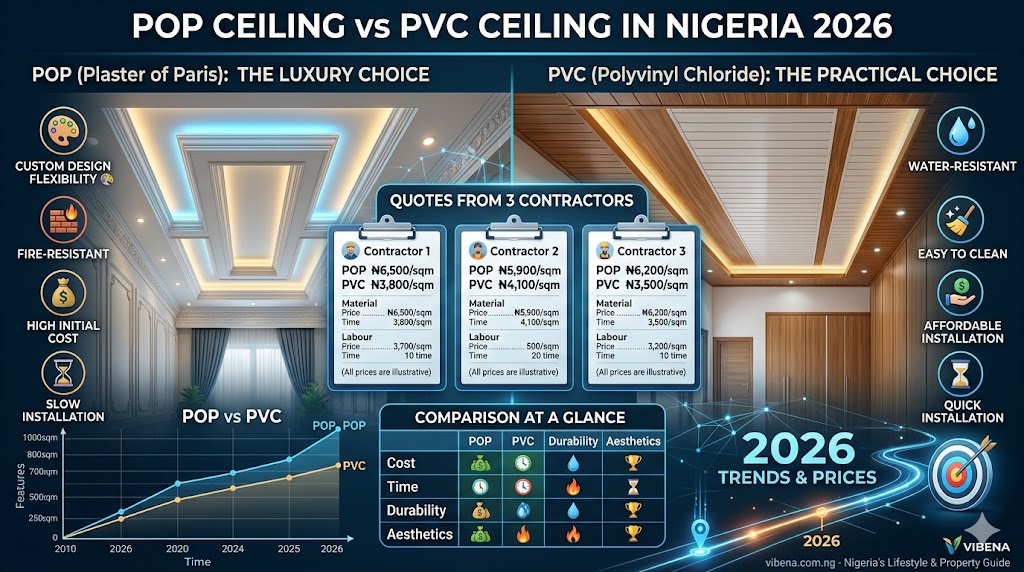
| Factor | POP Ceiling | PVC Ceiling | Winner |
|---|---|---|---|
| Average total cost (14 sq.m room) | ₦183,333 | ₦141,067 | PVC (₦42,266 cheaper) |
| Cost per square metre (installed) | ₦13,095 | ₦10,076 | PVC |
| Installation time | 3 days average | 1.2 days average | PVC |
| Appearance | Seamless, smooth, premium | Panel lines visible, modular | POP |
| Design flexibility | High (curves, recesses, cove lighting) | Low (mostly flat with trim options) | POP |
| Water resistance | Poor (absorbs water, stains, collapses) | Excellent (waterproof) | PVC |
| Weight | Heavy (~15kg per sq.m) | Light (~2 to 3kg per sq.m) | PVC |
| Durability | 5 to 10 years before cracking | 15 to 25 years with proper installation | PVC |
| Maintenance | Needs repainting every 2 to 3 years | Wipe clean with damp cloth | PVC |
| Heat resistance | Moderate (insulates slightly) | Low (can warp in extreme heat) | POP |
| Sound insulation | Moderate | Low | POP |
| Termite resistance | Not applicable (plaster) | PVC itself is termite-proof, but timber framework is vulnerable | Tie |
| Repairability | Difficult (section repairs leave visible patches) | Easy (replace individual panels) | PVC |
| Painting required | Yes (every 2 to 3 years) | No (comes pre-finished) | PVC |
What Each Contractor Recommended (And Why)
I asked each contractor which option they would install in their own home. Their answers were revealing.
Emeka (POP specialist): “For my sitting room, POP. For everything else, PVC.” He explained that POP gives a premium look in living rooms and reception areas where aesthetics matter most, but for bedrooms, kitchens, and bathrooms, PVC makes more practical sense.
Femi (does both): “PVC with wood-grain finish. It is cheaper to install, cheaper to maintain, and my customers who choose POP always call me back within 3 years for crack repairs. PVC customers never call me back.” He added that the wood-grain PVC panels have dramatically improved in quality over the past two years and now look convincingly like real wood from a distance.
Ibrahim (PVC specialist): “PVC, obviously. But I am biased.” He laughed, then added seriously: “In Lagos specifically, with the vibration from generators, the humidity, and the building settling, POP cracks faster than anywhere else in Nigeria. I have replaced more collapsed POP ceilings than I can count.”
My Personal Experience: What I Chose and Why
After comparing the quotes, talking to all three contractors, and spending a weekend thinking about it, I went with PVC ceiling installed by Ibrahim for ₦100,200.
Here is why.
The Budget Reality
I was splitting the cost 50/50 with my landlord. My share of the PVC installation was ₦50,100. My share of the cheapest POP quote (Ibrahim’s ₦143,500) would have been ₦71,750. That is a ₦21,650 difference. As a freelancer watching every naira, especially with the rising cost of living in Lagos, the cheaper option was compelling.
The Practical Reality
My POP ceiling collapsed because of a combination of building vibration (two compound generators running daily), humidity damage, and poor original installation. Replacing it with another POP ceiling felt like setting myself up for the same failure in a few years.
PVC is waterproof. My room has had minor roof seepage during heavy rain in the past. POP absorbs that moisture, stains, weakens, and eventually collapses. PVC shrugs it off. I wipe it with a cloth and move on.
The Time Reality
Ibrahim completed the installation in one day. He arrived at 8 AM, his helper removed the old POP by 10:30 AM (carefully, to avoid damaging the walls), they installed the timber framework by 12:30 PM, and had all the PVC panels clipped in by 4:30 PM. By 5 PM, my room had a brand new ceiling.
A POP installation would have meant 3 days minimum, plus the dust, the wet plaster mess, the drying time, and the painting. My room is my office. I cannot afford to lose 3 working days. I documented my full work-from-home setup, which the ceiling is now part of, in my guide on how to set up a home office in a bedroom.
What I Gave Up
I will not pretend the PVC looks as premium as a well-done POP ceiling. The panel lines are visible if you look closely. The plain white glossy finish is clean but not as sophisticated as a smooth, painted POP surface.
For a sitting room interior design where first impressions matter, I might have chosen POP. For my bedroom-office where functionality beats aesthetics, PVC was the right call.
The Installation: What Actually Happened
Let me walk through the installation process because it is useful for anyone planning this work.
Old Ceiling Removal (2.5 Hours)
Ibrahim’s helper used a claw hammer and a flat bar to carefully pry off the old POP from the metal framework underneath. The POP came off in chunks, creating a significant amount of dust. We covered my furniture and electronics with old bedsheets beforehand, which was essential. Even with covering, fine plaster dust got everywhere.
The old metal framework was in reasonable condition, but Ibrahim decided to install a new timber framework anyway because his PVC clips are designed for timber battens.
Framework Installation (2 Hours)
Ibrahim screwed treated 2×2 timber battens directly into the concrete ceiling using masonry screws, spaced approximately 60cm apart running parallel to the shortest wall. He used a spirit level to ensure the battens were flat and even.
He pointed out two areas where the concrete ceiling had small depressions and shimmed the battens with thin plywood pieces to maintain a level surface. This attention to detail is important because PVC panels will follow the contour of the framework. An uneven framework means a wavy ceiling.
Panel Installation (3.5 Hours)
The PVC panels interlock using a tongue-and-groove system. Ibrahim started from one wall and worked toward the opposite wall. Each panel clicked into the previous one with a satisfying snap. He used a handsaw to cut panels to length where they met the walls.
The light point cut-outs were made using a hole saw attachment on a drill. Clean, round holes exactly the size of my recessed light fittings.
The last panel in each row required careful trimming to fit, and Ibrahim used a utility knife and ruler for precision. The edge trim was glued and pinned along the perimeter, covering the gap between the panels and the wall.
The Finished Result
By 5 PM, I had a clean, bright, new ceiling. The plain white glossy panels reflected light well, making my room feel brighter. The panel lines were visible but not ugly. They create a subtle, linear pattern that looks intentional rather than unfinished.
I have been living with this ceiling for two months now. Zero issues. Zero cracks. Zero maintenance.
Long-Term Cost Comparison: The 10-Year View
The upfront cost tells only half the story. Here is what each ceiling type actually costs over 10 years, based on my research and the contractors’ estimates for maintenance.
POP Ceiling: 10-Year Cost
| Expense | Timing | Cost |
|---|---|---|
| Installation | Year 0 | ₦183,333 |
| First repaint | Year 2 to 3 | ₦25,000 |
| Crack repairs | Year 3 to 4 | ₦15,000 |
| Second repaint | Year 5 to 6 | ₦25,000 |
| Major repair (section collapse) | Year 6 to 8 | ₦40,000 |
| Third repaint | Year 8 to 9 | ₦25,000 |
| 10-Year Total | ₦313,333 |
PVC Ceiling: 10-Year Cost
| Expense | Timing | Cost |
|---|---|---|
| Installation | Year 0 | ₦141,067 |
| Occasional cleaning | Yearly | ₦0 (DIY with damp cloth) |
| Panel replacement (if damaged) | Year 5 to 7 (one or two panels) | ₦5,000 |
| 10-Year Total | ₦146,067 |
Over 10 years, the PVC ceiling costs roughly ₦167,000 less than the POP ceiling. That difference is driven almost entirely by POP’s ongoing maintenance needs: repainting, crack repairs, and eventual section replacements.
For anyone watching their budget carefully, and that includes most freelancers, remote workers, and students in Nigeria, that ₦167,000 saving over a decade is significant. It is enough to buy a decent laptop, fund several months of internet, or cover a major portion of annual rent.
When You Should Still Choose POP
Despite everything I have written, there are legitimate reasons to choose POP:
You want a premium, seamless look. For a sitting room, reception area, or office space where clients visit, a well-finished POP ceiling with cove lighting and a clean cornice looks undeniably more upscale than PVC.
You want design flexibility. POP can be moulded into curves, stepped designs, tray ceilings, and intricate patterns. PVC is limited to flat panels in various finishes. If you are designing an interior that needs architectural detail in the ceiling, POP is the only option.
Your building has minimal vibration. In newer, well-built structures without nearby generator vibration, POP lasts longer because there is less movement causing cracks. If you are in a purpose-built apartment complex rather than a typical Lagos compound, POP may hold up better.
You have the budget for maintenance. If repainting every 2 to 3 years and occasional crack repairs are within your budget, POP’s aesthetic advantages may be worth the extra long-term cost.
When PVC Is the Clear Winner
You live in a building with generators running daily. The vibration from generators accelerates POP cracking significantly. PVC is unaffected by vibration. I wrote about the noise and vibration impact of generators in my quietest generator comparison.
Your roof has any history of leaking. One water stain on POP requires patching, sealing, and repainting. Water on PVC dries and leaves no trace.
You are renting and negotiating with your landlord. PVC is cheaper, faster to install, and easier to maintain, which makes it an easier sell to a landlord who is splitting costs with you.
You want minimal disruption. For a remote worker who cannot afford to lose 3 working days, PVC’s one-day installation is a massive advantage.
You are furnishing a small apartment on a budget. If you are furnishing a mini flat in Nigeria for under ₦500K, every naira saved on the ceiling is a naira available for furniture, appliances, or electrical wiring.
Common Mistakes to Avoid When Installing Either Ceiling
After talking to three contractors and reading dozens of Nigerian renovation forums, here are the mistakes that cause the most problems:
For POP Ceilings
Hiring the cheapest contractor. POP installation is a skill. A poorly mixed batch, uneven application, or weak framework leads to early cracking and collapse. The cheapest quote often means the thinnest application and the least experienced worker. Pay for quality or pay twice when it fails.
Not allowing proper drying time. POP needs at least 24 to 48 hours to dry completely before sanding and painting. Rushing this process traps moisture inside the plaster, which causes bubbling and peeling within months.
Using low-quality paint. The ceiling paint matters more than most people think. Cheap paint yellows within a year and shows every stain. According to Femi, investing in a quality brand like Dulux or Berger adds ₦4,000 to ₦7,000 to your project but saves you from repainting sooner.
For PVC Ceilings
Using untreated timber battens. Untreated wood in Lagos humidity attracts termites and absorbs moisture, which can warp the framework and cause the PVC panels to shift. Insist on treated timber, or even better, use galvanised metal channels like Femi recommended.
Installing in direct sunlight areas without expansion gaps. PVC expands in heat. According to industry installation guidelines, leave a 2 to 3mm gap between panels and walls to allow for thermal expansion. Skip this and the panels will buckle on hot days.
Buying the thinnest panels available. PVC panels come in thicknesses from 5mm to 10mm. The thinnest (5mm) panels are cheaper but sag between support battens and feel flimsy when tapped. I recommend 8mm minimum for a ceiling that looks and feels solid.
Frequently Asked Questions
How much does a POP ceiling cost in Nigeria in 2026?
Based on my three contractor quotes, the average installed cost for a POP ceiling in Nigeria in 2026 ranges from ₦10,000 to ₦16,000 per square metre, including materials and labour. For a standard 14 square-metre room, expect to pay between ₦140,000 and ₦225,000 depending on your location, contractor, design complexity, and material quality.
How much does a PVC ceiling cost in Nigeria in 2026?
Based on my quotes, the average installed cost for a PVC ceiling in Nigeria in 2026 ranges from ₦7,000 to ₦13,000 per square metre. For a 14 square-metre room, expect ₦100,000 to ₦180,000 depending on panel finish (plain white vs wood-grain), framework material (timber vs metal), and contractor rates.
Which lasts longer, POP or PVC?
PVC lasts significantly longer. With proper installation, PVC ceilings can last 15 to 25 years without major maintenance. POP ceilings typically develop cracks within 3 to 5 years and may need major repairs or replacement within 7 to 10 years, especially in buildings with vibration from generators and thermal movement.
Can I install PVC ceiling over existing POP?
It is possible in some cases, but not recommended. The existing POP may be hiding structural issues (weak framework, water damage, cracks) that need to be addressed. All three contractors I spoke with recommended removing the old ceiling completely before installing a new one, regardless of type.
Is PVC ceiling good for a kitchen?
Yes, PVC is excellent for kitchens because it is waterproof, does not absorb cooking odours as deeply as POP, and can be wiped clean. I have written about kitchen organization for Nigerian cooking and a PVC ceiling is one of the easiest upgrades for a Nigerian kitchen.
Does PVC ceiling reduce heat?
PVC itself is a poor thermal insulator. However, the air gap between the PVC panels and the concrete ceiling above acts as a mild buffer. It will not replace proper ceiling insulation, but it is better than exposed concrete. For serious heat management, I tested several methods to cool a room without AC that work alongside any ceiling type.
Final Thoughts
My new PVC ceiling has been up for two months. Zero cracks. Zero stains. Zero maintenance. It cost me ₦50,100 (my half) and took one day to install. My room looks clean, bright, and professional on video calls.
Would a POP ceiling have looked more premium? Yes. Would it have survived the two generators vibrating my building every day, the Lagos humidity, and the occasional roof seepage? Based on the evidence of my previous POP ceiling lying in pieces on my desk, probably not.
The POP vs PVC ceiling debate in Nigeria often comes down to aesthetics versus practicality. POP wins on looks. PVC wins on everything else: cost, durability, maintenance, installation speed, and water resistance.
For a freelancer, remote worker, or student who needs a functional, durable, low-maintenance ceiling that does not break the bank, PVC is the smarter investment in 2026.
Get three quotes. Compare them. Ask each contractor what they would put in their own home. Then make your decision with real data, not opinions from the man selling cement.
Want to improve more of your living space? Check out my guides on one-bedroom apartment design in Nigeria and how to decorate a one-room apartment in Nigeria for budget-friendly ideas that make a real difference.

Oladepo Babatunde (Prince Babatee Tunde) is a Computer Scientist, researcher, and professional content writer with a Higher National Diploma in Computer Science from Kwara State Polytechnic, Nigeria.
With a background in technology and a passion for clear communication, Babatunde specializes in creating thoroughly researched, reader-focused content on productivity, personal development, home living, and technology. Every article he writes is backed by extensive research and fact-checking to ensure readers receive accurate, actionable information.
As a freelance writer, he has helped brands and publications deliver content that educates, engages, and empowers their audiences. His mission at Vibena is simple: make complex topics easy to understand and help Nigerians live smarter, more productive lives.