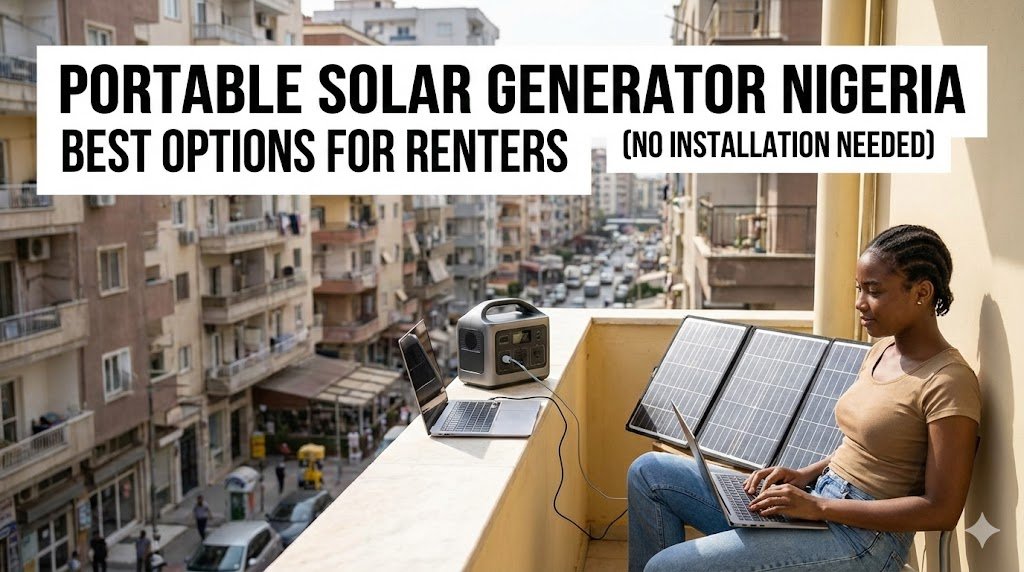
If you have ever sat in the dark wondering when PHCN would restore power, or counted how many litres of fuel your generator consumed in a single week, you already understand why portable solar generators are becoming essential for Nigerian renters. I remember the exact moment I decided enough was enough. It was February 2024, and I had just paid my landlord for six months rent in a one-bedroom apartment in Yaba. Three weeks later, I calculated I had spent over ₦45,000 on fuel alone to power a small generator that sounded like a truck engine every night.
That experience pushed me down a rabbit hole of research into portable solar generator Nigeria prices, alternative power solutions, and whether someone living in a rented apartment could actually benefit from solar power without drilling holes in a landlord’s ceiling or mounting panels they would have to abandon when moving out.
What I discovered changed everything about how I work, live, and budget for electricity. Nearly two years later, I am still using portable solar power daily, and the investment has paid for itself several times over. This guide shares everything I learned, including the mistakes I made, the brands that delivered on their promises, and the exact calculations you need to make before spending your money.
Nigerian Power Crisis 2026: Why Off-Grid Solar Solutions Are Essential
Before diving into specific products, understanding the broader context helps explain why portable solar generators represent a genuine market shift in Nigeria.
According to Mordor Intelligence, Africa’s portable generator market is projected to register growth during 2025-2030, with Nigeria identified as the fastest-growing region due to the country’s unreliable power supply and underdeveloped electricity grid3. The grid in Nigeria is simply not enough to serve the country’s needs, and the massive population and economy are powered mainly by electricity from small-scale generators.
Here is the staggering reality: According to the Central Bank of Nigeria, Nigerians spend an estimated USD 14 billion on generators and fuel yearly to prevent power outages from disrupting their lives and businesses3. Research indicates there are over 3 million generators in Nigeria running on diesel and petrol to supply electricity during power outages, showing the significant opportunity for solar panel companies and portable solar solutions2.
This grid instability and dependence on expensive fuel generators creates a massive opportunity for distributed renewable energy (DRE) solutions. Nigeria’s portable solar panel market was valued at USD 6.68 million in 2024 and is projected to reach USD 24.01 million by 2033, growing at an impressive 15.33% CAGR, significantly outpacing global averages1. This growth rate demonstrates the accelerating shift toward portable solar solutions among Nigerian consumers.
The global portable solar generators market is expected to grow from USD 829.9 million in 2025 to USD 1.11 billion by 2030 at a 6.08% CAGR7. Nigeria’s combination of unreliable grid infrastructure and abundant sunlight, with up to 7 hours of daily sunlight capable of producing 333,000 MW of solar power, positions it as a high-growth market within this global trend9.
Why Roof Solar Installation Is Not Worth It for Nigerian Renters
Let me be direct with you. If you are renting in Nigeria, installing a permanent rooftop solar system is almost always a terrible financial decision. I learned this the hard way when I initially considered a full solar installation for my apartment.
The mathematics simply do not work in your favour. A proper rooftop solar installation for a small apartment in Nigeria starts from around ₦1.5 million and can exceed ₦3 million for systems that can handle moderate loads. That is before you factor in installation costs, wiring, and the structural modifications your landlord probably will not approve anyway.
Here is the real problem. Most rental agreements in Lagos, Abuja, Port Harcourt, and other major cities run for one to two years. Even if you negotiate a longer lease, Nigerian rental culture means you could face unexpected situations, rent increases, or building issues that force you to relocate. Every person I know who rents has moved at least once in the past three years.
When you install rooftop solar panels, those panels become part of the building. You cannot easily take them with you. The wiring gets embedded in walls. The mounting brackets leave holes. Unless your landlord agrees to compensate you for the installation, and getting that agreement in writing is rare, you essentially donate an expensive power system to someone else’s property.
I spoke with a colleague who installed a ₦2.4 million solar system in his rented duplex in Lekki. When his landlord increased rent by 40% the following year and he decided to move, he had to negotiate for weeks just to recover a fraction of his investment. He ended up leaving the panels and taking only the inverter and batteries, losing over ₦1 million in the process.
Portable solar generators solve this problem completely. They require zero permanent installation. You can carry them when you move. They work in any apartment regardless of what your landlord permits. And in many cases, they cost between ₦200,000 and ₦700,000, which is far more manageable than permanent installations.
If you are already thinking about setting up a proper workspace in your rental, you might find our guide on how to set up a home office in a bedroom helpful for understanding how to organize your space around portable power solutions.
Solar Generator Load Calculation: How Much Power Do You Actually Need?
Before you spend a single naira on any portable solar generator, you need to understand exactly what you plan to power and for how long. This is where most people make expensive mistakes, and I was no exception.
When I bought my first portable power station, I overestimated its capabilities because I did not properly calculate my load. I assumed a 500Wh unit would last all day. In reality, it barely made it through a full work session because I had not accounted for how quickly my devices actually consumed power.
Here is how to calculate your needs properly.
Every electrical device has a wattage rating. Your laptop might be 45W to 65W. A standing fan runs between 30W and 75W depending on the type. LED bulbs typically use 7W to 15W each. Your phone charger pulls about 10W to 20W. A WiFi router needs around 10W to 15W.
To calculate how long a portable solar generator will power your devices, you divide the battery capacity in watt-hours by your total load in watts.
Let me give you a practical example. Say your laptop uses 60W, your DC fan uses 35W, your WiFi router uses 12W, and you have two LED bulbs at 10W each. Your total load is 127W.
If you buy a portable solar generator with 500Wh capacity, the theoretical runtime is 500 divided by 127, which gives you approximately 3.9 hours. However, you should always factor in efficiency losses of around 15% to 20%, so realistic runtime would be closer to 3.2 hours.
This is why understanding your actual needs matters enormously. Most Nigerian renters, especially remote workers and students, need power for laptops, phones, fans, and lighting. We are not trying to run refrigerators, air conditioners, or washing machines. Those appliances require serious power infrastructure that portable generators simply cannot provide efficiently.
Wattage Calculator for Common Nigerian Renter Scenarios
Light User (Student or Casual User) Laptop 45W plus phone charging 15W plus two LED bulbs 20W plus small DC fan 25W equals 105W total load. A 300Wh generator provides approximately 2.5 hours of continuous use.
Moderate User (Remote Worker) Laptop 65W plus external monitor 30W plus WiFi router 12W plus standing DC fan 35W plus three LED bulbs 30W plus phone charging 15W equals 187W total load. A 500Wh generator provides approximately 2.3 hours of continuous use.
Heavy User (Content Creator or Multiple Device User) Laptop 65W plus desktop monitor 45W plus WiFi router 15W plus standing fan 40W plus LED TV 32 inch at 50W plus decoder 25W plus four LED bulbs 40W plus phone and tablet charging 30W equals 310W total load. A 1000Wh generator provides approximately 2.8 hours of continuous use.
These calculations assume you are running all devices simultaneously, which rarely happens in practice. In my experience, a 500Wh unit actually lasts closer to 4 to 5 hours for moderate use because I am not constantly maxing out every device.
The lesson here is simple. Calculate your actual load, add a 20% buffer for safety, and buy accordingly. Do not let salespeople convince you to buy more capacity than you need, but also do not underestimate your requirements.
For those dealing with frequent power cuts, understanding how to maintain productivity during outages is crucial. Our detailed guide on how to stay focused during power outages offers practical strategies that complement having backup power.
Portable Solar Generator Nigeria Prices: Current Market Rates
The market for portable solar generators in Nigeria has expanded significantly over the past two years. You now have options ranging from budget-friendly local brands to premium international options. Understanding the price landscape helps you avoid overpaying or buying something that will not meet your needs.
Based on current market research and verified pricing from Nigerian retailers, here is what portable solar generator Nigeria prices look like across different capacity ranges:
Entry Level (200Wh to 400Wh): ₦150,000 to ₦350,000
These units work best for students, light users, or as emergency backup power. They can charge phones, power a few LED bulbs, run small fans, and keep a laptop going for a few hours. Popular options in this range include the Qasa Portable Solar Generator at around ₦185,000 and various local assembled brands.
The Hithium Hero 1 falls in the higher end of this category, offering 1000Wh capacity with 200W AC output for approximately ₦275,000 to ₦295,000. This represents excellent value for the capacity provided.
Mid Range (500Wh to 800Wh): ₦400,000 to ₦700,000
This is the sweet spot for most Nigerian renters who work from home or need reliable backup power for several hours daily. Units in this range can handle laptops, fans, routers, lighting, and even small appliances.
According to current pricing from Eden Power, their 500W Portable Solar Generator bundle, which includes a standing DC fan and 100W solar panel, sells for ₦650,000. The EcoFlow RIVER 2 Max with 512Wh capacity and 160W solar panel retails for approximately ₦689,000.
Upper Mid Range (1000Wh to 1500Wh): ₦700,000 to ₦1,100,000
Serious remote workers, small business owners, and content creators often need this capacity level. You can power multiple devices for extended periods and even run small appliances like blenders or mini fridges for short durations.
The EcoFlow RIVER 2 Pro with 768Wh capacity and 220W solar panel sells for around ₦897,000. The EcoFlow DELTA 2 with 1kWh capacity starts from approximately ₦987,000. The Hithium Hero 2 with 2000Wh capacity and 1000W output is priced around ₦680,000, which represents exceptional value for the specifications.
Premium Range (2000Wh and above): ₦1,200,000 to ₦2,500,000
These units approach mini inverter territory and can power small households for extended periods. They suit users with heavy power requirements or those wanting whole-day backup.
The EcoFlow DELTA 2 Max with 2kWh capacity and expansion capability retails for approximately ₦1,500,000. Larger mobile solar generators with 3000W output and 2560Wh LiFePO4 batteries sell for around ₦985,000 to ₦1,100,000.
When budgeting, remember that these prices often include solar panels, but not always. Confirm exactly what comes in the package before purchasing. A generator without a solar panel means you depend entirely on grid charging, which defeats much of the purpose.
If you are furnishing your first apartment on a budget, you might find our comprehensive guide on how to furnish a mini flat in Nigeria for under 500k useful for understanding where portable power fits into your overall spending plan.
Battery Technology: Why LiFePO4 Changes Everything
One of the most important factors in choosing a portable solar generator is battery technology, and this is where many Nigerian buyers make uninformed decisions.
Modern portable solar generators use one of two main battery types: standard lithium-ion (Li-ion) or lithium iron phosphate (LiFePO4). Understanding the difference can save you significant money over time.
Standard Lithium-Ion Batteries
These offer 500 to 1,000 charge cycles before significant degradation. If you charge daily, expect 2 to 3 years of optimal performance before capacity drops noticeably. They are lighter and often cheaper upfront.
LiFePO4 (Lithium Iron Phosphate) Batteries
Modern LiFePO4 implementations have extended operational lifespan to over 6,000 charge cycles, transforming portable solar generators from temporary accessories into durable long-term assets. This means daily charging for 10 to 15 years before significant degradation.
LiFePO4 batteries also offer superior thermal stability, meaning they are safer in Nigeria’s hot climate and less prone to overheating issues. They maintain consistent performance across a wider temperature range.
The cost calculation matters here. A ₦400,000 generator with standard lithium-ion lasting 3 years costs approximately ₦133,000 per year. A ₦550,000 generator with LiFePO4 lasting 10 years costs ₦55,000 per year. The premium pays for itself several times over.
When shopping, specifically ask whether the unit uses LiFePO4 chemistry. Premium brands like EcoFlow prominently advertise this feature. Budget brands often use standard lithium-ion without clearly stating so.
Best Portable Solar Generator Brands Nigeria: International vs Local Options
This is where many Nigerian buyers struggle. Do you pay premium prices for internationally recognized brands like EcoFlow and Bluetti, or do you trust local assembled options that cost significantly less?
I have used both, and the answer depends on your priorities, budget, and how much risk you are willing to accept.
International Brands: EcoFlow and Bluetti
EcoFlow has established a physical presence in Nigeria, which is significant. According to their Nigeria website, they offer direct sales with local warranty support. This matters because international brands shipping from overseas create customs complications and warranty headaches.
EcoFlow products use LiFePO4 batteries, which offer superior lifespan compared to standard lithium-ion cells. Their RIVER 2 series promises up to 3000 charge cycles, meaning the battery could last 8 to 10 years with daily use. The build quality is noticeably premium, with clear displays, multiple output ports, and efficient power management.
The downside is price. EcoFlow products cost 30% to 50% more than comparable local options. A 500Wh EcoFlow unit might cost ₦650,000 to ₦700,000, while a local brand with similar capacity might sell for ₦400,000 to ₦450,000.
Bluetti, while popular globally, has less established distribution in Nigeria compared to EcoFlow. Finding genuine Bluetti products with proper warranty support can be challenging. I would recommend EcoFlow over Bluetti for Nigerian buyers simply because of accessibility and after-sales support.
Local Assembled and Nigerian Brands
Several Nigerian companies now offer portable solar generators, either assembling units locally or importing and rebadging products with local support. Brands like Eden Power, Hithium, Fivestar, and various Darbotech offerings fall into this category.
Eden Power, based on customer reviews and market presence, has built a reasonable reputation. Their products often come bundled with practical accessories like DC standing fans and solar panels, creating ready-to-use packages. A 300W Eden Power system with fan and 50W solar panel sells for around ₦435,000.
The Hithium brand offers impressive specifications at competitive prices. Their Hero 2 unit provides 2000Wh capacity with 1000W AC output for approximately ₦680,000, which significantly undercuts international brands at similar capacity levels.
The advantages of local brands include lower prices, easier warranty claims, local support, and bundles designed for Nigerian usage patterns. The disadvantages include less proven long-term reliability, potentially shorter battery lifespan, and varying build quality between units.
Brand Comparison Table
| Feature | EcoFlow (International) | Eden Power (Local) | Hithium (Local) |
|---|---|---|---|
| Price Range | ₦650,000 – ₦1,500,000 | ₦350,000 – ₦700,000 | ₦275,000 – ₦700,000 |
| Battery Type | LiFePO4 | Varies | LiFePO4 (some models) |
| Warranty Support | Strong local presence | Good local support | Moderate |
| Build Quality | Premium | Good | Good |
| Bundled Accessories | Usually separate | Often included | Sometimes included |
| Long-term Reliability | Proven | Less data available | Less data available |
My Personal Recommendation
After using both international and local options, here is my honest assessment. If your budget allows and you value peace of mind, start with EcoFlow. The build quality, battery technology, and local support justify the premium. If you are budget-conscious and willing to accept some risk, local brands like Hithium and Eden Power offer good value, especially for entry-level needs.
Whatever you choose, avoid extremely cheap options from unknown brands on marketplaces. Those ₦80,000 to ₦120,000 “solar generators” often use low-quality batteries that degrade quickly, have inaccurate capacity ratings, and offer zero after-sales support.
For those specifically looking at power solutions for laptops, our dedicated guide on the best power banks for laptops in Nigeria provides complementary information on smaller backup options.
Solar Generator Charging Tips: Free Power at Work
This strategy changed how I think about portable solar generators, and I want to share it because it makes the economics work much better.
Most Nigerian renters work outside their homes at least some days per week. Whether you work in an office, a co-working space, or even visit a friend’s place with stable power, you have access to electricity beyond your own apartment.
The idea is simple. Your portable solar generator charges via standard AC power, not just solar panels. This means you can charge it anywhere with a working socket.
Here is how I implement this:
On days I go to a co-working space, I carry my portable generator with me. It weighs about 6kg, which is manageable in a backpack or bag. While I work, the generator charges from the wall socket. By the time I leave, it is fully charged and ready to power my apartment through the evening and night.
On days I work from home, I use solar charging during daylight hours. The combination means I rarely depend entirely on my apartment’s unreliable power supply.
This approach offers several advantages. First, you reduce wear on your solar panel since you are not solely dependent on it. Second, you take advantage of free electricity at your workplace or other locations. Third, you build redundancy into your power strategy.
One colleague takes this further. He keeps a second smaller power bank at work and swaps it with his home unit weekly. This way, he always has a fully charged backup waiting.
The key is having a generator light enough to transport. Units over 10kg become impractical for regular carrying. This is another reason the 300Wh to 600Wh range works well for most renters as they balance capacity with portability.
Portable Solar Generator vs Petrol Generator: Which Saves More Money?
Let me address this question directly because it is the one I asked myself repeatedly before buying.
The short answer is yes, for most Nigerian renters, a portable solar generator is worth the investment. But let me show you the mathematics.
Fuel Generator Costs and Self-Generation Expenses
A typical small petrol generator (Tiger or similar) uses approximately 0.5 to 1 litre of fuel per hour. With current petrol prices hovering around ₦600 to ₦700 per litre, running a small generator for 4 hours costs ₦1,400 to ₦2,800 daily.
If you run it 20 days per month, that is ₦28,000 to ₦56,000 monthly just on fuel. Over a year, you spend ₦336,000 to ₦672,000 on petrol alone.
Add maintenance costs, oil changes, spark plugs, servicing, and repairs. Budget another ₦5,000 to ₦15,000 monthly. Your annual fuel generator cost could reach ₦400,000 to ₦850,000.
Then there is the noise, the fumes, the inconvenience, and the neighbours who complain.
Market research confirms this burden: rising fuel prices are identified as a key market restraint for portable generators in Nigeria, impacting operating costs significantly5. This is precisely why the increasing availability and adoption of alternative energy sources such as solar power systems is reshaping the market5.
Portable Solar Generator Costs
A mid-range portable solar generator costs ₦400,000 to ₦650,000 once. A decent solar panel adds ₦50,000 to ₦150,000 if not bundled.
Your ongoing costs are essentially zero for fuel and minimal for maintenance. You might replace the internal battery after 5 to 8 years with standard lithium-ion, or 10 to 15 years with LiFePO4.
Break-Even Analysis
| Cost Factor | Petrol Generator (Annual) | Solar Generator (5-Year Average) |
|---|---|---|
| Fuel | ₦336,000 – ₦672,000 | ₦0 |
| Maintenance | ₦60,000 – ₦180,000 | ₦10,000 – ₦20,000 |
| Initial Cost (Amortized) | ₦30,000 – ₦50,000 | ₦100,000 – ₦130,000 |
| Total Annual | ₦426,000 – ₦902,000 | ₦110,000 – ₦150,000 |
If you spend ₦35,000 monthly on fuel generator operations and buy a ₦500,000 portable solar generator, you break even in approximately 14 to 15 months. Everything after that is savings.
The real value goes beyond money. No noise. No fumes. No trips to fuel stations. No maintenance headaches. No neighbours banging on your door at 10 PM because your generator is too loud.
Customer reviews from Eden Power users confirm this. One reviewer mentioned cutting monthly fuel costs by more than 50% after purchasing their system. Another described it as a “lifesaver” given fuel prices and electricity unreliability.
For a comprehensive look at permanent solar options and how they compare, our guide on solar inverter setup for Nigerian 2-bedroom flats provides context on the full installation path.
Government Support for Solar Power in Nigeria
Understanding Nigerian government initiatives helps you see the broader picture of where portable solar fits in the country’s energy transition.
Solar Power Naija Programme
Launched as part of the Economic Sustainability Plan in response to COVID-19, Solar Power Naija aims to expand energy access through solar home systems and mini-grids. The programme targets installation of 5 million new solar connections, creating jobs while addressing the country’s electricity deficit.
National Renewable Energy Policy and Vision 30:30:30
The Nigerian Government has developed the National Renewable Energy and Energy Efficiency Policy, with the accompanying Vision 30:30:30 policy, which aims at achieving 30,000 MW of electricity by 2030, with renewable energy contributing 30% of the energy mix3. The country has also set targets to achieve zero carbon emissions by 20602.
The National Renewable Energy and Energy Efficiency Policy established in 2014 details that Nigeria has a target of 20% electricity generation from renewable sources, mostly solar, in an effort to address the nationwide electricity shortage9.
Rural Electrification Fund (REF)
The REF supports private sector investment in off-grid electrification, with financing available for solar mini-grids and solar home systems. While primarily targeting rural areas, the programme has increased overall solar equipment availability and helped drive down prices nationally.
The Market Opportunity
Nigeria has high solar potential, receiving up to 7 hours of sunlight daily. If this sunlight can be harnessed, it will produce 333,000 MW of solar power, which should be more than enough to bridge the electricity gap in the country9.
This government focus on distributed renewable energy means more solar products enter the Nigerian market, prices become more competitive, and financing options expand. Portable solar generators benefit from this broader ecosystem even though they are primarily targeted at urban renters rather than rural electrification.
Portable Solar Generators for Small Business Owners
While this guide focuses primarily on renters, portable solar generators offer significant value for small business owners operating from rented premises.
The Small Business Power Problem
According to the Central Bank of Nigeria, Nigerians spend an estimated USD 14 billion on generators and fuel yearly3. For a tailor, phone repairer, barber, or small shop owner renting space, self-generation costs represent a massive drain on profitability.
Why Portable Solar Works for Small Businesses
A tailor running a sewing machine at 100W, a phone repairer using soldering equipment at 60W, or a trader powering a small freezer can operate effectively with 1000Wh to 2000Wh portable solar generators. The upfront cost is recovered within months through fuel savings.
The portability matters for business owners who rent shop space. When leases end or you find better premises, your power solution moves with you. No abandoned installations, no negotiations with landlords.
Market Segments and Applications
Research indicates that the outdoor and recreation segment represents the largest application category for portable solar panels in Nigeria1. However, the residential and small business segments are experiencing rapid growth as more Nigerians seek backup power reliability and energy independence from the unstable grid.
Alternative: Pay-As-You-Go Solar Solutions
For businesses wanting zero upfront costs, emerging solutions like microgrid operators offer pay-as-you-go solar with no initial investment. Companies operating mini-grids provide an alternative path to clean energy for business owners who cannot afford the lump sum for a portable generator.
What Different Capacity Solar Generators Can Actually Run
Let me cut through the marketing speak and tell you what you can realistically power with generators at different capacity levels. According to market analysis, storage capacity below 1500W held a dominant market position, capturing more than 46.5% share of the solar generator market due to affordability and suitability for residential and small business use11.
300Wh to 400Wh Generators
These entry-level units handle basic essentials. You can power a laptop for 4 to 6 full charges, run a DC fan for 8 to 12 hours, keep LED bulbs lit for 15 to 20 hours, charge phones 15 to 25 times, and run a WiFi router for 20 or more hours.
You cannot run AC fans for extended periods, power TVs for full movie marathons, or handle any cooking appliances.
Best for students, very light users, or as emergency backup.
500Wh to 600Wh Generators
This is the capacity I recommend for most Nigerian renters. You can power a laptop for 6 to 10 full charges, run a DC fan all day (10 to 15 hours), power a 32-inch LED TV for 8 to 12 hours, keep LED bulbs lit for 25 to 35 hours, charge phones 25 to 40 times, and run a WiFi router continuously for over 30 hours.
With solar panel input during the day, you can work from home comfortably through an 8-hour workday.
1000Wh to 1200Wh Generators
Now you are approaching serious backup power. You can power laptops and fans simultaneously all day, run a 43-inch TV for 15 or more hours, handle small appliances like blenders or toasters briefly, keep essential power through overnight outages, and support multiple users or devices.
According to Darbotech’s specifications for their 1200Wh Mega Package, this capacity level powers a 32-inch LED TV with decoder for about 17 hours, or a laptop continuously for 1 to 2 days depending on the laptop’s power rating.
2000Wh and Above
At this level, you approach mini inverter territory. You can run small refrigerators intermittently, power entire one-bedroom apartments for extended periods, handle brief high-draw appliances, and support heavy work-from-home setups with multiple devices.
The Hithium Hero 2 at 2000Wh with 1000W output handles most renter scenarios with capacity to spare.
Speaking of fans, choosing the right rechargeable fan makes a significant difference. Our rechargeable fan buyer’s guide covers what to look for when selecting fans that work well with portable power systems.
Addressing Common Questions About Portable Solar Generators
Based on my research and personal experience, let me address questions many Nigerian buyers have.
How long will a 1000 watt solar generator run?
A 1000Wh (watt-hour) generator runtime depends entirely on your load. Running a 100W total load gives you approximately 8 to 9 hours. Running a 200W load gives you 4 to 4.5 hours. Running a 500W load gives you less than 2 hours. The formula remains: capacity divided by load equals runtime, adjusted for efficiency.
What can a 3000 watt solar generator run?
A 3000W output generator can power most household appliances briefly, including small air conditioning units, refrigerators, microwaves, and power tools. However, capacity matters more than output. A generator with 3000W output but only 1500Wh capacity will only sustain high loads for short periods.
Can a solar generator run a refrigerator?
Technically yes, but practically it depends. Small mini-fridges (50 to 100W) can run on 1000Wh or larger generators, but regular full-size refrigerators require sustained power that drains portable units quickly. The startup surge when compressors kick in can also trip protections. For reliable refrigeration backup, you need at least 2000Wh capacity, and even then, expect limited runtime.
What are the disadvantages of a portable solar generator?
Limited capacity compared to traditional inverters, inability to run high-power appliances like air conditioners or large refrigerators, dependence on weather for solar charging, upfront cost higher than basic fuel generators, and battery degradation over years. However, for most renter applications focused on off-grid power solutions, advantages outweigh these limitations.
Additionally, the portable generator market in Nigeria faces challenges related to product quality, environmental sustainability, and regulatory restrictions or bans on the use of portable generators in certain urban areas5.
Can you leave a solar generator plugged in all the time?
Quality generators with smart battery management systems can stay plugged in, using pass-through charging. However, some cheaper units may overcharge batteries over time. Check your specific model’s recommendations. Generally, unplugging when fully charged extends battery lifespan, especially for standard lithium-ion batteries.
What is the difference between a solar generator and a portable generator?
A solar generator stores electricity in batteries and produces no emissions, operates silently, and can charge from solar panels or AC power. A portable generator (fuel-based) burns petrol or diesel to generate electricity on demand, produces noise and fumes, and requires ongoing fuel purchases. Solar generators have limited capacity; fuel generators can run as long as you have fuel.
For those thinking about larger permanent systems down the line, our analysis of the cost of solar power for a 3-bedroom flat in Nigeria helps you understand the investment required for whole-house solar.
Safety Warning: Protecting Your Investment and Your Home
I need to emphasize something critical that I learned through expensive mistakes and near misses.
Never use cheap extension boxes with portable solar generators.
Many Nigerian homes rely on extension cables and power strips to distribute electricity. Not all of these are created equal. Cheap extensions with thin wiring and plastic components cannot handle the loads portable generators deliver and can overheat, melt, or cause fires.
When I first set up my portable generator, I connected it to a ₦1,500 extension box from a roadside seller. Within two weeks, I noticed the socket was warm to the touch and the plastic was discoloured. I was lucky I caught it before anything worse happened.
Invest in quality surge-protected power strips rated for your expected load. Look for products with proper certifications and thick gauge wiring. This might cost ₦8,000 to ₦15,000 instead of ₦1,500, but that investment protects your expensive generator and, more importantly, prevents potential fires.
Also, never operate portable generators in enclosed spaces without ventilation. While they do not produce fumes like fuel generators, lithium batteries generate heat during charging and discharging. Ensure adequate airflow around your unit.
Store your generator away from water, direct sunlight when not in use, and extreme heat. Battery chemistry degrades faster in hot conditions, and Nigeria is hot enough without adding direct sun exposure to your expensive battery.
Making Your Final Decision: A Practical Framework
After reading this comprehensive guide, you probably want a clear recommendation. Here it is:
If you are a student or very light user: Budget ₦150,000 to ₦300,000. Look at the Qasa Portable Solar Generator, basic Hithium units, or entry-level local brands. Prioritize portability over capacity. A 200Wh to 400Wh unit handles phones, small fans, and occasional laptop charging.
If you are a remote worker or moderate user: Budget ₦400,000 to ₦700,000. The Eden Power 500W bundle, EcoFlow RIVER 2 Max, or Hithium Hero 2 offer excellent value. Get a unit with 500Wh to 1000Wh capacity and ensure it includes a solar panel of at least 100W. This range handles daily work-from-home needs comfortably.
If you are a content creator, heavy user, or want maximum backup: Budget ₦700,000 to ₦1,200,000. Look at EcoFlow DELTA 2, Hithium Hero 2, or larger Darbotech packages. You want 1000Wh or more capacity with expandability options if possible. This range supports multiple devices, longer outages, and occasional higher-power applications.
If you want whole-apartment backup with expansion potential: Budget ₦1,200,000 to ₦2,000,000 or more. The EcoFlow DELTA 2 Max with expansion batteries approaches mini inverter capability. At this level, consider whether a proper inverter installation might make more sense, especially if your landlord is accommodating.
My Personal Setup and How It Serves Me
Let me share my current configuration as a real-world example.
I use a 518Wh portable solar generator paired with a 100W monocrystalline solar panel. My primary daily load includes a 60W laptop, a 35W DC standing fan (which came bundled with the generator), a 15W WiFi router, and two 10W LED bulbs.
On typical work days, I start with a fully charged generator. The solar panel sits on my balcony, angled toward the sun. By midday, solar input roughly matches my consumption, meaning the battery stays relatively stable. By evening, I have used perhaps 30% to 40% of capacity, which regenerates the next morning.
On cloudy days or during harmattan when dust reduces solar efficiency, I might end the day at 20% to 30% capacity. Overnight charging using grid power (when available) brings it back up.
When I visit co-working spaces, I carry the generator and return with a full charge, giving me two to three days of buffer even if solar conditions are poor.
The DC fan was a game-changer I did not anticipate. Regular AC fans drain batteries quickly, but the DC fan uses so little power that I can run it continuously without significantly impacting work runtime. If you are buying a generator, strongly consider bundles that include DC fans.
Total investment was approximately ₦650,000 including everything. Compared to my previous ₦30,000 to ₦40,000 monthly fuel generator expenses, the system paid for itself within 18 months. I am now in pure savings territory, and the backup power reliability has transformed how I work from home.
Where to Buy Portable Solar Generators in Nigeria
For authentic products with proper warranty support, consider these options:
EcoFlow Nigeria (ng.ecoflow.com): Official Nigerian website with direct sales and local warranty.
Eden Power: Local company with positive customer reviews, bundled packages, and nationwide delivery.
Sulu Expert Solutions (Suluway.ng): Stocks multiple brands including Hithium, Fivestar, and others with various price points.
Darbotech: Based in Ibadan, offers flexible packages and financing options through third-party credit systems.
Jumia and Kara: Major e-commerce platforms stock portable generators, but verify seller authenticity and warranty terms carefully.
Leading solar panel players in Nigeria include Lumos Nigeria, Solar Depot Nigeria, Daystar Power, and Solynta Energy2.
Avoid extremely cheap units from unknown sellers. The ₦100,000 “1000Wh solar generator” that seems too good to be true probably has inflated specifications, low-quality batteries, and no real support.
Final Thoughts for Nigerian Renters
Portable solar generators represent one of the smartest investments Nigerian renters can make for achieving energy independence. The combination of unstable grid power, rising fuel costs, noise restrictions, and the transient nature of rental life makes portable, no-installation power solutions ideal for the clean energy transition many households are seeking.
You do not need to spend ₦3 million on rooftop panels you cannot take with you. You do not need to fill jerrycans with petrol every few days. You do not need to negotiate with neighbours about generator noise schedules.
A quality portable solar generator between ₦400,000 and ₦700,000 handles most remote worker and small household needs. The investment pays back within 12 to 18 months compared to fuel generator costs, and the convenience value is immeasurable.
Calculate your load honestly. Research brands carefully. Buy from reputable sellers with warranty support. Use quality extension cables. Implement the power harvest hack when possible. And enjoy quiet, clean, portable power wherever your rental journey takes you.
The electricity situation in Nigeria is unlikely to improve dramatically anytime soon. But your personal power situation absolutely can improve, starting with a single, portable, no-installation purchase that moves with you.
If power outages and productivity challenges affect your work, you might also want to explore our guide on productivity apps that work offline, which helps you stay productive even when both power and internet fail.

Oladepo Babatunde (Prince Babatee Tunde) is a Computer Scientist, researcher, and professional content writer with a Higher National Diploma in Computer Science from Kwara State Polytechnic, Nigeria.
With a background in technology and a passion for clear communication, Babatunde specializes in creating thoroughly researched, reader-focused content on productivity, personal development, home living, and technology. Every article he writes is backed by extensive research and fact-checking to ensure readers receive accurate, actionable information.
As a freelance writer, he has helped brands and publications deliver content that educates, engages, and empowers their audiences. His mission at Vibena is simple: make complex topics easy to understand and help Nigerians live smarter, more productive lives.