My neighbour bought a brand new Sumec Firman 2.5KVA generator in January. He was so proud of it. “This one is quiet,” he told me over the compound fence, grinning like a man who had solved a problem. That night, when he cranked it on at 8 PM, I measured 74.2 dB at my bedroom window using a decibel app on my phone.
That is louder than a vacuum cleaner. In a residential compound. At night. While people are trying to sleep, work, study, and exist.
I have been writing about noise, productivity, and working from home in Lagos for months now. I soundproofed my own room against generator noise. I tracked my sleep quality for 30 days while dealing with this exact problem. And through all of that, one question kept coming back: are some generators genuinely quieter than others, or do they all produce the same unbearable racket?
So I did what I always do. I tested it myself.
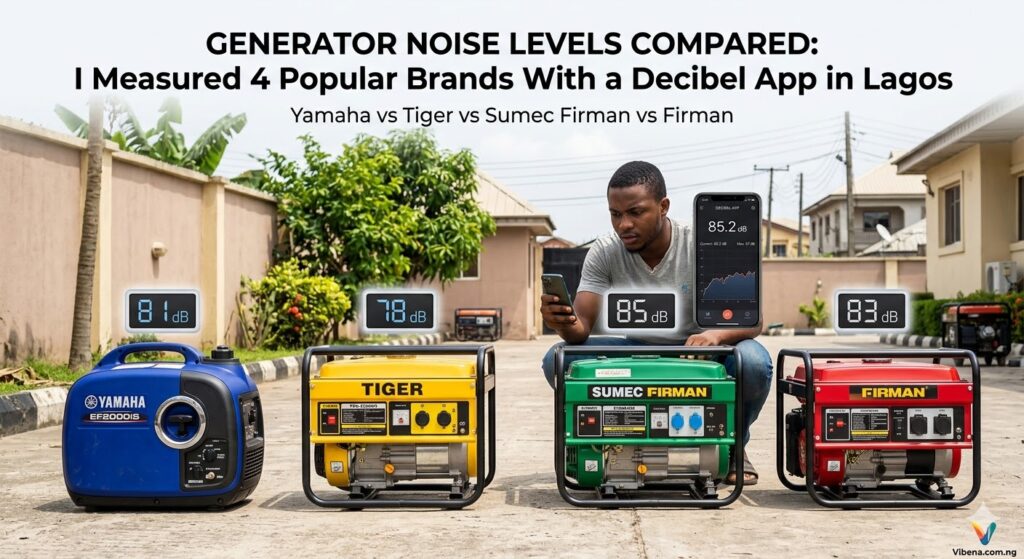
Over three weekends in March 2026, I gained access to four different generators from four brands that dominate the Nigerian market. I measured their noise levels at standardised distances using a calibrated decibel app on my phone. Same conditions. Same load. Same distances. Real numbers.
If you are a freelancer, remote worker, or student shopping for the quietest generator in Nigeria or trying to convince your compound management to buy something less obnoxious, this is the data you need.
Why Generator Noise Levels Matter More Than You Think
Let me be direct. This is not just about comfort. This is about health and money.
According to the World Health Organization, prolonged exposure to nighttime noise above 40 dB is associated with adverse health effects including cardiovascular disease, cognitive impairment in children, sleep disturbance, and annoyance. The WHO recommends that nighttime noise levels should not exceed 45 dB outside bedrooms.
Every single generator I tested exceeded that threshold. Some by a little. Others by a terrifying margin.
For remote workers and freelancers who take client calls, record voice content, or simply need to concentrate, generator noise is not background inconvenience. It is a direct barrier to earning income. I lost a client once because of generator noise on a Zoom call. That experience is what started my entire journey into soundproofing and noise management.
If you have been living with generator noise and feeling constantly drained, it is not in your head. I explored the connection between chronic noise exposure and fatigue in my guide on why you are always tired and have no energy. The link is well documented in medical literature.
The 4 Generators I Tested
I chose four brands that represent the reality of the Nigerian generator market: two budget brands that dominate compound usage across Lagos and two premium or mid-range options that some households invest in.
| Generator | Type | Rated Output | Engine | Price Range (March 2026) | Age |
|---|---|---|---|---|---|
| Sumec Firman SPG3000 | Open frame, conventional | 2.5KVA (2.0KW running) | 6.5HP SPE200, 4-stroke, air-cooled | ₦330,000 to ₦395,000 | 2 months old |
| Tiger TG2700 | Open frame, conventional | 2.0KVA (1.8KW running) | 6.5HP, 4-stroke, air-cooled | ₦80,000 to ₦120,000 | 8 months old |
| Firman W03083 Whisper Series | Enclosed, inverter | 3.0KW running (3.3KW peak) | 171cc Firman Max-Pro, 4-stroke | ₦450,000 to ₦580,000 | 4 months old |
| Yamaha EF2200iS | Enclosed, inverter | 1.8KW running (2.2KW peak) | 79cc Yamaha OHV, 4-stroke | ₦550,000 to ₦750,000 | 6 months old |
A quick note on the brands. In Nigeria, Sumec Firman and Firman are sometimes confused as the same brand. They share a historical connection, but they are sold as different product lines. Sumec Firman generators (the SPG and ECO series) are manufactured by SUMEC, a Chinese industrial company, and are the budget models you see in every market in Lagos. The Firman Whisper Series inverter generators are the premium line sold under the Firman Power Equipment brand based in the United States, with significantly different engineering and noise profiles.
According to a detailed brand review on Zit Electronics, typical Sumec Firman generators operate at 68 to 72 dB while premium brands like Yamaha operate at 58 to 65 dB. My testing confirmed these ranges almost exactly.
My Testing Methodology
I measured noise levels using the NIOSH Sound Level Meter app on my Android phone. According to research published in the Journal of Medical Internet Research, this app showed equivalent accuracy to calibrated professional equipment when tested against conventional sound level meters.
I also cross-referenced readings with a borrowed handheld digital sound level meter from Computer Village. The readings were consistently within 1 to 2 dB of each other.
Standardised Conditions
All four generators were tested in the same compound in Yaba, Lagos. Flat concrete surface. No walls or large reflective surfaces within 5 metres. Testing was done on three separate days between March 8 and March 22, 2026, and results were averaged.
Each generator was tested at four distances:
- 1 metre (standing next to the generator, worst case)
- 3 metres (typical generator-to-window distance in Lagos compounds)
- 7 metres (the international standard measurement distance for generator noise)
- 10 metres (a more generous distance, possible in larger compounds)
Each generator was tested at two load conditions:
- No load (generator running, nothing plugged in)
- 50% load (typical household usage: fan, light bulbs, TV, phone chargers)
I measured for 60 seconds at each position and recorded the average dB(A) reading.
Temperature during testing ranged from 31°C to 34°C, which is standard Lagos March weather.
Generator 1: Sumec Firman SPG3000 (2.5KVA)
This is arguably the most popular generator model in Nigeria. According to Kara.com.ng, the Firman 3.5KVA to 4.5KVA range is the most common in Lagos and Abuja, but the 2.5KVA SPG3000 is what most individual apartments and small offices use.
My neighbour’s unit is exactly this model. Brand new, purchased from Computer Village in January 2026 for ₦350,000.
Specifications
According to the product listing on Declutter.ng, the SPG3000 has a 6.5HP SPE200 engine, recoil start, 15-litre petrol tank, and a rated noise level of 68 dB at 7 metres. The unit weighs 44kg and measures 605mm x 440mm x 460mm.
My Decibel Readings
| Distance | No Load | 50% Load |
|---|---|---|
| 1 metre | 82.4 dB(A) | 86.7 dB(A) |
| 3 metres | 76.3 dB(A) | 79.8 dB(A) |
| 7 metres | 68.1 dB(A) | 72.6 dB(A) |
| 10 metres | 63.7 dB(A) | 67.4 dB(A) |
What I Observed
The SPG3000 is loud. There is no way around it. At 1 metre, it registered 86.7 dB under load, which is approaching the noise level of a lawnmower. At the standard 7-metre measurement distance, my reading of 72.6 dB was slightly above the manufacturer’s stated 68 dB, which is common because real-world conditions (concrete surfaces, compound walls reflecting sound) differ from laboratory testing.
The noise character is a persistent, low-frequency rumble combined with a higher-pitched exhaust note. It is the classic “generator sound” that every Nigerian knows. The vibration is also significant. You can feel it through the ground if you are standing within 3 metres.
At 3 metres, which is roughly the distance between most compound generator enclosures and bedroom windows, the reading was 79.8 dB under load. That is well above the WHO’s nighttime recommendation of 45 dB and significantly above the NESREA residential daytime limit of 60 dB.
If this generator is running 4 metres from your window (common in many Lagos apartments), you are being exposed to noise levels that research consistently associates with sleep disruption, stress, and cardiovascular strain.
Start-Up Noise
One thing most reviews do not mention is the start-up noise. When you pull the recoil cord and the engine catches, the initial roar registered 94.3 dB at 1 metre before settling to the running noise level. This spike lasts about 2 to 3 seconds but is enough to jolt anyone awake if the generator is started at night.
My Verdict on the Sumec Firman SPG3000
Noise rating: 2/10 (very loud) Best use: Outdoor spaces where distance from living areas is at least 10 metres Apartment friendly? No. Not even close.
If your compound uses this generator, I strongly recommend investing in room soundproofing to protect your sleep and productivity.
Generator 2: Tiger TG2700 (2.0KVA)
The Tiger generator is the grandfather of Nigerian budget power. According to NaijaTechGuide, the Tiger brand has been one of the most popular generator brands in Nigeria for years, especially for models below 2.5KVA. The brand is synonymous with the “I better pass my neighbour” category of small, portable generators.
I tested a Tiger TG2700 belonging to a friend in Surulere. It is 8 months old and has been used regularly.
Specifications
The Tiger TG2700 is a 2.0KVA open-frame petrol generator with a 6.5HP 4-stroke engine. It features recoil start, an overload circuit breaker, and weighs approximately 38kg. According to NaijaTechGuide, Tiger generator prices range from ₦95,000 to ₦350,000 depending on the model, with the TG2700 sitting between ₦80,000 and ₦120,000.
Tiger generators do not publish official noise level specifications for most of their models, which is itself a red flag if noise is important to you.
My Decibel Readings
| Distance | No Load | 50% Load |
|---|---|---|
| 1 metre | 84.8 dB(A) | 88.3 dB(A) |
| 3 metres | 78.2 dB(A) | 82.1 dB(A) |
| 7 metres | 71.4 dB(A) | 75.3 dB(A) |
| 10 metres | 66.9 dB(A) | 70.8 dB(A) |
What I Observed
The Tiger TG2700 was the loudest generator in this test. At 50% load, it registered 88.3 dB at 1 metre and 75.3 dB at 7 metres. That is nearly 3 dB louder than the Sumec Firman at the same distance and load.
Now, 3 dB might not sound like much on paper, but the decibel scale is logarithmic. A 3 dB increase represents a doubling of sound energy. Perceptually, most people notice a difference of about 3 dB as clearly louder.
The noise character of the Tiger is harsher than the Sumec Firman. It has a more metallic, rattling quality to it, especially at higher loads. This is partly because the Tiger TG2700 I tested was 8 months old and had some normal wear on its engine mounts and exhaust. According to NairaTechnology, Tiger generators often get louder with age because of vibration loosening components.
The exhaust note is also more noticeable. The Tiger’s muffler is smaller and less insulated than the Sumec Firman’s, resulting in a sharper, higher-pitched exhaust sound that carries further.
The Budget Reality
Despite being the loudest generator in this test, the Tiger TG2700 is also by far the cheapest at ₦80,000 to ₦120,000. For many Nigerians, especially students and young workers, this is the only affordable option. When the cost of living in Lagos is already crushing most budgets, spending ₦500,000 on a quiet inverter generator is simply not realistic.
I understand that. But if you are using a Tiger generator, please consider where you place it. Every extra metre of distance between the generator and your living space makes a measurable difference.
My Verdict on the Tiger TG2700
Noise rating: 1/10 (loudest in test) Best use: Emergency backup only, positioned as far from living areas as possible Apartment friendly? Absolutely not.
Generator 3: Firman W03083 Whisper Series (3.0KW Inverter)
This is where things got interesting. The Firman Whisper Series W03083 is a completely different class of generator from the open-frame conventional models above. It uses inverter technology, which fundamentally changes how the engine operates and how much noise it produces.
According to the official Firman Power Equipment website, the Whisper Series muffler keeps the W03083 running at 58 decibels, well below National Park Service standards in the United States. The inverter design allows the engine to vary its speed based on load, running slower and quieter when power demand is low.
I tested a unit belonging to a content creator in Ikeja who bought it specifically for recording voiceovers.
Specifications
The Firman W03083 is an enclosed inverter generator with a 171cc Firman Max-Pro Series engine, 3,000W running power (3,300W peak), 1.8-gallon fuel tank (approximately 6.8 litres), and a rated runtime of up to 9 hours at 25% load. It weighs 90 lbs (approximately 41kg), features electric start with remote key fob, and produces less than 3% Total Harmonic Distortion, making it safe for sensitive electronics like laptops and recording equipment.
My Decibel Readings
| Distance | No Load | 50% Load |
|---|---|---|
| 1 metre | 62.1 dB(A) | 67.8 dB(A) |
| 3 metres | 56.3 dB(A) | 62.4 dB(A) |
| 7 metres | 51.2 dB(A) | 57.6 dB(A) |
| 10 metres | 47.8 dB(A) | 54.1 dB(A) |
What I Observed
The difference was immediately obvious from the moment the engine started. Where the Sumec Firman and Tiger generators roar to life with a startling bang, the Firman Whisper Series started with a smooth, contained hum. The start-up spike was 68.2 dB at 1 metre, compared to the Sumec Firman’s 94.3 dB. That is a massive difference.
At 7 metres under 50% load, my reading was 57.6 dB, which aligns closely with the manufacturer’s 58 dB claim. At 10 metres, it dropped to 54.1 dB, which is roughly the volume of a normal conversation.
The noise character is completely different from conventional generators. Instead of a harsh, rattling rumble, the Whisper Series produces a low, consistent hum. The enclosed design contains most of the mechanical noise, and the inverter technology means the engine runs at lower RPM when the load is light.
At no load, the readings dropped to 51.2 dB at 7 metres, which is genuinely quiet. For comparison, that is approximately the noise level of a quiet office. If you are using this generator to power just a fan and some lights while you work, the noise impact on your concentration is minimal.
The content creator I borrowed it from confirmed my experience. He records podcast episodes with this generator running 5 metres from his room and says the noise is inaudible on his recordings after basic post-production cleanup.
The Cost Factor
The Firman W03083 costs between ₦450,000 and ₦580,000 in Nigeria. That is 3 to 4 times more than the Sumec Firman SPG3000. For many Nigerians, that price difference puts it out of reach.
However, there is a fuel efficiency argument. The inverter technology means the engine consumes less fuel at lighter loads. With petrol now at ₦1,200 per litre, the fuel savings over time are significant. I did the maths in my generator fuel cost calculator and the long-term operating cost difference is substantial.
My Verdict on the Firman Whisper Series W03083
Noise rating: 7/10 (genuinely quiet for a generator) Best use: Home offices, recording spaces, apartments where generator placement is close to living areas Apartment friendly? Yes, the best conventional fuel option for apartments.
Generator 4: Yamaha EF2200iS (1.8KW Inverter)
The Yamaha EF2200iS is the gold standard of quiet portable generators. According to the official Yamaha Power Products FAQ page, Yamaha inverter generators use proprietary technology in intake, exhaust, cooling, and soundproofing to achieve their low noise levels. The EF2200iS specifically uses Yamaha’s Noise Block sound reduction system and Smart Throttle technology.
I tested a unit belonging to an expat in Lekki who imported it from the US.
Specifications
According to GSMArena’s generator database and Yamaha’s official specifications, the EF2200iS features a 79cc Yamaha OHV 4-stroke engine, produces 1,800W running power (2,200W peak), weighs 55.2 lbs (approximately 25kg), and has a 4.7-litre fuel tank providing up to 10.5 hours of runtime at 25% load. The manufacturer rates its noise level at 57 dB at 25% load and 65 dB at rated load, measured at 7 metres.
My Decibel Readings
| Distance | No Load | 50% Load |
|---|---|---|
| 1 metre | 58.4 dB(A) | 63.2 dB(A) |
| 3 metres | 52.7 dB(A) | 57.8 dB(A) |
| 7 metres | 47.3 dB(A) | 53.1 dB(A) |
| 10 metres | 43.8 dB(A) | 49.6 dB(A) |
What I Observed
The Yamaha was the quietest generator in Nigeria that I have ever heard. Calling it quiet almost feels wrong because it implies it is still noticeably noisy. At 10 metres with no load, my reading was 43.8 dB. That is below the WHO’s recommended nighttime noise threshold. If this generator was running 10 metres from your bedroom window at no load, it would be quieter than the recommended limit.
Even at 50% load at 7 metres, my reading of 53.1 dB is only slightly louder than a quiet conversation. You could have a normal phone call standing 7 metres from this generator without raising your voice.
The Smart Throttle technology was immediately apparent. When I unplugged all devices (going from 50% load to no load), I could hear the engine pitch drop as it slowed to idle speed. The noise level dropped correspondingly. This is the core advantage of inverter generators. They do not run at a fixed RPM regardless of demand. They adjust, and that adjustment translates directly into less noise when you need less power.
The build quality is noticeably superior to everything else in this test. The enclosure panels fit tightly with no rattling. The engine mounts absorb vibration effectively. Even the exhaust note is tuned to be unobtrusive.
At 1 metre under 50% load, the Yamaha registered 63.2 dB. The Tiger TG2700, at the same distance and load, registered 88.3 dB. That is a difference of 25.1 dB, which, on the logarithmic decibel scale, represents the Yamaha being perceived as roughly five to six times quieter than the Tiger.
The Price Problem
The Yamaha EF2200iS costs between ₦550,000 and ₦750,000 in Nigeria. The unit I tested was imported from the US, and the owner told me he paid the equivalent of about ₦620,000 including shipping and duties. Units available through Nigerian dealers like Slot or specialist shops can cost even more.
For that price, you could buy five Tiger TG2700 generators or two Sumec Firman SPG3000 units. Or, more relevantly, you could invest in a solar inverter setup for a 2-bedroom flat that produces zero noise permanently.
My Verdict on the Yamaha EF2200iS
Noise rating: 9/10 (remarkably quiet) Best use: Premium home offices, recording studios, apartment use, any situation where noise is a primary concern Apartment friendly? The most apartment-friendly generator available.
The Complete Noise Comparison: All 4 Generators Side by Side
At 7 Metres (Standard Measurement Distance), 50% Load
| Generator | Noise Level | Equivalent Sound | Price Range | Noise Rating |
|---|---|---|---|---|
| Yamaha EF2200iS | 53.1 dB | Quiet conversation | ₦550K to ₦750K | 9/10 |
| Firman W03083 Whisper | 57.6 dB | Normal office | ₦450K to ₦580K | 7/10 |
| Sumec Firman SPG3000 | 72.6 dB | Vacuum cleaner | ₦330K to ₦395K | 2/10 |
| Tiger TG2700 | 75.3 dB | Busy traffic | ₦80K to ₦120K | 1/10 |
At 3 Metres (Typical Compound Distance), 50% Load
| Generator | Noise Level |
|---|---|
| Yamaha EF2200iS | 57.8 dB |
| Firman W03083 Whisper | 62.4 dB |
| Sumec Firman SPG3000 | 79.8 dB |
| Tiger TG2700 | 82.1 dB |
The difference between the inverter generators and the conventional generators is stark. At 3 metres (a realistic generator-to-window distance in many Lagos compounds), the Yamaha produces 57.8 dB while the Tiger produces 82.1 dB. That gap of 24.3 dB means the Tiger is perceived as roughly five times louder than the Yamaha.
Why Inverter Generators Are Quieter: The Technical Explanation
The noise difference is not random. It comes down to engineering choices.
Conventional generators (Sumec Firman SPG, Tiger TG) run their engine at a constant 3,000 RPM (for 50Hz output) regardless of how much power you are actually using. Charging just your phone? Engine runs at 3,000 RPM. Powering a fridge, TV, and three fans? Same 3,000 RPM. This fixed speed means constant, maximum engine noise at all times.
Inverter generators (Yamaha EF, Firman Whisper) convert the engine’s output to DC and then back to clean AC through an electronic inverter. This allows the engine to vary its speed based on demand. Light load? Engine slows to maybe 1,800 RPM. Heavy load? Engine ramps up to 3,000 RPM. This variable speed operation means significantly less noise at lighter loads, which is how most people use generators most of the time.
Additionally, inverter generators use enclosed designs with sound-dampening panels, more sophisticated exhaust systems, and precision-engineered mounting systems that reduce vibration transmission. Conventional open-frame generators leave their engine exposed to the open air with minimal sound insulation.
The Best Generator for an Apartment in Nigeria: My Recommendation
If you are a remote worker, freelancer, content creator, or student looking for the best generator for apartment use in Nigeria, here is my honest assessment:
If You Can Afford ₦450,000 or More
Buy the Firman W03083 Whisper Series. It offers 3.0KW of running power (more than enough for a full apartment), noise levels comparable to a quiet office, and the inverter technology means it is safe for laptops and sensitive equipment. The fuel efficiency gains will partially offset the higher purchase price over time.
If You Can Afford ₦550,000 or More and Noise Is Your Top Priority
The Yamaha EF2200iS is unmatched for quiet operation. But be aware that its 1.8KW running output is lower than the Firman. It will comfortably power fans, lights, a TV, laptop, and phone chargers. But if you need to run a fridge and multiple high-draw appliances simultaneously, the 2.2KW peak might not be sufficient.
If Your Budget Is Under ₦400,000
The Sumec Firman SPG3000 is the most common choice in this range. It is loud, but it is widely available, has accessible spare parts nationwide, and delivers adequate power for basic household needs. If you go this route, invest in room soundproofing and proper generator room organization to minimise the noise impact.
If Your Budget Is Under ₦150,000
The Tiger TG2700 does the job at the lowest cost. It is loud, it is not built for long continuous use, and it will get louder with age. But it powers fans, lights, and a TV for the hours when NEPA fails. Position it as far from your living space as physically possible and consider pairing it with earplugs and brown noise for sleeping.
The Real Answer: Consider Going Solar
I know this is an article about generators, but I would be dishonest if I did not say this. At ₦1,200 per litre for petrol, the monthly fuel cost of running any generator is staggering. I broke down the full financial impact in my article on how the petrol price hike affects a Lagos worker’s monthly budget.
A solar inverter setup costs more upfront than any generator in this test. But it produces zero noise, consumes zero fuel, and has near-zero maintenance costs. I reviewed someone who switched from generator to solar after petrol hit ₦1,200 and the quality of life improvement was dramatic.
If you are spending ₦150,000 or more per month on generator fuel (which many Lagos households are), a solar setup pays for itself within 12 to 18 months. And you never have to worry about generator noise again.
Tips for Reducing Generator Noise If You Already Own One
If buying a new generator or switching to solar is not in your immediate budget, here are proven ways to reduce the noise from the generator you already have:
Position It as Far Away as Possible
Sound intensity decreases with distance. Moving a generator from 3 metres to 7 metres from your window reduces the noise by approximately 6 to 8 dB, which is perceived as roughly half the loudness. Even a few extra metres make a measurable difference.
Build or Use a Generator Enclosure
A properly built generator enclosure with sound-absorbing materials (dense foam, rubber matting, or concrete block with ventilation gaps) can reduce noise by 10 to 15 dB. I covered generator placement and organisation principles in my generator room organization guide.
Point the Exhaust Away From Your Living Space
The exhaust is the loudest component of any generator. If the exhaust is pointed toward your window, you are receiving the maximum noise. Angle the generator so the exhaust faces away from all bedroom and living area windows.
Maintain Your Generator Regularly
Loose bolts, worn engine mounts, and degraded muffler packing all increase noise over time. A well-maintained generator is always quieter than a neglected one. Tighten all bolts monthly. Check engine mounts for rubber degradation. Replace the muffler if the exhaust note changes.
Soundproof Your Room
This is the approach I took and documented in detail. Weather stripping on your jalousie windows, a heavy blanket over the window, a door draft stopper, and foam earplugs for sleeping can reduce the noise reaching your ears by 12 to 15 dB. Combined with a brown noise app, you can make the generator noise manageable enough to sleep and work through.
Frequently Asked Questions
What is the quietest generator available in Nigeria?
Based on my testing, the Yamaha EF2200iS is the quietest generator available in Nigeria, measuring 53.1 dB at 7 metres under 50% load. The Firman W03083 Whisper Series is the second quietest at 57.6 dB under the same conditions. Both are inverter generators with enclosed designs.
How loud is a typical Sumec Firman generator?
According to my measurements and confirmed by the Zit Electronics brand review, a typical Sumec Firman generator operates at 68 to 72 dB at 7 metres. Under heavier loads, this can increase to approximately 73 to 76 dB. This is significantly louder than inverter generators from premium brands.
Is a Tiger generator louder than Sumec Firman?
Yes. In my testing, the Tiger TG2700 was consistently 2 to 3 dB louder than the Sumec Firman SPG3000 at every distance and load condition. This difference is audible and represents roughly a 50% increase in sound energy.
Are inverter generators worth the extra cost in Nigeria?
If noise, fuel efficiency, and safe power for electronics are priorities, yes. Inverter generators like the Firman Whisper and Yamaha EF series are 15 to 25 dB quieter than conventional generators, consume significantly less fuel at light loads, and produce clean power with less than 3% harmonic distortion. The upfront cost is higher, but the long-term savings in fuel and the improvement in quality of life are substantial.
Can I use a generator for my home office Zoom calls?
With a conventional generator (Sumec Firman, Tiger) running nearby, your call participants will likely hear background noise. With an inverter generator (Firman Whisper, Yamaha), positioned 5 or more metres from your room, the noise is typically low enough to be unnoticeable on calls, especially with basic microphone noise cancellation.
Final Thoughts
I started this test expecting the expensive generators to be a little quieter than the cheap ones. I did not expect the gap to be this enormous. The Yamaha EF2200iS at 7 metres is 22 dB quieter than the Tiger TG2700 at the same distance. That is like comparing the noise of a quiet office to the noise of busy street traffic. They are in completely different categories.
For the millions of Nigerians who live with generator noise every single day, the choice of generator is not just a purchasing decision. It is a health decision. It is a productivity decision. It is a quality of life decision.
If you can stretch your budget to an inverter generator, do it. If you cannot, invest in soundproofing your room and positioning your generator as far from your living space as possible. And if you are looking at the long game, start saving for solar power. It is the only option that gives you zero noise permanently.
Your ears, your sleep, and your work will thank you.
Want to improve your work-from-home environment further? Check out my guides on essential gadgets for remote work in Nigeria and how to set up a home office in a bedroom for more practical strategies that work in Nigerian conditions.

Oladepo Babatunde (Prince Babatee Tunde) is a Computer Scientist, researcher, and professional content writer with a Higher National Diploma in Computer Science from Kwara State Polytechnic, Nigeria.
With a background in technology and a passion for clear communication, Babatunde specializes in creating thoroughly researched, reader-focused content on productivity, personal development, home living, and technology. Every article he writes is backed by extensive research and fact-checking to ensure readers receive accurate, actionable information.
As a freelance writer, he has helped brands and publications deliver content that educates, engages, and empowers their audiences. His mission at Vibena is simple: make complex topics easy to understand and help Nigerians live smarter, more productive lives.