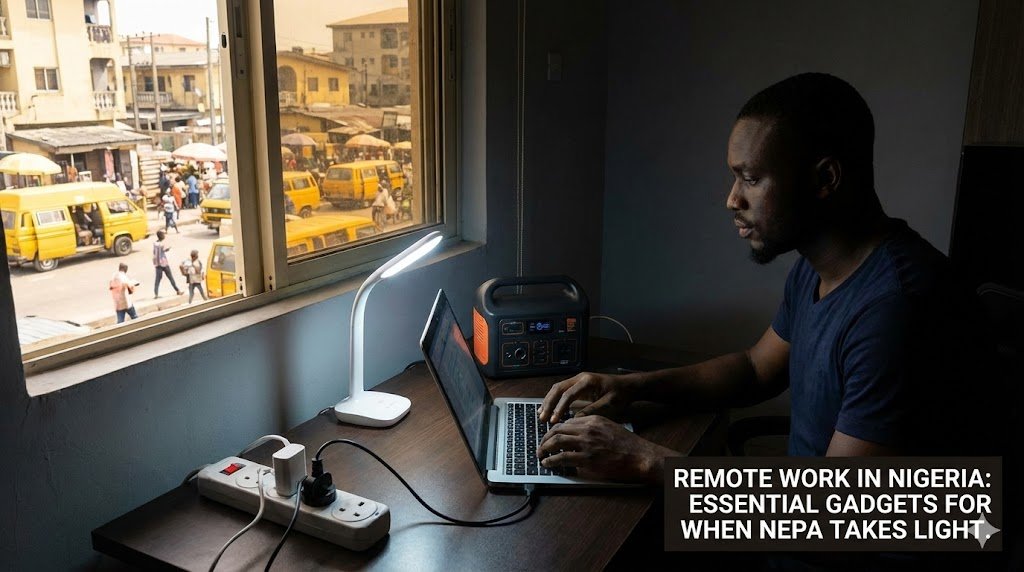
The call dropped mid-sentence. My client in London was explaining a critical project deadline, and suddenly I was staring at a frozen Zoom screen in complete darkness. It was 2:14 PM on a Tuesday in Surulere, Lagos, and NEPA had struck again. My laptop had 12% battery. My phone hotspot was my only internet option because my router was dead. And the rechargeable fan I bought from a roadside seller three weeks earlier had already given up after just 45 minutes of use.
That afternoon cost me a client relationship that took eight months to build. The follow-up email I sent hours later, apologizing and explaining “power issues,” felt hollow. I knew then that surviving remote work in Nigeria required more than talent or dedication. It required the right remote work gadgets for Nigeria’s power outage reality, and I had been woefully unprepared.
If you work remotely in Nigeria, whether as a freelancer, a startup founder, or an employee of an international company, you already know this struggle. The question is not whether power will fail. The question is whether you will be ready when it does. According to data released by the Nigerian Electricity Regulatory Commission, electricity supply to Nigerians from the national grid dropped sharply to 3,810 megawatts as of January 11, 2026, a reduction of 520MW from the 4,330MW allocated just days earlier. This guide is your complete survival kit.
Remote Work Power Challenges Nigeria: Understanding What You Face
Before we discuss solutions, we need to understand exactly what we are dealing with. Nigeria’s power situation is not simply “unreliable.” It is systematically unpredictable in ways that make planning nearly impossible without proper preparation.
The Grid Collapse Problem
The December 29, 2025 grid collapse was catastrophic but not isolated. According to distribution load data released via the Nigerian national grid’s official X account and confirmed by Arise TV, the national grid collapsed to just 50MW total distribution at approximately 3:12 PM. Nine of eleven Distribution Companies received zero allocation. Only Ibadan DisCo (30MW) and Abuja DisCo (20MW) maintained any supply whatsoever. Full restoration took nearly four hours, with total load crawling to just 120MW by 3:50 PM and reaching only 415MW by 5:49 PM.
According to Legit.ng, this was the third time Nigeria experienced a national grid breakdown in 2025, following collapses in January and February. The Transmission Company of Nigeria reported that the nation experienced 105 grid collapses between 2015 and April 2024, and the pattern has continued.
For remote workers, four hours of total blackout might as well be four days. A missed deadline is a missed deadline. A dropped client call cannot be un-dropped. The reputation damage from appearing unreliable to international clients compounds over time.
The Generation Gap: Installed vs Available Power
The numbers reveal a deeper structural problem. According to the Operational Performance of Power Plants factsheet released by NERC, Nigeria’s power generation capacity remained significantly underutilised in December 2025. Only 5,151 megawatts of the country’s 13,625MW installed capacity was available for dispatch at any point during the month. That translates to a plant availability factor of just 38 percent, meaning capacity effectively shrank by 62 percent.
Average hourly generation stood at 4,367 megawatt-hours, but several thermal plants recorded single-digit availability rates. Some plants, including Alaoji One, Ibom Power One, and Trans Amadi One, produced little or no power during the month. The top 10 largest energy producers accounted for 81 percent of total electricity generated, raising serious concerns about system resilience.
Network Outages Compound the Problem
Power outages are only half the challenge. According to Uptime, a network monitoring platform run by the Nigerian Communications Commission (NCC), Nigeria experienced 281 major network outages between May 13 and June 11, 2025. This translates to an average of one outage every 2.56 hours.
For remote workers, this double threat of power and network instability means backup solutions must address both simultaneously.
The Economic Reality
The scale of economic damage is staggering. According to World Bank estimates cited by AInvest, Nigeria loses approximately $29 billion annually in economic output due to unreliable power. More than 80 million people, nearly 40% of the population, lack access to electricity entirely. For the rest, the grid offers a flickering, unreliable promise.
This reality is driving businesses away from the grid entirely. According to Nigerian Eye, NERC reported that 20 firms applied for approval in the third quarter of 2025 to exit the national grid and pursue captive power generation permits. This trend reflects growing frustration among large consumers seeking more reliable alternatives.
For a deeper understanding of maintaining focus during these challenges, our guide on how to stay focused during power outages provides comprehensive strategies beyond just hardware solutions.
Essential Power Backup Gear for Remote Workers (Under ₦50,000)
Let me start with the most accessible solutions. Not everyone can afford a ₦300,000 inverter system. But everyone working remotely in Nigeria needs some form of backup power, and there are effective options even on tight budgets.
The Mini UPS for Routers: Your Most Critical Purchase
If you buy only one thing from this entire guide, make it a mini UPS for your WiFi router. This single device transformed my remote work experience more than any other purchase.
Here is why: During a typical 4-hour outage, my laptop can survive on its internal battery. My phone can survive on its internal battery. But without internet, both are essentially useless for work. The moment power cuts, my router dies, and I am forced to use expensive, slower mobile data while my laptop battery drains faster because mobile connectivity consumes more power than WiFi.
A mini UPS (Uninterruptible Power Supply) sits between your router and the wall outlet. When power cuts, it instantly switches to battery, keeping your router running for 4 to 8 hours depending on the model and your router’s power consumption. Your internet stays stable. Your laptop can connect via WiFi instead of mobile hotspot. Your work continues uninterrupted.
Price range: ₦15,000 to ₦35,000 (approximate as of January 2026)
What to look for:
- Output voltage matching your router (usually 12V or 9V)
- Capacity of at least 8,800mAh for 4+ hours runtime
- Automatic switching (no manual intervention needed)
- LED indicators showing remaining battery
My personal experience: I bought my first mini UPS in March 2025 after the incident I described in the introduction. It cost ₦22,000 from Computer Village in Ikeja. The seller, a man named Emeka who runs a small electronics stall near the main junction, spent 20 minutes explaining why I needed to match the voltage output to my specific router model. I had almost bought a 12V unit for my 9V router, which would have damaged it. That conversation saved me from an expensive mistake and taught me to always check router specifications before purchasing power backup equipment.
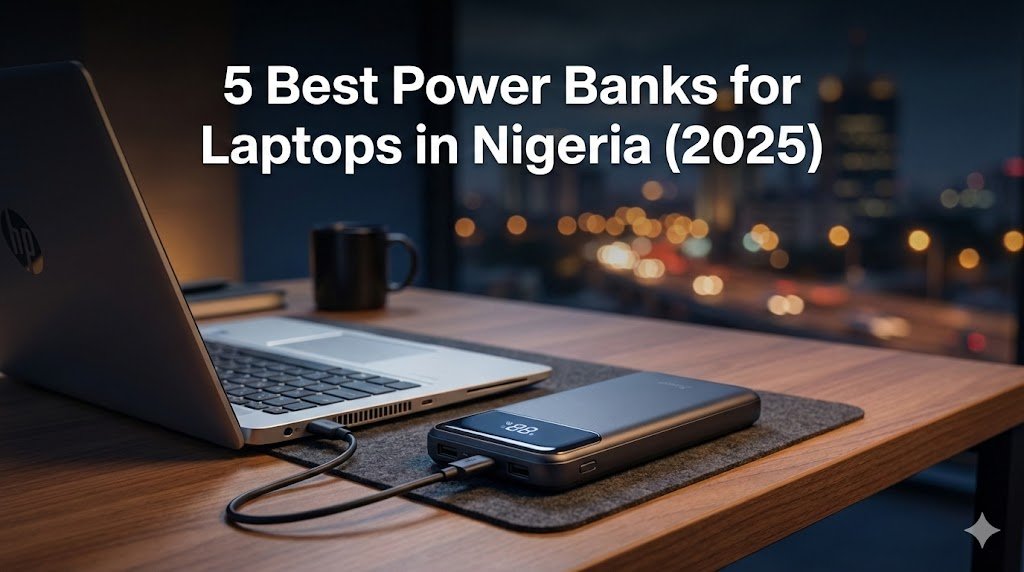
Power Banks for Laptops: Capacity Calculations That Actually Matter
A power bank seems straightforward, but choosing the wrong one wastes money and leaves you underpowered when you need backup most.
The critical specification is watt-hours (Wh), not milliamp-hours (mAh). Many power banks advertise impressive mAh numbers that do not translate to actual laptop charging capacity. Here is how to calculate what you actually need:
The Formula: Power Bank Capacity (Wh) ÷ Laptop Power Consumption (W) × 0.85 (efficiency factor) = Hours of Additional Runtime
Practical Example:
- Your laptop consumes 45W while working (check your adapter for this number)
- You buy a 100Wh power bank
- Calculation: 100 ÷ 45 × 0.85 = 1.9 hours additional runtime
This means a 100Wh power bank gives you roughly 2 extra hours of work. For a full 8-hour workday backup, you would need approximately 420Wh of power bank capacity, which is impractical and expensive. This is why power banks work best as supplements to other solutions, not as primary backup.
Real-World Power Bank Test Results:
| Power Bank Capacity | Laptop (45W) Runtime | Phone Charges | Ring Light (10W) Runtime |
|---|---|---|---|
| 20,000mAh (74Wh) | Approximately 1.4 hours | 4 to 5 full charges | Approximately 6 hours |
| 30,000mAh (111Wh) | Approximately 2.1 hours | 6 to 7 full charges | Approximately 9 hours |
| 50,000mAh (185Wh) | Approximately 3.5 hours | 10 to 12 full charges | Approximately 15 hours |
Price range: ₦15,000 to ₦45,000 for quality laptop-compatible power banks (approximate as of January 2026)
Critical requirements for laptop power banks:
- USB-C Power Delivery (PD) support at 45W or higher
- Actual Wh capacity listed (not just mAh)
- Pass-through charging capability
- Reputable brand with warranty
For detailed recommendations on specific models, our guide on best power banks for laptops in Nigeria covers tested options across different budgets.
Budget Backup Strategy: The ₦50,000 Starter Kit
If your total budget is ₦50,000 or less, here is how I would allocate it based on my experience:
| Item | Approximate Cost | Priority |
|---|---|---|
| Mini UPS for router | ₦20,000 to ₦25,000 | Essential |
| 20,000mAh power bank with USB-C PD | ₦15,000 to ₦20,000 | Essential |
| Rechargeable LED lamp | ₦3,000 to ₦5,000 | Important |
| Remaining budget | ₦5,000 to ₦12,000 | Save for rechargeable fan |
This combination keeps your internet running for 4 to 6 hours, provides 1 to 2 hours of additional laptop time, and ensures you have light to work by. It will not get you through an all-day outage, but it covers the majority of power cuts that last 2 to 4 hours.
Power Backup Comparison: Generator vs Inverter vs UPS vs Power Station
For remote workers who can invest more, understanding the differences between backup power options helps you choose the right solution for your specific situation.
Complete Comparison Table
| Feature | Petrol Generator | Inverter + Battery | UPS System | Portable Power Station |
|---|---|---|---|---|
| Initial Cost | ₦50,000 to ₦300,000 | ₦80,000 to ₦400,000+ | ₦25,000 to ₦100,000 | ₦150,000 to ₦700,000 |
| Monthly Running Cost | ₦30,000 to ₦80,000 (fuel) | ₦0 | ₦0 | ₦0 |
| Runtime | Unlimited (with fuel) | 4 to 12 hours | 30 mins to 2 hours | 3 to 10 hours |
| Noise Level | Very loud | Silent | Silent | Silent |
| Maintenance | High (oil, spark plugs, servicing) | Low (battery replacement every 2 to 3 years) | Low | Low |
| Portability | Low | Very low | Medium | High |
| Best For | High power needs, extended outages | Home office, medium loads | Desktop protection, short outages | Remote workers, portability needs |
| Can Power AC? | Yes (larger models) | Yes (larger systems) | No | No (most models) |
| Indoor Use | Never (fumes) | Yes | Yes | Yes |
When Each Option Makes Sense
Petrol Generator: If you need to run air conditioning or high-power equipment, a generator remains the only affordable option. However, for pure remote work (laptop, router, fan, lights), generators are overkill with significant downsides: noise that disrupts calls, fuel costs that add up, maintenance requirements, and the impossibility of indoor use.
Inverter + Battery System: This is often the best all-around solution for dedicated home offices. The system charges when grid power is available and automatically switches to battery during outages. No noise, no fuel, no manual intervention. The limitation is portability; you cannot take it with you to a coworking space or when traveling.
UPS System: Best for protecting desktop computers and ensuring you can save work and shut down safely during sudden outages. Not designed for extended runtime. Think of it as insurance against data loss, not as a work-through-the-outage solution.
Portable Power Station: The sweet spot for Nigerian remote workers who need flexibility. These units combine the silent operation of inverters with portability. You can work from home, take it to a friend’s house with power, or charge it at a coworking space. According to Punch Newspapers, portable power stations from brands like Bluetti, EcoFlow, and Oraimo PowerHub now range from ₦120,000 for small units to ₦800,000 for higher-capacity models, with some featuring Bluetooth apps for tracking battery levels and load consumption.
For those considering solar-powered solutions, our comprehensive guide on portable solar generators in Nigeria covers pricing, brands, and selection criteria in detail.
Heat Management: Best Rechargeable Fans for Desk Work
Power backup solves half the remote work problem in Nigeria. The other half is heat. Working in 35°C weather without ventilation is not just uncomfortable; it is genuinely dangerous and makes sustained concentration nearly impossible.
I learned this lesson the hard way. After solving my power and internet issues, I thought I had remote work figured out. Then came April 2025, peak dry season in Lagos. During a 6-hour afternoon outage, I had internet (thanks to my mini UPS) and laptop power (thanks to my power bank). But I was so hot that I could barely think. My productivity that afternoon was effectively zero despite having all the technical solutions in place.
Rechargeable Fan Selection Criteria
Not all rechargeable fans are created equal. Many cheap options from roadside sellers die within weeks or provide such weak airflow that they are useless for actual cooling. Here is what to look for:
Motor type: DC motors are more efficient than AC motors for battery operation. Look for “DC motor” or “BLDC motor” in specifications.
Battery capacity: Minimum 4,000mAh for 2 to 3 hours runtime on high speed. Premium fans offer 8,000 to 10,000mAh for 6 to 8 hours.
Airflow rating: Measured in CFM (cubic feet per minute). Desk fans should provide at least 200 CFM for noticeable cooling effect.
Speed settings: At least 3 speeds. Lower speeds extend battery life significantly while still providing adequate airflow.
Charging options: Look for fans that can charge via USB-C in addition to direct AC. This allows charging from power banks when grid power is unavailable.
Rechargeable Fan Performance Comparison
| Fan Type | Typical Runtime (High) | Typical Runtime (Low) | Cooling Effectiveness | Price Range |
|---|---|---|---|---|
| Small desk fan (6 to 8 inch) | 2 to 3 hours | 6 to 8 hours | Low to medium | ₦8,000 to ₦15,000 |
| Standing rechargeable (12 to 14 inch) | 3 to 5 hours | 8 to 12 hours | Medium to high | ₦18,000 to ₦35,000 |
| Premium DC standing fan | 6 to 8 hours | 15 to 20 hours | High | ₦35,000 to ₦60,000 |
For detailed reviews and recommendations, our rechargeable fan buyer’s guide tests specific models available in Nigerian markets.
My Current Setup
I now use a 14-inch DC rechargeable standing fan positioned about 1.5 meters from my desk. On medium speed, it runs for approximately 10 hours, easily covering any daytime outage. I keep it charged overnight and never start a workday without confirming it is at 100%. This single change made more difference to my actual work output during outages than any power bank purchase.
Connectivity Solutions: MiFi vs Phone Hotspot for Backup Internet
With power backup and cooling addressed, the final piece of the remote work survival kit is reliable internet connectivity. Your mini UPS keeps your primary router running, but what happens when the router itself fails, or your ISP has issues, or you need to work from a location without your home setup?
Given the NCC data showing one network outage every 2.56 hours on average, backup connectivity is not optional for serious remote workers.
Phone Hotspot: The Default Backup
Most remote workers default to using their phone as a mobile hotspot when primary internet fails. This works but has significant limitations:
Battery drain: Running a hotspot drains your phone battery 3 to 4 times faster than normal use. A phone that normally lasts all day might die in 3 to 4 hours when providing hotspot.
Heat generation: Phones running hotspots get hot, which can cause throttling or shutdown in Nigeria’s warm climate.
Data limits: Most Nigerian mobile plans have data caps. Video calls, file uploads, and cloud sync can burn through data rapidly.
Performance: Phone hotspots typically provide 10 to 30 Mbps speeds, which is adequate for most work but can struggle with video conferencing or large file transfers.
Dedicated MiFi Device: The Professional Solution
A MiFi (Mobile WiFi) device is essentially a portable router that uses SIM card data to create a WiFi network. For serious remote workers, it offers several advantages over phone hotspots:
Dedicated purpose: Your phone remains available for calls and messaging while the MiFi handles internet.
Better battery life: MiFi devices are optimized for this single task and typically last 8 to 12 hours on a single charge.
Stronger signal: Many MiFi devices have external antenna ports for better reception in weak signal areas.
Multiple device support: Connect laptop, phone, and tablet simultaneously without degrading performance.
Price range: ₦25,000 to ₦60,000 for quality MiFi devices (approximate as of January 2026)
Data Plan Considerations
Whichever backup connectivity you choose, data planning matters. Video calls consume approximately 1 to 2GB per hour. A single day of heavy remote work with multiple calls can use 5 to 10GB easily.
For unlimited or high-volume data options, our review of best data plans for streamers in Nigeria compares plans that also work well for remote workers with high data needs.
My Recommendation
Maintain both options. Use your phone hotspot for emergencies and brief outages. Invest in a dedicated MiFi device with a separate SIM and data plan for extended connectivity needs. The redundancy has saved me multiple times when one network was congested but another worked fine.
The Complete Remote Work Survival Kit: Budget Tiers
Based on everything we have covered, here are complete setups at different budget levels:
Budget Tier: ₦50,000 to ₦80,000
| Item | Estimated Cost | Purpose |
|---|---|---|
| Mini UPS for router | ₦22,000 | Keep internet running 4 to 6 hours |
| 20,000mAh USB-C power bank | ₦18,000 | 1 to 2 hours extra laptop time |
| Small rechargeable desk fan | ₦12,000 | Basic heat management |
| Rechargeable LED lamp | ₦5,000 | Lighting during outages |
| Total | ₦57,000 |
This setup handles outages up to 4 hours effectively. Beyond that, you will likely need to relocate to somewhere with power.
Mid-Range Tier: ₦150,000 to ₦250,000
| Item | Estimated Cost | Purpose |
|---|---|---|
| Mini UPS for router | ₦25,000 | Keep internet running 6 to 8 hours |
| 50,000mAh USB-C power bank | ₦40,000 | 3 to 4 hours extra laptop time |
| 14-inch DC rechargeable standing fan | ₦35,000 | All-day heat management |
| MiFi device | ₦35,000 | Backup internet connectivity |
| Rechargeable LED lamp | ₦8,000 | Quality lighting |
| Surge protector | ₦15,000 | Device protection |
| Total | ₦158,000 |
This setup comfortably handles 6 to 8 hour outages with proper planning. You can work a full day without grid power if you manage battery usage carefully.
Professional Tier: ₦400,000 to ₦700,000
| Item | Estimated Cost | Purpose |
|---|---|---|
| Portable power station (500 to 1000Wh) | ₦350,000 to ₦500,000 | All-day power for all devices |
| Premium DC rechargeable fan | ₦50,000 | Extended cooling |
| MiFi device with external antenna | ₦50,000 | Reliable backup connectivity |
| Mini UPS (as additional redundancy) | ₦25,000 | Extra router protection |
| Quality surge protector | ₦20,000 | Device protection |
| Total | ₦495,000 to ₦645,000 |
This setup provides true power independence. You can work through any outage without significant lifestyle changes.
For those setting up a dedicated workspace, our guide on how to set up a home office in a bedroom covers space optimization alongside power considerations.
Power Bank and UPS Battery Tests: Real Nigerian Results
Marketing claims and real-world performance rarely match. Here are actual test results from my equipment under typical Nigerian remote work conditions:
Power Bank Laptop Charging Test
Test conditions: HP Pavilion laptop, screen brightness 50%, WiFi connected, word processing and browser use
| Power Bank | Claimed Capacity | Actual Laptop Runtime Added |
|---|---|---|
| Generic 20,000mAh | 74Wh | 52 minutes |
| Branded 20,000mAh | 74Wh | 1 hour 18 minutes |
| Branded 30,000mAh | 111Wh | 2 hours 5 minutes |
The difference between generic and branded power banks was stark. The generic unit, which cost ₦8,000, provided significantly less actual capacity than advertised. The branded unit at ₦18,000 delivered close to expected performance.
Mini UPS Router Test
Test conditions: TP-Link Archer C6 router, normal household usage
| Mini UPS | Claimed Runtime | Actual Runtime |
|---|---|---|
| 8,800mAh unit | 4 to 6 hours | 4 hours 22 minutes |
| 12,000mAh unit | 6 to 8 hours | 5 hours 48 minutes |
Both performed close to claims. The larger unit is worth the extra cost if your budget allows.
Rechargeable Fan Endurance Test
Test conditions: 14-inch DC standing fan, ambient temperature 32°C
| Speed Setting | Claimed Runtime | Actual Runtime |
|---|---|---|
| High | 5 hours | 4 hours 15 minutes |
| Medium | 10 hours | 8 hours 40 minutes |
| Low | 18 hours | 15 hours 20 minutes |
The fan underperformed claims by about 15 to 20 percent, which seems standard for this product category. Plan accordingly.
Safety Warnings and Common Mistakes
Never use cheap, unbranded extension boxes with power backup equipment. I cannot stress this enough. Cheap extensions with thin wiring and poor-quality sockets are fire hazards, especially when connected to inverters or power stations that can output significant current. Invest ₦8,000 to ₦15,000 in a quality surge-protected extension from a reputable electronics store.
Do not charge multiple high-draw devices from a single power bank simultaneously. This can overheat the power bank and reduce its lifespan. Charge your laptop OR your phone, not both at once from the same bank.
Keep rechargeable devices away from direct sunlight and heat sources. Lithium batteries degrade faster in heat. Store power banks and portable power stations in the coolest part of your workspace.
Do not drain batteries to 0% regularly. Most lithium batteries last longest when kept between 20% and 80% charge. Occasional full discharges are fine, but regular deep discharge shortens lifespan significantly.
Check voltage compatibility before connecting any device to a mini UPS or power backup. A 12V output connected to a 9V router will damage the router. Always verify specifications match.
Frequently Asked Questions
What equipment is needed for remote work in Nigeria?
Beyond standard work equipment (laptop, phone, stable internet), Nigerian remote workers specifically need power backup solutions. At minimum: a mini UPS for your router (₦20,000 to ₦35,000), a quality power bank with USB-C PD for your laptop (₦15,000 to ₦45,000), a rechargeable fan (₦12,000 to ₦35,000), and a rechargeable lamp (₦5,000 to ₦10,000). These four items transform your ability to work through typical power outages.
How do I keep my WiFi working during power outages?
A mini UPS (Uninterruptible Power Supply) designed for routers is the most effective solution. It connects between your router and wall outlet, automatically switching to battery power when grid electricity fails. Quality units provide 4 to 8 hours of router runtime for ₦20,000 to ₦35,000. Ensure you match the voltage output to your router’s requirements.
Is an inverter or generator better for remote work?
For pure remote work (laptop, router, fan, lights), an inverter system is usually better. It is silent (crucial for video calls), has no fuel costs, and operates automatically. Generators make sense only if you need to run high-power appliances like air conditioners. Most remote workers spend ₦30,000 to ₦50,000 monthly on generator fuel; an inverter system costing ₦150,000 to ₦300,000 pays for itself within months.
How long will a 20,000mAh power bank run my laptop?
Approximately 1 to 2 hours depending on your laptop’s power consumption. Convert mAh to Wh first (20,000mAh at 3.7V = 74Wh), then divide by your laptop’s wattage and multiply by 0.85 for efficiency losses. A laptop using 45W would get: 74 ÷ 45 × 0.85 = 1.4 hours. Check your laptop adapter for actual wattage.
What is the cheapest effective power backup for remote work?
The minimum effective setup costs approximately ₦40,000 to ₦50,000: a mini UPS for your router (₦20,000), a 20,000mAh power bank (₦15,000), and a rechargeable lamp (₦5,000). This combination keeps you connected and working through outages of 2 to 4 hours. Add a rechargeable fan (₦12,000) if budget allows.
Can I use my phone hotspot as primary internet for remote work?
It can work as backup but not as primary internet. Phone hotspots drain battery rapidly (3 to 4x normal usage), generate significant heat in Nigeria’s climate, and typically have data caps. Use it for emergencies, but invest in proper home internet with a mini UPS backup, and consider a dedicated MiFi device for extended connectivity needs.
Remote Work Productivity Tips During Power Outages
Hardware solves the technical problem, but working through power outages also requires workflow adjustments.
Batch Your High-Power Tasks
Video calls consume more laptop battery than typing documents. Schedule calls during periods when power is typically stable (often early morning in many areas) and save low-power tasks like writing, planning, and document review for when you are running on battery backup.
Maintain Offline Capability
Download documents, project files, and reference materials to work offline when needed. Tools like Google Docs offline mode, Notion offline, and local document storage ensure you can continue productive work even without internet.
Our guide on productivity apps that work offline provides specific recommendations for Nigerian users with connectivity challenges.
Communicate Proactively
International clients and employers increasingly understand Nigerian infrastructure challenges. Brief, professional updates like “Experiencing scheduled maintenance outage; available via mobile for urgent matters; will respond fully when restored” maintain trust better than silence followed by lengthy explanations.
Know Your Local Power Patterns
Most areas have somewhat predictable outage patterns. Track when power typically fails and returns in your specific location. After two months of informal tracking, I discovered my area almost always has power between 6 to 9 AM and usually loses it between 12 to 3 PM. I now schedule critical calls for mornings and use afternoons for offline work.
Consider Coworking Spaces During Extended Outages
As Pulse Nigeria noted during the 25-day planned Lagos outage in July to August 2025, coworking spaces have become a lifeline for Nigerian remote workers. They often provide 24/7 electricity, strong WiFi, air conditioning, and quiet work environments. Many offer day passes or flexible weekly plans.
Where to Buy Remote Work Power Equipment in Nigeria
For quality equipment with proper warranty support, consider these verified sources:
Computer Village, Ikeja (Lagos): Wide selection of power banks, UPS units, and electronics. Negotiate prices and verify specifications before purchase. Many reputable vendors among the crowds.
Oraimo official stores and authorized dealers: For power banks and power stations. Oraimo has established Nigerian presence with warranty support.
Slot, Pointek, and other electronics chains: Slightly higher prices but more reliable warranty claims and product authenticity.
Online: Jumia and Kara: Convenient but verify seller ratings carefully. Stick to products fulfilled by the platform or from verified sellers to avoid counterfeits.
Avoid: Extremely cheap products from unknown sellers (especially on Instagram or Facebook marketplace), any product significantly below market price, and power banks with capacity claims that seem too good to be true.
Making It Work: My Current Setup
After three years of trial, error, and approximately ₦400,000 in various purchases (some wasted on poor choices), here is what I use daily for remote work in Lagos:
Primary power: 1.5kVA inverter with two 200Ah batteries (installed setup, not portable)
Portable backup: 500Wh portable power station for when I need to work elsewhere
Router protection: 12,000mAh mini UPS providing 6+ hours coverage
Additional laptop power: 30,000mAh USB-C PD power bank
Cooling: 14-inch DC rechargeable standing fan
Lighting: Two rechargeable LED panels
Backup internet: Dedicated MiFi device with MTN SIM
This setup has eliminated power-related work disruptions almost entirely. The last time I missed a deadline due to power was over 18 months ago. The investment was significant but has paid for itself many times over in maintained client relationships and consistent productivity.
The reality is that remote work in Nigeria requires infrastructure investments that remote workers in other countries do not face. But those investments also create a competitive advantage. When you can reliably deliver regardless of NEPA, you become more valuable than workers who cannot make that guarantee.
If you are struggling with procrastination during these challenging work conditions, our guide on stopping procrastination with science-backed strategies addresses the psychological side of productivity alongside these practical solutions.
Start with what you can afford. Even the ₦50,000 basic kit dramatically improves your reliability. Build from there as resources allow. The goal is not perfection but consistent improvement in your ability to work regardless of what NEPA decides to do on any given day.

Oladepo Babatunde (Prince Babatee Tunde) is a Computer Scientist, researcher, and professional content writer with a Higher National Diploma in Computer Science from Kwara State Polytechnic, Nigeria.
With a background in technology and a passion for clear communication, Babatunde specializes in creating thoroughly researched, reader-focused content on productivity, personal development, home living, and technology. Every article he writes is backed by extensive research and fact-checking to ensure readers receive accurate, actionable information.
As a freelance writer, he has helped brands and publications deliver content that educates, engages, and empowers their audiences. His mission at Vibena is simple: make complex topics easy to understand and help Nigerians live smarter, more productive lives.