It was 11:30 PM on a humid Tuesday in Lagos. My generator had just sputtered and died because I forgot to buy fuel on my way back from work. The heat was already creeping back into the room, and the silence was only broken by my neighbor’s “I-better-pass-my-neighbor” generator screaming next door.
That was the night I decided I was done. No more late-night fuel runs, no more noise, no more struggling with staying focused during power outages, and no more fighting with the changeover switch during a National Grid collapse.
If you are reading this, you are probably in the same boat. You live in a 2-bedroom flat, you are tired of the unpredictability of DisCos (like Ikeja Electric or EKEDC), and you want to know the truth about the solar inverter setup for Nigerian 2-bedroom flat and the actual solar inverter setup for Nigerian 2 bedroom flat cost.
In this guide, I’m sharing my actual experience. I won’t just give you Google definitions. I’m going to show you exactly how much I spent, the mistakes I made (so you don’t have to), and a realistic price breakdown for 2026 using proper photovoltaic (PV) terminology.
Let’s strip away the marketing noise and look at the reality of my journey.
⚠️ IMPORTANT DISCLAIMER
- Electricity Kills: A 2.5 kVA inverter produces 220V AC electricity, just like NEPA. If you touch live wires, it can be fatal. I am a tech enthusiast, not a certified electrical engineer. This guide shares my personal experience. Always hire a qualified technician for the final connections.
- Price Volatility: Prices in Nigeria change weekly based on the FX rate. The costs listed here are estimates as of 2026. Always confirm current prices at Alaba or Ikeja before budgeting.
- DIY Risk: If you install this yourself to save money, you risk voiding warranties or damaging expensive components. Proceed with caution.
📋 QUICK ANSWER
| Feature | Recommendation |
|---|---|
| System Size | 2.5 kVA – 3.5 kVA |
| Total Cost | ₦950,000 – ₦2.6M (2026) |
| Panels Needed | 4-6 × 550W (Monocrystalline PERC) |
| Batteries | 2 × 220Ah Tubular OR 1 Lithium Pack |
| Payback Period | 18-24 months |
| Maintenance Level | Moderate (Tubular) to Low (Lithium) |
My Solar Journey: Why I Finally Switched from Generator
Let’s be honest, living in Nigeria means you are your own local government. You provide your own water, your own security, and definitely your own power.
For years, I relied on a 3.5 kVA petrol generator. I even optimized my generator setup, but it remained a money pit. Especially after the major electricity tariff increase in April 2024, keeping the lights on became a financial burden. Between servicing the carburetor every other month and the rising cost of fuel, I calculated I was burning through about ₦60,000 to ₦80,000 monthly just to sleep with a fan on and keep my food from spoiling.
I was hesitant to switch to solar because of the upfront cost. When I finally installed my system in March 2025, dropping nearly ₦2 million felt like a huge risk. But looking back, the peace of mind is priceless. This shift isn’t just personal; it’s a national trend. In fact, TechCrunch noted that the Nigerian solar market has reached grid parity specifically due to fuel subsidy removals, driving massive adoption.
Furthermore, with the Federal Government’s 2026 targets to expand renewable energy access, going solar is becoming the only sustainable path forward. The gentle hum of the inverter is barely noticeable compared to my old generator’s coughing and sputtering. When I did the math on my generator expenses over two years, the solar setup actually looked cheaper.
The biggest challenge? Finding information specific to a 2-bedroom flat. Most guides talk about massive duplexes or tiny self-contain apartments. I needed a middle-ground solution—something that could carry my freezer, my work laptop (often paired with a power bank for redundancy), the TV, and fans, without breaking the bank.
With the “why” firmly established—and data showing Nigeria added over 63.5 MWp of solar capacity recently according to AFSIA—the next logical question was the “how much?”
How Much Does a Solar Inverter Setup Cost for a 2-Bedroom Flat in Nigeria?
This is the question everyone asks first. In 2026, prices have stabilized a bit, but quality components still cost money.
For a standard 2-bedroom apartment, you generally fall into the 2.5 kVA to 3.5 kVA range. Anything less (like 1.5 kVA) will struggle with a freezer due to inductive load surges. Anything more (5 kVA) might be overkill unless you plan to run multiple ACs 24/7.
Solar Inverter Setup for Nigerian 2 Bedroom Flat Price (2026 Breakdown)
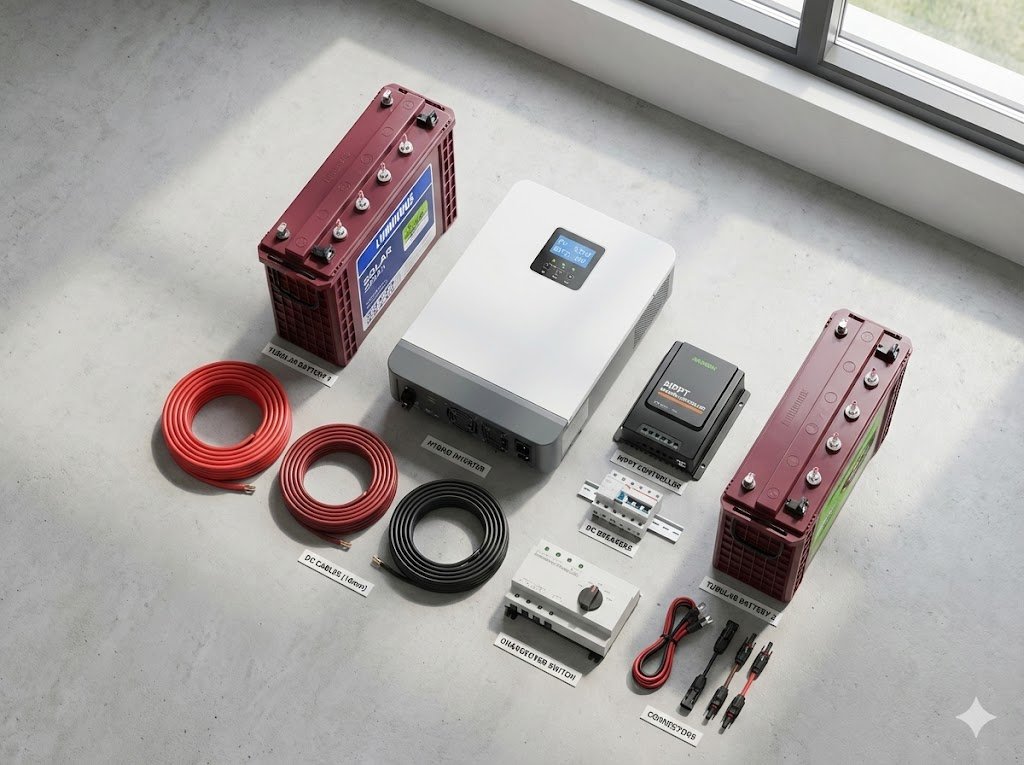
Here is the market reality if you go to Alaba International Market or order from reputable installers in Ikeja today.
| Component | Specifications | Estimated Cost (₦) |
|---|---|---|
| Inverter | 2.5 kVA Pure Sine Wave (Hybrid) | ₦250,000 – ₦420,000 |
| Solar Panels | 4 × 550W Monocrystalline PERC | ₦200,000 – ₦600,000 |
| Batteries | 2 × 220Ah Tubular (OR 1 Lithium) | ₦300,000 – ₦700,000 (Tubular)₦900,000 – ₦1,200,000 (Lithium) |
| Charge Controller | 60A MPPT (Often built-in) | ₦0 – ₦80,000 |
| Installation | Workmanship & Logistics | ₦100,000 – ₦150,000 |
| Accessories | Cables, Rack, Breakers, Changeover | ₦100,000 – ₦150,000 |
| TOTAL | Standard to Premium Setup | ₦950,000 – ₦2,600,000 |
Note: Prices fluctuate with the dollar rate. The lower end of the battery price (₦150k each) reflects budget brands, while the higher end (₦350k each) is for premium brands like Luminous or Eastman. For a worry-free solar inverter setup for Nigerian 2-bedroom flat, I strongly recommend budgeting toward the higher end for batteries.
For context, Techpoint Africa’s pricing breakdown quoted a complete 2.5 kVA solar system at roughly ₦1.9 million, which aligns perfectly with my experience for a quality setup. For comparison, SunPlenti’s 2025 guide lists complete 1kVA-2.5kVA systems with batteries at ₦1.2M-2.5M, while TekTins quotes premium 5kVA setups at ₦3M-5M—confirming that quality varies dramatically with price.
However, the sticker price is just the starting point; here is what drives the final figure up or down.
What Affects Your Total Solar Installation Cost?
I learned the hard way that the sticker price isn’t the only thing that matters. Here is what changes the final bill:
- Battery Technology & Brand Quality (The Big One):
- Tubular Batteries: The price gap is huge here. You can find budget brands (like Mercury or local assemblies) for as low as ₦150,000, but premium brands (like Luminous, Starplus, or Eastman) can cost up to ₦370,000 each. Don’t be fooled: the cheaper ones often have shorter lifespans and less lead content (C20 vs C10 rating).
- Lithium Batteries: More expensive (approx. ₦900k – ₦1.2M for a robust pack). However, they have a higher Depth of Discharge (DoD)—you can use 80-90% of their capacity compared to 50% for tubular. They last 3x longer and charge faster. I started with tubular to save money, but I’m saving up to switch to Lithium next year.
- Roof Distance: I live on the ground floor of a two-story building. The cost of DC cables to run from the roof to my flat was almost double what my friend paid because he lives on the top floor. Copper cable is expensive in Nigeria right now!
- Location: Installers in Lagos (especially Island side) often charge a premium compared to installers in places like Ibadan or Ogun state.
Once you’ve settled on your budget and storage, the next critical step is figuring out exactly how to generate that power.
How Many Solar Panels Do I Need for a 2-Bedroom Apartment?
If you ask a trader in Alaba, they might tell you “buy as many as you can.” But if you are in a rented apartment, you have limited roof space.
For a solar inverter setup for Nigerian 2-bedroom flat, the magic number usually falls between 4 to 8 panels (550W each).
The Calculation Logic
I used this simple formula based on Peak Sun Hours:
- Total Daily Load: My flat consumes about 4-5kWh per day (without AC).
- Sun Hours: We get about 4-5 hours of “peak” sun in Nigeria (Irradiance > 1000W/m²).
- The Math: 4 panels x 550W = 2,200 Watts (2.2 kWp).
- 2,200W x 4 hours sun = 8,800 Watt-hours (8.8kWh).
Even with efficiency losses (dust, heat, cable resistance), 4 to 6 panels are usually enough to charge your batteries fully by 2 PM.
| Appliance Load | Recommended Panels (550W) | Roof Space Needed |
|---|---|---|
| Basic (Lights, Fans, TV) | 2 – 4 Panels | Small |
| Standard (Plus Fridge/Freezer) | 4 – 6 Panels | Medium |
| Heavy (Plus Inverter AC) | 8 – 12 Panels | Large |
Calculations are great, but I needed to see it work in the real world before committing.
What Can a 2.5 kVA Solar System Power? (Real-World Test)
When I installed my 2.5 kVA system, I stress-tested it immediately. I wanted to know its breaking point. Here is the truth:
Can a 2.5 kVA Inverter Carry a Fridge?
Yes, absolutely. My medium-sized innovative fridge runs 24/7 on this setup. Modern fridges have “smart compressors” (often Digital Inverter Technology) that don’t draw a huge surge when they start. However, if you have an old, rusty thermocool fridge from 1999, the startup surge might trip the inverter.
Can a 1.5 kVA Inverter Carry a Freezer?
It depends, but be careful. A 1.5 kVA can technically run a small chest freezer, but the inductive startup surge is risky. If the freezer kicks in while you are watching TV and have the fans on, the lights might flicker, or the system might shut down to protect itself. For a freezer, sticking to 2.5 kVA is safer.
Can I Run AC with a Solar Panel?
On a 2.5 kVA system? Barely. I have a 1HP Dual Inverter AC. I can run it during the afternoon when the sun is blazing hot and the panels are producing maximum power. But running it at night on batteries alone? It drains my batteries in less than 2 hours. If you want AC at night, you need a 5 kVA setup and a massive Lithium battery bank. Otherwise, you might want to learn how to cool your flat without AC to save battery life.
Seeing these limits, you might be wondering how to customize this for your specific flat without blowing up your inverter.
Solar Inverter Sizing Guide: Matching Your Flat’s Power Needs
Don’t just buy what your neighbor bought. Your consumption is different.
How Do I Calculate How Many Solar Panels I Need? (The “Energy Audit” Method)
Don’t guess. If you guess, you will either overspend or wake up in darkness at 2 AM. But before you calculate, you need accurate numbers.
Pre-Step: Finding Your Appliance Wattage (Where to Look)
Most people guess their TV consumes 200W when it’s actually 50W. Here is how to find the real numbers:
- The “Secret” Sticker: Every electrical appliance has a silver or white label.
- TVs/Fridges: Check the back panel.
- Standing Fans: Check under the base.
- Laptops: Check the text on the black charging block (look for “65W” or “90W”).
- The “Volts x Amps” Trick: If you don’t see “W” (Watts), look for “V” (Volts) and “A” (Amps). Multiply them. (e.g., 220V x 0.5A = 110 Watts).
- The “Pro” Move: For fridges that turn on and off, stickers are misleading. Buy a cheap “Plug-in Watt Meter” (about ₦15,000 on Jumia). Plug your fridge into it for 24 hours to see exactly how much energy it actually consumes in a day.
Here is the exact 3-step formula I used to size my system correctly. The goal here isn’t just to run appliances during the day; it’s to generate enough surplus power to fill your batteries for the night.
Step 1: Calculate Your “Night Load” (Watt-hours)
You need to know how much “fuel” (electricity) your house “drinks” when the sun goes down. List your critical appliances and how many hours you run them.
- Ceiling Fan: 70W × 8 hours = 560Wh
- LED TV (43″): 50W × 4 hours = 200Wh
- Laptop Charging: 65W × 3 hours = 195Wh
- LED Bulbs (4): 10W (×4) × 6 hours = 240Wh
- Fridge (Smart Inverter): 150W × 12 hours (duty cycle) = 1,800Wh
- Total Daily Energy Need: 2,995Wh (approx 3kWh)
(Tip: Save power by swapping AC fans for rechargeable fans to lower this number.)
Step 2: Apply the “Nigerian Sun Factor”
In Lagos, we effectively get only 4 to 5 hours of “Peak Sun” (when the sun is strong enough to generate maximum power).
- Divide your Total Daily Energy Need by Peak Sun Hours.
- Calculation: 2,995Wh ÷ 4.5 hours = 665 Watts.
This means you need to generate 665 Watts every single hour for those 4.5 hours to break even.
Step 3: Add the Efficiency Buffer (Crucial!)
Theoretical math fails in the real world. You lose power to heat, dust on panels, and cable resistance. Always add a 30% safety margin (multiply by 1.3).
- Calculation: 665 Watts × 1.3 = 864 Watts.
The Verdict: You need a minimum of 864 Watts of solar panels to stay powered up.
Action: Since modern panels typically come in 500W-600W sizes, you cannot buy “864 Watts” exactly. You should buy two 550W panels (Total 1,100W). This covers your need with a healthy surplus for cloudy days.
What is the 20% Rule for Solar Panels?
When sizing your system, always apply the 20% rule: Never run your inverter above 80% of its rated capacity continuously.
A 2.5 kVA inverter (approximately 2,000W output at 0.8 Power Factor) should ideally handle loads of 1,600W or less for optimal lifespan and efficiency. This “headroom” prevents overheating and ensures the fan isn’t screaming 24/7. If you max out your inverter constantly, you shorten its life significantly.
What is the Solar 120% Rule?
I learned this vital tip from my installer: Your solar panel array should be sized at 100-120% of your inverter’s capacity.
Solar panels rarely produce their full Watt-peak (Wp) due to real-world conditions. For a 2.5 kVA system, this means installing 2,500W – 3,000W of panels (roughly 5-6 × 550W panels). This accounts for efficiency losses from heat, dust (Harmattan), and cable resistance, ensuring you get decent power even when conditions aren’t perfect.
Now that we have the technical sizing down, let’s talk about the real victory: the impact on your wallet.
My 6-Month NEPA vs Solar Cost Comparison
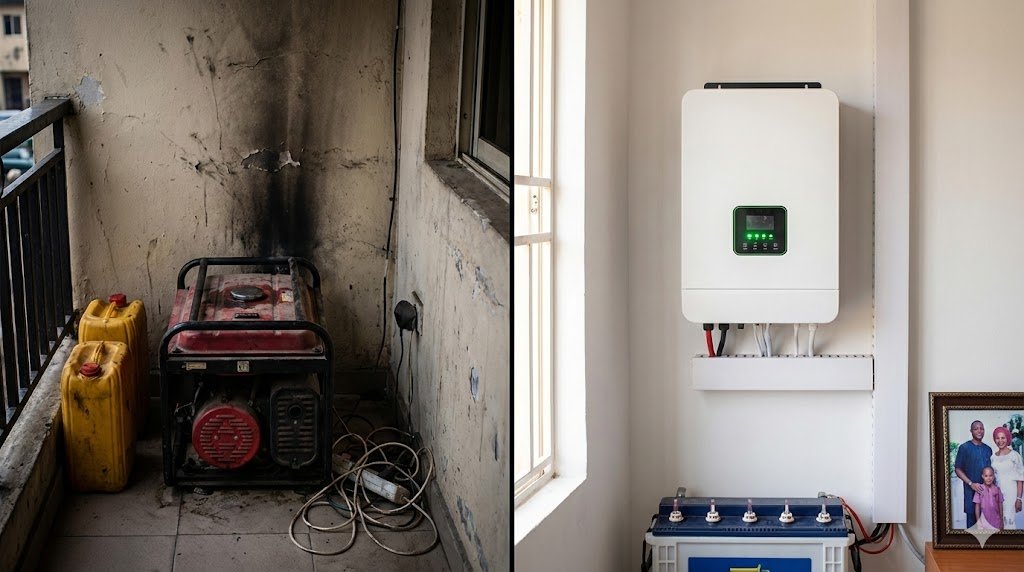
This is where the rubber meets the road. Managing electricity bills is a huge part of the cost of living in Lagos, so was spending almost ₦2 million worth it?
Before Solar (Monthly):
- NEPA Bill (Band A): ₦40,000 (Calculated on the expensive Band A tariff, meaning I got 20+ hours of light but paid a premium rate per unit).
- Generator Fuel: ₦60,000
- Generator Maintenance: ₦5,000
- Total: ₦105,000 / month
After Solar (Monthly):
- NEPA Bill (Backup/Heavy AC use): ₦15,000
- Generator Fuel: ₦0 (I barely use it)
- Distilled Water for Batteries: ₦2,000
- Total: ₦17,000 / month
Savings: ₦88,000 per month. ROI (Return on Investment): At this rate, the system pays for itself in about 22 months. After that, it’s essentially free electricity (minus battery replacements every few years).
To validate this further, TekTins notes that running a larger 5kVA generator for just 4 hours daily can cost ₦150,000 to ₦250,000 per month in Lagos—making solar’s 22-month payback period even more attractive for households with heavier power needs.
If those numbers look good to you, here is exactly what you need to look for in the market to build this system.
Component Shopping List with Real Nigerian Prices
If you are heading to the market, take this list with you.
Solar Panels (2026 Market Prices)
Look for “Half-cut Monocrystalline PERC” panels. They perform better in partial shade (like if a palm tree casts a shadow on your roof). Expect to pay ₦50,000 – ₦150,000 per 550W panel.
Inverters and Charge Controllers
I recommend Hybrid Inverters. These combine the inverter and the MPPT charge controller into one box. It looks neater on your wall and is easier to wire. Popular brands in Nigeria like Felicity, Growatt, or Must are reliable. For a deeper dive into premium options like Victron or Sunsynk, you can check Earthbond’s 2026 inverter rankings.
- MPPT vs PWM: Always check for MPPT (Maximum Power Point Tracking). It costs a bit more but extracts 30% more power from your panels compared to older PWM controllers, which is a lifesaver during the rainy season.
- Pure Sine Wave: Ensure you buy a Pure Sine Wave inverter. Cheaper “modified sine wave” units create “dirty” power (High THD) that makes fans hum loudly and can damage sensitive electronics like laptops and TVs over time.
- Hybrid vs. Off-Grid: Most setups for flats are Hybrid systems—they intelligently switch between solar, battery, and NEPA. A strictly Off-grid system has no connection to NEPA, which is risky in a flat unless you have a massive battery bank.
Batteries: Lithium vs Tubular Comparison
- Tubular: Good for budget but heavy. You can find reliable 220Ah options between ₦150,000 and ₦350,000 depending on the brand quality. These are true Deep Cycle batteries, designed to be drained and recharged repeatedly. Avoid standard car batteries; they are not deep cycle and will die in 3 months. They must be kept in a ventilated area because they emit fumes.
- Lithium (LiFePO4): The gold standard. Safe to keep inside your flat (no fumes). Zero maintenance. If you can afford the extra ₦400k, do it.
Essential Accessories (Don’t Forget These!)
- DC Breaker (63A – 100A): Protects your battery from short circuits.
- PV Breaker/Isolator: Allows you to turn off the solar panels safely.
- Surge Protection Device (SPD): With Nigeria’s unstable grid and frequent lightning, an SPD is non-negotiable. It sacrifices itself to save your expensive inverter from voltage spikes.
- 16mm² or 25mm² Pure Copper Cable: Do not use 10mm cable for battery connections; it will get hot and melt due to high amperage.
- Distilled Water (for Tubular): Buy a 25-litre keg (approx ₦5,000) for top-ups.
- Vaseline/Petroleum Jelly: To coat battery terminals against corrosion.
Where to Buy Solar Components in Lagos
The most popular markets include Alaba International Market (best prices, but verify quality), Ikeja Computer Village (mixed quality), and authorized dealers in Lekki and Victoria Island (premium prices but genuine products). For those outside Lagos, markets in Aba, Onitsha, and Port Harcourt offer competitive pricing.
If you want to verify installer credibility or avoid flying blind, Techpoint Africa’s list of top solar companies for 2025 is a great resource to cross-check established brands versus market traders.
Having the parts is one thing; installing them safely in a concrete Lagos apartment is another challenge entirely.
Pre-Installation Checklist: Do This Before Buying
Don’t just rush to buy panels. Do these checks first to avoid “stories that touch”:
- Check Your Distribution Board (DB): Open your fuse box. Are your heavy loads (AC, Water Heater, Electric Stove) on separate breakers from your lights and sockets? If not, you need an electrician to separate them. You do not want your inverter trying to power your water heater by accident.
- Verify Earthing: Bad earthing can destroy your inverter during a lightning storm. Ask an electrician to test your building’s earthing. If it reads above 5 Ohms, fix it.
- Space Prep: If using Tubular batteries, you need a ventilated space (balcony or airy corridor). They release hydrogen gas when charging. Do not put tubular batteries in your bedroom.
Step-by-Step Installation Process for Nigerian Apartments
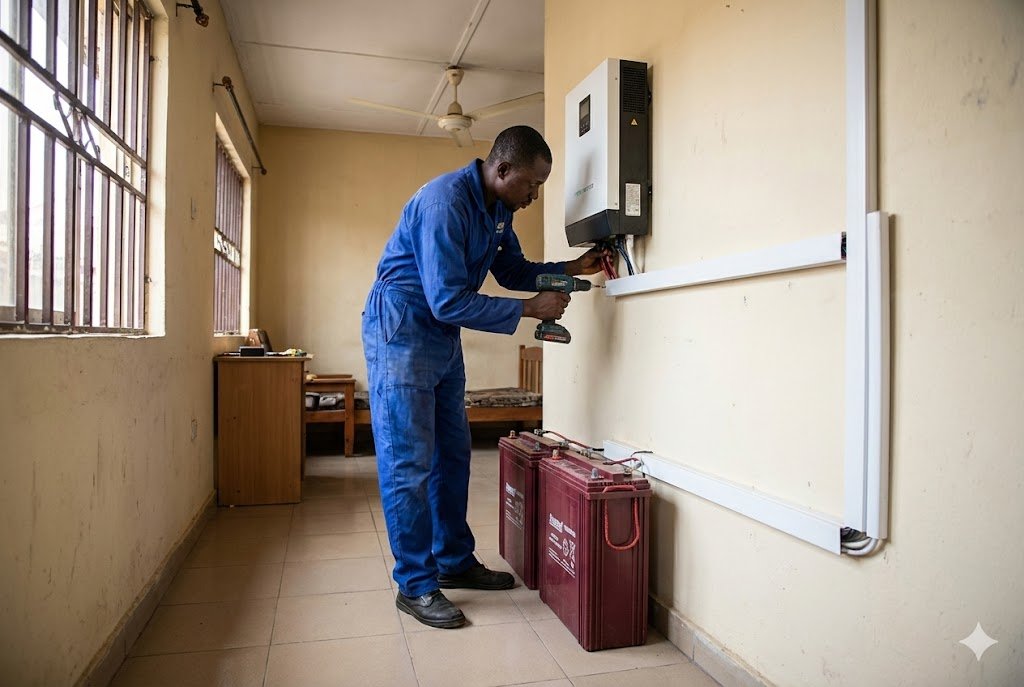
Installing in a flat is different from a bungalow.
Apartment-Specific Challenges
- The Landlord: Before you buy one screw, ask your landlord. Some are paranoid about roof damage. I had to sign an undertaking that I would fix any leaks caused by the installation. Dealing with property restrictions is often one of the hidden costs of Lagos apartments that renters forget.
- Wiring in Concrete Buildings: Most Lagos flats are built with solid concrete. You can’t easily run new wires inside the walls. My installer had to use surface trunking (white plastic casing). It looks neat if done well, but make sure they use high-quality adhesive or screws.
- The Changeover Switch: Ensure they install an automatic changeover. You don’t want to be getting up to switch from Solar to NEPA manually.
Getting it on the wall is only half the battle; keeping it running requires a routine to avoid failure.
How to Maintain Your Solar Setup (The “Don’t Blow It” Guide)
Solar is “set and forget” only if you do the bare minimum. Here is my monthly routine:
1. The Water Ritual (Tubular Only)
- How Often: Every 2-3 months.
- What to Do: Check the float indicators on top of the battery. If the red float has dropped low, it needs water.
- How to Execute: Top up with Distilled Water ONLY. Never use tap water (it kills the battery cells) or acid (it destroys the plates). Fill just to the “Max” line.
2. The Harmattan Cleanse
- Frequency: Every 2 weeks during Harmattan (Dec-Feb), monthly otherwise.
- The Task: Dust kills power (shading effect). I go up to the roof (or pay someone) to wipe the panels with a soft cloth and plain water.
- Crucial Tip: Do this early morning (7 AM). If you wash hot panels in the afternoon sun, the glass can crack due to thermal shock.
3. The Terminal Check
- Schedule: Every 3 months.
- What to Look For: Check the battery terminals. If you see white powder (sulfation/corrosion), it creates resistance.
- The Fix: Pour hot water mixed with baking soda on it to clean it, then coat with Vaseline. Tighten any loose bolts. Loose bolts = melted terminals.
4. The Digital Checkup (Firmware & Temperature)
- Schedule: Monthly.
- What to Look For: Check your inverter’s display screen or mobile app.
- The Fix:
- Temperature: Most modern hybrid inverters display internal temperature. If it consistently reads above 45°C, improve ventilation immediately. Heat kills electronics.
- Updates: If your hybrid inverter (like Growatt) has Wi-Fi monitoring, check periodically for firmware updates that fix bugs and improve efficiency.
Even with a maintenance routine, I wasn’t immune to errors—here are the pitfalls I fell into.
What I Would Do Differently: Lessons from My Solar Setup
Looking back, I made a few mistakes.
- I skimped on the cables: I bought cheaper cables to save ₦15,000. Big mistake. The wires got warm when the load was high due to voltage drop, wasting energy. I had to pay to replace them with proper 16mm pure copper cables later.
- I underestimated the ‘Ironing’ factor: My wife tried to use the electric pressing iron on the system. It drained the battery instantly. We now strictly iron only when NEPA is around or during peak sun hours.
- I didn’t clean the panels: For the first 3 months, I ignored the panels. The dust from Harmattan reduced my power by 30%. Now, I pay the gateman ₦2,000 to wash them once a month.
I want to be completely transparent with you; solar isn’t a magic bullet for everyone.
Disadvantages of Solar Panels You Should Know
I’m not here to sell you a dream. There are downsides.
- Initial Cost is Painful: Dropping nearly ₦2 million at once is hard for most civil servants or salary earners.
- Weather Dependency: In July and August, when it rains for days in Lagos, your batteries won’t charge fully. You will need NEPA or a small gen as backup during these weeks.
- Battery Degradation: Batteries don’t last forever. Tubular batteries might need replacing in 2-3 years. You need to have a “sinking fund” to save for replacements.
Simple Solar Glossary for Beginners
- MPPT (Maximum Power Point Tracking): A smart technology in your charge controller that squeezes up to 30% more juice from your panels, especially during cloudy Nigerian days.
- Pure Sine Wave: A type of inverter that produces clean electricity, identical to what NEPA supplies. It’s safe for all your sensitive electronics like TVs and laptops.
- Deep Cycle Battery: A battery built to be drained and recharged hundreds of times. Unlike car batteries (which are for quick bursts), these are designed for long-term power supply.
Frequently Asked Questions
Q: Will a 200W solar panel run a fridge?
A: No, not reliably. A 200W panel produces roughly 800Wh per day (200W × 4 sun hours). A standard Nigerian fridge consumes 1,200-2,000Wh daily. You would need at least 2-3 × 200W panels (or better, 1-2 × 550W panels) to power a fridge consistently.
Q: Can a 2 bedroom flat run on solar only?
A: Yes, if you manage your load. You can run lights, fans, TV, and fridge. But heavy appliances like electric cookers and ACs usually require grid support or a massive, expensive system.
Q: Which battery is best for solar in Nigeria?
A: Lithium Iron Phosphate (LiFePO4) is the best for longevity and performance. Tubular batteries are the best value for money if you are on a budget. Avoid standard car batteries; they will die in 3 months.
Q: Does solar increase the value of my flat?
A: If you own the flat, yes. If you rent, the equipment is yours to take when you move, which is a great asset.
Q: How do I know if my installer is genuine?
A: Ask for pictures of their previous jobs. A good installer will have a neat setup with proper trunking and safety breakers. If they just twist wires together with black tape, run away.
Q: How often should I have my solar system professionally inspected?
A: At minimum, once per year. A qualified technician can identify issues like loose connections, corroded terminals, or failing capacitors that aren’t visible to untrained eyes.
Ready to stop sweating at night? Start by checking your electric bill to see how many units (kWh) you use in a month. That’s the first step to sizing your freedom from NEPA.

Oladepo Babatunde (Prince Babatee Tunde) is a Computer Scientist, researcher, and professional content writer with a Higher National Diploma in Computer Science from Kwara State Polytechnic, Nigeria.
With a background in technology and a passion for clear communication, Babatunde specializes in creating thoroughly researched, reader-focused content on productivity, personal development, home living, and technology. Every article he writes is backed by extensive research and fact-checking to ensure readers receive accurate, actionable information.
As a freelance writer, he has helped brands and publications deliver content that educates, engages, and empowers their audiences. His mission at Vibena is simple: make complex topics easy to understand and help Nigerians live smarter, more productive lives.