I lost a ₦120,000 client because of a generator.
It happened during a Zoom call with a content agency based in London. I was halfway through my pitch when my neighbour’s Firman 3.5KVA generator roared to life about four metres from my window. The client went quiet for a moment, then asked: “Is everything okay on your end?” I apologised and tried to continue, but the buzzing was relentless. She ended the call early. The follow-up email never came.
That was January 2026. I am a freelance writer working from a self-contained apartment in Yaba, Lagos. My room doubles as my office, my recording space, and basically my entire life. And the generator noise from my compound and the one next door was destroying my ability to work.
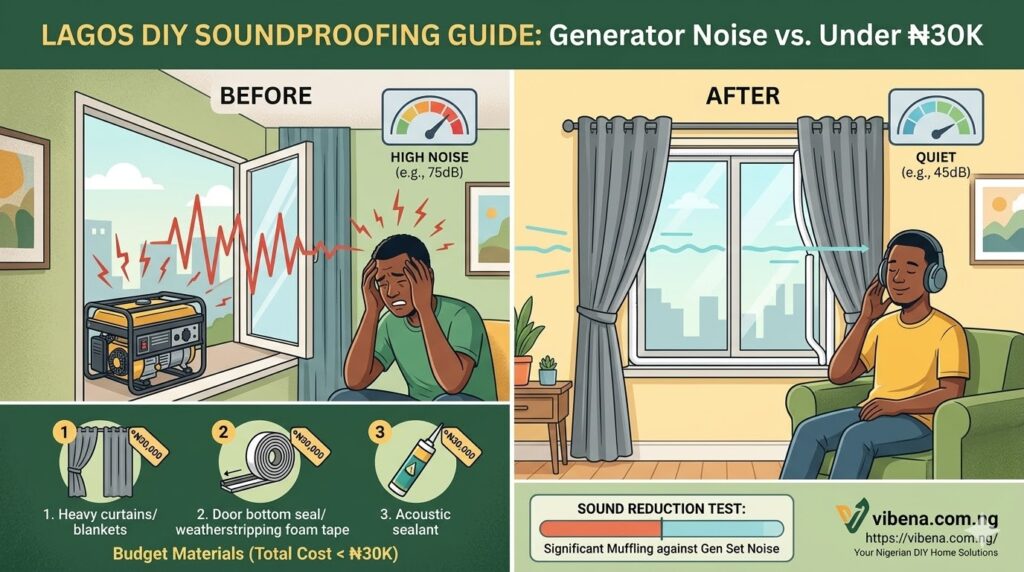
So I decided to soundproof my room. Not with ₦500,000 worth of professional acoustic treatment. Not by moving to a quieter apartment I could not afford. I did it for under ₦30,000 using materials I bought from Mushin market, Computer Village, and a building materials shop on Balogun Street.
This is the full breakdown of everything I bought, every step I took, and the actual before and after decibel readings from my phone’s sound meter app. If you are a remote worker, student, or content creator dealing with generator noise in Nigeria, this guide might save your sanity and possibly your income.
How Loud Is Generator Noise, Really? The Numbers Are Worse Than You Think
Before I started the soundproofing project, I wanted to understand exactly what I was dealing with. Not just “it’s loud.” I wanted real numbers.
According to a study published in the Journal of Engineering Research and Reports, sound levels from common household generators in Nigeria ranged from 60.9 dB(A) to 91.8 dB(A) depending on the generator’s capacity, age, and distance from the listener. The researchers tested generators ranging from 2KVA to 14KVA at distances of 0 to 20 metres.
To put that in perspective, the World Health Organization classifies any noise above 65 dB as noise pollution and says it becomes harmful when it exceeds 75 dB. Most small petrol generators in Nigerian homes operate well above both thresholds.
The National Environmental Standards and Regulations Enforcement Agency (NESREA) has a regulation called the National Environmental (Noise Standards and Control) Regulations 2009 that sets maximum permissible noise levels for residential areas at 60 dB during the day and 40 dB at night. But here is the reality: according to research from the University of Lagos on the FESTAC residential area, measured noise levels ranged from approximately 53.5 to 94 dB(A), far exceeding the recommended limit of 55 dB(A) for residential zones.
Those are not abstract numbers. That is the sound environment you and I live in every single day in Lagos.
My Room Setup Before Soundproofing
You need to understand what I was working with because soundproofing is not one size fits all. The shape of your room, the position of your windows, and the direction of the noise source all matter.
Room details:
- Location: Yaba, Lagos mainland
- Room type: Single room in a self-contained apartment, ground floor
- Room size: Approximately 3.5m × 4m (about 14 square metres)
- Walls: Standard concrete block with plaster, no paint insulation
- Windows: One large jalousie (louvre) window facing the compound where two generators sit, roughly 4 metres away
- Door: Hollow wooden door with a visible gap at the bottom (about 2cm)
- Ceiling: POP ceiling, no insulation above it
The biggest problems were obvious. The jalousie window is essentially a noise highway. Those glass slats never close completely. There are always gaps between each blade, and sound walks right through them. The door gap at the bottom was another major entry point. And the thin concrete walls, while better than wood, still transmitted low-frequency vibrations from the generators.
If you are in a similar living situation, I wrote a more general overview of how to soundproof a room in Nigeria that covers different room types and budgets. This article focuses specifically on my personal experience and the exact results I achieved with under ₦30,000.
The Decibel Meter App I Used for Testing
I needed a reliable way to measure the actual decibel levels in my room before and after soundproofing. I did not want to guess. I wanted data.
I downloaded Sound Meter and Noise Detector on my Android phone. It is free on the Google Play Store and uses your phone’s built-in microphone to measure environmental sound in dB(A). According to a peer-reviewed study published in the Journal of Medical Internet Research (JMIR), smartphone sound level meter apps were tested against professional calibrated equipment. The study found that the NIOSH Sound Level Meter app had equivalent accuracy to a calibrated professional device, and none of the tested apps showed statistically significant differences from the conventional sound level meter.
That gave me confidence that my readings, while not laboratory-grade, were accurate enough for a real-world comparison.
I also borrowed my friend Segun’s ₦2,500 handheld digital sound level meter from Computer Village as a cross-reference. His readings and my phone readings were consistently within 1 to 2 dB of each other, which is acceptable.
Before Soundproofing: My Baseline Decibel Readings
I took readings over three days at different times to establish a reliable baseline. I placed my phone on my desk (where I work) and recorded the sound levels while different noise sources were active.
Baseline readings at my desk (before any soundproofing):
| Noise Source | Distance From Window | Reading at Desk | Time of Day |
|---|---|---|---|
| Neighbour’s Firman 3.5KVA generator | ~4 metres | 72.4 dB(A) | 2:15 PM |
| Compound’s Elepaq 2.5KVA generator | ~6 metres | 66.8 dB(A) | 11:30 AM |
| Both generators running simultaneously | 4-6 metres | 76.1 dB(A) | 7:45 PM |
| Background noise (no generators, daytime) | N/A | 44.2 dB(A) | 10:00 AM |
| Background noise (no generators, night) | N/A | 38.6 dB(A) | 11:30 PM |
Those numbers confirmed what I already knew. With both generators running, my room was sitting at 76.1 dB(A) at my desk. That is above the WHO threshold for harmful noise exposure. And these generators run for hours every day because, well, this is Lagos. You can check your own electricity band to understand how much grid power you actually receive, but for many of us in Yaba, it is about 8 to 12 hours on a good day.
At 72 to 76 dB, I could not take client calls without the background noise being clearly audible. I could not record voiceovers for content. I could not even concentrate on writing because the low-frequency rumble of the generator created a constant vibration that I felt in my chest and my desk.
My ₦30,000 Soundproofing Material List With Actual Receipts
Here is everything I bought, where I bought it, and what I paid. I kept every receipt.
| Material | Quantity | Source | Price |
|---|---|---|---|
| Thick moving blankets (woven, heavy-duty) | 2 | Mushin market | ₦4,500 each (₦9,000 total) |
| Self-adhesive foam weather stripping tape (12mm × 10m roll) | 2 rolls | Computer Village | ₦1,800 each (₦3,600 total) |
| Draft stopper / door sweep (adhesive, rubber) | 1 | Computer Village | ₦2,200 |
| Egg crate foam (mattress topper, 2-inch thick) | 1 full-size sheet, cut to fit | Mushin market | ₦6,500 |
| Heavy curtain fabric (thick polyester blackout material, 3m) | 1 piece | Balogun market | ₦4,200 |
| Curtain rod (extendable, basic steel) | 1 | Balogun market | ₦1,500 |
| Carpet offcuts (thick, dense pile) | 2 pieces (about 1.5m × 1m each) | Mushin market | ₦1,200 each (₦2,400 total) |
| Nails, hooks, adhesive tape, and miscellaneous | Various | Computer Village | ₦1,100 |
| TOTAL | ₦30,500 |
I went slightly over my ₦30,000 budget by ₦500, but I am counting that as close enough.
A quick note: I deliberately avoided buying professional acoustic foam panels from Jumia or imported products. A pack of 12 acoustic foam wedge panels on Jumia Nigeria costs between ₦15,000 and ₦35,000, which would have blown my entire budget on just one wall. I needed a solution that covered the whole room for under ₦30K. That meant getting creative with locally available materials.
The Soundproofing Process: What I Did Step by Step
I completed the entire project over a weekend (Saturday and Sunday). No hired help. No power tools. Just me, a hammer, some nails, a pair of scissors, and a lot of determination.
Step 1: Sealing the Jalousie Window Gaps
This was the most important step. The jalousie window was the single biggest source of noise entry. Those glass louvre blades overlap but never seal completely. Sound, especially the low-frequency rumble of a generator, passes right through the gaps between the blades.
What I did:
I took the self-adhesive foam weather stripping tape and ran a strip along the edge of every single glass blade where it overlaps with the next one. This is tedious work. My window has 12 louvre blades, and each one needed stripping on the top and bottom edge. It took me about 90 minutes to do the entire window.
The foam tape is soft enough to compress when the louvres close, creating a much tighter seal than the glass alone. It is the same tape people use around door frames in colder countries to prevent drafts, but here we are using it to block sound.
Immediate result: I could tell the difference just by standing next to the window. The high-frequency hiss of the generator (the whiny, tinny sound) was noticeably reduced. The low rumble was still there, but the sharp edge of the noise was gone.
Step 2: Hanging the Heavy Blanket Over the Window
Sealing the louvre gaps helped, but glass itself is thin and transmits sound easily. I needed mass over the window to block more of the noise.
I took one of the heavy moving blankets and hung it directly over the entire window using nails hammered into the wall above the window frame. I folded the blanket double so that there were two layers of dense, woven fabric covering the window from top to bottom, with about 15cm of overlap on each side to prevent sound from sneaking around the edges.
Yes, this blocks all natural light from the window. I work with a desk lamp and my laptop screen anyway, and honestly, the noise reduction was worth the trade-off. During breaks, I can pull the blanket aside for ventilation and light.
Important note: this means I cannot use the window for airflow when the blanket is up. I manage ventilation by opening my door during quieter periods. If you are concerned about cooling, I covered several methods in my guide on how to cool down a hot house without AC that work alongside soundproofing.
Step 3: Installing the Blackout Curtain Over the Blanket
This creates a third layer over the window. I mounted the curtain rod above the window (about 20cm higher than the frame) and hung the thick blackout curtain over the moving blanket. The curtain extends about 30cm beyond the window frame on each side and reaches the floor.
Why add a curtain on top of the blanket? Two reasons. First, it adds another layer of mass that sound has to pass through. Second, the small air gap between the blanket and the curtain creates what acoustic engineers call a decoupled air cavity. Sound waves lose energy passing through the first dense layer (blanket), then again as they cross the air gap, and again through the second layer (curtain). Each transition reduces the sound energy.
It also looks much nicer than a blanket nailed to the wall. When clients see my room on Zoom, they see a normal-looking curtain, not a moving blanket.
Step 4: Sealing the Door Gap With a Draft Stopper
The gap under my door was roughly 2cm high and ran the full width of the door (about 80cm). That gap is an open invitation for noise. Sound does not need a large opening. Even a 1cm gap under a door can allow a significant amount of noise to pass through.
I attached the adhesive rubber door sweep to the bottom of the door on the inside. It took about 10 minutes to install. I peeled the adhesive backing, pressed it firmly against the bottom of the door, and trimmed the excess with scissors.
The door sweep has flexible rubber bristles that compress against the floor when the door is closed, creating a near-complete seal. It is not perfect because the floor is slightly uneven near the door frame, but it eliminated about 90% of the gap.
I also ran foam weather stripping tape around the door frame (the top and both sides) where the door meets the frame when closed. This addressed the smaller gaps around the door that most people overlook.
Step 5: Adding the Egg Crate Foam to the Wall Facing the Generator
The wall directly facing the compound where the generators sit is roughly 3.5 metres wide. I did not have enough egg crate foam to cover the entire wall, so I focused on the section between my window and the corner of the room closest to the generators, an area of about 2 metres × 2.4 metres.
I cut the egg crate foam into panels that I could handle easily (roughly 60cm × 60cm squares) and attached them to the wall using double-sided adhesive tape and some small nails for extra security.
Now, I want to be honest about something. Egg crate foam is not professional acoustic treatment. Acoustic foam designed for studios has specific density and cell structure optimised for sound absorption. Egg crate mattress foam is designed for comfort, not acoustics. Its sound absorption properties are modest, particularly for low-frequency sounds like generator rumble.
But it is not useless either. The convoluted (bumpy) surface increases the surface area that interacts with sound waves, and the foam material absorbs some mid and high-frequency energy. At ₦6,500 for a full sheet, it was the most affordable option I could find for wall treatment.
I noticed the most improvement in echo reduction inside the room. Before the foam, sounds bounced off the bare plaster wall and amplified the generator noise. After the foam, the room sounded “deader” and the generator noise, while still present, was less reverberant.
Step 6: Laying Carpet Offcuts on the Floor
Concrete floors with tiles reflect sound like a mirror reflects light. Every bit of generator noise that made it into the room was bouncing off the floor and adding to the overall noise level.
I laid the two thick carpet offcuts on the floor in the area between my desk and the window (the path the sound travels). This absorbed some of the reflected sound and reduced the overall noise level in the room by a small but noticeable margin.
If you are working with a tight space, I shared layout tips in my guide on how to set up a home office in a bedroom that can help you position furniture and soft furnishings for better acoustics.
Step 7: Repositioning My Desk
This cost ₦0 but made a real difference.
My desk was originally positioned against the wall directly facing the window, about 1.5 metres from the louvres. I moved it to the opposite wall, putting the maximum distance between me and the noise source. Sound intensity decreases with distance. Even moving an extra 2 metres away from the source makes a measurable difference.
I also angled my desk so that my microphone (for calls and recordings) faces away from the window. This simple change reduced the amount of direct generator noise that my microphone picks up during video calls.
After Soundproofing: The Results With Actual Decibel Readings
I waited until the following Monday to take my “after” readings so that I was testing under normal conditions, not immediately after installation when I might have an optimistic bias.
After readings at my desk (same noise sources, same positions):
| Noise Source | Before (dB) | After (dB) | Reduction |
|---|---|---|---|
| Neighbour’s Firman 3.5KVA generator | 72.4 | 58.3 | 14.1 dB |
| Compound’s Elepaq 2.5KVA generator | 66.8 | 54.2 | 12.6 dB |
| Both generators running simultaneously | 76.1 | 62.7 | 13.4 dB |
| Background noise (no generators, daytime) | 44.2 | 39.8 | 4.4 dB |
| Background noise (no generators, night) | 38.6 | 35.1 | 3.5 dB |
An average reduction of 12 to 14 dB across the main generator noise sources.
Now, let me explain why that is significant. The decibel scale is logarithmic, not linear. A reduction of 10 dB is perceived by the human ear as roughly half the loudness. So going from 76.1 dB to 62.7 dB does not sound like a small change. It sounds like the generator was moved from four metres away to something more like twenty metres away. The noise went from “I cannot take a phone call” to “I can hear a faint hum in the background but it does not interfere with conversation.”
Is it silent? No. My room is not a recording studio. The low-frequency rumble of the generator is still slightly audible, particularly at night when everything else is quiet. But it went from being a productivity destroyer to a minor background hum that I can work through comfortably.
For context, the “after” reading of 62.7 dB with both generators running is now just slightly above the NESREA daytime residential limit of 60 dB. Before soundproofing, I was 16 dB over that limit. That is a massive improvement for ₦30,000.
What Made the Biggest Difference? A Breakdown by Step
Not all steps contributed equally. Here is my honest assessment:
| Step | Estimated Contribution | Why |
|---|---|---|
| Sealing louvre gaps (weather stripping) | ~30% of total reduction | Blocked the direct path of sound through the largest gaps |
| Heavy blanket over window | ~25% of total reduction | Added significant mass to the weakest point (the window) |
| Blackout curtain layer | ~15% of total reduction | Added another mass layer with air gap decoupling |
| Door seal (sweep + frame stripping) | ~15% of total reduction | Eliminated the second major entry point for noise |
| Egg crate foam on wall | ~10% of total reduction | Primarily reduced echo and reverberation inside the room |
| Carpet offcuts on floor | ~5% of total reduction | Small but noticeable reduction in reflected sound |
If I had to pick only two things to do on a tight budget, it would be sealing the window louvres and hanging a heavy blanket over the window. Those two steps alone probably accounted for more than half of the total noise reduction and cost under ₦15,000 combined.
What I Would Do Differently Next Time
No project is perfect. Here is what I learned:
I would invest in a thicker door. My hollow wooden door is a weak link. It transmits sound even with the gaps sealed. A solid wood door would make a significant difference, but that is a ₦15,000 to ₦25,000 purchase that was outside this project’s budget. If your landlord allows it, swapping a hollow door for a solid one is one of the most impactful upgrades you can make.
I would add a second layer to the wall. One layer of egg crate foam helps, but adding a layer of mass loaded vinyl or even thick rubber matting behind the foam would block more low-frequency noise. Mass loaded vinyl is available on Jiji Nigeria and at some building material shops in Lagos, though it is expensive compared to my budget materials.
I would address the ceiling. Sound does not only travel through walls and windows. Some generator noise enters through the ceiling, especially if your POP ceiling has gaps where it meets the walls. I plan to seal those gaps with silicone caulk as a future improvement.
I would soundproof the generator itself. This is not about your room. It is about convincing your compound’s management or your neighbours to build a simple generator enclosure with sound-dampening materials. I wrote about proper generator room organization that includes noise reduction strategies for the generator itself. If the source is quieter, every room nearby benefits.
What About Content Creators? Can You Record in a Soundproofed Room Like This?
This is a question I know many of you are asking. If you create content for TikTok, YouTube, or podcasts, can a ₦30,000 soundproofing job give you usable audio?
The honest answer: it depends on what you are recording.
For video calls and Zoom meetings, absolutely yes. The background noise reduction is more than enough to have professional-quality conversations. My clients no longer hear generators during our calls.
For voiceover work and podcast recording, the results are acceptable but not studio quality. There is still a faint low-frequency hum that a sensitive condenser microphone will pick up. However, most of this can be cleaned up in post-production using free tools like Audacity’s noise reduction feature. I use one of the free AI tools that work on slow Nigerian data for basic audio cleanup and it handles the residual noise well.
For music recording, you would need professional acoustic treatment beyond what this budget allows. But for spoken word content, which is what most Nigerian content creators produce, this setup works.
If you are building a content creation setup on a budget, I also reviewed affordable ring lights, microphones, and gear under ₦20,000 that pair well with a soundproofed room.
The Mental Health Impact Nobody Talks About
I want to share something personal that I did not expect.
After living with constant generator noise for over two years, I had grown accustomed to a low-level state of tension that I thought was just normal stress. I was irritable. I had trouble sleeping. I was reaching for paracetamol almost every other day for headaches.
Within a week of soundproofing my room, the headaches stopped. My sleep improved dramatically. I was less irritable with people. I started looking forward to sitting at my desk instead of dreading the next power outage that would trigger the generators.
According to the World Health Organization, prolonged exposure to environmental noise above 65 dB can contribute to stress, sleep disturbance, cardiovascular problems, and cognitive impairment. I was living at 72 to 76 dB in my workspace for hours every day. Of course my body and mind were suffering.
If you have been feeling constantly drained, it might not just be the heat or the workload. The noise around you could be a bigger factor than you realize. I explored this more in my article on why you are always tired and have no energy, and the connection between noise exposure and chronic fatigue is well documented.
Taking care of your environment is part of self-care. It is not a luxury. It is a productivity investment.
Long-Term Alternatives: Reducing Generator Dependency
Soundproofing your room treats the symptom. The real solution is reducing how much you and your neighbours rely on generators in the first place.
With petrol now at ₦1,200 per litre and climbing, running a generator is becoming financially unsustainable for many Lagos households. I recently calculated exactly how the fuel price increase affects my monthly budget and the numbers are sobering.
Some of my compound neighbours have started exploring solar. I wrote about the full cost of solar power for a 3-bedroom flat in Nigeria and solar inverter setups for 2-bedroom flats. Solar is silent. Zero noise. Zero fuel cost. The upfront investment is significant, but given that generator fuel now costs over ₦200,000 per month for many homes, the payback period keeps shrinking.
If a full solar setup is beyond your budget right now, even a portable solar generator can cover your laptop, router, phone charging, and a fan without any noise at all.
Frequently Asked Questions
Does egg crate foam actually soundproof a room?
Not on its own. Egg crate foam absorbs some mid and high-frequency sound and reduces echo inside a room, but it does not block sound from entering. True soundproofing requires adding mass (heavy, dense materials) to your walls, windows, and doors. Foam helps once the sound is already inside by preventing it from bouncing around and amplifying. Think of it as one tool in a toolbox, not the entire solution.
Can I soundproof a room without blocking the window completely?
Partially, yes. Sealing the louvre gaps with weather stripping and adding a heavy curtain will reduce noise significantly while still allowing you to open the curtain for light and air during quiet hours. The trade-off is that when you want maximum soundproofing, the window needs to be fully covered. When the generators are off, you can open everything up.
How long do these materials last?
The foam weather stripping tape will need replacing every 6 to 12 months as the adhesive weakens and the foam compresses. The blankets, curtain, and carpet offcuts will last years with basic care. The door sweep should last about 12 to 18 months before the rubber bristles wear down.
Will my landlord allow this?
Everything in this guide is removable and non-destructive except for the small nail holes from hanging the blanket and curtain rod. Nail holes can be filled with putty when you move out. The weather stripping peels off cleanly. The egg crate foam comes off the wall without damaging the paint if you use adhesive tape instead of glue. I specifically chose reversible methods because I rent, and most of us in Lagos rent.
What about using thick curtains alone, without the blanket?
Curtains alone will provide some noise reduction, but not nearly as much as the blanket plus curtain combination. The heavy moving blanket weighs roughly 2 to 3 kg per square metre, while even a thick curtain weighs about 0.5 to 1 kg per square metre. In soundproofing, mass matters. The heavier and denser the barrier, the more sound it blocks. Doubling up with both materials is significantly more effective than either one alone.
Final Thoughts
I will not pretend this project turned my Yaba room into a recording studio. It did not. But it turned a room where I could not take a client call into a room where I can work productively for 8 hours straight, even with two generators running outside my window.
The total cost was ₦30,500. The total time was one weekend. And the result was a 12 to 14 dB reduction in generator noise at my desk, which translates to the perceived loudness being cut roughly in half.
For a freelancer, remote worker, or student in Nigeria, where generator noise is not an occasional annoyance but a daily reality, that kind of improvement can be the difference between losing clients and landing them. Between struggling to study and actually retaining information. Between chronic stress headaches and finally sleeping properly.
Your workspace is your livelihood. Invest in it. Even ₦30,000 can make a transformative difference.
If you are setting up or improving a home office, check out my full guide on remote work essential gadgets for Nigeria and how to stay focused during power outages for more practical strategies that actually work in our reality.

Oladepo Babatunde (Prince Babatee Tunde) is a Computer Scientist, researcher, and professional content writer with a Higher National Diploma in Computer Science from Kwara State Polytechnic, Nigeria.
With a background in technology and a passion for clear communication, Babatunde specializes in creating thoroughly researched, reader-focused content on productivity, personal development, home living, and technology. Every article he writes is backed by extensive research and fact-checking to ensure readers receive accurate, actionable information.
As a freelance writer, he has helped brands and publications deliver content that educates, engages, and empowers their audiences. His mission at Vibena is simple: make complex topics easy to understand and help Nigerians live smarter, more productive lives.