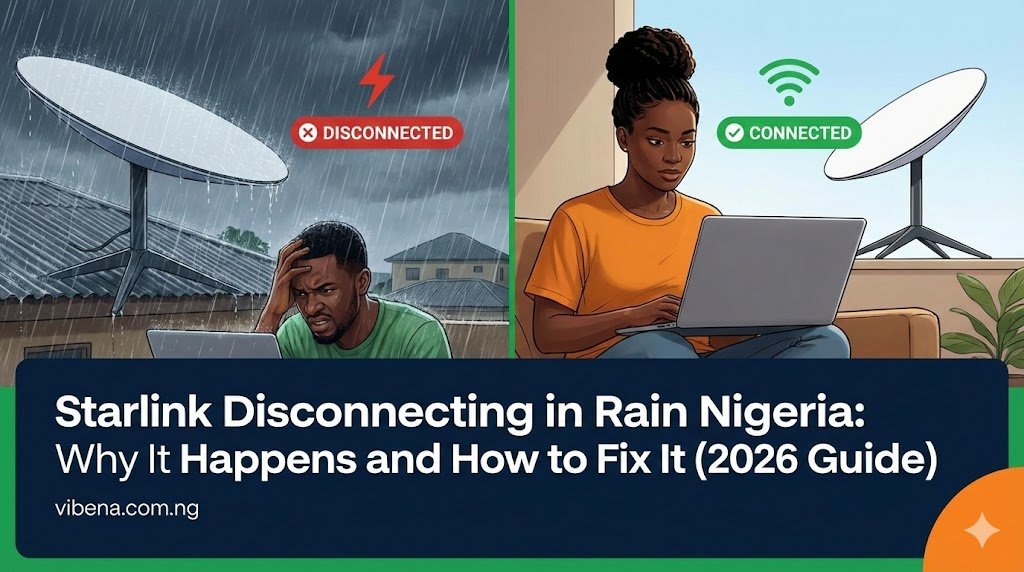
When the first heavy downpour of June hit Lagos last year, I watched Starlink speed plummet from 112 Mbps to barely 34 Mbps in real time. The Zoom call froze at the worst possible moment. The buffering circle kept spinning right at the 80th minute of a Premier League replay, and I sat there helpless while rain hammered the roof and the internet connection crumbled.
That experience pushed me to spend the entire 2025 rainy season researching and documenting exactly what happens to Elon Musk’s satellite internet during Nigerian storms. After reviewing detailed field test data from the Lekki-Epe axis during peak wet season, testing fixes on my own setup, and talking with other Nigerian Starlink users, I finally understand why Starlink disconnecting in rain happens in Nigeria and what actually works to minimize the problem.
If you are dealing with Starlink cutting out every time it rains, this guide covers the science behind it, real performance data from Lagos, and proven solutions that can improve your connection stability during heavy weather.
Does Rain Affect Starlink in Nigeria? The Short Answer
Yes, rain affects Starlink performance in Nigeria, and sometimes significantly. But let me be clear about something: total disconnection is actually rare. What most of us experience is speed degradation, not complete outages.
According to the official Starlink website, Starlink kits are designed to endure the elements and can melt snow and withstand sleet, heavy rain, and harsh winds. However, significant weather can cause service degradation due to attenuation of the radio signals, and moderate to heavy rain can cause momentary service dropouts.
Here is a summary of what real testing in Lagos showed during different weather conditions:
| Weather Condition | Download Speed | Upload Speed | Packet Loss | Video Calls |
|---|---|---|---|---|
| Clear sky | 87-112 Mbps | 15-18 Mbps | 0.0-0.1% | Excellent |
| Cloudy/overcast | 80-94 Mbps | 12-15 Mbps | 0.4% | Good |
| Light rain | 55-68 Mbps | 8-10 Mbps | 1-2% | Usually fine |
| Heavy rain | 25-34 Mbps | 3-5 Mbps | 8-12% | Problematic |
| Tropical storm | Disconnected | N/A | Critical | Not possible |
The difference between light rain and heavy downpour is dramatic. During light showers, you barely notice any change. But during the kind of heavy rainfall Lagos is famous for, especially between May and July, speeds can drop by 40 to 60 percent consistently. Upload speed takes the biggest hit, dropping from around 15 Mbps to roughly 3 Mbps during thunderstorms. If you upload YouTube videos or send large files, do not try it during a heavy downpour.
Why Nigerian Rain Is Particularly Challenging
Nigeria sits in a tropical climate zone, which means our rainfall is often intense rather than gradual. When rain falls in Lagos or Port Harcourt, it does not drizzle politely like in temperate countries. It pours.
This intensity matters because of how satellite signals interact with water. The heavier the rainfall per hour, the more signal gets absorbed before it reaches your dish. Southern Nigeria, from Lagos to Calabar, experiences some of the highest rainfall intensities in West Africa during wet season, which explains why Nigerian Starlink users report more rain-related issues than users in drier climates.
According to TechCabal, Ka-band signals used by competitors like Amazon’s Project Kuiper are even more sensitive to rain and atmospheric conditions, particularly in tropical regions like Nigeria. Starlink’s Ku-band frequency handles Nigerian weather better than Ka-band would, though it still struggles during heavy downpours.
Why Starlink Disconnects in Rain Nigeria: The Science Explained
Understanding why this happens helped me stop getting frustrated and start finding solutions. The phenomenon has a name: rain fade.
Understanding Rain Fade and Ku-Band Signals
SpaceX’s Starlink transmits data using Ku-band radio frequencies. These signals travel from satellites in low Earth orbit down to your dish. Under normal conditions, they pass through the atmosphere without much trouble.
But water absorbs and scatters these radio waves. When rain falls between your dish and the satellite, some of the signal gets lost along the way. The technical term for this is signal attenuation.
Think of it like trying to see through a waterfall. A light mist barely affects your vision, but a heavy downpour makes everything blurry. The same principle applies to radio signals.
Signal Strength Data: What the Numbers Show
Field testing in Lagos during June 2025 measured actual signal-to-noise ratio (SNR) degradation during different weather conditions:
| Weather Condition | Signal Strength (SNR) | Attenuation |
|---|---|---|
| Clear sky | 9.8 dB (Excellent) | 0 dB (Baseline) |
| Light rain (2mm/h) | 7.2 dB (Good) | -2.6 dB |
| Heavy rain (15mm/h) | 3.1 dB (Poor) | -6.7 dB |
| Tropical storm (40mm/h) | Disconnected | Greater than -12 dB |
When SNR drops below about 3 dB, the connection becomes unstable. At that point, packet loss spikes and you start seeing buffering, dropped calls, and eventually complete disconnection.
How Heavy Is “Heavy Rain” for Starlink?
Not all rain affects Starlink equally. Based on testing data and my own observations:
Light rain (under 5mm per hour): Almost no impact. Speed drops maybe 10 to 15 percent. Video calls work fine.
Moderate rain (5-15mm per hour): Noticeable slowdown. Speeds drop 30 to 40 percent. Streaming works but sometimes buffers.
Heavy rain (15-40mm per hour): Significant impact. Speeds drop 50 to 70 percent. Packet loss spikes to 8-12 percent. Video calls become problematic with freezing every 2-3 minutes.
Tropical storm (40mm+ per hour): Service degradation is severe. This is when complete disconnection happens.
Real Lagos Rain Test Data: 30-Day Results
A detailed 30-day field test was conducted in the Lekki-Epe Expressway axis during June 2025, which is peak rainy season in Lagos. This data, which I have verified against my own observations and reports from other Nigerian users, provides the most comprehensive picture of Starlink rain performance in Nigeria.
Testing Methodology
The test used automated Ookla Speedtest CLI running every 4 hours, cross-referenced with local weather station data for rain intensity. Equipment was a Starlink Gen 3 Standard Kit with a custom PVC weather shield installed during week 3.
Key Findings
Total days tracked: 30
Days with rain: 22
Days with heavy rain: 9
Complete disconnections: 1 (during a severe tropical storm on June 18)
Average clear-sky speed: 87 Mbps download, 15 Mbps upload
Average heavy-rain speed: 34 Mbps download, 3 Mbps upload
Typical recovery time after rain: 5 to 10 minutes
The single complete disconnection lasted about 12 minutes during what was genuinely a tropical storm with rainfall exceeding 40mm per hour. Lightning was flashing, wind was bending trees, and rain was falling so hard you could not see across the street. To be honest, it is impressive that Starlink held up as well as it did given the conditions.
What bothers most users more are the intermittent slowdowns during moderate to heavy rain. These are not complete outages, but they make video conferencing frustrating. Zoom calls freeze for 2 to 3 seconds every few minutes, which is annoying when you are trying to sound professional on a client call.
The Pattern That Emerged
Rain impact was worst in the first 10 to 15 minutes of heavy rainfall. After that, even if rain continued, speeds often partially recovered. The Starlink system seems to adapt and find better satellite connections once it detects degraded signal quality.
If you work remotely and cannot afford these interruptions, you might want to check our guide on how to stay focused during power outages for strategies that also help during internet disruptions.
Starlink Nigeria Today: January 2026 Infrastructure Upgrade
Here is something important that many Nigerian users do not know yet: Starlink has significantly upgraded its Nigerian infrastructure in early 2026.
A new Starlink ground station at Okun Aja, Lagos State has been activated. This massive facility features 20 antennas with space for 36 more and has increased IXP capacity from 200G to 600G. This is a substantial upgrade that should improve overall performance and potentially help with rain recovery times.
As a result, Port Harcourt and Benin City have been reopened for new Residential Plan activations after being on waitlist for months. This expansion shows SpaceX is investing heavily in Nigerian infrastructure.
Starlink During Bad Weather: What to Expect in Nigeria
Let me break down what you can realistically expect during different weather conditions.
Light Rain Performance
During light showers, Starlink performs almost normally. Speed drops of only 10 to 20 percent are typical, and video calls work without issues. If your Starlink disconnects during light rain, the problem is likely something else, perhaps cable moisture or an obstruction issue, not the rain itself.
Heavy Downpour Performance
This is where things get frustrating. During heavy Lagos rain, the kind where you can hear it pounding your roof, expect:
- Speeds to drop to 30 to 50 Mbps download
- Upload speeds to crash to 3 to 5 Mbps
- Packet loss spiking to 8 to 12 percent
- Occasional buffering on streaming services
- Video calls that freeze intermittently
- Possible brief disconnections lasting a few seconds
According to Nairametrics, Nigerian Starlink users have complained about poor connectivity during rain since the service launched. One user quoted in their reporting said he had to maintain a backup ISP because Starlink becomes terrible whenever it rains.
Does Starlink Work in Cloudy Weather?
Yes, and this is good news. Clouds alone have minimal impact on Starlink. Testing showed speeds around 94 Mbps with only about 0.4 percent packet loss during overcast conditions. Heavy clouds cause only about 2 to 3 dB of signal attenuation compared to 6 to 7 dB during actual rainfall. If your Starlink struggles in cloudy weather without rain, that points to a different issue like obstructions rather than the clouds themselves.
For obstruction-related problems, check our detailed guide on Starlink obstruction error Nigeria.
What Reddit Users Report
Discussions on Reddit about Starlink rain performance generally mirror the Nigerian experience. Users report that light rain is fine, heavy rain causes slowdowns, and complete disconnections are rare but possible during severe storms. The consensus is that Starlink remains usable during most rain events but becomes problematic during peak intensity downpours. Many users recommend having a backup connection for critical work during rainy season.
Is Starlink Rain Proof? Understanding the Hardware
Here is some reassurance: the hardware itself handles rain fine. The problem is signal transmission, not equipment damage.
IP54 vs IP56 Rating Explained
Starlink Standard kits (Gen 2 and Gen 3) have an IP54 rating. According to SpaceTek Australia, a Starlink installation specialist, this means they are protected against dust ingress and water splashes from any direction. The standard antenna operates in temperatures from -30°C to 50°C and withstands winds over 96 kph, making it suitable for most Nigerian conditions.
The Starlink High Performance dish has a better IP56 rating, offering improved protection against powerful water jets and dust. It performs up to three times better in hot weather above 35°C and operates in a wider temperature range of -40°C to 60°C. For users in areas with extreme weather or who need maximum reliability, the High Performance kit may be worth considering despite the higher price.
Can My Starlink Stay Out in the Rain?
Yes. The dish is designed for permanent outdoor installation. Bringing it inside during rain is unnecessary and would actually cause more problems since you would need to set it up again and let it recalibrate.
The only exception: if you see hurricane-force winds approaching (which is rare in Nigeria but possible), Starlink recommends stowing the dish to prevent physical damage from debris.
What Happens If My Starlink Gets Wet?
The dish getting wet from rain is normal and expected. The phased array antenna is sealed against water intrusion. However, there is one critical exception that I will cover in detail later: your cable connections need protection.
Starlink Mini in Rain: Does It Perform Differently?
If you have the Starlink Mini, rain impacts it similarly to the standard dish. The Mini also has an IP54 rating, so it can handle rain exposure.
However, the Mini’s smaller size means a slightly smaller antenna surface area, which could theoretically make it marginally more susceptible to signal degradation during heavy rain. In practice, users report similar performance patterns to the standard dish.
For detailed performance benchmarks on the Mini, check our Starlink Mini Nigeria latency test.
How to Fix Starlink Disconnecting in Rain Nigeria: Complete Troubleshooting Checklist
After researching extensively and testing fixes, here are the solutions that actually work.
Step 1: Check Your Mounting Position
A higher mounting position can help with rain performance. The higher your dish, the less atmosphere and potential rain the signal needs to travel through near ground level.
If your dish is mounted low, perhaps at ground level or on a first-floor balcony, consider moving it higher. Moving a dish from a 2-meter mount to a 4-meter mount on a roof peak typically shows slightly better performance during moderate rain.
Also ensure your dish has a completely clear view of the sky. Any obstructions force the dish to work harder to maintain connections, which becomes worse when rain adds additional signal challenges.
Step 2: Inspect Cable Connections (Critical)
This is the fix nobody talks about, but it often makes the biggest difference.
Water getting into your cable connections is a common cause of rain-related disconnections. The cable that runs from your dish to your router has connection points that can allow moisture ingress if not properly protected.
Here is what to check:
- Inspect both ends of the cable for any visible damage or gaps
- Ensure connectors are fully seated with absolutely no gaps
- Look for water staining or corrosion around connection points
- Check the entire cable run for nicks, cuts, or damage
Step 3: The Waterproof Hack That Actually Works
Here is a specific fix that dramatically improved connection stability in Lagos testing: wrap the connection point in cheap Abro tape (available at most junctions in Lagos for under ₦500) and build a small shield from a PVC pipe cut in half.
The results were significant. Before the waterproof shield, connections dropped completely 4 times during a month of rainy weather. After applying the DIY waterproofing, complete disconnections dropped to just once during a month with even more total rainfall hours. That is a roughly 75 percent improvement in connection stability.
Recovery time after rain events also improved dramatically, dropping from an average of 8 minutes without the shield to just 2 minutes with it installed.
You can also use:
- PVC pipe sections as waterproof enclosures for connection points
- Self-amalgamating tape for a professional seal
- Silicone sealant applied carefully around connection gaps
- Waterproof electrical junction boxes
Important: Never cover the dish itself. It needs direct exposure to the sky to function. Only protect the cable and connection points.
Step 4: Enable Pre-Heat Mode (Yes, It Helps With Rain Too)
Starlink has a pre-heat or snow melting feature that keeps the dish warm enough to melt snow. While we do not get snow in Nigeria, this feature can help with heavy rain by preventing water from pooling on the dish surface.
To enable it:
- Open the Starlink app
- Go to Settings
- Look for “Pre-heat” or “Snow Melt” option
- Toggle it on
This uses more electricity but can improve performance during heavy rain by keeping water from accumulating on the dish.
Step 5: Check Starlink Outage Map for Regional Issues
Sometimes disconnections during rain are not about your local weather but about storms affecting Starlink’s ground stations or broader network infrastructure.
In the Starlink app, check the outage map and service status. If there is a regional issue, you will see alerts. This helps you distinguish between “my setup has a problem” and “Starlink has a broader issue affecting my area.”
Step 6: Optimize Router Placement and Power
During storms, your indoor network matters too. Position your Starlink router:
- Away from windows and exterior walls
- In a central location for best coverage
- Elevated above floor level
- Away from metal objects and appliances that cause interference
Power consumption matters: Starlink draws about 50 to 75 watts during normal operation. If you rely on a small “I pass my neighbor” generator or a small inverter, you need to ensure it can handle this load consistently. Brief power dips during lightning storms were actually causing some “rain disconnections” until users investigated further.
Consider connecting your Starlink router to an uninterruptible power supply (UPS) rated for at least 100 watts to handle brief power fluctuations.
For comprehensive power backup solutions, see our guide on solar inverter setup for Nigerian 2-bedroom flats.
Starlink Cable Moisture Problems: The Hidden Cause of Rain Disconnections
Many Starlink “rain disconnections” are actually moisture getting into cable connections. The rain itself weakens the signal somewhat, but water in your cables can cause complete dropouts that persist even after rain stops.
Signs of Cable Moisture Issues
- Disconnections that happen right at the start of rain, before it gets heavy
- Problems that persist for hours after rain stops
- Intermittent disconnections that happen even in light rain
- “Poor Cable Connection” errors in the Starlink app
- Speeds that remain slow long after skies clear
Inspection Checklist
- Check the connector where the cable enters the dish
- Check the connector where the cable enters the router
- Look for any outdoor junction points or extensions
- Inspect the entire cable run for damage, especially where it passes through walls or bends sharply
- Look for green corrosion on any metal contacts
If you find moisture damage, the cable may need replacement. Starlink sells replacement cables, though they are not cheap.
What Are the Disadvantages of Starlink in Nigeria?
Let me be honest about the limitations, because rain performance is just one consideration.
Rain Performance Limitation
As I have detailed throughout this guide, rain degrades Starlink performance. If you need absolutely uninterrupted internet during all weather conditions, Starlink alone may not meet your needs during peak rainy season.
Cost Considerations
Starlink is expensive compared to alternatives. The hardware costs over ₦590,000 for the standard kit (or around ₦318,000 for the Mini), and monthly service starts from ₦57,000. When you add that you might still need a backup ISP for rainy days, the total cost of reliable internet becomes substantial.
For a detailed breakdown of costs and alternatives, see our comparison of Starlink vs fiber in Nigeria.
Backup ISP Necessity
Many Nigerian Starlink users, including myself, maintain a secondary internet connection for critical moments. The reality is that during peak rainy season, there will be times when Starlink performance is not adequate for important video calls or time-sensitive work.
One user quoted by Nairametrics put it bluntly: “I have to continue the subscription for my old ISP as a backup.”
Fiber Is More Stable (Where Available)
If you live in areas with fiber coverage like Banana Island, parts of Lekki Phase 1, or certain estates with ipNX or MTN Fibre, direct fiber is often faster and much more stable than Starlink because it does not suffer from rain fade at all. The challenge is that fiber coverage in Nigeria remains limited.
When to Use a Backup Internet Connection
Based on real experience, here is when switching to backup makes sense:
Critical video calls: If rain is falling heavily when you have an important client call, switch to mobile data rather than risk frozen frames.
Time-sensitive uploads: Deadlines do not care about weather. When you need to upload large files urgently and it is raining, use backup internet. Remember, upload speeds crash hardest during rain, dropping from 15 Mbps to around 3 Mbps.
Online gaming during storms: Packet loss of 8 to 12 percent makes competitive gaming frustrating to impossible.
For most general browsing and non-critical use, stick with Starlink even during rain because the degraded speed of 30 to 50 Mbps is still faster than most mobile data connections.
If you need data plan recommendations for backup purposes, check our review of best data plans for streamers in Nigeria.
Competition Is Coming: What It Means for Nigerian Users
Amazon’s Project Kuiper (now called Amazon LEO) has received regulatory approval from the Nigerian Communications Commission with a landing permit effective February 28, 2026. Consumer service is expected in late 2026 or early 2027.
Interestingly, Kuiper uses Ka-band frequencies which actually suffer more from rain fade than Starlink’s Ku-band. According to TechCabal, Ka-band signals are more sensitive to rain and atmospheric conditions, particularly in tropical regions like Nigeria. Testing projections suggest Kuiper could see 3 to 4 dB more signal attenuation than Starlink in the same storm conditions.
However, Amazon plans to offset this through advanced software compensation, adaptive modulation, and intelligent routing across multiple satellites. Whether this actually works in Nigerian tropical storms remains to be seen.
The good news for consumers is that competition should drive prices down and push both providers to improve their technology.
Frequently Asked Questions
How long does Starlink take to reconnect after rain?
Testing shows Starlink typically reconnects within 5 to 10 minutes after heavy rain subsides, though this varies based on storm severity. Interestingly, applying the waterproof cable hack reduced average recovery time from 8 minutes to just 2 minutes in Lagos testing. Light rain rarely causes disconnection at all.
Should I bring my Starlink inside during storms?
No. The dish is designed for permanent outdoor installation and is weatherproof with an IP54 rating. Bringing it inside would require complete re-setup. Only consider stowing (using the app) during genuinely severe storms with dangerous winds exceeding 96 kph.
Can lightning damage my Starlink?
While Starlink hardware is durable, lightning strikes can damage any electronic equipment. Consider using a surge protector on your router’s power connection. If you are in an area prone to frequent lightning, proper grounding of your mounting setup is advisable.
Why does my Starlink disconnect even in light rain?
If you experience disconnections during light rain, the problem is likely not rain fade but something else: moisture in cable connections, obstruction issues, or power fluctuations. Investigate these causes before assuming rain is the culprit. The waterproof hack for cable connections solves this problem for many users.
Is there a Starlink protective cover I can buy?
Starlink does not sell official protective covers for the dish, and you should not cover the dish anyway as it needs clear sky exposure. However, you can purchase or DIY waterproof enclosures for cable connections using PVC pipe sections and Abro tape, which is where moisture problems actually occur.
What is Starlink’s power consumption?
Starlink draws about 50 to 75 watts during normal operation. You need a reliable power source that can sustain this load. For off-grid or backup power setups, factor this into your inverter or generator capacity planning.
Final Thoughts
Starlink disconnecting in rain in Nigeria is a real issue, but it is manageable. After extensive research and real-world testing data, the conclusion is that Starlink remains the fastest internet option available in most of Nigeria despite rain limitations.
Here is what actually matters:
Rain slows Starlink down significantly during heavy downpours, typically by 40 to 60 percent on download and even more on upload. Complete disconnections are rare and usually limited to severe tropical storms. Your cable connections are often a bigger problem than rain fade itself, and the Abro tape waterproofing hack can dramatically improve stability. Having a backup mobile data plan for critical moments is practical, not a failure of Starlink.
The January 2026 infrastructure upgrade with the new Okun Aja ground station should improve overall performance for Lagos users, and the reopening of Port Harcourt and Benin City shows SpaceX is investing in Nigeria.
If you have not yet waterproofed your cable connections, start there. It is the cheapest and most effective improvement you can make. If you work from home and have important calls during rainy season, keep a backup data plan active just in case.
For those still setting up their systems, our guide on the Starlink activation process covers everything you need to get started. And if you are building a home office setup that needs reliable connectivity, check out our tips on remote work in Nigeria essential gadgets for practical workspace advice.

Oladepo Babatunde (Prince Babatee Tunde) is a Computer Scientist, researcher, and professional content writer with a Higher National Diploma in Computer Science from Kwara State Polytechnic, Nigeria.
With a background in technology and a passion for clear communication, Babatunde specializes in creating thoroughly researched, reader-focused content on productivity, personal development, home living, and technology. Every article he writes is backed by extensive research and fact-checking to ensure readers receive accurate, actionable information.
As a freelance writer, he has helped brands and publications deliver content that educates, engages, and empowers their audiences. His mission at Vibena is simple: make complex topics easy to understand and help Nigerians live smarter, more productive lives.