Imagine this scenario: It is 2:00 PM on a Tuesday. You are a developer in Surulere, Lagos, or perhaps a virtual assistant in Enugu. You are on a critical stand-up call with your team in London or New York. You are just about to explain the new feature you built, and suddenly—silence. Your screen freezes. The familiar “Reconnecting…” wheel spins mockingly.
For many Nigerian remote workers, freelancers, and digital nomads, this is a common challenge. Finding stable internet often means juggling multiple service providers to compensate for power outages and network congestion. For thousands of professionals dealing with NEPA disruptions, learning how to stay focused during power outages is just as important as having reliable internet.
Starlink Mini is a portable satellite internet kit from SpaceX designed to address some of these infrastructure gaps. However, for a professional relying on it for their livelihood, it is important to look past the marketing. You need to know if the latency (ping) is low enough for a smooth video call and how it actually compares to local 5G alternatives like MTN and Airtel.
In this guide, we analyze verified real-world data from December 2025 to provide an objective look at Starlink Mini’s performance in Nigeria. We will compare it against the latest benchmarks for 5G to help you determine which service fits your specific location and work needs.

What is Starlink Latency and Why Does It Matter for Remote Work?
Before we analyze the speed tests, we need to understand the most critical metric for remote work: latency.
What is Latency?
In simple terms, latency (often called “ping”) is the time it takes for data to travel from your laptop to a server and back. It is measured in milliseconds (ms). High download speeds are great for streaming, but high latency is what causes “lag” during live interactions.
The “120ms Threshold”
For real-time applications, lower is always better. Here is a general guide:
- 0-40ms: Excellent. Optimal for gaming and real-time coding collaboration.
- 40-100ms: Good. Very acceptable for most video calls.
- 100-120ms: Borderline. You may notice slight delays or audio clipping.
- Over 120ms: Poor. Frequent stutters and freezing during video calls.
Starlink’s Technology: Because Starlink satellites orbit in Low-Earth Orbit (LEO)—about 550km above Earth—they offer significantly lower latency than traditional satellite internet.
How Fast is Starlink in Nigeria? Latest 2025 Speed and Latency Data
The data for Starlink in Nigeria shows a significant gap between “best-case” scenarios and national averages. Performance varies based on cell capacity and user density.
Corrected Speed Table (December 2025)
| Metric | Best Case Scenario | Real-World Average | Range / Details |
|---|---|---|---|
| Download Speed | 199 Mbps | 104 – 111 Mbps | Real-world tests (e.g., Ilorin) |
| Upload (Standard) | 34 Mbps | 22.4 Mbps | 10 – 34 Mbps range |
| Upload (Mini) | N/A | 7.5 Mbps | Significant limitation vs Standard |
| Latency (Ping) | 19 ms | 25 – 50 ms | Typical range for land-based use |
The Speed Reality Check
- Optimal Conditions: In uncongested areas or during off-peak hours, Starlink can hit speeds near 200 Mbps with pings under 20ms.
- Real-World Results: Recent independent tests in locations like Ilorin show consistent averages between 104 Mbps and 111 Mbps.
- National Performance: While individual tests are high, performance varies significantly by location and network congestion. In high-density cities like Lagos, speeds may fluctuate during peak hours as the network manages thousands of active users.
Starlink Mini vs Starlink Standard: Which is Best for Remote Work?
The Starlink Mini is backpack-sized and designed for portability. For a Nigerian remote worker, the choice often comes down to power management vs. raw performance.
Detailed Hardware & Speed Comparison (Speedcast Data)
| Metric | Starlink Mini | Starlink Standard (Gen 3) |
|---|---|---|
| Download Speed | Up to 136 Mbps | 25-150 Mbps (Up to 400+ Mbps on Performance tier) |
| Upload Speed | 7.5 Mbps | 5-20 Mbps |
| Field of View | 110° | 110° |
| Snow Melt | 25mm/hour | 40mm/hour |
| Power Draw | 25-40 Watts | 75-100 Watts |
| Hardware Cost | ₦345,000 – ₦411,000 | ~₦590,000 – ₦624,000 |
⚡ Practical Power Context
- Inverter Use: On a typical 200Ah inverter battery, the Starlink Mini can run for 4-6 hours. Pair it with one of the best power banks for laptops in Nigeria for extended backup.
- Solar Users: The Mini can be maintained during the day with a single 100W solar panel, making it highly efficient for off-grid setups.
- Backup Strategy: Check our generator room organization guide for tips to make your power setup more efficient.
⚠️ Mini Package Priority Warning
One critical technical detail often overlooked: The Starlink Mini’s standard package puts you at the lowest priority among Starlink users. In areas with heavy traffic or connectivity issues, Mini users will be the first to experience slower speeds. Upgrading to a higher subscription tier increases your priority during periods of high congestion.
Is Starlink Better Than 5G? The 3-Way Showdown
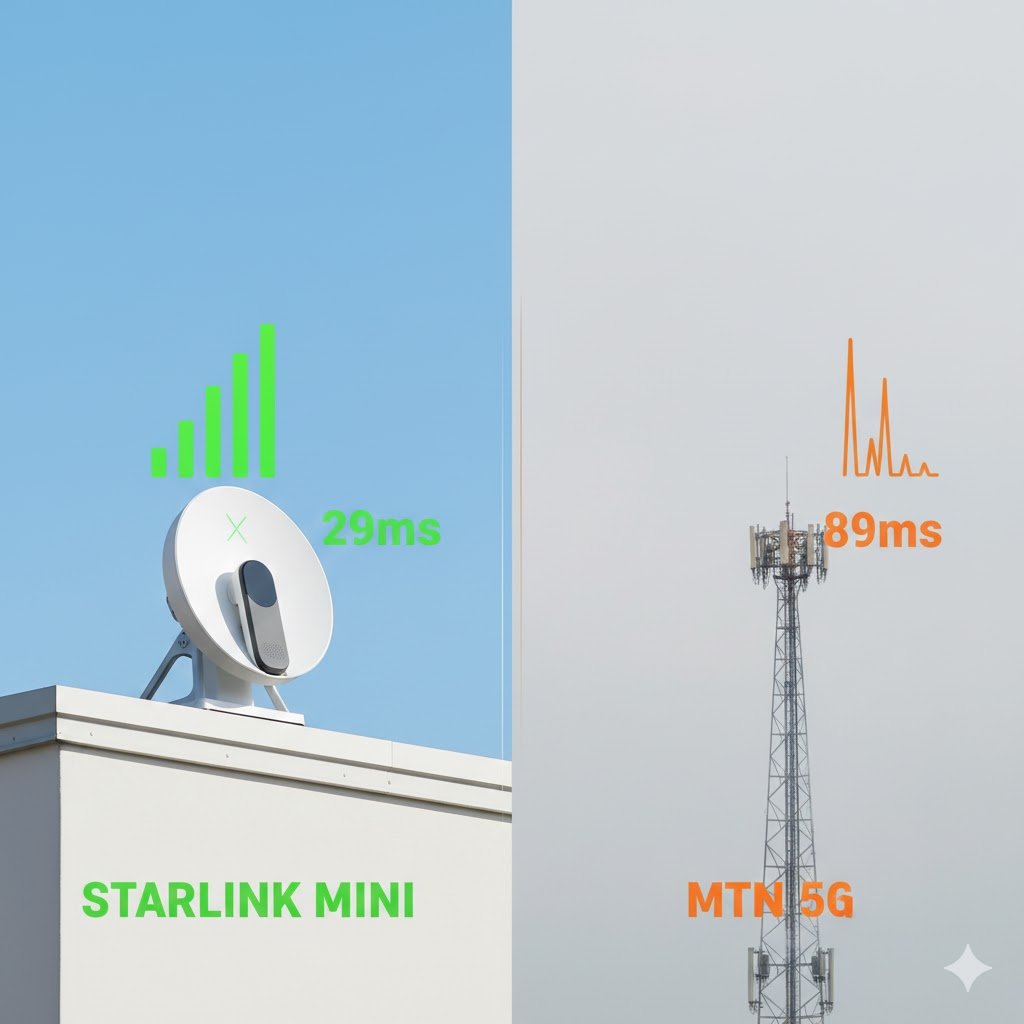
MTN 5G performance varies dramatically by location. In “Golden Zones” like Victoria Island, advertised speeds can reach up to 1 Gbps with latency as low as 15ms. However, real-world testing in Ilorin showed only 24 Mbps download with 89.6ms latency—significantly worse than Starlink’s 104 Mbps in the same location.
Starlink vs. 5G Comparison (Dec 2025)
| Metric | Starlink (Tested) | MTN 5G (Ilorin Test) | Starlink Advantage |
|---|---|---|---|
| Download Speed | 104-111 Mbps | 24 Mbps | 4x faster |
| Upload Speed | 22-24 Mbps | 3 Mbps | 8x faster |
| Latency | 23-29 ms | 89.6 ms | 1/3 the ping |
| Consistency | High | Variable by hour | Starlink |
Important Caveat: These results are from testing in Ilorin. Always test coverage at your specific location before committing.
Real User Experience: The Verdict from the Field
To get a true sense of performance, we have to look at how people are using it daily across Nigeria.
Direct Quote from a Nigerian Tester:
“I cannot declare a national winner. Nigeria is too big. Network performance depends heavily on your exact location. In my location, Starlink performed better overall.”
The Digital Nomad Perspective
Global testing of the Mini across 20+ countries provides additional context for Nigerian users. Digital nomads report download speeds ranging from 60-170 Mbps and upload speeds of 8-30 Mbps. Latency consistently stays below 50ms in most areas—ideal for smooth HD video calls. The key limitation remains urban density: the more Starlink users nearby, the slower your individual speeds will be.
Starlink Performance for Professional Applications
1. Video Conferencing (Zoom, Teams, Google Meet)
Latency is stable for professional use. However, the Mini’s 7.5 Mbps upload limit means you should avoid heavy sharing during calls. If you are setting up a dedicated office, our guide on how to set up a home office in a bedroom covers the essentials.
2. Code Collaboration and Offline Fallbacks
The low ping makes pair-programming feel snappy. During storms, having productivity apps that work offline ensures you don’t lose momentum.
3. Gaming and Real-Time Application Caveat
- User Assessment: One Nigerian user noted: “Latency on Starlink is between 25 to 50 milliseconds—great for video calls and Zoom. But if you are a Call of Duty warrior or a FIFA champion, you might still notice occasional lag spikes.”
Starlink Performance During Rainy Season and Harmattan
Rainy Season (June – September)
- User Observation: One Nigerian user noted: “I tested my speed during rainfall and it was barely around less than 100 Mbps. So that’s okay. But on normal days with a clear sky, it’s going to do better than that.”
Pricing and Value Considerations
The ₦57,000 monthly fee needs to be weighed against your overall budget. Check our breakdown of the cost of living in Lagos Nigeria to plan. If you’re juggling a day job and freelance work, our guide on time management for side hustlers can help you maximize both.
The “Unlimited” Data Reality
One Nigerian user reported consuming 1.75 TB in a single month without experiencing throttling, confirming that the “unlimited” plan delivers genuine high-volume usage.
Should You Choose Starlink? Final Verdict
✅ Consider Starlink Mini IF:
- You live in an area with poor 5G/Fiber coverage.
- You need a connection that works during long power outages.
- You travel and need a portable office.
❌ Stick to Fiber or 5G IF:
- You are in a “Golden Zone” in Lagos or Abuja with strong 5G.
- You already have stable fiber that meets your needs.
Conclusion
The Starlink Mini is a breakthrough for Nigerian remote workers, especially with its power efficiency. While the priority ranking and 7.5 Mbps upload limit are hurdles, the 25-50ms latency provides the stability needed for global competition. Building a morning routine for Nigerian professionals starts with knowing your tools are ready to work.
References and Authoritative Sources
- Official Pricing & Specs: Starlink Nigeria
- 5G Speed Rankings: TechCabal / Ookla 2025 Report
- Availability Updates: Space in Africa Starlink Report
- Network Experience Data: Opensignal Nigeria 2025 Report

Oladepo Babatunde (Prince Babatee Tunde) is a Computer Scientist, researcher, and professional content writer with a Higher National Diploma in Computer Science from Kwara State Polytechnic, Nigeria.
With a background in technology and a passion for clear communication, Babatunde specializes in creating thoroughly researched, reader-focused content on productivity, personal development, home living, and technology. Every article he writes is backed by extensive research and fact-checking to ensure readers receive accurate, actionable information.
As a freelance writer, he has helped brands and publications deliver content that educates, engages, and empowers their audiences. His mission at Vibena is simple: make complex topics easy to understand and help Nigerians live smarter, more productive lives.