I remember standing on my roof in Lekki, sweating under the sun, trying to align my new Starlink dish. After coughing up ₦590,000 for the hardware, I really hoped this would be the end of my internet struggles. My existing fiber connection was good, but road construction kept cutting the cables, leaving me offline for days.
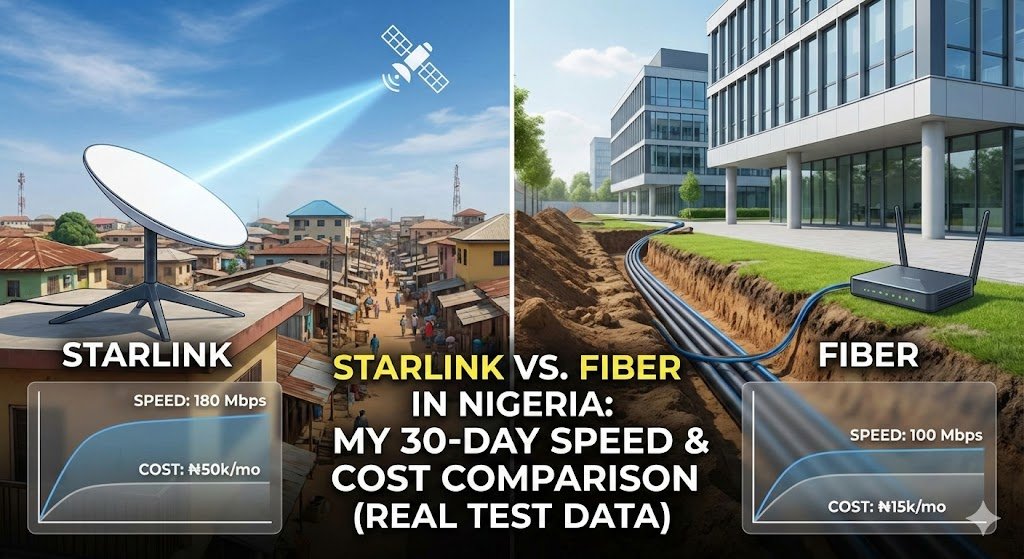
So, I did what any frustrated remote worker would do—after setting up my home office properly—I ran Starlink vs. fiber internet side-by-side for 30 days.
This isn’t just a list of specs I found on Google. This is my personal log of what happens when the Lagos rain starts falling, how much it actually costs when you add up the monthly bills, and whether Elon Musk’s satellite internet is really better than the fiber cables dug into our streets.
If you live in Nigeria and are trying to decide where to put your money, here is everything I learned.
Before I share my full 30-day log, let’s look at the summary for those who need to make a quick decision.
Quick Answer: Is Fiber Better Than Starlink in Nigeria?
Is Full Fibre Better Than Starlink for Nigerian Homes?
If you are in a rush, here is the honest truth: It depends on where you live.
If you live in central Lagos, Abuja, or an estate with direct fiber access (like ipNX or MTN Fibre), Full Fibre is better because it is cheaper and better for gaming. However, if you live anywhere else—or if your power supply is unstable—Starlink wins hands down.
| Feature | Starlink (Satellite) | Fiber Optic (ipNX/MTN/FiberOne) |
|---|---|---|
| Speed | Fast (40-100 Mbps) | Consistent (50-150 Mbps) |
| Latency (Ping) | Higher (~60ms) | Low (~15ms) |
| Setup Cost | Very High (₦300k – ₦590k) | Low (₦20k – Free) |
| Reliability | Affected by heavy rain | Affected by cable cuts/power |
Quick Summary: Key Questions Answered
| Question | Answer |
|---|---|
| What is faster, fiber or Starlink? | Fiber (up to 1Gbps vs ~50-100Mbps on Starlink). |
| Is Starlink faster than 5G? | No—5G can hit 300Mbps, but Starlink offers truly unlimited data. |
| Will Starlink replace fiber? | No—they serve different markets (Rural vs. City). |
| Is Starlink ₦40,000/month? | No—it is ₦57,000/month as of early 2026. |
Now that you have the bird’s-eye view, let’s get down to business. How fast is it really when you wake up at 6 AM versus 9 PM?
Starlink vs. Fiber Speed Test Results: My 30-Day Data
Speed is usually the first thing people ask me about. “Is it fast?” To answer this, I ran speed tests every morning and evening for a month using Ookla.
Download Speed Comparison
When I first turned Starlink on, I saw speeds hitting 150 Mbps. I was impressed. However, over the 30 days, it settled down.
- Starlink Average: In my tests, Starlink vs fiber speed test results showed Starlink averaging about 45 Mbps to 80 Mbps. It fluctuates. On Friday nights when everyone is streaming, it can dip. Your experience may vary sha, especially if you are in a crowded area.
- Fiber Average: My fiber plan (capped at 75 Mbps) delivered exactly 75 Mbps almost 95% of the time. Fiber acts like a pipe; if you pay for a certain size, you usually get that size.
Note: According to Ookla’s 2025 data, most users get under 50 Mbps in crowded areas, which matches what I saw.
Upload Speed Comparison
This is where fiber destroys satellite.
- Starlink: I usually get 10-15 Mbps upload speed. It’s fine for Zoom, but uploading a 2GB YouTube video takes a while.
- Fiber: My provider offers “symmetrical speeds.” If I have 75 Mbps down, I get 75 Mbps up. If you are a content creator in Nigeria, fiber is superior here. Pair it with affordable content creation equipment and you’re set.
Starlink vs. Fiber Latency: Which Has Lower Ping?
Starlink vs fiber latency is the biggest difference I noticed.
- Starlink: My ping hovered around 55ms to 70ms.
- Fiber: My ping was usually 9ms to 15ms.
My Personal Experience: When I tried playing Call of Duty or FIFA online on Starlink, I noticed a tiny delay (“lag”). It wasn’t unplayable, but it was annoying. On Fiber, the gameplay was smooth. If you are a serious gamer, stick to fiber.
Speed is great, but does it offer value for money? Let’s talk about the part that hurts the wallet—the cost.
Starlink vs. Fiber Price in Nigeria: True Cost Breakdown
Let’s talk about the Naira, because this is where the decision gets hard.
Starlink Costs (Hardware + Monthly)
Starlink is an expensive entry.
- Standard Kit Total: ₦707,200 (Hardware ₦590,000 + Activation ₦80,900 + Shipping ₦36,300) — includes 1 month free subscription.
- Mini Kit Total: ₦754,300 (Hardware ₦318,000 + Activation ₦400,000 + Shipping) — Yes, the Mini now costs MORE upfront due to the high activation fee, despite cheaper hardware.
- Important Note on Activation Fees: The ₦80,900 (Standard) and ₦400,000 (Mini) activation fees appear to apply primarily to high-demand areas like Lagos, Abuja, and Port Harcourt. Users in other cities may be exempt. Some recent reports suggest these fees may be waived periodically. Always check the final checkout total on
starlink.combefore paying, as this changes frequently. - Monthly Subscription: ₦57,000 (~$39) for the residential plan. Always verify current rates on Starlink’s official Nigeria pricing page.
- Business Plan: Starts around ₦159,000/month (Priority data).
Fiber Internet Costs in Nigeria
Fiber providers like MTN, ipNX, and FiberOne have much lower entry barriers. However, alternatives like Spectranet and Airtel are strong contenders, especially if you deal with constant power outages.
Here is a detailed breakdown of the major competitors:
| Provider | Plan Name | Speed / Data | Monthly Cost | Key Advantage |
|---|---|---|---|---|
| MTN Fibre X | Standard | 50 Mbps | ₦25,000 | Widespread coverage |
| ipNX | FOS Xtreme | 100 Mbps | ₦53,925 | Top-tier speed reliability |
| FiberOne | SmartHome | 65 Mbps | ₦28,706 | Best budget fiber option |
| Spectranet | Diamond | 200GB Cap | ₦30,000 | Built-in battery backup (works during NEPA outages) |
| Spectranet | Platinum | 325GB Cap | ₦35,000 | Data rollover feature |
| Airtel Fibre | Unlimited 30 | 60 Mbps | ₦30,000 | Truly unlimited data |
| Airtel Fibre | Unlimited 50 | 80 Mbps | ₦50,000 | Low disruption risk |
Note on MTN Pricing: The 50 Mbps plan for ₦25,000 is a common entry point, but always check MTN’s official FibreX page for the latest promos and coverage.
Note on Spectranet: While Spectranet is technically 4G LTE/5G (not pure fiber), it is a critical alternative because their routers often come with internal batteries. This means when “NEPA takes light,” your internet stays on for a few hours without needing a generator—a massive win over standard fiber routers that go dark instantly.
12-Month Cost Comparison Table
Here is what you will spend in your first year (using 2026 estimates):
| Item | Starlink (Standard) | Fiber (Avg 50Mbps Plan) |
|---|---|---|
| Hardware + Activation + Shipping | ₦707,200 | ₦25,000 |
| Monthly Bill (x12) | ₦627,000 (11 months + 1 free) | ₦300,000 (at ₦25k/mo) |
| TOTAL 1st Year | ₦1,334,200 | ₦325,000 |
Starlink vs fiber price analysis shows that Starlink costs over 4x more in the first year due to that massive upfront fee. This is a significant factor considering the rising cost of living in Lagos.
If that price tag hasn’t scared you off, you need to know that paying for Starlink isn’t exactly straightforward. Here is the trick to buying it.
How to Buy Starlink in Nigeria (The Payment Headache)
Here is what most reviews skip over. Buying Starlink in Nigeria isn’t as simple as using your GTBank or Zenith card.
CRITICAL FIRST STEP: Check the Availability Map
Do not pay a kobo until you do this.
In popular areas like Lekki, Ikeja, and Maitama, Starlink cells are currently “at capacity”. TeleGeography’s Q1 2025 data confirms that major hubs are often labeled “sold out.”
January 2026 Capacity Update (Good News): Port Harcourt and Benin City have been reopened for new Residential Plan activations! This is thanks to the launch of a new Starlink ground station at Okun Aja, Lagos State. This massive station features 20 antennas (with space for 36 more) and has increased IXP capacity from 200G to 600G. If you live in these cities, check the map immediately—you might be able to get the cheaper Residential plan now.
- The Risk: Some users have paid ₦590,000 for a kit from a reseller, only to get home and find they cannot activate it because their specific location is “Sold Out” or Waitlisted.
- The Fix: Go to
starlink.com/mapand search for your specific address. If it says “Waitlist,” do not buy the Standard Residential kit hoping it will work. It won’t. You will be forced to buy the “Roam” plan to bypass this, which costs significantly more per month. - The “Enugu Workaround” (And Why It Costs More): Many Nigerians try to bypass capacity limits by activating kits in states with availability (like Enugu) and then moving them to Lagos or Abuja.
- Real User Experience: “I had to activate it in Enugu first, then bring it back to Abuja. Later, they moved me to the Roam plan. I am paying more now, but at least the internet is stable.”
- Warning: This confirms that while this trick “works” to get you online, Starlink will eventually detect the location mismatch and force you onto the more expensive Mobile – Regional (Roam) plan.
New Requirement: Mandatory NIN Verification & Identity Matching
Don’t forget your NIN. As of December 31, 2025, the Nigerian government requires mandatory biometric verification for Starlink users.
- Crucial Detail: After joining the waitlist or ordering, you must submit identification details. These must match the name used during the order process exactly. If the name on your card/order does not match your NIN/ID, the order will not be fulfilled.
Shipping & Delivery Timeline
Once you hurdle the payment and ID verification, Starlink offers door-to-door shipping (usually via DHL).
- Timeline: Delivery typically takes within 21 days after payment.
- Cost: Shipping fees range from ₦15,000 to ₦36,300 depending on your location in Nigeria.
The Card Problem
Nigerian Naira debit cards are generally blocked from international transactions or have a $20/month limit. Starlink charges in Naira (₦), but the payment gateway often behaves like an international transaction, or your bank simply flags it.
The Solution: Most users (including myself) have to use Virtual Dollar Cards or Fintech apps like:
- EverTry / Payday / Chipper Cash: You fund these wallets with Naira and they generate a virtual USD/Naira card that works on the Starlink website.
- Resellers & Used Market: You can buy from third-party sellers, but expect to pay a massive premium. Due to capacity limits, pre-activated or “used” kits in high-demand areas like Lagos often sell for ₦700,000 to ₦1,000,000.
Warning: If you buy a “used” kit from someone, ensure they transfer the “Kit Identifier” to your email officially. Do not just take the box; you will be locked out.
You have bought the kit, but can you keep it running when NEPA takes light? Let’s look at the power requirements.
The “NEPA” Factor: Power Consumption
In Nigeria, we don’t just ask “is it fast?”; we ask “how much fuel will it consume?”
- Starlink Standard Kit: Consumes 50-75 Watts. This is like running a bright incandescent bulb. It will drain a standard 200Ah inverter battery faster than you think if you leave it on 24/7.
- Starlink Mini: Consumes only 20-40 Watts. You can actually power this with a large USB-C power bank (PD 100W rated)! See our best power banks for laptops for options that work. For detailed speed benchmarks, check our Starlink Mini Nigeria latency test.
- Fiber (ONT + Router): Consumes 10-15 Watts. Fiber is much friendlier to your inverter setup.
Verdict: If you rely on a small “I pass my neighbor” generator or a small inverter, Fiber is safer. For Starlink, you need a solid power backup plan. If you’re considering solar, check out our solar inverter setup guide for Nigerian flats or our breakdown of solar power costs in Nigeria.
Now that we’ve covered the technicals and the bills, let’s simplify things. Here are the brutal pros and cons.
Starlink vs. Fiber Pros and Cons
To help you decide, I listed the good and the bad based on my daily usage.
Three Disadvantages of Starlink
- High Upfront Cost: Dropping over ₦700k (or ₦754k for the Mini) is a huge investment for internet.
- Rain Fade: During a heavy Lagos thunderstorm on a Tuesday afternoon, my signal cut out completely for 5 minutes.
- Capacity Issues: While Port Harcourt and Benin City have recently reopened, capacity remains tight in parts of Lagos (Lekki, Ikeja) and Abuja. Starlink has paused new sign-ups in these full “cells”. You might buy the kit and find out you can’t activate it immediately.
Advantages of Starlink
- Works Anywhere: I took my dish to a friend’s house in Epe where there is zero fiber coverage. It worked perfectly.
- You Own the Infrastructure: If I move houses, I just pack my dish. With fiber, I have to beg the ISP to relocate my line.
- Setup Speed: I was online 20 minutes after opening the box. Fiber installation can take 2 weeks of waiting for technicians.
Fiber Advantages
- Lower Latency: Much better for real-time applications like gaming and day-trading stocks.
- Consistent Speeds: It doesn’t fluctuate as much as satellite.
- Cheaper Monthly: You save over ₦30,000 every month compared to Starlink.
Fiber Disadvantages
- Location Limited: If the cable doesn’t pass the front of your gate, you can’t get it.
- Physical Damage: In Nigeria, road construction or vandals often cut fiber cables. I once had downtime for 4 days while they fixed a cut cable.
- Power Dependent: You need a serious inverter setup to keep your fiber router and the outdoor unit (ONT) powered. Starlink just needs one plug (and consumes about 50-75W).
- The “Unlimited” Lie (FUP): Be careful with the word “Unlimited” from local ISPs. Many have a hidden “Fair Usage Policy” (FUP). This means if you download too much (like 500GB or 1TB), they drastically reduce your speed to something painfully slow (like 1 Mbps) until the next month. You are still connected, but you can’t really do anything. Starlink generally doesn’t enforce these hard caps on standard plans.
Those are the general points, but there is one specific Nigerian factor we can’t ignore: The Rainy Season. Here is what happened during a storm.
Starlink vs. Fiber Optic: Rain Performance Test
This is a critical part of the Starlink vs. Fiber debate in Nigeria, whether rain or shine (or no light).
I tested this during a heavy downpour on January 4th. The sky was black.
- Fiber: Kept running at full speed. No change.
- Starlink: My speed dropped from 70 Mbps to 15 Mbps. Then, during the heaviest thunder, it disconnected for about 3 minutes saying “Searching for Satellites.”
My take: If you need 100% uptime for a critical bank meeting during a storm, Fiber is safer. But for general browsing, Starlink recovers very quickly once the heaviest rain passes.
Surviving the rain is one thing, but what if you are trying to headshot someone in Call of Duty? Let’s talk latency.
Gaming Deep Dive: Packet Loss vs. Ping
Gamers, listen up. It’s not just about Ping.
- Packet Loss: Starlink works by handing off your connection from one satellite to another every few minutes. Sometimes, this handoff drops a “packet” of data. In Call of Duty, this looks like your character freezing for a split second (rubber-banding). I experienced about 1-3% packet loss occasionally.
- Fiber: Packet loss is usually 0%.
If you are a casual gamer, Starlink is fine. If you are playing competitive matches where every millisecond counts, stick to Fiber.
Okay, so you are online. But what happens when things break? This is where the experience differs wildly.
Customer Support: The Silent Treatment
This is Starlink’s biggest weakness in Nigeria.
- Starlink Support: Previously, Starlink had no direct line, but this has changed. Update: Starlink now has a Nigerian customer care line: +234 800 123 5240. You can also reach assistance through the official support portal or via the Starlink mobile app. However, response times on tickets can still vary, ranging from 2 hours to 3 days.
- Fiber ISPs (ipNX/MTN): They have call centers. You can yell at a human being (though whether they fix it immediately is another story!). At least you can reach them.
Customer service aside, people still want to know about raw performance comparisons. Let’s tackle the big questions.
What is Faster: Fiber or Starlink?
Technically, Fiber is faster if you pay for the top-tier plans. Providers like ipNX offer Gigabit (1000 Mbps) plans for businesses. Starlink generally caps out around 200 Mbps in ideal conditions, but realistically hovers around 50 Mbps in Nigeria now.
However, asking “what is faster, fiber or Starlink?” is tricky. In a rural area, Starlink is infinitely faster because the alternative is a slow 3G mobile network!
Will Starlink Replace Fiber Optic in Nigeria?
I don’t think so. Will Starlink replace fiber optic? No. They serve different needs. Fiber is the backbone for cities, office buildings, and densely populated areas like Yaba or Victoria Island. Starlink is the champion for the rest of Nigeria—the estates on the outskirts, the factories in Agbara, and the remote workers in villages.
Is Starlink Faster Than 5G in Nigeria?
I also compared my Starlink to my MTN 5G router and Airtel’s Indoor Router. If you’re considering 5G, make sure your phone supports the right bands—see our guide to phones that support MTN 5G in Nigeria.
- 5G Speed: Can hit 300 Mbps+ (very fast) on MTN, but often capped on Airtel depending on the plan.
- 5G Cost: Data is expensive or speed-throttled.
- Starlink: Slower speed (50-100 Mbps), but Truly Unlimited Data with no speed caps.
Here is how the 5G giants compare on price:
| Provider | Plan Name | Data Cap | Monthly Cost | Speed Potential |
|---|---|---|---|---|
| MTN 5G | HyNetFlex | 200GB | ₦37,500 | Up to 300 Mbps |
| MTN 5G | HyNetFlex Ruby | 260GB + 2GB/day | ₦45,000 | Up to 300 Mbps |
| Airtel 5G | Router (Indoor) | Unlimited* | ₦30,000 | Capped (Variable) |
Note: Airtel’s “Unlimited” ₦30,000 plan is often speed-capped (e.g., up to 20 Mbps), unlike Starlink which gives you full available speed at all times.
If you download large files, Starlink is better because you don’t have to count your gigabytes or suffer through a 20 Mbps speed cap.
Can I Stream Movies With Starlink?
Yes. Can I stream movies with Starlink? Absolutely. I watched Netflix in 4K resolution almost every night. If you’re a heavy streamer, also check our best data plans for streamers in Nigeria for backup options. It requires about 25 Mbps to stream 4K, and Starlink easily handles that. The only time it buffered was during that heavy rainstorm I mentioned earlier.
Starlink and Fiber aren’t your only choices. Let’s quickly look at who else is fighting for your subscription.
Who Is Starlink’s Biggest Competitor in Nigeria?
It’s not actually the fiber companies. Who is Starlink’s biggest competitor? It’s the 5G Mobile Networks (MTN, Airtel).
What Internet Is Better Than Starlink in Nigeria?
If you are looking for alternatives, Spectranet and MTN 5G are the main answers for specific needs.
- Spectranet is “better” than Starlink if you have power issues, because their routers often include backup batteries.
- MTN 5G is “better” than Starlink if you want speed (up to 300 Mbps) without the high hardware cost, provided you are in a good 5G coverage zone.
Most Nigerians use mobile routers. But for “fixed” home internet, the competitors are:
- ipNX (Known for speed but high cost)
- FiberOne (Budget-friendly)
- Spectranet (For areas without fiber)
We have looked at the data, the money, and the alternatives. It is time for a decision. Here is what I honestly recommend.
Which Should You Choose? My Honest Recommendation
Quick Decision Guide (Cheat Sheet)
- Budget under ₦35k/month + Lagos/Abuja estate → Choose MTN Fibre X or Airtel Fibre.
- No fiber coverage + can afford ₦707k upfront (including activation/shipping) → Choose Starlink Standard.
- Frequent traveler + needs portability → Choose Starlink Mini (₦318k).
- Power-challenged area + moderate speeds okay → Choose Spectranet (has battery backup).
- Heavy data user + good 5G coverage → Consider MTN 5G HyNetFlex.
Choose Starlink If:
- You live in an area where fiber providers say “sorry, we don’t cover your street.”
- You travel often within Nigeria and want to take your internet with you (using the Roam or Mini plan).
- You hate data caps and want truly unlimited internet.
Choose Fiber If:
- You live in a serviced estate in Lagos, Abuja, or Port Harcourt.
- You are a competitive gamer who needs low ping.
- You are on a budget and don’t want to spend ₦590k on hardware.
If you still have a few questions scratching at the back of your mind, I’ve answered the most common ones below.
Frequently Asked Questions
Is Starlink ₦40,000 a Month?
No. While prices change, as of early 2026, the residential plan is ₦57,000 per month. The “Lite” or Mini plans might offer different pricing structures, but the standard unlimited home plan is no longer ₦38k or ₦40k.
What Is the Starlink 2-Month Rule?
If you pause your Starlink service, you retain your spot for a limited period. However, in capacity-constrained areas (like Lagos or Abuja), extended inactivity may result in losing your cell allocation. When you try to reactivate, you could be placed on a waitlist or be unable to reactivate residential service at all. Always check with Starlink support before pausing in high-demand Nigerian cities.
Are People Moving Away From Starlink?
Some users in Lagos are complaining about slower speeds compared to 2023. This is because more people are joining the network. However, for people outside the major cities, Starlink remains a lifesaver.
Can I Use a Power Bank to Run Starlink?
For the Standard Kit (V3/V4): No. You need a proper inverter setup because it requires AC power (100-240V) and consumes 50-75W. For the Starlink Mini: YES. The Mini is a game-changer for Nigeria. It runs on DC power and consumes just 20-40W. You can power it with a 100W PD (Power Delivery) USB-C Power Bank. This means you can work from a cafe or a park using just a laptop power bank!
Starlink Roam vs. Residential: Which Should I Buy?
Many Nigerians buy “Roam” to avoid the waitlist in Lagos, but be careful:
Residential (₦57,000): Lowest latency, highest speed priority, but locked to one location. You cannot move it to your village for Christmas without changing your address (which risks losing your Lagos spot).
Roam (Mobile Regional): Slightly more expensive for unlimited data (or cheaper for capped 50GB plans), allows you to use it anywhere in Nigeria. The catch: You are “deprioritized.” If a cell is full, Residential users get speed first. Your speed might drop to 5-10 Mbps during peak hours (7 PM – 10 PM).
Is the Starlink Mini Good for Home Use?
The Starlink Mini (approx ₦318,000) is excellent for portability but has limitations for a full household.
Pros: Cheaper hardware, fits in a backpack, runs on USB-C power.
Cons: Built-in WiFi router is weaker (covers fewer rooms), fewer ports for ethernet cables.
Verdict: Great for a solo remote worker or bachelor pad. For a family of 5 streaming Netflix in different rooms, get the Standard Kit.
Does Starlink Work Well for Gaming (FIFA/Call of Duty)?
It’s complicated.
Latency: Ping is decent (30-60ms), which is playable.
Packet Loss: This is the killer. Because the dish switches satellites every few minutes, you might experience “micro-stutters” or 1% packet loss. In FIFA, this feels like your player ignoring a pass command. In Call of Duty, you might rubber-band.
Conclusion: Casual gaming is fine. Competitive/Ranked gaming? Fiber is superior.
Do I Need a Technician to Install Starlink?
No. It is designed for DIY. The app uses your phone’s camera to scan the sky and tells you exactly where to place the dish.
However: In Nigerian homes with high concrete parapets or steep roofs, you might need a local installer just to handle the physical mounting and drilling to get the cable inside neatly. But the actual “setup” is just plugging it in.
About the Author
Oladepo Babatunde (Prince Babatee Tunde) is a Computer Scientist, researcher, and professional content writer with a Higher National Diploma in Computer Science from Kwara State Polytechnic, Nigeria.
With a background in technology and a passion for clear communication, Babatunde specializes in creating thoroughly researched, reader-focused content on productivity, personal development, home living, and technology. Every article he writes is backed by extensive research and fact-checking to ensure readers receive accurate, actionable information.
As a freelance writer, he has helped brands and publications deliver content that educates, engages, and empowers their audiences. His mission at Vibena is simple: make complex topics easy to understand and help Nigerians live smarter, more productive lives.
Disclaimer: Prices mentioned (₦) are based on the rates as of January 2026 and are subject to change by SpaceX or Nigerian ISPs. Speeds vary based on your specific location and weather.

Oladepo Babatunde (Prince Babatee Tunde) is a Computer Scientist, researcher, and professional content writer with a Higher National Diploma in Computer Science from Kwara State Polytechnic, Nigeria.
With a background in technology and a passion for clear communication, Babatunde specializes in creating thoroughly researched, reader-focused content on productivity, personal development, home living, and technology. Every article he writes is backed by extensive research and fact-checking to ensure readers receive accurate, actionable information.
As a freelance writer, he has helped brands and publications deliver content that educates, engages, and empowers their audiences. His mission at Vibena is simple: make complex topics easy to understand and help Nigerians live smarter, more productive lives.