You are scrolling through Twitter and see someone tweet about earning ₦50,000 for a single article. Then another person shares how they made ₦150,000 last month writing for international clients. You think to yourself: I can write. Why am I not making this kind of money?
But then the doubts creep in. You have no writing experience. No portfolio. No clients. No idea where to even start. I know exactly how that feels because I was in that same position two years ago.
When I wrote my first paid article, I had never been published anywhere. I had no journalism degree, no content marketing certificate, and definitely no connections in the industry. What I had was a phone, an internet connection, and a willingness to figure things out. That first article paid me ₦8,000. Within eight months, I was earning over ₦200,000 monthly from writing alone.
This guide is everything I wish someone had told me when I started. By the time you finish reading, you will have a clear roadmap for launching your freelance writing career in Nigeria, even if you have absolutely zero experience right now.
Can You Really Become a Freelance Writer With No Experience?
Let me give you the honest answer: yes, but you need a strategic approach.
The biggest challenge new writers face is what I call the experience paradox. Clients want to see your previous work before hiring you, but you need clients to create that previous work. It feels like an impossible loop.
Here is what I discovered: experience matters less than most people think. What clients actually care about are three things. First, they want to see that you can write well, which you can demonstrate through samples you create yourself. Second, they want to know you understand their industry, which comes from the knowledge you already have. Third, they want reliability and clear communication, which is entirely within your control from day one.
When I landed my first client, I had zero professional writing credits. What I did have was five sample articles I had written specifically to show what I could do. The client read those samples, liked my style, and gave me a chance. That is how most writers start.
The Nigerian Freelance Writing Landscape in 2026
According to industry analysis from Writertain Creatives, freelance writing in Nigeria has moved far beyond side hustles and hidden gigs. It is now a legitimate career path with multiple opportunities, diverse platforms, and increasingly competitive rates.
Three major factors are driving this growth. First, digital platforms are expanding their presence in Africa. Websites like Upwork and Fiverr now have targeted outreach campaigns for African freelancers. Nigerian writers are taking advantage of these changes to access clients worldwide.
Second, local digital publishing is exploding. Platforms like Writertain, Writers.ng, Selar, and regional content hubs are creating massive demand for writers to produce blogs, newsletters, and social media content for Nigerian brands.
Third, remote work has become the default. More Nigerian startups are hiring writers remotely, and global agencies are outsourcing to Africa because of the combination of affordability and skill quality.
What Nigerian Freelance Writers Actually Earn in 2026
Let me break down the real numbers so you know what to expect.
For Nigerian clients and local businesses:
| Content Type | Rate Range |
|---|---|
| Short blog post (500 words) | ₦10,000 to ₦20,000 |
| Long blog post (1000 to 1500 words) | ₦25,000 to ₦60,000 |
| Website copy (per page) | ₦15,000 to ₦50,000 |
| Social media captions (monthly package) | ₦30,000 to ₦100,000 |
| Product descriptions | ₦2,000 to ₦10,000 each |
| Email newsletters | ₦5,000 to ₦20,000 |
| Editing services | ₦3,000 to ₦10,000 per 1,000 words |
For international clients:
| Content Type | Rate Range |
|---|---|
| Blog articles | $40 to $150 per article |
| Copywriting | $80 to $300 per page |
| Technical writing | $100 to $400 per document |
| Ghostwriting books | $5,000 to $20,000 depending on length |
How Much Do Nigerian Writers Charge Per Word?
According to research from Contra’s Nigerian content writer analysis, per-word pricing follows a clear structure based on experience level.
Per-word rates by experience level:
| Experience Level | Naira Rate Per Word | International Rate |
|---|---|---|
| Entry-level (0 to 2 years) | ₦0.5 to ₦1.5 | $0.01 to $0.03 |
| Mid-level (2 to 5 years) | ₦3.0 to ₦5.0 | $0.03 to $0.05 |
| Expert (5+ years) | ₦5.0+ | $0.05+ |
These rates translate to significant cost advantages for international clients, representing approximately 60 to 80 percent savings compared to US-based writers. This is why many global companies actively seek Nigerian writers.
Hourly rates for Nigerian freelance writers:
| Experience Level | Hourly Rate |
|---|---|
| Entry-level | ₦2,000 to ₦5,000 |
| Mid-level | ₦7,000 to ₦15,000 |
| Expert | ₦40,000+ |
According to data from Expaat, entry-level rates for content writing typically range from ₦2,000 to ₦5,000 per hour, while expert freelancers in Nigeria charge upwards of ₦40,000 per hour, especially when working with international clients on specialized content like regulatory documentation or technical writing.
These numbers might seem modest when you are starting from zero. But here is the truth: I went from earning nothing to making ₦15,000 per article within my first three months. The progression is faster than you think if you follow the right steps.
Step 1: Choose Your Writing Niche
This is where most beginners go wrong. They try to be everything to everyone, offering to write about any topic under the sun. I made this exact mistake.
For my first two months, my pitch was essentially “I can write anything you need.” The result? Almost no responses. Then I narrowed my focus to fintech and personal finance content. Suddenly, I was getting replies. Within weeks, I had more inquiries than I could handle.
Best Niches for Nigerian Freelance Writers in 2026
Fintech content is booming right now. Companies like OPay, PalmPay, Moniepoint, and Kuda are constantly publishing content. They need writers who understand digital banking, mobile money, and financial inclusion in the Nigerian context.
Technology and software writing pays well because companies need people who can explain complex concepts clearly. This includes SaaS companies, app developers, and tech startups.
Personal finance resonates deeply with Nigerian audiences. People are hungry for content about saving, investing, and managing money in a challenging economy. If you understand money matters, this niche has plenty of opportunities.
Health and wellness content is always in demand, though it requires careful attention to accuracy. Companies in this space pay premium rates for writers who can produce trustworthy content.
Real estate is growing rapidly in Nigeria, and developers, agents, and property platforms all need content that speaks to local buyers and investors.
E-commerce and small business content serves the massive number of entrepreneurs using platforms like Jumia, Konga, and Instagram shops. They need product descriptions, marketing copy, and educational content.
The Framework for Choosing Your Niche
Think about the intersection of three factors: what you already know, what pays well, and where you can compete.
What do you know from your education, work experience, hobbies, or personal interests? I chose fintech because I had spent years reading about personal finance and understood how Nigerians think about money. That existing knowledge gave me an edge.
What pays well in the market? Some niches simply command higher rates. Technical writing pays more than lifestyle content. B2B content pays more than general consumer writing.
Where can you realistically compete? If you are just starting, you probably cannot compete with experienced writers for high-level strategy work. But you can compete for blog posts, social media content, and website copy in niches where you have genuine knowledge.
Why General Writing Keeps You Broke
When you tell a potential client “I write anything,” you are actually saying “I am not particularly good at anything specific.” Specialists earn two to three times more than generalists because they bring focused expertise that clients value.
A fintech company would rather hire someone who understands digital banking than a general writer who needs everything explained. A health brand wants someone who knows the difference between evidence-based information and wellness trends. Niche expertise commands premium rates.
If you are feeling stuck on niche selection, our guide on creating a personal development plan can help you identify your strengths and interests more clearly.
Step 2: Build Writing Skills Fast Using Free Resources
You do not need expensive courses to become a competent freelance writer. Everything I learned in my first year came from free resources and deliberate practice.
Essential Skills to Develop
SEO writing basics are non-negotiable in 2026. Most clients want content that ranks on Google. Learn how to research keywords, structure articles for search engines, and write compelling meta descriptions. You can learn all of this from free YouTube tutorials and Google’s own resources.
Headline writing determines whether anyone reads your content. A great article with a weak headline gets ignored. Study headlines from successful publications and practice writing multiple versions for every piece you create.
Research and fact-checking separate professional writers from amateurs. Learn how to find credible sources, verify information, and cite your references properly. This skill becomes especially important for YMYL topics like health and finance.
Grammar and clarity form your foundation. Use Grammarly’s free version to catch basic errors. Read your work aloud to check for flow. Edit ruthlessly until every sentence earns its place.
Free Learning Resources
Google Digital Garage offers free courses on content marketing and digital skills with certifications you can add to your LinkedIn profile.
HubSpot Academy has excellent free certifications in content marketing, inbound marketing, and SEO that look impressive to potential clients.
Coursera allows you to audit many writing courses for free from universities like Northwestern and University of California.
Skillshare offers a free trial period where you can access writing courses from working professionals.
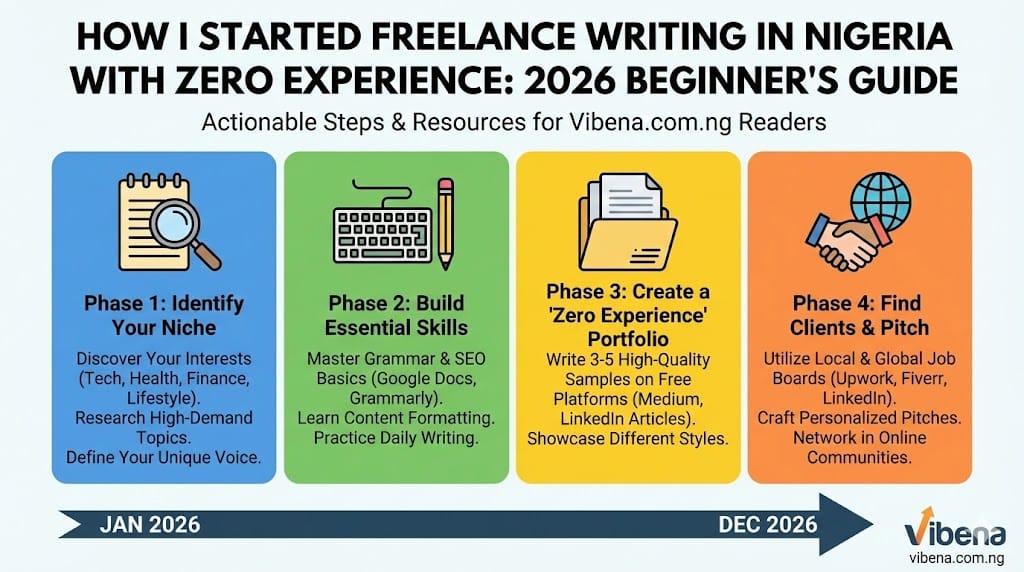
But honestly, the best way to improve is through practice. Set yourself a challenge: write five sample articles this week, each between 500 and 800 words, all in your chosen niche. Store them in Google Drive with shareable links. This exercise alone will teach you more than hours of passive learning.
Step 3: Create a Portfolio Without Clients
Here is the secret that changed everything for me: you do not need clients to build a portfolio. You need writing samples, and you can create those yourself.
Method 1: Write Guest Posts for Nigerian Blogs
Many Nigerian blogs accept guest contributions. They get free content, and you get a published sample with your name on it. Look for blogs in your niche that have a “Write for Us” page or accept contributor submissions.
This approach builds visibility while creating portfolio pieces. When a potential client sees that you have been published on established platforms, it signals credibility.
Method 2: Publish on Medium or LinkedIn
Both platforms are free and give you instant access to an audience. Write articles on topics in your niche and publish them consistently. These pieces serve double duty: they build your portfolio and can attract clients directly.
Medium’s Partner Program also lets you earn money from reader engagement, creating a potential passive income stream while you build your portfolio.
LinkedIn is particularly powerful for B2B writing. According to industry observations, 2025 saw LinkedIn become one of the strongest spaces for freelance opportunities, with content managers and marketing agencies hiring Nigerian writers directly after seeing their posts.
Method 3: The Spec Piece Method
Write articles as if you were hired by your dream clients. Want to write for a fintech company? Create a sample article about digital banking in Nigeria. Want to work with health brands? Write a piece about wellness trends among young Nigerians.
When you pitch these companies later, you can show them exactly what you would create for them. This demonstrates initiative and gives them a concrete example of your work.
Method 4: Start a Simple Blog
Creating your own blog shows commitment and initiative. It does not need to be fancy. A free WordPress.com site or even a Substack newsletter is enough to demonstrate your voice and expertise.
Write consistently about your niche topics. Over time, this content becomes both your portfolio and a way to attract clients organically.
How Many Samples You Need
Aim for three to five strong pieces in your niche. Quality matters far more than quantity. One excellent article demonstrates your abilities better than ten mediocre ones.
Step 4: Set Up Your Freelance Writer Brand
Before you start pitching clients, establish a consistent professional presence.
Choose Your Brand Identity
Decide whether you will use your real name or a pen name. Either works, but be consistent across all platforms. Your name becomes your brand, so choose something you are comfortable building a reputation around.
Set Up Your Social Media Presence
LinkedIn is essential for reaching B2B clients. Optimize your headline to clearly state what you do: “Freelance Fintech Writer | Helping Nigerian Startups Create Engaging Content.” Add your best samples to the Featured section. Write posts that demonstrate your expertise.
Twitter/X connects you to the Nigerian writing community. Follow other writers, engage with their content, and share your own insights. Many job opportunities get shared in writing communities on this platform.
Focus your energy on platforms where your potential clients spend time. If you are targeting tech startups, LinkedIn and Twitter matter most. If you are writing for lifestyle brands, Instagram might be more relevant.
Create a Simple Website (Optional but Powerful)
A personal website shows professionalism and serves as a central hub for your portfolio. It does not need to be expensive. Free options like Carrd or WordPress.com work perfectly for beginners.
Your website should include your services, sample work, a brief bio, and contact information. As you gain clients and testimonials, add those as well.
Step 5: Set Up Payment Systems Before Pitching
Nothing kills a client relationship faster than payment difficulties. Before you send your first pitch, make sure you can actually receive money.
For Nigerian Clients
Most local clients prefer bank transfers. Ensure your bank details are ready to share. Some clients use Paystack or Flutterwave for payments, so familiarize yourself with how these work.
For International Clients
Payoneer is the most reliable option for Nigerian freelancers receiving international payments. It offers reasonable exchange rates and allows you to receive payments in multiple currencies.
Wise (formerly TransferWise) provides excellent exchange rates and reliable transfers to Nigerian bank accounts.
PayPal has limited functionality in Nigeria, but some international clients only pay through PayPal. Having an account ready can prevent lost opportunities.
Direct bank wire works for larger contracts but often involves higher fees.
Set up at least Payoneer and a local bank account before you start pitching. When a client asks how to pay you, having immediate answers shows professionalism.
If you are setting up a dedicated workspace for your freelance career, our guide on setting up a home office in a bedroom covers everything from desk arrangement to managing distractions.
Step 6: Set Your Rates as a Beginner
Pricing is one of the most confusing aspects of freelancing. Charge too little and you burn out. Charge too much and you get no clients. Here is how to find the right balance.
Beginner Rate Guide
| Content Type | Local Client Rate | International Client Rate |
|---|---|---|
| 500-word article | ₦5,000 to ₦15,000 | $15 to $30 |
| 1000-word article | ₦10,000 to ₦25,000 | $30 to $60 |
| Website copy (per page) | ₦10,000 to ₦25,000 | $25 to $50 |
| Product description | ₦2,000 to ₦5,000 | $5 to $15 |
| Social media post | ₦1,000 to ₦3,000 | $3 to $10 |
These rates are starting points. As you gain experience and testimonials, raise them steadily.
Do Not Work for Free
“Write for exposure” is almost always a bad deal. Exposure does not pay rent or buy data. The only exception is strategic guest posting on high-visibility platforms where the credibility boost genuinely helps your career.
If someone cannot pay you, they are not a client. They are asking for charity.
Per Word vs Per Project Pricing
Per-word pricing works well for longer content with clear word count requirements. It is transparent and easy to calculate. According to Expaat’s freelancer pricing guide, a freelance writer might charge ₦30,000 for a 1,000-word blog post using per-project pricing.
Per-project pricing works better for website copy, content packages, and ongoing work. It allows you to price based on value rather than just word count.
I use per-word pricing for blog posts and articles, but per-project pricing for website copy and larger assignments.
When to Raise Your Rates
Increase your rates after completing five to ten projects successfully. Raise them again when you have strong testimonials. Raise them when demand exceeds your capacity. And review your rates every three to six months as your skills improve.
Most freelancers wait too long to raise rates. If you are consistently busy and never getting pushback on pricing, you are probably undercharging.
Step 7: Find Your First Clients in Nigeria
This is where the work gets real. Finding clients requires consistent effort and strategic outreach.
Method 1: LinkedIn Cold Outreach
LinkedIn is the most effective platform for landing B2B writing clients. Here is how to make it work.
First, optimize your profile completely. Your headline should clearly state what you do and who you help. Your summary should showcase your niche expertise and include a call to action. Add your best samples to the Featured section.
Then, start sending connection requests to people who might hire writers: content managers, marketing directors, founders of startups in your niche, and editors at publications you want to write for.
Once connected, send a brief message introducing yourself. Here is a template that worked for me:
“Hi [Name], I noticed [Company] is growing its content presence, and I really enjoyed your recent article about [specific topic]. I am a freelance [niche] writer who helps [type of businesses] create engaging content for their audience. Would you be open to seeing a few samples that might be relevant to your content needs?”
The key is personalization. Reference something specific about their company or content. Generic messages get ignored.
Method 2: Freelance Platforms
International platforms:
| Platform | Best For | Fees |
|---|---|---|
| Upwork | Long-term contracts, higher pay | 10 to 20% |
| Fiverr | Beginners, quick gigs | 20% flat |
| Fiverr Pro | Premium rates for experienced writers | 20% flat |
| ProBlogger Job Board | Blogging gigs, $40 to $100 per post | Free to apply |
| Contena and ClearVoice | Higher-paying long-form work | Varies |
| Guru | WorkRoom collaboration features | Varies |
| Truelancer | Curated marketplace, crypto payouts | Low fees |
Nigerian and African platforms:
| Platform | Best For |
|---|---|
| Writers.ng | Nigeria’s largest content platform, SEO content |
| Writertain | Creative content, books, Nigerian focus |
| Selar Content Calls | Nigerian creators seeking writers |
| Jobberman | Job listings including content roles |
| Remote4Africa | African remote opportunities |
| Findworka | Nigerian tech and creative, low commission |
| Betternship | Vetted African talent with EOR support |
| Jobbers.io | No commission fees |
| TERAWORK | Multi-currency payments, Nigerian platform |
| Expaat | Vetted Nigerian and global freelancers |
| JustFrom5K | Entry-level Nigerian freelancers |
Writers.ng deserves special mention as Nigeria’s largest content writing platform, offering SEO-optimized content opportunities starting at competitive per-word rates. It is specifically designed for the Nigerian market and worth exploring.
Many Nigerian writers now use Fiverr Pro to charge premium rates once they have established their reputation on the platform.
On Fiverr and Upwork, success comes from a combination of a strong profile, competitive initial pricing, and excellent delivery that earns five-star reviews. The first few projects are about building credibility more than making money.
Method 3: Direct Business Outreach
Find businesses in your niche that have blogs but post infrequently or have weak content. Send them a pitch offering specific content ideas.
“Hi, I noticed your blog has not been updated in a few months. I have some ideas for articles that could help drive traffic to your site: [Idea 1], [Idea 2], [Idea 3]. Would you be interested in discussing how I could help?”
This approach works because you are solving a problem they already have.
Method 4: Writer Communities and Referrals
Join Nigerian writer communities on WhatsApp and Telegram. Members often share job leads and refer work to each other. Networking with other writers can generate opportunities you would never find alone.
Twitter also has an active community of Nigerian writers who share opportunities and support each other.
Step 8: Write Your First Article Like a Professional
Landing the client is only half the battle. Delivering excellent work is what turns one project into an ongoing relationship.
Understand the Brief Completely
Before you write a single word, make sure you understand exactly what the client wants. Ask about word count, tone, target audience, key messages, and deadline. Confirm any technical requirements like formatting or SEO keywords.
Asking questions upfront prevents wasted time on revisions later.
Research Thoroughly
Even if you know your niche well, research every article specifically. Use Google Scholar for credible sources. Check industry publications for current trends. Analyze what competitors have written on similar topics.
Good research is what separates professional content from surface-level fluff.
Structure Your Article Clearly
Start with a hook that grabs attention. Use clear subheadings that guide readers through your content. Make each section deliver specific value. End with a strong conclusion that reinforces your main points.
Proper structure makes your writing easier to read and more likely to rank well in search engines.
Edit Before Submitting
Never submit a first draft. Read through your work at least twice. Use Grammarly to catch grammatical errors. Read aloud to check for flow. Remove unnecessary words and tighten your sentences.
Professional writers are really professional editors. The quality of your editing often matters more than the quality of your first draft.
If power outages are affecting your productivity, our guide on how to stay focused during power outages offers practical strategies for Nigerian writers dealing with unreliable electricity.
How to Start Freelance Writing as a Student in Nigeria
If you are still in school or serving NYSC, freelance writing offers flexibility that few other income sources can match.
Start with five to ten hours per week. This is enough to build skills and earn money without destroying your grades. Focus on platforms like Fiverr that let you control your availability.
Your academic knowledge can become your niche. Studying medicine? Write health content. Studying business? Write about entrepreneurship and finance. Studying engineering? Technical writing might be your path. Studying law? Legal content writing pays premium rates.
The knowledge you are gaining in your courses is exactly what makes specialized content valuable. A medical student writing about health topics brings credibility that a general writer cannot match.
Use breaks strategically. Semester breaks and holidays are perfect times to take on more projects and accelerate your growth. NYSC service year can also be an excellent time to build your freelance career since the schedule often allows flexibility.
For students specifically, our guide on student side hustles covers additional income options that complement freelance writing.
Common Mistakes Nigerian Freelance Writers Make
Learning from others’ errors can save you months of struggle.
Underpricing drastically is epidemic among Nigerian writers. When you charge ₦2,000 for an article that should cost ₦10,000, you are not just hurting yourself. You are training clients to expect unrealistic rates. Price fairly from the start.
Having no niche focus makes you invisible. “I write anything” is not a selling point. Specialists get hired; generalists get ignored.
Not asking questions before starting leads to frustrating revisions. Clarify expectations upfront. It is better to ask ten questions before writing than to rewrite the article three times.
Missing deadlines destroys your reputation instantly. If you commit to a deadline, meet it. If something comes up, communicate immediately. Reliability matters more than brilliance.
Ignoring payment setup costs you clients. When someone wants to hire you and you cannot receive payment, they hire someone else. Have your systems ready.
Expecting instant success leads to disappointment. Your first months are about learning, not earning. Be patient and focus on improving.
Not reading the client’s existing content results in mismatched tone and style. Always review what the client has published before to understand their voice.
Scaling From ₦10k to ₦100k+ Monthly
The path from beginner to established writer follows a predictable pattern.
Months 1 to 3: Foundation
Your goal is landing your first three to five clients. Accept rates at the lower end of your range to build your portfolio and gather testimonials. Collect feedback aggressively. Every completed project should result in a review or testimonial you can use.
Focus on delivering excellent work and refining your process. Speed and quality improve with practice.
Months 4 to 6: Growth
Raise your rates by 20 to 30 percent. You now have testimonials and samples to justify higher pricing. Ask satisfied clients for referrals. Most new clients come from existing client recommendations.
Start specializing more deeply in your niche. The more focused your expertise, the more you can charge.
Months 7 to 12: Scaling
Create retainer agreements with recurring clients. A single client paying ₦50,000 monthly for four articles is better than constantly hunting for new one-off projects. Stable income comes from relationships, not platforms.
At this stage, you might have more work than you can handle. This is a good problem. Raise your rates again or consider subcontracting overflow work to other writers.
Income Milestones
| Stage | Monthly Target | How to Achieve |
|---|---|---|
| Beginner | ₦30,000 to ₦50,000 | 3 to 5 articles at ₦10,000 each |
| Intermediate | ₦100,000 to ₦200,000 | Higher rates plus more clients |
| Advanced | ₦300,000+ | Retainers plus premium rates |
| Expert | ₦500,000+ | International clients plus specialization |
These milestones are achievable. I reached the intermediate level within eight months of starting from zero. The timeline depends on your effort, niche, and how quickly you improve.
Tools Every Nigerian Freelance Writer Needs
You do not need expensive software to start. Begin with free tools and upgrade as your income grows.
Free Tools to Start With
Grammarly catches grammar and spelling errors. The free version handles most of what beginners need.
Hemingway Editor checks readability and highlights complex sentences. It is free online.
Google Docs works for writing and collaborating with clients. Most clients accept Google Docs submissions.
Google Drive stores your portfolio samples and client work. Create organized folders for easy access.
Trello or Notion helps track projects and deadlines. Organization becomes essential as you take on more clients.
Canva creates simple graphics for social media and content promotion. The free version offers plenty of features.
Paid Tools to Consider Later
Grammarly Premium provides advanced suggestions and tone detection. Worth it once you are earning consistently.
Surfer SEO helps optimize content for search engines. Useful if you specialize in SEO content.
These investments make sense when your income supports them. In the beginning, free tools are more than sufficient.
For writers working in challenging conditions, our list of productivity apps that work offline can help you stay productive even when internet connectivity fails.
Realistic Timeline: From Zero to Paid Writer
| Month | Milestone |
|---|---|
| Month 1 | Choose niche, create 3 to 5 samples, set up profiles and payment systems |
| Month 2 to 3 | Send 50+ pitches, land first 1 to 3 clients, complete first paid projects |
| Month 4 to 6 | Build testimonials, establish workflow, earn ₦50,000 to ₦150,000 monthly |
| Month 7 to 12 | Raise rates, develop repeat clients, earn ₦200,000 to ₦500,000 monthly |
| Year 2+ | ₦500,000+ monthly possible with strong client base and specialization |
This timeline assumes consistent effort. If you are treating freelancing as a serious pursuit rather than a casual experiment, these milestones are realistic.
Frequently Asked Questions
Can I become a freelance writer with no experience?
Yes. Start by creating your own samples in a specific niche. Build a portfolio through Medium posts, guest articles, or spec pieces. Begin on platforms like Fiverr where competition is accessible for beginners.
Do I need a laptop or can I use my phone?
You can start with just a phone and internet connection. Many Nigerian writers began exactly this way. A laptop makes longer writing sessions more comfortable, but it is not required initially.
How long before I get my first client?
With consistent daily effort on pitching and portfolio building, most writers land their first client within two to eight weeks. The timeline depends on your niche, pitch quality, and how many outreach messages you send.
What if my English is not perfect?
Use Grammarly to catch errors. Many successful Nigerian writers are not “perfect” in a textbook sense. Clarity and value matter more than flawless grammar. Your unique perspective is an asset, not a limitation.
Can I do this while working a 9 to 5?
Absolutely. Many writers start freelancing part-time during evenings and weekends before transitioning to full-time. Our guide on time management for side hustlers covers strategies for balancing both.
Do I need to register a business?
Not initially. You can operate as an individual freelancer. Register a business when you are earning consistently and want the professional benefits of formal registration.
How much should I charge for a 500-word article?
Beginners should charge ₦5,000 to ₦15,000 for local clients or $15 to $30 for international clients. Established writers charge ₦10,000 to ₦20,000 or more locally.
How much should I charge for a 1000-word article?
Beginners should charge ₦10,000 to ₦25,000 for local clients or $30 to $60 for international clients. Experienced writers charge ₦25,000 to ₦60,000 or more locally.
What is the per-word rate for Nigerian freelance writers?
Entry-level writers typically charge ₦0.5 to ₦1.5 per word, mid-level writers charge ₦3.0 to ₦5.0 per word, and expert writers charge ₦5.0 or more per word. For international clients, this translates to $0.01 to $0.05+ per word.
Is Fiverr better or Upwork?
Fiverr is better for beginners because of its gig-based structure and accessibility. Upwork is better for long-term career building because fees drop over time and contracts tend to be larger. Using both strategically is the smartest approach.
Can I make $1000 a month freelance writing?
Yes, but not immediately. At $50 per article, you need 20 articles monthly. This is achievable within six to twelve months of consistent effort and skill development.
What is Writers.ng?
Writers.ng is Nigeria’s largest content writing platform, offering SEO-optimized content opportunities for Nigerian writers. It is worth exploring as a local alternative to international platforms.
Your Next Step Starts Today
Freelance writing in Nigeria is no longer an underground hustle. It is a professional field with real opportunities and growing recognition. The writers earning ₦100,000, ₦300,000, or even ₦500,000 monthly started exactly where you are now.
The difference between them and people who never break through is simple: they started, they persisted, and they kept improving.
Your first step is not complicated. Choose a niche based on what you already know. Write one sample article today. Just one. Then write another tomorrow. By the end of this week, you will have the beginning of a portfolio.
From there, set up your profiles, prepare your payment systems, and start reaching out to potential clients. Every “no” brings you closer to your first “yes.”
I started with nothing but a phone and determination. Two years later, writing pays my bills and gives me freedom I never imagined. That same opportunity exists for you right now.
The question is not whether you can do this. The question is whether you will start.

Oladepo Babatunde (Prince Babatee Tunde) is a Computer Scientist, researcher, and professional content writer with a Higher National Diploma in Computer Science from Kwara State Polytechnic, Nigeria.
With a background in technology and a passion for clear communication, Babatunde specializes in creating thoroughly researched, reader-focused content on productivity, personal development, home living, and technology. Every article he writes is backed by extensive research and fact-checking to ensure readers receive accurate, actionable information.
As a freelance writer, he has helped brands and publications deliver content that educates, engages, and empowers their audiences. His mission at Vibena is simple: make complex topics easy to understand and help Nigerians live smarter, more productive lives.