Look, we’re all busy. As a busy Nigerian juggling work, family, and Lagos traffic (or the busy market in Ibadan, or the oil business in Port Harcourt), finding time for self-care feels impossible. Who has an hour to sit and write a whole journal? No one, right?
That’s exactly why we need to talk about the Power of Micro-Journaling. This isn’t about writing long stories; it’s about making big changes in small steps. It’s about using 2-minute prompts to boost your mental health and improve every single day. Micro-journaling serves as the daily foundation for creating a comprehensive personal development plan.
Globally, nearly 1 in 7 people live with a mental disorder, with anxiety and depressive disorders being the most common, according to the World Health Organization (WHO). In Nigeria, this translates to approximately 40 million people experiencing mental health challenges. Accessible self-care tools have never been more important. This reflective practice is free, has no stigma, and supports your emotional wellness right from your phone.
Important Disclaimer: While micro-journaling supports mental wellness and has been shown to reduce symptoms of stress and anxiety, it is not a replacement for professional mental health treatment. If you are experiencing severe depression, anxiety, suicidal thoughts, or other serious mental health concerns, please consult a qualified healthcare provider. For comprehensive information on mental health conditions, visit the National Institute of Mental Health (NIMH). In Nigeria, you can contact Nigerian mental health resources: Mentally Aware Nigeria Initiative (MANI), She Writes Woman, or call the Mental Health Foundation Nigeria helpline.
I’ve personally practiced micro-journaling for six months as a Lagos-based professional, and it’s transformed how I handle stress during third mainland bridge traffic. I was skeptical—’How can two minutes matter?’—but it became a daily habit that reduced my evening anxiety and improved my sleep quality.
This self-care routine is your quick reflection ticket. It’s simple and fast—you write down just a few sentences about your thoughts, feelings, or day. It’s what you need right now. By the end of this guide, you’ll know exactly how to start a 2-minute journaling practice that fits into your busiest day, even as a Nigerian professional navigating a demanding life.
What Is Micro-Journaling?

Ever felt too busy to journal? This is where micro-journaling comes in! What is micro journaling?
It’s a brief, focused writing practice. You capture thoughts, feelings, or experiences in just a few sentences—it usually takes only 2–5 minutes daily. It’s short-form journaling that respects your time.
Think of traditional journaling, where you fill pages like Morning Pages. That’s great, but it takes a lot of time. This reflective practice is different—it’s super short and focused. Instead of a long stream of consciousness, you use quick reflection techniques and write specific answers to a prompt.
The biggest benefit is that it is a time-efficient wellness practice. For Nigerians navigating power cuts, data costs, and busy schedules, this practice is easy. You only need your phone’s notes app or a small notebook, making it accessible whether you’re in Surulere or Abuja. Because it’s so quick, it’s a habit you can actually keep. This consistency is key to improving your mental health journaling and self-reflection.
The Science Behind Micro-Journaling’s Power
You might be wondering, “Can two minutes really do anything?” The answer is a resounding yes.
Science consistently shows that brief mindfulness exercises give you real mental health benefits. They help you understand yourself and process emotions, just like longer journaling does. The main difference is that this short format is easier to stick with when you’re busy.
This brief journaling practice offers serious mental health benefits. When you write things down, even for just a moment, you move those chaotic thoughts from your head onto the page or screen. This helps with thought organization and brings clearer thinking. The self-awareness gained through consistent micro-journaling naturally translates to building confidence in your career as you recognize your strengths, acknowledge your growth, and identify areas for development.
Research confirms this works. According to a 2022 systematic review published in the National Library of Medicine (NIH), journaling interventions resulted in statistically significant reductions in mental health symptoms, with anxiety showing a 9% improvement and depression showing a 6% improvement compared to control groups. This proves that writing can be as helpful as some established therapies. A 2022 study presented at the American Physiological Society conference found that 85% of medical students reported journaling helped them achieve their goals, while 57% said it improved their physical and mental health. Remarkably, 83% planned to continue the practice after the study ended. This proves how practical and valuable this short practice is.
It supports your emotional regulation because it helps you name what you are feeling. Naming an emotion—like frustration over a “go-slow”—immediately reduces its power over you. This short practice helps you reduce stress and manage your worries. Consistency with micro-journaling builds powerful self-awareness, leading to better mental well-being over time.
Now that you understand why micro-journaling works, let’s explore how to do it. We’ll start with one of the most popular and beginner-friendly methods: the 3-2-1 technique.
Breaking the Silence: Mental Health in Nigerian Culture
For many Nigerians, discussing mental health openly remains challenging. Cultural expectations of strength, religious perspectives, and the fear of stigma can prevent people from seeking formal help.
This is precisely why micro-journaling is so powerful for Nigerian contexts—it’s completely private, requires no explanation to family or friends, and carries zero stigma. Your journal is your safe space where you can be completely honest about your feelings without judgment.
Understanding the 3-2-1 Method of Journaling
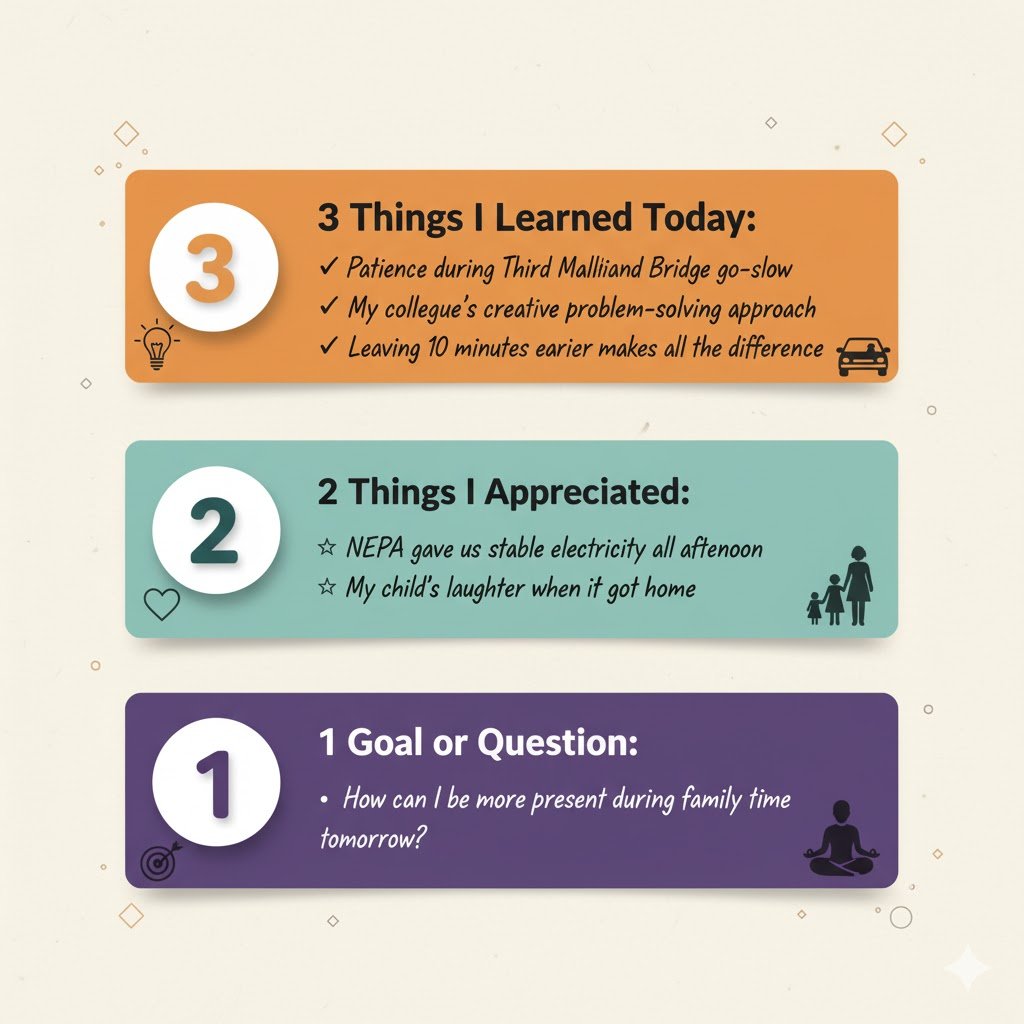
The 3-2-1 method started as a reflection strategy, and we’ve adapted it here for powerful daily self-reflection. It’s one of the most popular quick methods and a great starting point for anyone seeking daily mindfulness writing.
The 3-2-1 method of journaling is a structured reflection technique where you identify:
- 3 Things You Learned
- 2 Things You Appreciated
- 1 Question or Goal You Have
Let’s look closely at how this journaling method works:
3 Things You Learned
These don’t have to be big, university-level lessons. They should be simple takeaways from your day. Instead of ‘what I learned from my yoga class,’ think ‘what I learned from navigating third mainland bridge traffic’ (maybe patience!) or ‘what I learned about my colleague during a difficult meeting.’ This helps you focus on pattern recognition.
2 Things You Appreciated
This focuses on the gratitude practice element. It’s about finding the small wins. What two things made you smile or feel thankful? Maybe it was stable electricity this afternoon, or your child’s laughter, or that delicious jollof rice you had for lunch. Appreciating these things helps boost your mood improvement.
1 Question or Goal
This is your future-focused reflection. What do you need to know or achieve tomorrow? When identifying your one goal or question in the 3-2-1 method, consider using a structured approach to setting SMART goals for 2026 to ensure your daily reflections align with your long-term aspirations. It’s an exercise in setting intention and focus for your personal development.
How to Implement the 3-2-1 Method
This method is quick, structured, prevents blank page anxiety, and builds consistency. Try practicing it in the evening. You can write it on your phone notes while you are waiting for dinner, or in a small notebook just before bed. It requires just 2-3 minutes.
Nigerian Adaptation: Use this practice right before you settle in for the night, even during the heat, or before NEPA takes light (so you can use your phone light to write it down quickly!).
Pros and Cons:
- Pros: Quick, structured, prevents blank page anxiety, builds consistency.
- Cons: Can sometimes feel limiting for complex emotions or if you need more depth.
Now, I’ll be honest—some days the 3-2-1 method feels constraining. Maybe you had an incredible day and three learnings isn’t enough. Or maybe you had a rough day and can’t think of two things to appreciate (trust me, I’ve been there during Lagos blackouts in 40-degree heat!). That’s totally fine. The structure is a guide, not a prison. Adapt it to fit your day.
Quick Summary: The 3-2-1 Method
This method is incredibly efficient for daily reflection:
- Time: Takes only 2-3 minutes.
- Best For: Beginners seeking structure.
- Format: 3 learnings + 2 appreciations + 1 goal.
- Best Time: Evening before bed for emotional closure.
The 5-Minute Journal Method Explained
Another excellent technique for short-form journaling is the 5-Minute Journal. What are the 5 minute journal prompts?
This method uses specific morning and evening questions to bookend your day with intention and reflection. It takes five minutes in total. The 5-minute journal method works perfectly as part of a comprehensive building a powerful morning routine for Nigerian professionals. By practicing these prompts right after waking, you set positive intentions before the chaos of Lagos traffic begins.
Morning Prompts (Setting Intention)
You answer these three short prompts right when you wake up.
- “I am grateful for…” (3 things)
- Nigerian Example: Stable electricity this morning, my children’s health, or a new business opportunity I’m chasing.
- “What would make today great?” (3 things)
- Nigerian Example: Complete that proposal, call grandmother, enjoy amala for lunch.
- “Daily affirmation: I am…” (1 statement)
- Nigerian Example: “I am capable of handling whatever challenges come my way,” or “I am focused and strong.”
Evening Prompts (Self-Reflection)
You answer these two prompts before you go to sleep.
Picture this: You’re lying in bed, fan humming (if NEPA cooperates), the day’s chaos finally quiet. You pull out your phone, and in the glow of the screen, you type: “Today, my daughter’s giggle when I walked in made everything worth it.” That’s it. That’s your journal entry. Two seconds of reflection that bookends your day with gratitude.
- “Highlights of the day” (3 things)
- Nigerian Example: Finally closing that deal, avoiding traffic on Lekki-Epe Expressway, sharing a funny moment with a friend.
- “What I learned today” (2 things)
- Nigerian Example: I learned that leaving home 10 minutes earlier makes a difference; I learned to trust my instincts in a meeting.
How to Adapt to 2-3 Minutes
If five minutes is still too much, simply focus on one morning and one evening prompt. Use bullet points instead of full sentences. It’s great for a morning molue commute (if you’re not driving) or while you wait for your tea to cool. This method is all about building a daily affirmation and reflection habit.
How Journaling for 10 Minutes a Day Transforms Your Emotional Wellness
Now, if you can stretch to just a little bit more time—say, Journaling for 10 minutes a day—the benefits for your emotional wellness are profound.
Research suggests that doing this self-care routine for just 10 minutes daily can help reduce anxiety, improve your mood, and support stress management, though individual results vary. It’s all about maximizing the mental health benefits of consistent reflection.
Here are the specific ways it helps your mind:
Reducing Stress and Anxiety
According to the University of Rochester Medical Center, journaling helps manage anxiety, reduce stress, and cope with depression by helping you prioritize problems and identify triggers. When you feel stressed about job security, family expectations, or money pressures, your worries can get stuck on a loop in your head (worrying on repeat). Brief journaling helps get those worries out. While micro-journaling provides significant stress reduction benefits, combining it with 15 quick ways to relieve stress at home creates a comprehensive wellness approach for busy Nigerians.
You write down the fear, and suddenly it’s outside of you, not trapped inside. This immediately supports stress reduction and anxiety reduction. Research from Positive Psychology studies shows that journaling helps us accept rather than judge our mental experiences, resulting in fewer negative emotions in response to stressors.
Managing Depression Symptoms
This reflective practice can provide a helpful way to process emotions, but remember, it supports—it doesn’t replace—professional treatment for depression. When you write about your feelings, it helps fight emotional numbness and gives you a sense of control and self-awareness. It’s important to remember that consistency building is more important than the intensity of your writing.
Disclaimer: While journaling supports mental wellness, it’s not a replacement for professional mental health treatment. If you are struggling with severe depression, please seek professional help. We must avoid making unverified medical claims.
Processing Trauma and Grief
Writing for just a few minutes can provide a safe outlet for difficult emotions. This is culturally sensitive, as talking about feelings can be difficult in some Nigerian settings. Writing offers privacy to process painful experiences. Remember, this complements, not replaces, therapy.
Improving Emotional Regulation
Over time, looking back at your entries helps you spot patterns. You start to see what triggers your frustration or sadness. For example, you might realize traffic always makes you short-tempered. Once you identify triggers, you can develop healthier, more mindful responses. According to mental health experts at the University of Rochester Medical Center, journaling helps you prioritize problems, fears, and concerns while tracking symptoms and identifying triggers, providing valuable clarity for managing mental health. As you develop pattern recognition through daily micro-journaling, you’ll begin noticing recurring thoughts that hold you back. This self-awareness is the first step in overcoming limiting beliefs and developing a growth mindset that drives real success. This is the core of emotional processing.
The 10-Minute Framework
If you have 10 minutes, try this:
- 3 minutes: Brain dump/free writing (just write whatever comes to mind).
- 4 minutes: Structured prompts (use 3-2-1 or 5-Minute prompts).
- 3 minutes: Action planning or gratitude list.
Realistic expectations: Most research studies show benefits appearing within the first month of consistent practice, with depression symptoms showing particular improvement after 30 days of daily journaling. Keep going!
Medical Disclaimer: The information in this article is for educational purposes only and is not intended as medical advice, diagnosis, or treatment. Mental health conditions require professional evaluation and treatment. Micro-journaling is a complementary wellness practice, not a substitute for therapy, medication, or professional mental health care. If you’re experiencing mental health symptoms that interfere with daily life, please consult a qualified healthcare provider.
Practical 2-Minute Micro-Journaling Prompts You Can Start Today (The Action Section)

This is the most practical part! These 2-minute prompts are designed for the person who needs quick reflection techniques right now. For each one, you should be able to write 1-3 sentences.
Morning Prompts for Nigerians (2 minutes each)
These set your intention and focus for a productive day. Start your day by asking yourself “What’s one thing I’m grateful for this morning?” This could be as simple as stable electricity or a good night’s sleep. Then identify your top priority by asking “What’s my top priority today?”—the one thing that must get done. Following that, set an emotional intention with the prompt “How do I want to feel by bedtime?” Finally, build mental resilience by considering “What challenge might I face today, and how will I handle it?” When you write this and notice procrastination appearing repeatedly, it’s time to implement science-backed strategies to stop procrastinating that work specifically for Nigerian professionals. This frames your entire day around feeling prepared and in control.
Afternoon Check-in Prompts (2 minutes)
Use these during your lunch break or while waiting for a meeting to start. Focus on assessing your energy and managing mid-day stress. Begin by checking in with “How am I feeling right now in this moment?” to help with immediate emotional regulation. Next, focus on the positive with “What’s one win from this morning?” to stop yourself from dwelling on negatives. Finally, practice stress reduction by asking “What do I need to let go of to have a better afternoon?” to drop any lingering frustration.
Evening Reflection Prompts (2 minutes)
These bring closure to your day.
Picture this: You’re lying in bed, fan humming (if NEPA cooperates), the day’s chaos finally quiet. You pull out your phone, and in the glow of the screen, you type: “Today, my daughter’s giggle when I walked in made everything worth it.” That’s it. That’s your journal entry. Two seconds of reflection that bookends your day with gratitude.
Start your evening closure by reflecting on “What made me smile today?” to focus on positivity. Boost your self-compassion next with “What did I do well today?” Then, use gentle self-correction for personal growth with “What could I have done better?” to identify one actionable lesson. Finally, end the day on a positive, future-focused note with “What am I looking forward to tomorrow?”
Special Situation Prompts
During stressful moments, ask yourself: “What is the one thing I can control right now?” When you’re facing a difficult decision, your journal prompt could be: “What does my gut tell me is the right path?” And when celebrating success, reflect on: “How will I recognize this success tomorrow?”
Different Micro-Journaling Methods Compared
It’s great to know your options! You don’t have to stick to just one style. Here is a comparison of common journaling methods:
| Method | Time Required | Best For | Structure | Nigerian Context |
|---|---|---|---|---|
| 3-2-1 Method | 2-3 minutes | Structured thinkers, beginners | 3 learnings, 2 appreciations, 1 goal | Perfect for quick evening routine before NEPA takes light or power cuts |
| 5-Minute Journal | 5 minutes | Morning/evening routine lovers | Morning + Evening prompts | Great for a mindful break during your morning molue commute or at the office. |
| One-Line-A-Day | 1 minute | Extreme time constraints | Single sentence daily | Ideal for super busy Lagos professionals who just need the simplest daily practice. |
| Stream of Consciousness | 2-5 minutes | Emotional processors | Unstructured writing | Best when you need to vent stress or just clear your head completely. |
This comparison table shows that consistency building matters more than perfection. The best journaling practice is the one you will actually do! It’s okay to mix structured vs. unstructured methods depending on how you feel on a particular day.
Which Method Should YOU Choose?
If you’re completely new to journaling $\rightarrow$ Start with One-Line-A-Day for one week, then progress to 3-2-1 method. If you want morning motivation $\rightarrow$ Use the 5-Minute Journal’s morning prompts only. If you need stress relief $\rightarrow$ Stream of Consciousness is your friend. If you want structure $\rightarrow$ 3-2-1 method provides the perfect framework.
Remember: The best method is the one you’ll actually do consistently. Start with the easiest, not the ‘best.’
Setting Up Your Micro-Journaling Practice in Nigeria
The beauty of a sustainable self-care routine is its simplicity. Let’s make your micro-journaling practice actionable and location-specific.
Tools and Apps That Work in Nigeria
Micro-journaling is one of the most accessible self-care routines available.
Unlike therapy, which can cost ₦15,000–₦50,000 per session in Lagos or Abuja—expenses many Nigerians cannot afford—micro-journaling is genuinely free. Your phone’s notes app or a ₦100 notebook from your local shop is all you need.
For Nigerians managing expensive data plans, this reflective practice is highly data-conscious. It doesn’t require an internet connection. Your phone’s built-in notes app works completely offline, making the practice free even when you can’t afford data.
- Phone notes app: Always accessible, no data needed, and perfect for writing on the go.
- WhatsApp Saved Messages: A familiar tool for all Nigerians. You can create a chat with yourself and just send prompts there.
- Small notebook: Essential! Works perfectly during power cuts when your phone battery is low.
- Google Docs/Drive: Syncs across devices when you have data, so your entries are safe.
Finding Your 2-Minute Window
You can find two minutes anywhere!
- During your morning get-ready routine. This is a great place to integrate micro-journaling into your morning routine.
- On your commute (if you aren’t driving in the go-slow).
- During a short lunch break.
- While waiting for an appointment, at the PHCN office, or in a bank queue.
- Before bed, even if it’s hot—it’s just two minutes!
Building the Habit
Habit formation is crucial for the Power of Micro-Journaling.
- Start small: Just one prompt daily for the first week.
- Habit stacking: Do it at the same time each day, tied to another habit (e.g., after you drink your morning coffee, or before you brush your teeth at night).
- Set a reminder: Use your phone to remind you.
- No guilt: If you miss a day, just restart, no wahala! The goal is cumulative practice.
Nigerian-specific challenges:
- What if power goes out? Use your phone notes or the small notebook.
- What if I miss a day? Just restart, no guilt.
- What if family interrupts? That’s okay, two minutes can wait, or just step outside briefly.
Common Mistakes to Avoid in Micro-Journaling
To ensure you maintain consistency building, avoid these simple mistakes:
- Writing too much: This defeats the “micro” purpose. Keep it brief—one to three sentences per prompt is enough. If you write three pages, it’s no longer micro-journaling!
- Judging your writing: Your journal is only for you. Grammar, spelling, and neat handwriting don’t matter. This is not for a teacher or a boss.
- Skipping when busy: These are the days you need it most! The two minutes of this mindfulness exercise can clear your head and make you more productive.
- Expecting immediate transformation: Changes come with consistency over 2-3 weeks, not overnight. Be patient.
- Making it complicated: Simple prompts work better than elaborate, complex systems. Keep it easy to do.
- Forcing positivity: It’s okay to write about difficult days and hard feelings. Micro-journaling is for emotional awareness, not just being happy all the time.
- Comparing to others: Your journey is unique to your Nigerian context. Don’t worry about what other people are doing.
When to Expand Beyond Micro-Journaling
Micro-journaling is a brilliant foundation, but sometimes you need more. Here are signs you’re ready for deeper work:
- You consistently write for 5+ minutes without even noticing the time pass.
- You feel constrained by the brevity of the prompts.
- You want deeper exploration, perhaps for trauma processing or decision-making.
Next steps to consider:
- Morning Pages method: Writing three pages of stream-of-consciousness every morning.
- Goal-setting journals: Focused only on achieving big goals. If you’re ready to move from daily reflection to long-term planning, explore an effective goal-setting framework for young Nigerians or learn how to develop a growth mindset that drives real success.
- Therapeutic journaling: Writing specifically to explore and heal from past events.
Important note: Micro-journaling remains valuable even as you expand—many people maintain a quick daily practice alongside deeper weekly sessions.
Start Your Micro-Journaling Practice Right Now (Yes, Right Now!)
Don’t wait until tomorrow. Don’t wait to buy a special notebook. Don’t wait for the ‘perfect time.’ Do this exercise right now:
Your First 2-Minute Journal Entry (Do This Now):
- Open your phone’s notes app or grab any paper.
- Set a timer for 2 minutes.
- Answer this: “What’s one thing I’m grateful for in this exact moment?”
- Write 1-3 sentences. Don’t overthink it.
Done? Congratulations! You just completed your first micro-journal entry. That’s the power of micro-journaling—it’s so simple, you’ve already started.
Frequently Asked Questions About Micro-Journaling
Is this brief reflection as effective as longer journaling?
Yes, research shows brief, consistent reflection provides similar mental health benefits to longer sessions. The key advantage is that it’s easy to sustain. The most effective journaling is the kind you actually do every day!
Can I do short-form journaling on my phone?
Absolutely—your phone’s notes app is perfect for micro-journaling, especially for busy Nigerians who always have their phones accessible. You can even use WhatsApp’s “message yourself” feature.
What if I miss several days?
Simply restart without guilt. This practice’s power comes from cumulative practice, not perfect streaks. Just pick up your pen or phone and start again.
Should I journal in English or Pidgin?
Write in whatever language feels most natural—your journal is private, so use English, Pidgin, Yoruba, Igbo, or mix them! The important thing is that you express yourself honestly.
How long before I see benefits?
Most research studies show benefits appearing within the first month of consistent practice, with depression symptoms showing particular improvement after 30 days of daily journaling. Give it a consistent try for a month, and you will see the change.
Can micro-journaling help with anxiety?
Yes, brief journaling helps externalize anxious thoughts and identify patterns, though it complements rather than replaces professional treatment for anxiety disorders. It’s an excellent tool for managing the daily symptoms of stress.

Oladepo Babatunde (Prince Babatee Tunde) is a Computer Scientist, researcher, and professional content writer with a Higher National Diploma in Computer Science from Kwara State Polytechnic, Nigeria.
With a background in technology and a passion for clear communication, Babatunde specializes in creating thoroughly researched, reader-focused content on productivity, personal development, home living, and technology. Every article he writes is backed by extensive research and fact-checking to ensure readers receive accurate, actionable information.
As a freelance writer, he has helped brands and publications deliver content that educates, engages, and empowers their audiences. His mission at Vibena is simple: make complex topics easy to understand and help Nigerians live smarter, more productive lives.