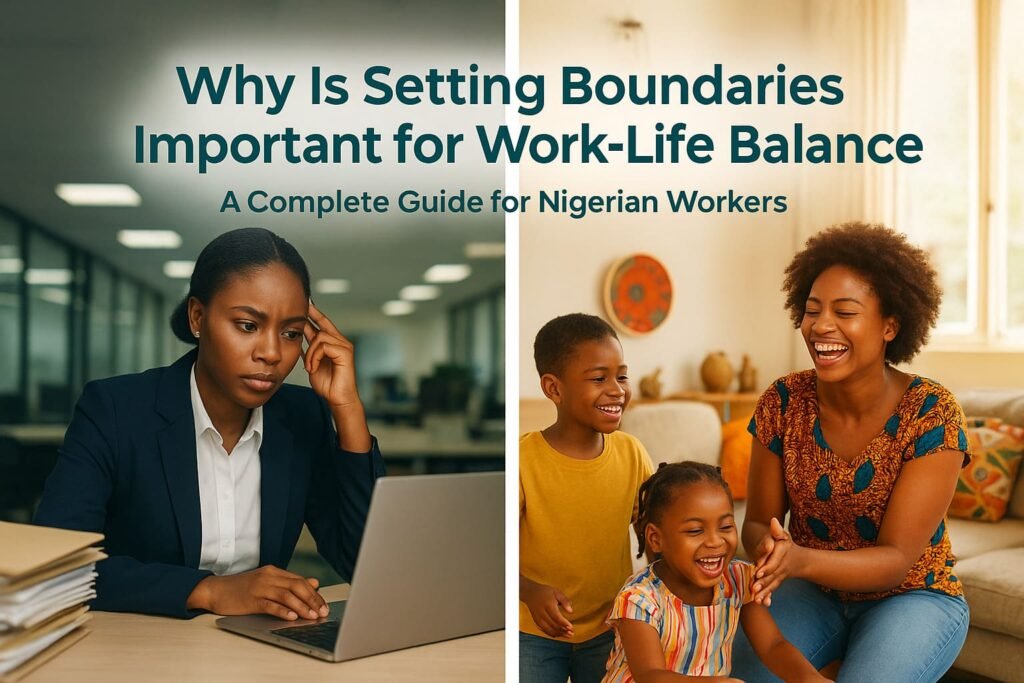
It’s 9:45 PM on a Wednesday night in Lagos. Your phone buzzes for the fifth time—another “urgent” email from your supervisor, oga Kazeem. Your children are asleep, and you haven’t seen them awake since Monday morning. This scenario plays out daily for millions of Nigerian workers struggling to balance professional demands with their personal lives. We know the pressure: the fear of losing your job, the long commute through Lagos traffic, and the expectation of 24/7 availability in many Nigerian companies. This demanding environment is driving a fundamental shift: Nigerian employees are now confidently leaving even higher-paying roles for better work culture and work-life balance (Techpoint Africa, 2025)—make we talk true, nobody wants to be perpetually stressed for cash alone.
Why is setting boundaries important for work-life balance? Research shows that clear workplace boundaries significantly reduce stress levels, improve productivity improvement, and prevent burnout prevention—a growing problem in Nigerian workplaces where many professionals report difficulty balancing work and family responsibilities.
In this comprehensive guide, you’ll discover:
- The science behind Boundary Theory and why it matters here in Nigeria.
- Specific challenges Nigerian workers face with work-life balance.
- Practical, culturally-appropriate strategies on how to set boundaries at work in Nigeria.
- How boundary management improves mental health and career success.
We’ll give you the tools you need to take back your personal time protection and achieve a better, healthier life.
Why Is Setting Boundaries Important for Work-Life Balance?
Let me be straight with you about this: Simply put, boundaries are the invisible rules you set for yourself and others about how you will allow work to mix with your personal life. They are like a strong fence around your family time, your rest, and your peace of mind.
In Nigeria, where the work culture often demands too much, setting clear rules is not selfish—E no easy, but it is absolutely essential for survival and long-term success.
8 Specific Benefits of Workplace Boundaries
When you set professional boundaries at your job, you gain much more than just free time. You gain respect, health, and a better career. Here are the life-changing benefits of workplace boundaries:
- Stress Reduction: Boundaries help you manage your workload and the demands of your job. When you know you won’t answer calls after 6 PM, the stress of always being on disappears. This helps stress management.
- Burnout Prevention: Burnout is when you are constantly exhausted and feel like you have nothing left to give. It’s a very real problem in high-demand sectors like Nigerian banks or the Nigerian healthcare sector. Boundaries create separation, giving your brain and body the rest they need.
- Increased Productivity: When you separate work and rest, your focus improves. You work harder and smarter during office hours because you know your time is limited. Studies show focused work is better work. This leads to productivity improvement.
- Better Mental Health: Constant work-life conflict in Nigeria can cause serious anxiety and overwhelm. Setting a boundary—like refusing to read negative work emails at night—protects your inner peace and helps your mental health at work.
- Improved Relationships: Your family and friends need your full attention. When you put your work phone away during dinner, you are fully present. This strengthens relationships at home and improves your career-family balance.
- Career Advancement: Boundaries teach your colleagues and your oga (boss) that you are professional and respect your time. People respect those who respect themselves. Boundaries show workplace respect and lead to a stronger professional reputation.
- Physical Health Benefits: Less stress means better sleep, better digestion, and lower blood pressure. Protecting your personal time protection means more time for self-care practices and exercise.
- Greater Job Satisfaction: When you feel in control of your life and you like the balance you have, you are happier at work. This increases job satisfaction and makes you want to stay at your company longer.
What Is the Boundary Theory of Work-Life Balance?
You might be wondering, “Why do I need boundaries at work?” Well, the idea of boundaries isn’t just a random suggestion; it’s based on solid research called Boundary Theory.
Boundary Theory, developed by researchers like Clark (2000) and Ashforth et al. (2000), explains how people mentally and physically separate their job (the work domain) from their home life (the family domain). Here is the simple version:
Every person draws invisible lines—called boundaries—between their job and their home life. These lines can be strong or weak, flexible or rigid.
The Integration-Segmentation Continuum
Think of boundaries like the fence around your compound in your neighborhood.
- Segmentation (Strong Fences): This is when you keep your two worlds completely separate. A segmenter might leave their work phone and laptop at the office every day. They practice work domain separation.
- Integration (Weak Fences): This is when you mix your two worlds freely. An integrator might check work emails during family dinner or handle personal calls during a meeting.
Most Nigerian workers need to find a healthy middle ground, known as boundary flexibility. This means your fence can move a little when a true emergency happens, but it stays strong most of the time.
Work-Family Border Theory
A related idea is the Work-Family Border Theory. This concept focuses on the “borders” between your different roles (like employee, spouse, parent, or student).
When you have a strong boundary, it reduces role conflict. For example, when you are home, you are 100% parent. When you are at work, you are 100% employee. Weak boundaries cause work-family spillover, where the stress from one role crosses over and damages the other.
The Four Types of Work Boundaries You Must Set

To protect yourself, you need to set four kinds of boundaries. These are your boundary management strategies:
- Time Boundaries (Temporal Boundaries): This is about when you work and when you stop. For instance, in many industries, the Nigerian Labour Act (2004) specifies standard working hours. You need a boundary to enforce this.
- Example: “I will not check my work WhatsApp group after 7 PM.”
- Space Boundaries (Physical Boundaries at Work): This is about where you work. If you work from home, it means designating a specific spot for work only.
- Example: “My bedroom is for sleeping, not for logging into the company server.”
- Emotional Boundaries: This protects your feelings and energy. You avoid taking on other people’s stress or office politics. This is critical for mental health.
- Example: “I will listen to a frustrated colleague, but I will not let their negative mood affect my whole day.”
- Behavioral Boundaries: This dictates what activities belong to work versus home. It helps you manage boundary enactment—the actions you take to enforce your rules.
- Example: “I will not discuss the details of my office problems during my children’s playtime.”
Understanding these four types is the first step. The next step is applying them to the realities of the Nigerian workplace culture.
The Challenge of Work-Life Balance in Nigerian Workplaces

If you work in Nigeria, you know the reality: work-life balance in Nigerian companies is very difficult to achieve. From what I’ve seen working with Nigerian professionals, boundaries are often seen as “not being a team player,” and there’s a strong cultural expectation of respecting authority without question. This leads to severe work-life conflict in Nigeria.
The “Always-On” Culture
The biggest challenge is the “always-on” work culture. Many Nigerian employers, especially in high-pressure sectors, expect the following from their staff:
- Answering calls from the oga or madam at any hour.
- Working weekends without question and sometimes without overtime pay.
- Staying late without notice or bringing work overload home regularly.
- Being available 24/7 on the company’s WhatsApp group.
This expectation is driven by many factors, including high unemployment (which makes employees fear job loss) and weak enforcement of the Nigerian Labour Act (2004), which should protect workers from excessive hours.
While the Nigerian Labour Act protects workers in industrial settings, it does not stipulate maximum working hours for all workers. Instead, guidance is generally derived from the International Labour Organization (ILO) Hours of Work Convention, 1919, which limits work hours in industrial undertakings to eight hours per day and 48 hours per week—a standard often ignored in practice.
The Critical 2025 Nigerian Workplace Reality
As we move through 2025, the conversation around work-life balance in Nigeria is shifting—but not fast enough. According to recent HR statistics, Nigeria ranks 60th globally in work-life balance, reflecting persistent structural challenges.
The data paints a troubling picture: 45% of Nigerian employees report low trust in management, while employees are 10.4 times more likely to leave their jobs due to toxic work environments than due to low wages—a finding from MIT Sloan Management Review that challenges the assumption that Nigerian workers will tolerate anything for a paycheck.
Harassment remains endemic, with 35% of Nigerian employees reporting workplace harassment experiences (Jobberman study), and 69% having considered quitting due to work-related stress (CareerJunction survey). These aren’t just statistics—they represent millions of Nigerian professionals suffering in silence.
The Generational Divide
The workplace culture clash is particularly evident between generations. 70% of Gen Z employees say they won’t stay in a job for more than 2 years, compared to older millennials who are willing to commit 3-5 years. Gen Z workers overwhelmingly prefer remote work (68%), yet only 14% of Nigerian jobs offered remote options in 2024.
This creates a fundamental mismatch: younger workers enter the workforce expecting flexibility, autonomy, and boundaries—values that clash directly with traditional Nigerian workplace hierarchies built on deference to authority and physical presence as proof of commitment.
Economic Pressures Complicate Boundaries
The economic reality cannot be ignored. With inflation reaching 34.2% in June 2024 and unemployment remaining high, many Nigerian workers feel trapped in toxic workplaces. Even with the minimum wage increase to N70,000 in July 2024, the cost of living in cities like Lagos means that quitting a boundary-violating job isn’t always financially viable.
This is why strategic, culturally-informed boundary-setting becomes even more critical—it’s about surviving and thriving in difficult conditions, not just idealistic career advice.
The Intersectional Challenge
Workplace boundaries are not equally difficult for all Nigerians. Research on Nigerian workplace dynamics shows that ethnicity, religion, gender, and regional affiliation significantly affect how boundaries are received. Women, in particular, face a ‘double shift’—full work responsibilities plus primary household duties. Younger workers may face pressure from older managers who view boundary-setting as disrespectful, rooted in traditional hierarchical norms. Additionally, digital resistance movements like #HorribleBoss (which trended in 2022 and resurfaced in March 2023) reveal that many Nigerian employees, especially from marginalized groups, face structural barriers including ethnic favoritism, gendered microaggressions, and class-based silencing. These intersecting factors mean that boundary-setting strategies must be adapted to your specific identity position and workplace power dynamics.
Finally, the simple fact of Lagos and Abuja commuting challenges—spending four hours in traffic daily—already eats up the personal time that boundaries are meant to protect. It’s tough, but that means setting and protecting your limits is even more important.
Sector-Specific Work-Life Conflict
The struggle is different depending on your job:
| Sector | Common Boundary Challenges | Entity Mentions |
|---|---|---|
| Banking Sector | Long hours, pressure to meet impossible targets, Saturday work, immediate response required even after official closing time. | Nigerian banks |
| Healthcare | Short staffing, continuous on-call demands, severe burnout rates, and emotional fatigue. | Nigerian hospitals/healthcare sector |
| Technology/Fintech | 24/7 support expectations, handling global clients across different time zones, and high pressure in the rapidly growing financial technology (fintech) industry. | Nigerian telecommunications companies / Fintech firms |
| Power Sector | Irregular schedules, dealing with constant system issues (NEPA issues), and emergency call-outs. | NEPA/Power sector companies |
How to Set Healthy Work Boundaries in Nigerian Workplaces
The need for boundaries is reinforced by the fact that flexible work arrangements are now a standard expectation for employees. Setting boundaries in Nigeria requires boundary management strategies that are smart, respectful, and firm. You can do this without being rude or risking your job (Abeg, let’s be diplomatic, but firm).
Start Small and Build Gradually
If you go from answering your phone at midnight to ignoring it completely, you will shock your oga and cause problems. A gradual approach works best in the Nigerian workplace culture:
| Starter Boundary (Safe) | How to Implement |
|---|---|
| Delaying Evening Responses | Don’t answer a 7 PM email immediately. Reply at 8:05 AM the next morning. This sets a temporal boundary immediately. |
| Creating a “Wrap-up Ritual” | Before you leave the office, take 10 minutes for a transition ritual. Write a short to-do list for tomorrow, close your laptop, and physically say “I am done for the day.” |
| Protecting Lunchtime | Eat lunch away from your desk. If a colleague interrupts, politely say, “Let me finish my lunch, and I will be at your desk in 15 minutes.” This is a physical boundary at work. |
Communication Strategies That Work in Nigeria
The key to success is framing your boundaries as something that improves your performance, not limits it.
1. The “Delayed Yes” Technique: Instead of saying “No,” which can sound disrespectful, say, “Yes, I will get this done, but I need to focus on X first. I can promise you this will be on your desk first thing tomorrow morning.”
2. Framing as Performance Improvement: Tell your manager: “Sir/Madam, I am dedicating my evenings to rest so that I can bring my sharpest mind and highest productivity improvement to the team during office hours. Rest allows me to avoid errors and burnout prevention.”
3. Sample Script for Your Boss (Use professional Nigerian English): The Problem: Your boss sends you a task at 8:30 PM. Your Response: “Good evening, Sir/Madam. Thank you for this. I’ve noted it down and I will address it fully as my top priority at 8 AM sharp tomorrow morning when I am fresh. Have a good evening.” (Trust me, this works.)
Boundary Strategies by Type
Time Boundaries (Temporal Boundaries)
- Set Specific Work Hours: If you are a civil servant in Abuja or work for a company registered under the Corporate Affairs Commission (CAC), you have specific hours. Stick to them. For Nigerian professionals running side businesses while working full-time, managing temporal boundaries becomes even more critical. Learn specific strategies for balancing your 9-5 job with side business demands without burning out.
- Use the “Email Response Time” Strategy: Tell your team: “I check emails twice daily at 10 AM and 3 PM.” This manages their expectation and protects your time management and focus.
- Weekend Protection: Make weekends non-negotiable family time. Use the transition rituals concept—put your work phone in a drawer on Friday evening and don’t touch it until Monday morning. One of the most effective transition rituals is establishing a morning routine that creates clear work-life separation. Starting your day with intention helps you mentally prepare for work while protecting your personal morning time.
Physical Boundaries (Space Boundaries)
- Designate Your Space: If working from home, ensure your family knows your physical boundaries at work. When the office door is closed, you are working.
- Leave it Behind: Whenever possible, leave work materials (laptops, files, uniforms) at the office. This supports work domain separation.
Emotional Boundaries
- Don’t Absorb Stress: Avoid letting the emotional drama or stress of your coworkers become your own problem. Practice emotional boundaries. Listen, offer comfort, but don’t take on their burden.
- Practice Mindfulness: Take short, deep breaths when you feel overwhelmed. Mindfulness practices help you stay grounded and stop emotional work-family spillover.
Behavioral Boundaries
- Device-Free Moments: Establish “device-free” rules for family time, especially dinner. Put all phones away. This is essential for protecting your work-family border theory and your relationships.
- No Work Talk at Home: Make a rule: “We do not discuss work problems for the first hour after I get home.” This helps your family get the best version of you.
- Technology Management: Managing your time boundaries becomes easier with the right tools. Discover productivity tools that help you manage work boundaries even during NEPA outages, ensuring you can track your hours and protect your personal time regardless of power availability.
Dealing with Pushy Employers
Sometimes, even the best strategies fail because an employer simply won’t respect your limits.
- Document Everything: Keep a record of all the extra hours you work. If you must escalate, you have evidence.
- Reference Labor Laws: While enforcement is weak, politely referring to the guidelines like the International Labour Organization (ILO) Hours of Work Convention can sometimes remind a manager of their responsibilities.
- Recognize Toxic Environments: Setting boundaries requires professional confidence. Many Nigerian workers struggle with this because they fear being seen as uncommitted. Building the career confidence needed to set boundaries helps you communicate your needs without fear or guilt. If you have set boundaries clearly and respectfully, and your employer consistently punishes you or disrespects you, you must recognize that you might be in a toxic environment. Protecting your mental health and long-term career might require a change.
The Life-Changing Benefits of Workplace Boundaries for Nigerian Professionals
Setting boundaries is hard work, but the results are truly life-changing. When you move from a life of constant work overload to one with clear limits, you experience immediate changes in your health, relationships, and career success.
According to recent work-family boundary research published in 2025, there is a direct relationship between alignment of boundary preferences and enactment with employee well-being. When your actual boundaries match what you truly prefer, your well-being improves significantly. The research shows that work-family conflict mediates this relationship—meaning boundaries reduce conflict, which then improves your mental health and job satisfaction. For Nigerian workers, this matters enormously. The study confirms that when you enact the boundaries you actually prefer (whether segmentation or integration), your anxiety decreases, your energy improves, and your overall life satisfaction increases.
Before and After Boundaries: A Real Change
| Without Boundaries | With Boundaries |
|---|---|
| Always tired and irritable | Better sleep quality and reduced anxiety |
| Poor focus and frequent mistakes | Increased focus and productivity |
| Missing family events or always on the phone | More time with family, deeper relationships |
| High risk of burnout and physical illness | Effective stress reduction and better physical health |
| Feeling like a servant to the job | Feeling in control and gaining workplace respect |
Professional Benefits
Many people worry that boundaries will damage their career. The truth is the opposite. Boundaries are a sign of professionalism.
- Quality Over Quantity: When you focus intensely during your working hours, the work quality you produce is higher. This is a crucial factor in productivity improvement.
- Respect and Reputation: When you don’t jump every time the phone rings outside of work, colleagues and bosses learn to value your time. This builds professional reputation and enhances your job satisfaction.
- Career Longevity: By practicing burnout prevention, you ensure you have the energy and drive to succeed for the long term. You don’t get frustrated and quit after a few years.
Personal Benefits
The greatest rewards are at home. By protecting your personal time protection, you get:
- Energy for Hobbies: You can finally start that side business, go to the gym, or spend time on self-care practices.
- Stronger Relationships: Your partner and children get the best version of you, not the exhausted, stressed version. This improves your overall mental health.
- Greater Life Satisfaction: Feeling like you have a successful career and a happy home is the ultimate goal, and boundaries make it possible.
The following examples represent composite scenarios based on common experiences reported by Nigerian workers. Names and specific details have been changed to protect privacy.
Success Stories: Nigerian Professionals Who Found Balance

It can be difficult to believe this will work in a Nigerian context, but many professionals across different sectors have successfully set and maintained their boundaries.
Story 1: Chioma, Lagos-Based Marketing Manager
- The Problem: Chioma, a marketing manager for a Nigerian telecommunications company in Lagos, was answering client emails until 11 PM daily. She missed her children’s school events and felt constantly exhausted. She was deep into work-family conflict in Nigeria.
- Boundaries Set: She established a clear temporal boundary of “No work emails after 7 PM.” She also made weekends completely off, including company WhatsApp groups.
- The Challenge: Her boss, a traditional oga, initially questioned her commitment. She calmly explained: “Sir, I need evening rest to give my best work during office hours. I found that late-night work was making me tired the next day.”
- The Result: Three months later, her work quality improved dramatically. She was more focused and less stressed. She received a raise and her boss now respects her boundaries, often defending her time against others.
- Key Lesson: Start with one boundary. Prove it works. Add more gradually.
Story 2: Emeka, Senior Analyst in Abuja
- The Problem: Emeka worked for a big accounting firm in Abuja. He was a classic integrator, mixing work and home life constantly. He was suffering from high stress management issues and work overload.
- Boundaries Set: Emeka set a physical boundary at work. He dedicated a small corner in his house for work, and when he left that corner, he left work behind. He also started using transition rituals—a 15-minute walk after work to clear his head.
- The Challenge: His biggest challenge was his own guilt. He felt lazy when he was not working.
- The Result: The physical separation helped him mentally. He used his newfound clarity to manage his team better and found that his productivity jumped because he was no longer distracted. He now has a thriving side business on the weekends.
- Key Lesson: Sometimes, you need physical separation to create mental separation.
Story 3: Amina, Teacher in Port Harcourt
- The Problem: Amina, a teacher, was constantly dealing with parent calls and school requests late into the night. Her emotional boundaries were non-existent, and she was absorbing all the stress from her students and colleagues.
- Boundaries Set: She made two key emotional boundaries. First, she stopped participating in negative office gossip. Second, she set a specific communication boundary: “I only answer parent WhatsApp messages between 8 AM and 5 PM.”
- The Challenge: Other teachers complained she wasn’t being flexible. She simply said, “I need to protect my energy so I can give my best to the children during class time.”
- The Result: She felt lighter and happier. She stopped taking work stress home, improving her mental health and making her a much better, more patient teacher.
- Key Lesson: Boundaries protect your energy so you can use it where it matters most.
Boundary-Setting Mistakes Nigerian Workers Should Avoid
Setting boundaries is a skill, and like any skill, you will make mistakes. By avoiding these common errors, you can be successful in the Nigerian workplace culture:
- Setting Too Many Boundaries at Once: Don’t try to change every rule overnight. Start small with one or two key areas (like after-hours emails) and let your colleagues adjust.
- Not Communicating Boundaries Clearly: You cannot expect people to read your mind. You must clearly and politely tell your oga or madam what your new rules are—this is key. Say, “I will be unavailable after 7 PM.” Don’t just disappear.
- Being Inconsistent: If you say you won’t check emails on Saturday, but then you check them “just this once,” you teach others that your boundary is not real. Consistency is the foundation of workplace respect.
- Apologizing for Your Needs: Never apologize for protecting your health or your family time. Instead of saying, “Sorry, I can’t take this call,” say, “I am focused on my family right now, but I will follow up first thing tomorrow morning.” —Be confident about your boundaries!
- Ignoring Cultural Context: Remember the deep respect for elders and authority in Nigeria. Frame your boundary with respect (using “Sir” or “Madam”) and explain that it is for the good of your work performance, not defiance. Many Nigerian workers believe that setting boundaries equals being ‘lazy’ or ‘disrespectful.’ These limiting beliefs keep you trapped in toxic work patterns. Learn strategies for overcoming the limiting beliefs that make boundary-setting feel impossible and develop the growth mindset needed for professional success with personal wellness.
Important Note on Application and Limitations
While these strategies have worked for many Nigerian professionals, every workplace is different. Some highly toxic environments may not respond to boundary-setting efforts. If you’ve tried these approaches consistently for 3–6 months without improvement, it may be time to consider whether this employer aligns with your long-term career and health goals.
Self-Assessment: Which Boundary Do You Need Most?
Before you start setting limits, take this quick, simple quiz. Rate yourself honestly from 1 (Never) to 5 (Always) based on your typical work week.
| Boundary Focus | Statement | Rating (1-5) |
|---|---|---|
| Time | I check or respond to work messages/emails after my official closing time. | |
| Time | I rush through personal tasks because I feel guilty about not working. | |
| Space | My work laptop/files are often visible or open in my personal living area. | |
| Space | I often use my personal phone for high-stakes work communication. | |
| Emotional | I carry the stress, drama, or negativity from my colleagues home with me. | |
| Emotional | I struggle to say ‘no’ to extra tasks, even when my plate is full. | |
| Behavioral | I interrupt family time (dinner, outings) to deal with non-emergency work issues. | |
| Behavioral | When I am finally resting, my mind is completely consumed by work problems. |
Results Interpretation
Check which category (Time, Space, Emotional, or Behavioral) had the highest average score. That is likely the area where you need to focus your first, strongest boundary!
Frequently Asked Questions (FAQ)
Setting boundaries in the Nigerian workplace culture can raise fears. Here are the most common questions I hear from professionals across Lagos and Abuja:
1. Will boundaries hurt my chances of promotion?
Abeg, this is the biggest fear! No, if done correctly, boundaries will boost your chances. Setting boundaries shows maturity, time management skills, and self-respect—all traits of a leader. If you frame your limits as a way to avoid burnout prevention and ensure high-quality work during official hours (e.g., “I need rest to focus on strategy tomorrow, Sir”), your boss will see it as performance enhancement, not defiance. Leaders value quality and control, not just busy-ness.
2. What if I’m the only one setting boundaries on my team?
Make we talk true: You probably won’t be the only one, but you might be the first person brave enough to enact them. The key is consistency. When you are consistent, your team members and your oga will quickly adapt to your new rules. If they see you performing better, you become the benchmark. In my experience coaching workers across Lagos, when one person sets a healthy boundary, it often gives others permission to do the same, slowly improving the entire team’s culture.
3. How long before I start seeing real results?
You should feel a change in your personal stress levels—stress management—within the first 2 to 4 weeks (less anxiety, better sleep). However, it takes time for your employer and colleagues to fully adjust their expectations. Give the process at least three months of strict consistency. After 90 days, you will notice a significant, measurable difference in your work-life balance and overall mental health.
Conclusion & Next Steps
We started by asking why is setting boundaries important for work-life balance, and the answer is clear: without them, you lose control of your time, your health, and your happiness. The unique challenges of Nigerian workplace culture—the expectation of work overload, high rates of toxicity, and the difficulty of enforcing labor rights—make boundary management strategies not a luxury, but a necessity.
You now understand Boundary Theory and have practical, culturally-sensitive strategies on how to set boundaries at work in Nigeria. Don’t wait for your company to fix the problem; you must start fixing it for yourself today. Setting a clear limit is a professional move that shows self-respect and leads to burnout prevention, higher productivity improvement, and better mental health. Take that first step to protect your energy and your peace. You deserve to succeed both at the office and at home.
Taking Action: Your Next Steps
- Set Your First SMART Goal: Don’t just think about boundaries—make them concrete. Use the SMART framework to set specific SMART goals for your boundary implementation, such as ‘I will not respond to work emails after 7 PM for the next 30 days.’
- Plan for the Long Term: Setting boundaries is just one component of your professional growth. Consider creating a comprehensive personal development plan that includes work-life balance goals alongside your career advancement objectives.

Oladepo Babatunde (Prince Babatee Tunde) is a Computer Scientist, researcher, and professional content writer with a Higher National Diploma in Computer Science from Kwara State Polytechnic, Nigeria.
With a background in technology and a passion for clear communication, Babatunde specializes in creating thoroughly researched, reader-focused content on productivity, personal development, home living, and technology. Every article he writes is backed by extensive research and fact-checking to ensure readers receive accurate, actionable information.
As a freelance writer, he has helped brands and publications deliver content that educates, engages, and empowers their audiences. His mission at Vibena is simple: make complex topics easy to understand and help Nigerians live smarter, more productive lives.