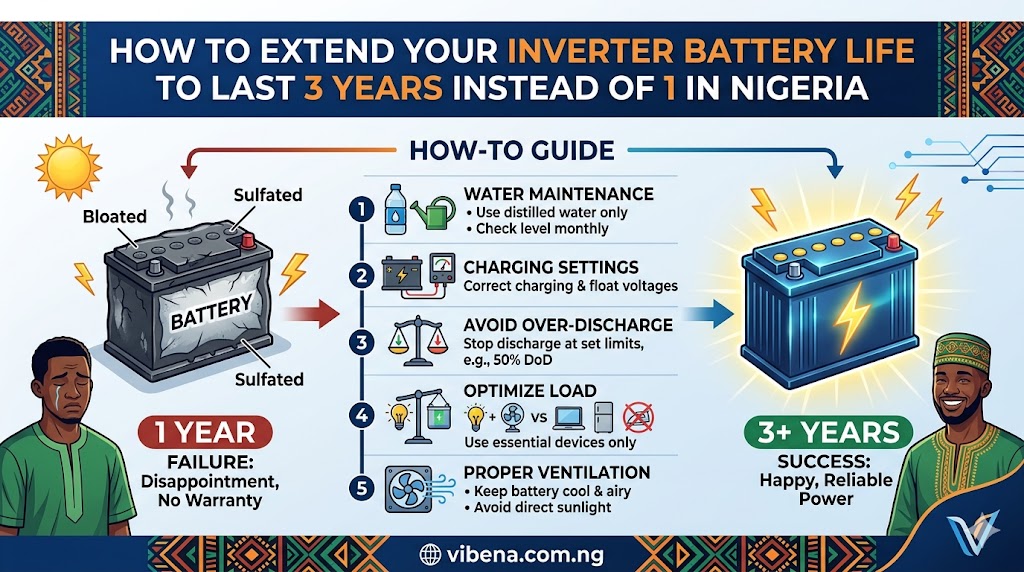
You bought the battery. The technician installed it. Everything worked fine for the first few weeks. Then slowly, the backup time started shrinking. What used to last four hours began struggling to hold two. By month ten, your neighbours had power on inverter and you were already pricing a replacement. This guide explains inverter Battery Life in simple, practical terms.
This is not a bad luck story. It is a very common Nigeria story.
The truth that most battery sellers will not tell you is this: inverter batteries in Nigeria do not die early because of low quality alone. They die early because of what happens after installation. The daily habits, the wrong assumptions, the maintenance steps nobody explained.
A well-maintained tubular inverter battery should last between five to eight years. A poorly maintained one, running under Nigerian conditions with no attention, often fails within twelve to eighteen months. The gap between those two outcomes is not the brand. It is the care.
This guide covers exactly what you need to do, what you need to stop doing, and how to understand your battery well enough to make it last years longer than the average Nigerian inverter battery survives.
What Nigerian Conditions Do to Your Inverter Battery
Before the maintenance tips, you need to understand the battlefield your battery operates in every single day.
Nigeria’s climate often experiences extreme temperatures, which is a major factor in impacting the lifecycle of inverter batteries. In coastal cities like Lagos and Port Harcourt, high humidity compounds the problem. In northern states like Kano and Kaduna, dry heat is the bigger aggressor.
High ambient temperatures and humidity can shorten battery life drastically. Not all battery types tolerate Nigeria’s climate equally. Flat plate batteries degrade quickly in heat. Tubular models offer better thermal durability. LiFePO4 lithium battery types deliver superior heat resistance and stable cycles in both coastal and northern regions.
Then there is the power situation itself. Most Nigerian homes experience between eight and twenty hours of power outage daily, depending on the PHCN band. This means your battery is not cycling gently once or twice a day. It is working harder than any battery in a stable-grid country would ever need to.
Usage habits matter more than brand alone. A household in Lagos that overloads their inverter and drains their battery fully every night can cause battery failure within two years. A household that manages load and maintains their system properly can stretch six years or more out of the same battery type.
The challenge is real. The solution is entirely within your control.
Know Your Battery Type First — This Changes Everything
Not all inverter batteries work the same way or have the same maintenance needs. Getting this wrong means you could be maintaining your battery incorrectly and shortening its life with good intentions.
Tubular (Flooded Wet-Cell) Batteries
These are the most common inverter batteries in Nigeria. Tubular batteries are designed specifically for deep-cycle applications, making them ideal for use in inverter systems. Unlike flat plate batteries, tubular batteries are constructed with tubular positive plates, which enhances their performance and lifespan.
They are the go-to choice for Nigerian homes because their durability and ability to withstand frequent and prolonged power cuts makes them a strong performer in local conditions.
The key thing to know: they require active maintenance. You must check and top up water levels with distilled water regularly. With proper care, a well-maintained tubular battery can last five to eight years. Without maintenance, expect eighteen to twenty-four months before serious degradation.
Brands like Luminous, Lento, Eastman, Felicity Solar, and Genus tubular batteries are widely trusted in Nigeria, and their tubular products are designed for frequent power cuts and high load applications.
AGM (Sealed Maintenance-Free) Batteries
AGM batteries are the sealed, maintenance-free, dry-cell batteries. They require no water topping and no electrolyte checks. With a lifespan of approximately 400 cycles at 80% depth of discharge, they offer a balance between cost and convenience.
The trade-off is that they are less forgiving of deep discharges compared to tubular batteries, and if your inverter settings are wrong, they degrade faster without showing visible warning signs.
Gel Batteries
Gel batteries resist moisture well, which makes them suitable for more enclosed or humidity-prone environments. Their average lifespan is typically four to five years under controlled charging conditions. They work similarly to tubular batteries in many ways but use a special charger and can be permanently damaged by high charging voltages.
Do not use an equalization charge on a gel battery. This is a mistake that will destroy it immediately.
LiFePO4 (Lithium Iron Phosphate) Batteries
This is the premium option gaining ground in Nigeria in 2025 and 2026. Lithium batteries offer the longest life, up to ten to fifteen years, with minimal maintenance. They can be discharged to 90% to 95% depth of discharge without shortening lifespan, compared to only 50% for lead-acid and tubular types.
A 12V 200Ah LiFePO4 battery costs between ₦315,000 and ₦470,000 in Nigeria as of early 2026, which is more expensive than tubular options. But lithium lasts four times longer and requires virtually no active maintenance, making the long-term cost-per-year significantly lower.
For users who can afford the upfront cost, lithium is the smartest long-term investment. For those on a tighter budget, a well-maintained tubular battery remains the best value.
The Real Reason Most Nigerian Inverter Batteries Die Early
Understanding what kills your battery is the fastest way to stop it from happening.
Sulfation: The Silent Battery Killer
This is the number one cause of premature inverter battery death in Nigeria, and most people have never heard the word.
When a lead-acid battery remains discharged for too long, lead sulfate crystals form on the battery plates. These crystals harden over time, reducing the battery’s ability to charge and discharge efficiently, eventually leading to complete failure.
When the water level in your tubular battery drops too low, the lead plates get exposed to air, and this accelerates sulfation rapidly. It reduces battery efficiency and shortens its lifespan in a way that cannot be fully reversed once advanced.
Frequent discharges without adequate charging can lead to sulfation, a process where lead sulfate crystals build up on the battery plates, reducing capacity and lifespan. Regularly charging the battery is the most direct prevention.
Deep Discharge: The Most Common Mistake in Nigeria
This is the most painful part to read if you have been doing this without realizing it.
For tubular and AGM deep cycle batteries, the recommended depth of discharge is a maximum of 70% to 80%. If you discharge your battery only to 50% before recharging it, you significantly extend its lifespan. But this is not always possible in Nigeria, where the PHCN grid’s power is not predictable or reliable.
Most Nigerians discharge their inverter batteries up to 80% since there is often no choice. Regularly discharging a tubular or AGM deep cycle battery beyond 80% will shorten its life. For lithium batteries, this does not apply: a lithium battery can be depleted to 90% of its total capacity without any repercussions.
When your inverter’s low battery alarm sounds, turn it off immediately. Do not allow your inverter to shut itself off. That final stretch of discharge before automatic shutoff is doing serious damage to your battery chemistry.
Overcharging: Just as Dangerous as Undercharging
Overcharging is a common cause of reduced battery life. Overcharging and undercharging can both cause plate damage, sulfate buildup, and reduce the battery’s capacity. It also causes overheating, which in Nigeria’s already hot climate compounds the damage faster.
Ensure your inverter is equipped with a reliable automatic voltage regulator or charge controller. These devices prevent overcharging by regulating the charging voltage and preserving the battery’s chemical composition.
Battery swelling is a direct result of overcharging or excessive heat. If you ever see your battery casing looking bloated or distorted, that is a serious warning. A swollen battery can rupture. Never ignore it.
Overloading the Inverter
Battery failure during an outage often results from wrong inverter battery rating or capacity mismatch. Using a low-capacity flat plate battery to power multiple fans, freezers, and pumps will quickly drain the system and shorten its life dramatically.
Each battery has a certain load capacity, the amount of power it can safely supply in watts. Exceeding that will not only discharge your battery faster, but it can seriously damage the internal systems of your battery and reduce its inverter battery life.
Operate at less than 50% of rated load during power outages where possible. Heavy and continuous discharge reduces battery life significantly.
How to Extend Inverter Battery Life in Nigeria: 10 Practical Steps
1. Top Up Your Tubular Battery Water the Right Way
This is the most critical maintenance task for tubular battery owners, and the most commonly neglected.
For lead-acid batteries, maintaining the right water levels is crucial for optimal performance. Check the water level in each cell regularly and top up with distilled water only when needed.
Never use tap water, borehole water, or rainwater. These contain minerals and impurities that contaminate the electrolyte and accelerate plate damage. Only distilled water works.
Check every two to three months under normal usage conditions. In hot months, or if your inverter is running heavily, check monthly. The water level should sit between the minimum and maximum markings inside each cell.
Overfilling is also a mistake. Overfilling can lead to acid spillage during charging, which corrodes terminals and damages the battery housing beneath. Fill to just below the maximum mark and no higher.
2. Clean Your Battery Terminals Every Month
Corrosion on battery terminals hinders performance and leads to poor connections. Terminal corrosion restricts current flow to and from the battery, causing slow charging and reduced backup time.
Every month, visually inspect your terminals. If you see white or blue powder forming around the connection points, that is corrosion and it needs to be cleaned immediately.
Clean your battery terminals monthly with a solution of baking soda and warm water. Apply the solution gently with an old toothbrush, scrub away the corrosion, rinse carefully with a small amount of clean water, and dry thoroughly.
After cleaning, apply a thin layer of petroleum jelly or terminal grease to both terminals. This creates a moisture barrier that slows the return of corrosion and improves electrical contact.
Always turn off your inverter completely before cleaning terminals. Safety first.
3. Control the Temperature Around Your Battery
Heat is your battery’s worst enemy in Nigeria.
Inverter batteries are sensitive to temperature extremes. Excessive heat accelerates the chemical reactions within the battery, leading to faster degradation. All deep cycle inverter batteries should be charged, stored, and discharged between 10 degrees Celsius to 35 degrees Celsius.
Nigeria regularly pushes ambient temperatures above 35 degrees Celsius, especially between March and May. This means that where you place your battery matters enormously.
Never install your tubular battery in an enclosed, unventilated room or cupboard. Never place it near a generator, a kitchen, or a sun-facing wall that traps heat. The battery needs airflow around it at all times.
If possible, place your battery in a cool, shaded, well-ventilated space, such as a covered outdoor section, a ventilated store room, or near an open corridor. A small rechargeable fan positioned nearby during heavy usage hours can make a real difference.
Note also that tubular batteries emit hydrogen gas during charging. This is a normal part of their operation, but it means they must never be installed in a completely sealed indoor space. Install them in a ventilated area, preferably outside or in a space with open airflow.
4. Never Mix Old and New Batteries or Different Battery Types
This is one of the most overlooked mistakes when Nigerian households expand their inverter setup.
Do not mix batteries of different ages, types, or sizes. You should not mix flooded and sealed lead-acid batteries because their charge profiles differ. When old and new batteries are mixed in series, the resistance mismatch causes the new batteries to discharge faster while the old batteries overheat. The new batteries fail prematurely, and the old batteries degrade even faster.
If one battery in your bank fails, replace the entire battery bank with new batteries of the same type, capacity, and brand. Replacing just the one dead battery and leaving older ones beside it is a fast way to ruin everything you just bought.
5. Perform an Equalization Charge Every One to Three Months
This step is specifically for tubular and flooded lead-acid battery owners. Do not do this with gel batteries.
Equalization charging is the process of temporarily and carefully overcharging the battery to ensure that each cell receives an equal charge and to break down any soft sulfate crystals that may have begun forming on the plates.
Equalize the charge every one to three months to prevent sulfation and balance cells. This is one of the most powerful preventive maintenance steps you can take for a tubular battery in a high-discharge environment like Nigeria.
Most modern inverters have an equalization setting in the menu. Check your inverter manual for the correct procedure. If your inverter does not have this feature, a qualified electrician can perform it manually with the right equipment.
6. Use LED Bulbs and Energy-Efficient Appliances
Reducing the load on your inverter is one of the fastest ways to extend your battery’s lifespan.
Switch to LEDs, energy-saving fans, and high-efficiency appliances to lower the drain on batteries. LED lights save more energy, reduce carbon emissions, and decrease consumption or pressure from inverter batteries.
The maths here is significant. A regular bulb draws between 60 to 100 watts. An LED equivalent draws 7 to 12 watts. If you have six bulbs running on your inverter and you switch all of them to LED, you are saving between 300 to 500 watts of continuous load. Over hours and days, that translates directly into longer backup time and fewer deep discharge cycles.
Similarly, energy-saving fans, inverter air conditioners with low startup currents, and efficient freezers all reduce the daily stress on your battery considerably.
7. Install a Battery Monitor or Hydrometer
You cannot manage what you cannot measure. Most Nigerian inverter owners have no idea what their battery voltage actually is at any point during the day.
Install a battery monitor or hydrometer to track voltage, depth of discharge, and temperature. This helps catch anomalies early before they become expensive problems.
A simple digital battery voltage display costs very little and plugs directly into your inverter system. It shows you real-time battery status so you know exactly when to stop drawing power, when to check water levels, and when something is not right with the charging behavior.
For tubular batteries specifically, a hydrometer measures the specific gravity of the electrolyte in each cell. If the reading in one cell is significantly different from the others, it is an early sign that something inside that cell has gone wrong, and you can address it before full failure occurs.
8. Keep Your Inverter Settings Correctly Configured
A poorly configured inverter is one of the most underrated causes of short battery life in Nigeria.
Low-quality inverters worsen battery performance because poor inverter settings cause voltage spikes and incorrect charge cycles. Smart inverters protect batteries better. A good charge controller regulates voltage and current properly, which is the foundation of healthy battery chemistry.
When your inverter is installed, ensure the following settings match your battery type and specifications:
- Battery type setting: Select tubular, AGM, gel, or lithium as appropriate
- Charging voltage: Set to the manufacturer’s recommended float and bulk charge voltage
- Low voltage cutoff: Set this to disconnect the battery before it drops below safe levels, preventing deep discharge automatically
- Charging source priority: Configure whether PHCN power or solar should charge the battery first
Do not assume the default settings are correct for your specific battery. Many installers in Nigeria leave inverters at factory default settings that do not match the actual battery installed. Get a qualified technician to verify these settings at installation and again after any power event that caused unusual behavior.
9. Cycle Your Battery Regularly Even When PHCN Gives Extended Power
This sounds counterintuitive, but it is important.
It is always good to discharge and recharge your inverter battery regularly. That way, the chemical components are kept active and healthy for years. A fully discharged inverter battery that is abandoned for a long time without charging loses its ability to hold a charge.
If you live in an area with relatively stable power supply and your inverter battery sits idle for long periods, it can actually harm the battery. Even if rarely used due to frequent grid power, cycle your battery fully at least twice a month to prevent sulfation and maintain capacity.
A battery that sits at partial charge for weeks without cycling develops stratification, where the electrolyte separates and becomes denser at the bottom of the cells. This creates uneven charging and accelerates plate corrosion.
10. Get a Professional Check Every Six to Twelve Months
Some inverter battery problems cannot be caught by visual inspection alone.
Seek professional maintenance at least once a year, or more frequently if you use your battery heavily or in harsh climates like those common across Nigeria. A professional technician uses specialized tools including multimeters, load testers, and battery analyzers to measure voltage, current, resistance, capacity, and state of charge.
They can identify and fix issues such as corrosion, leakage, sulfation, or stratification, and restore the battery condition before minor issues become irreversible damage.
The cost of a professional annual inspection is a small fraction of what a replacement battery costs. A 200Ah tubular battery in Nigeria costs between ₦155,000 and ₦420,000 depending on brand and retailer, as of 2026. One professional maintenance visit costs a tiny fraction of that.
Warning Signs Your Inverter Battery Is Struggling
Catch these early and you can often reverse the damage or at least prevent total failure.
Shorter backup time than before. If your battery used to last four hours and now struggles to hold two under the same load, the capacity has degraded significantly. This is often caused by sulfation or repeated deep discharges.
Battery takes much longer to fully charge. If your battery takes significantly longer to reach full charge than it used to, or never quite gets there, it may have internal cell damage or significant sulfation.
Swollen or distorted casing. Battery swelling is a serious warning sign. It shows internal damage often resulting from overcharging or heat. A swollen battery is a safety hazard. Have it replaced immediately.
Rotten egg or burning smell. A sulfurous smell from your battery indicates acid leakage or internal damage. This is urgent. Switch off your inverter and contact a technician the same day.
Hissing, crackling, or buzzing sounds. These are common signs of internal battery damage and require inspection. Some sound during charging is normal for tubular batteries, but unusual noise is not.
Corroded or consistently loose terminals. If you clean your terminals and the corrosion returns faster than expected, it suggests the battery is venting more gas than normal, which can indicate overcharging or internal damage.
Should You Upgrade to a Lithium Battery in Nigeria?
This is the question more Nigerians are asking in 2026, and the answer depends entirely on your situation.
Lithium batteries available in Nigeria, particularly LiFePO4 types from brands like Felicity Solar, Deye, Pylontech, and Blue Carbon, can last ten to fifteen years with minimal maintenance. They allow for 90% to 95% depth of discharge, meaning you get almost all the stored power usable. They charge three to five times faster than lead-acid batteries and require no water topping, no equalization, and no terminal cleaning.
As of early 2026, a 12V 200Ah LiFePO4 battery costs between ₦315,000 and ₦470,000, while a comparable tubular battery of the same capacity costs roughly ₦155,000 to ₦420,000 depending on the brand. The lithium option is more expensive upfront. But a lithium battery lasting ten to twelve years versus a tubular battery lasting three to five years means fewer replacements, less maintenance time, and lower total cost over a decade.
If you are setting up a new inverter system and your budget allows it, lithium is the smarter long-term investment, particularly if you are also adding solar panels. For those already running a tubular system, the maintenance steps in this guide will stretch your current battery significantly further before a replacement becomes necessary.
You can read more about specific solar and inverter setup options in our guide on solar inverter setup for a Nigerian two-bedroom flat and our honest review on switching from generator to solar in Nigeria for a real-world cost comparison.
Your Inverter Battery Maintenance Calendar
Rather than trying to remember everything, use this simple schedule:
Every month:
- Clean battery terminals with baking soda and water solution
- Apply petroleum jelly after cleaning
- Check for physical damage, swelling, or unusual smells
- Check inverter settings and confirm charging is completing correctly
Every two to three months:
- Check water level in tubular battery cells
- Top up with distilled water only if needed
- Check battery voltage with a multimeter at rest (should read 12.6V or higher for a fully charged 12V battery)
- Perform equalization charge if applicable
Every six months:
- Full professional inspection recommended for heavy-use systems
- Check all cable connections for looseness or corrosion
- Inspect battery housing for cracks or leakage
Every twelve months:
- Full professional inspection for all systems
- Assess battery capacity against original performance baseline
- Review load management: are you running more appliances than when the system was installed?
One Last Thing Before You Close This Tab
Your inverter battery does not fail because of some unavoidable Nigerian reality. It fails because of fixable habits.
The difference between a battery that lasts eighteen months and one that lasts six years is not luck, not brand loyalty, not even how stable your PHCN supply is. It is whether you topped up the water on time. Whether you turned off the inverter when the alarm sounded. Whether you cleaned the terminals before the corrosion spread. Whether your battery had enough ventilation during the last dry season.
These are small things. Done consistently, they add years to your battery life and hundreds of thousands of naira back into your pocket.
Start with just two actions this week: check your battery water level and clean the terminals. That alone puts you ahead of most Nigerian inverter owners.
For more power management guides built specifically for Nigerian homes and remote workers, read our guide on the best internet options for remote work in Nigeria, our review of remote work essential gadgets for Nigeria, and our comparison of cheap inverters reviewed for Nigerian homes.
Frequently Asked Questions
How long should an inverter battery last in Nigeria?
A well-maintained tubular inverter battery should last five to eight years in Nigeria. Flat plate batteries average around three years. Gel batteries typically last four to five years. LiFePO4 lithium batteries last ten to fifteen years. Poor maintenance, deep discharging, and high temperatures can reduce any of these lifespans to under two years.
Why does my inverter battery drain so fast in Nigeria?
The most common causes are overloading the inverter with too many appliances, deep discharging beyond 80%, sulfation from irregular charging habits, incorrect inverter settings, and high ambient temperatures reducing battery efficiency. Start by identifying which appliances are connected and compare their total wattage against your inverter’s rated capacity.
Can I use tap water to top up my inverter battery in Nigeria?
No. Tap water, borehole water, and rainwater all contain minerals and impurities that contaminate the electrolyte and damage battery plates. Only use distilled water. You can buy distilled water from most supermarkets and electrical supply stores across Nigeria.
How do I know when my inverter battery needs replacement?
Key signs include backup time dropping to less than 50% of what it was when new, the battery taking significantly longer to charge fully, visible swelling of the battery casing, a rotten egg smell coming from the battery, and a resting voltage that falls below 11.8V for a 12V battery even after a full charge cycle.
Is it better to buy a lithium or tubular inverter battery in Nigeria?
If your budget allows, LiFePO4 lithium batteries offer superior lifespan, zero maintenance, and better performance for deep discharges. They cost more upfront but are significantly cheaper over a decade when replacement costs are factored in. Tubular batteries remain the best value option for most Nigerian households who are willing to perform regular maintenance.
How often should I check my tubular inverter battery water level?
Check the water level in each cell at least once every two to three months under normal usage conditions. In hot seasons, such as the dry harmattan months between November and February, or during periods of heavy inverter use, check monthly. Top up only with distilled water and never overfill above the maximum line inside each cell.
What should I do if my inverter battery smells like rotten eggs?
Switch off your inverter immediately. The smell of rotten eggs from a battery indicates hydrogen sulfide gas, which usually signals acid leakage, overcharging, or severe internal damage. Ventilate the area and contact a qualified technician the same day. Do not continue using the battery until it has been professionally inspected.
Looking for more practical guides on managing power in your Nigerian home? Read our detailed review on the cost of solar power for a three-bedroom flat in Nigeria and our buyer’s guide for the best power banks for laptops in Nigeria if you need reliable backup for your devices while the inverter charges.
For official information and updates, visit the Nigerian Electricity Regulatory Commission.

Oladepo Babatunde (Prince Babatee Tunde) is a Computer Scientist, researcher, and professional content writer with a Higher National Diploma in Computer Science from Kwara State Polytechnic, Nigeria.
With a background in technology and a passion for clear communication, Babatunde specializes in creating thoroughly researched, reader-focused content on productivity, personal development, home living, and technology. Every article he writes is backed by extensive research and fact-checking to ensure readers receive accurate, actionable information.
As a freelance writer, he has helped brands and publications deliver content that educates, engages, and empowers their audiences. His mission at Vibena is simple: make complex topics easy to understand and help Nigerians live smarter, more productive lives.