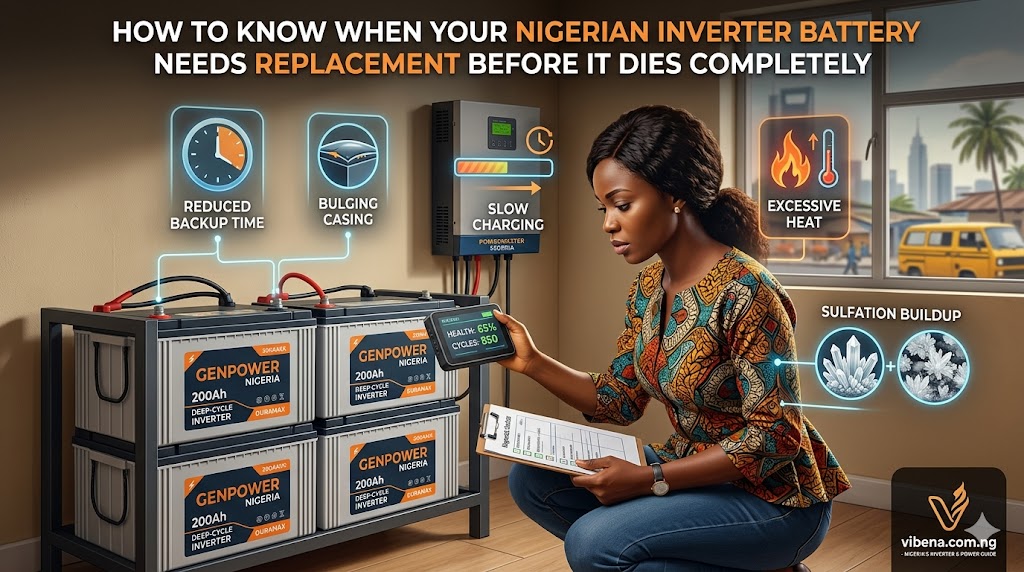
I have been installing and servicing inverter systems across Lagos, Abuja, and Port Harcourt for years. And in all that time, there is one thing that has stayed consistent: most Nigerians do not replace their inverter battery until it has already completely failed them, usually at 11pm, in the middle of a blackout, with a crying baby and a warm refrigerator full of food. This guide explains inverter Battery Needs Replacement in simple, practical terms.
It did not have to be that way.
Your inverter battery always gives you warnings before it dies. Always. The problem is that most people either do not know what to look for, or they see the signs and assume the problem will fix itself. It will not.
In this guide, I will walk you through every inverter battery sign of failure in Nigeria that I have seen on the field, how to test your battery at home with basic tools, exactly when to replace your inverter battery, and how to avoid being the person who paid ₦200,000 for a battery that lasted eighteen months because they missed the early signals.
Why Nigerian Inverter Batteries Fail Earlier Than They Should
Before the warning signs, let us talk honestly about why this is such a common problem in Nigeria specifically. Understanding the “why” helps you catch the “when.”
Nigeria’s grid delivers unstable voltage that can range wildly between 160V and 270V. This constant voltage instability forces your inverter and battery into more charge and discharge cycles than any manufacturer designs for. Add to this Nigeria’s high ambient temperatures, which regularly exceed 35 degrees Celsius across most of the country between March and May, and you have conditions that accelerate internal battery chemistry breakdown faster than in any temperate climate.
According to information from MANLY Battery’s analysis of inverter battery performance in Nigeria, high ambient temperatures and humidity can shorten battery life drastically, and not all battery types tolerate Nigeria’s climate equally. Flat plate batteries, which are still common in many homes across Lagos and Kano, degrade the fastest under this heat. Tubular batteries handle it better but are not immune.
Flat plate batteries: typical lifespan of around three years with proper care in Nigeria. Tubular batteries: typically seven to eight years with consistent maintenance under Nigerian conditions. AGM and Gel batteries: four to five years with proper charge control. LiFePO4 lithium batteries: ten to fifteen years with virtually no maintenance.
The question is not whether your battery will eventually fail. It will. The question is whether you will catch it early enough to replace it on your terms instead of the battery’s terms.
Warning Sign 1: Your Backup Time Has Dropped Significantly
This is the most obvious and the most ignored signal of inverter battery failure in Nigeria. I cannot count how many service calls I have attended where the customer said, “It used to give us four hours but now it barely does two, we thought that was normal.”
It is not normal.
As explained by the technical team at Luminous Nigeria, if your inverter used to run for several hours and now barely lasts an hour or two, it is a clear sign the battery’s efficiency has dropped. The battery’s ability to hold a charge decreases over time, especially when it has not been properly maintained.
Here is how to track this properly at home. The next time NEPA takes light, note the exact time your inverter switches on. Run the same appliances you normally use. Note the exact time either the inverter alarm sounds or power cuts. Compare that window against what it was six months ago and a year ago.
A healthy battery might lose about 10% to 15% of capacity in the first two years under normal Nigerian cycling. If you are losing more than 40% to 50% of your original backup time, your battery is communicating something serious. Do not ignore this.
In my experience on the field, a tubular 200Ah battery that used to supply a Lagos home for five hours but now struggles past two hours has either significant sulfation, one or more dead cells, or has been repeatedly deep-discharged beyond safe levels. None of those situations resolves on its own.
Warning Sign 2: The Battery Is Taking Much Longer to Fully Charge
A healthy inverter battery charges within a predictable window. For a 200Ah tubular battery on a standard 20A charger, expect roughly ten to twelve hours for a full charge from near-empty under normal conditions.
When that same battery starts taking sixteen, eighteen, or even twenty-plus hours to reach full charge, something is wrong inside the cells. This is not a charger problem in most cases. It is a battery problem.
As documented by energy storage experts at Battery University, when a battery begins to age or develop internal faults, the charging time extends. This not only leads to electricity wastage but also puts additional load on the inverter system. A delay in full charging despite adequate power supply is a strong indicator that your battery may be deteriorating.
How to confirm this on a tubular battery:
Watch the float indicators on top of your battery during charging. These small transparent caps change color or float at different levels as the cells fill with charge. If two or three of your six cells appear to fill significantly faster or slower than the rest, you have a cell imbalance. That imbalance will only worsen over time.
This sign is especially easy to miss because you are usually not watching your battery charge at 2am when PHCN decides to restore power. Set a reminder to check your battery voltage with a multimeter in the morning after a full charge overnight.
Warning Sign 3: The Voltage Numbers Are Telling You Something
This is where a simple digital multimeter becomes one of the most powerful tools you can own as a Nigerian inverter user. A basic multimeter costs between ₦3,000 and ₦8,000 at any electrical market across Nigeria, from Alaba International Market in Lagos to Wuse Market in Abuja.
Here is what the voltage readings mean for a standard 12V inverter battery:
After a full charge and at least one hour of rest with no load connected, a healthy 12V battery should read 12.6V or higher. As noted by Mercury Direct, a Nigeria-based inverter and battery supplier, a fully charged 12V battery should read around 13.5V immediately after charging comes off. A lower resting reading may signal a problem.
Here is a practical guide to reading your battery’s voltage health at rest:
12.6V and above: Battery is healthy and fully charged. 12.4V to 12.6V: Battery is at approximately 75% to 100% charge. Acceptable. 12.0V to 12.4V: Battery is partially discharged. Needs a charge. 11.8V to 12.0V: Battery is significantly discharged. Charge immediately. 11.8V or below after a full overnight charge: Your battery has a serious problem. This reading after charging means the battery is no longer holding charge correctly. Below 10.4V in any state: As confirmed by Mercury Direct’s technical guidance, a 12V battery reading below 10.4V is critically low and may need a boost charge or replacement.
If you check your battery after a full overnight charge and it reads below 12.0V at rest, test it again over three consecutive days. If it consistently reads low, that battery needs professional attention immediately. Do not wait for it to die during a blackout.
Warning Sign 4: The Battery Smell Is Trying to Tell You Something Dangerous
I have walked into people’s homes and known the battery was in serious trouble before I even saw it. The smell in the room gave it away.
A healthy tubular inverter battery operating correctly produces minimal smell. Some faint odor during active charging is normal for flooded tubular batteries since they vent small amounts of hydrogen gas. What is not normal is a persistent, strong smell of rotten eggs, burning plastic, or sulfuric acid in the room.
According to technical documentation from Tikweld Products and Services, if your tubular battery emits an unusual smell, it may indicate overcharging or a leak. This is a serious issue that should be addressed immediately. You should turn off the battery and inverter and seek professional assistance.
The rotten egg smell specifically indicates hydrogen sulfide gas, which is released during overcharging or internal breakdown. As confirmed by Mercury Direct’s technical team, this gas is toxic and flammable in high concentrations. This is not something to investigate casually.
What to do immediately if you smell rotten eggs from your battery:
Switch off your inverter completely. Open all windows and doors in the room. Do not turn on any light switches or use an open flame anywhere near the battery. The hydrogen gas can ignite. Call a qualified inverter technician the same day. Do not reconnect or use the system until a professional has assessed it.
This is one of the most urgent signs I respond to during service calls. I have seen situations where a combination of prolonged overcharging and a poorly ventilated room created genuinely dangerous conditions. Take it seriously.
Warning Sign 5: Physical Swelling, Bulging, or Distortion of the Battery Casing
Pick up a torch or simply look closely at the sides and bottom of your battery casing right now. If the sides are perfectly flat and rectangular, your battery housing is structurally intact. If any side appears pushed outward, rounded, or noticeably different from how it looked when the battery was new, that battery is swelling.
Battery swelling is a serious physical indicator. As explained in the technical literature from Star Plus Battery, a battery that appears swollen or bulging on the casing is a serious safety hazard. This bulging signifies internal pressure buildup due to gas accumulation, potentially leading to a battery explosion.
A swollen battery casing means internal gases have built up to the point where the case is deforming under pressure. This is caused by overcharging, extreme heat exposure, or severe internal cell failure. According to Mercury Direct’s inverter battery guidance, a swollen battery is permanently damaged and must be replaced immediately. There is no repair for a swollen battery.
Do not poke, pierce, or apply any pressure to a swollen battery. Disconnect it carefully wearing rubber gloves. Place it in a well-ventilated outdoor area away from any heat source and contact a technician or a responsible battery recycler. In Lagos, BuyScrap Nigeria offers collection services for faulty batteries at their locations in Oshodi and Agege.
This warning sign has no grey area. A swollen battery is a dead battery that also presents a safety risk to your household. Replace it immediately.
Warning Sign 6: Visible Acid Leakage, Staining, or Cracks on the Casing
Look at the area around your battery, particularly the floor or shelf it sits on and around the base of the battery casing. If you see white crystalline deposits, brown or yellowish staining, or any wet residue around the battery, you are looking at electrolyte leakage.
As highlighted in the technical guidance from Star Plus Battery Nigeria, excessive leakage or corrosion around the battery terminals indicates a potential internal breach. This leakage can damage the inverter and surrounding equipment. Any cracks or visible damage to the battery casing compromise its integrity and pose a safety risk.
Leaked battery acid is corrosive. It will damage whatever surface your battery sits on, and if it reaches your inverter’s circuitry, it can cause electrical damage worth significantly more than the battery replacement cost.
Check not just around the base but also around each cell cap on top of your tubular battery. Dried white powder or yellowish crust around the caps often indicates electrolyte was pushed out during overcharging, which is a sign your inverter settings may need adjustment and your battery may have been damaged by repeated overcharging events.
Warning Sign 7: Abnormal Heat During or After Charging
It is normal for a tubular battery to feel slightly warm to the touch during active charging. What is not normal is heat that is uncomfortable to hold your palm against, or heat that continues for an extended time after charging has completed and the battery has been resting.
As documented by Tikweld’s battery maintenance guide, tubular batteries should not overheat during regular use. If you notice your battery becoming excessively hot, it could be due to poor ventilation or an issue with the battery cells. Poor ventilation causes or worsens overheating in Nigeria’s climate.
Abnormal heat indicates that the battery’s internal resistance has increased significantly. Higher internal resistance means the battery is working harder to accept and deliver charge, which creates more heat as a byproduct. This is usually a sign of advanced sulfation or multiple failing cells.
Check these things before concluding it is the battery:
First, verify that your inverter’s battery type setting matches your actual battery. If you have a tubular battery but the inverter is set to “flat plate” or “sealed,” the charge profile will be wrong and it will overcharge your tubular battery. Second, confirm the battery is not in an enclosed space. In my installation experience across Nigerian homes, I have seen batteries installed inside sealed wooden boxes with no ventilation. Nigeria’s heat plus a sealed battery compartment creates temperatures that can easily exceed 45 degrees Celsius internally, which can accelerate battery failure by twelve to eighteen months.
Warning Sign 8: Hissing, Crackling, or Sputtering Sounds
A healthy tubular inverter battery charges quietly. You might hear very occasional faint bubbling from the cells during active charging, which is the gassing phase at the top of a charge cycle. That is normal.
What is not normal are persistent hissing sounds, crackling noises, or sputtering during operation at any point in the charge or discharge cycle. As confirmed by the team at Star Plus Battery Nigeria, hissing, sizzling, or sputtering sounds emanating from the battery during charging or operation are red flags. These noises could indicate internal damage or overheating, both of which require immediate attention and likely a battery replacement.
These sounds mean something is happening inside the cells that should not be happening. Whether it is violent gassing from overcharging, internal short circuits between plates, or the electrolyte itself boiling from extreme heat, none of these are situations you can safely ignore.
Switch off the inverter, allow the battery to cool in a ventilated area, and call a technician. Do not attempt to open the battery cells yourself while active gassing is occurring.
Warning Sign 9: Frequent Inverter Shutdowns and Alarms Even Under Light Load
This sign is easy to dismiss because the inverter alarm is a normal part of life in any Nigerian home. But there is a specific pattern to watch for.
When your inverter triggers its low-battery alarm and shuts down while running only light appliances like a fan, a few LED lights, and a phone charger, and you have charged the battery normally, that pattern tells you the battery can no longer hold the capacity it is supposed to.
As noted in Luminous Nigeria’s technical documentation, Luminous inverters are programmed to shut down at 10.8 volts. If your battery is reaching that voltage threshold quickly even under minimal load, the usable capacity has dropped dramatically.
According to information from Mercury Direct Nigeria, if your inverter is not charging the battery bank, they might have dropped below the operational threshold. Inverters require a minimum DC voltage to start the charging circuit, and if a battery stays below that threshold, the inverter treats it as either too far gone to charge or in a protection state.
This pattern, where the alarm triggers quickly and the battery barely holds a charge, usually points to either significant capacity loss from repeated deep discharge, advanced sulfation, or one or more dead cells in the battery bank.
Warning Sign 10: Your Battery Has Exceeded Its Expected Lifespan
This is the warning sign people overlook because there is nothing dramatic about it. No alarm. No smell. No swelling. Just time.
As documented by multiple battery specialists, lead-acid batteries have a lifespan of around three to five years. Tubular batteries can last longer, up to seven to eight years with consistent maintenance in Nigeria. Lithium batteries older than ten years showing multiple performance issues should be replaced rather than repaired.
If your battery is four years or older and you have not been performing regular maintenance, and you are starting to notice any of the signs above, do not try to stretch it further. In my field experience, the cost of a failed battery taking out your connected appliances or damaging your inverter’s internal charging circuits often exceeds the cost of a proactive replacement.
Assess the age of your battery honestly. If it was installed in 2020 or earlier, and you are in 2026 now, you are at or beyond the average replacement window for most tubular batteries in Nigerian conditions. Plan the replacement. Do not wait to be forced into it.
How to Do a Proper Battery Health Test at Home
You do not need to be a technician to do a basic assessment. Here is what you can do with tools that cost less than ₦15,000 total.
The Multimeter Voltage Test
Purchase a basic digital multimeter from any electrical market. Disconnect all loads from your inverter. Allow your battery to rest with no charging and no discharge for at least four to eight hours. Then measure the voltage across the battery terminals.
Use this reference: a fully charged, healthy 12V battery at rest should read 12.6V or above. Anything below 12.0V at rest after a full overnight charge is a serious concern.
The Hydrometer Test for Tubular Batteries
A battery hydrometer measures the specific gravity of the electrolyte inside each cell of your tubular battery. As confirmed by Discover Battery’s testing guide, the readings should be at or above 1.280 at full charge with a tolerance of plus or minus 0.005.
Hydrometer test results to know:
1.265 to 1.299: Battery cell is fully charged and healthy. 1.210 to 1.265: Cell is partially charged. Charge and retest. Below 1.150: Cell is severely discharged or failing. Large variation between cells (more than 0.050 difference): One or more cells have failed internally.
You can buy a basic battery hydrometer from electrical markets across Nigeria for between ₦3,000 and ₦7,000. It is one of the most useful diagnostic tools for any Nigerian tubular battery owner.
If after equalization charging one cell still reads significantly lower than the others, that cell has failed. A battery with a failed cell cannot be repaired effectively, and continued use will damage the remaining cells and possibly the inverter itself.
The Load Test
This is the most practical real-world test. After a full overnight charge, disconnect the inverter from PHCN. Run only your most essential, consistent load, like two ceiling fans and four LED bulbs. Start a timer. Record how long the battery sustains that load before the alarm sounds.
Compare that against the manufacturer’s specification for your battery capacity and load. A 200Ah tubular battery running at approximately 200 to 250 watts of load should sustain between five and eight hours depending on the inverter’s efficiency. If you are getting significantly less than that consistently, your battery capacity has degraded past the acceptable threshold.
When Should You Replace Your Inverter Battery? The Clear Criteria
Based on field experience and the technical guidance from battery specialists and manufacturers, replace your inverter battery when:
The backup time has dropped to less than 50% of what it originally provided under the same load. The resting voltage reads consistently below 12.0V after a full overnight charge. The battery is physically swollen, cracked, or leaking. The battery has a strong and persistent rotten egg or burning smell. One or more cells test significantly lower than others on a hydrometer after equalization. The battery is five or more years old and showing multiple performance warning signs simultaneously. The battery fails to charge normally even after checking all connections, inverter settings, and ruling out the inverter as the source of the problem.
According to guidance from Mercury Direct Nigeria, battery swelling, persistent sulfation after treatment attempts, individual cell failure, and capacity loss below 60% of the original rating indicate immediate replacement needs. Additionally, batteries older than five years in the lead-acid category or ten years in the lithium category showing multiple problems should be replaced rather than repaired.
Should You Try to Revive a Failing Battery or Just Replace It?
I get this question on almost every service call. People do not want to spend ₦150,000 to ₦420,000 on a new 200Ah tubular battery when they are hoping there is a cheaper fix.
The honest answer is this: some early-stage sulfation can be reversed with equalization charging. A battery with severely low water that has not yet suffered plate damage can sometimes recover significantly after distilled water top-up and a slow full charge. These are worth trying before replacement if the battery is under three years old and showing only one or two mild signs.
As noted by Lento India’s battery revival documentation, reviving a dead battery is possible in many cases with the right approach. But they are equally clear: if your battery is physically damaged, swollen, or leaking, do not attempt revival. It is unsafe. Replace it immediately.
If your battery is over four years old, showing three or more of the warning signs above, and the hydrometer or multimeter tests confirm significant degradation, the money you spend on revival attempts is money that could go toward a new battery. I have seen Nigerian households spend ₦30,000 to ₦40,000 on various revival attempts over three to four months, only to buy a new battery anyway. You are better off making that decision earlier.
What to Buy When You Do Replace Your Battery
When replacing your inverter battery in Nigeria in 2026, here are the most relevant options available locally:
For tubular batteries, trusted brands in the Nigerian market include Luminous, Lento, Kan, Energos, Felicity Solar, Eastman, Cleon, and Fabton. A 200Ah tubular battery from these brands ranges from approximately ₦155,000 to ₦280,000 depending on the brand and the retailer. Lento tubular batteries, according to the brand’s own documentation, can last five to seven years with proper maintenance under Nigerian conditions.
For lithium LiFePO4 batteries, brands available in Nigeria include Pylontech, Deye, Blue Carbon, and Felicity Solar. A 12V 200Ah lithium battery runs between ₦315,000 and ₦470,000 as of early 2026. The significantly longer lifespan, zero maintenance requirement, and better deep discharge tolerance make this the smartest long-term investment for those who can afford the upfront cost.
One critical rule when replacing: do not mix old and new batteries in the same bank. As confirmed by Mercury Direct Nigeria’s technical guidance, you should never mix different battery types or different ages and capacities in the same bank. This creates imbalanced charging and discharging, leading to premature failure of all batteries. Always replace the entire battery bank at the same time with identical batteries.
For more on choosing the right inverter and battery system for your home from the ground up, read our guide on solar inverter setup for a Nigerian two-bedroom flat and our honest review on switching from generator to solar in Nigeria. If you want to go deeper on keeping your current battery alive longer before replacement becomes necessary, our guide on how to extend inverter battery life in Nigeria covers every maintenance step in detail.
How to Dispose of a Dead Inverter Battery Responsibly in Nigeria
Please do not dump a dead inverter battery in your compound, by the roadside, or in open drainage. Inverter batteries contain lead and sulfuric acid, both of which are toxic to soil and groundwater when not disposed of properly.
Dead or faulty inverter batteries contain toxic materials like lead and sulfuric acid, which can harm the environment if not handled properly. In Lagos, BuyScrap Nigeria accepts most types of inverter batteries including lead-acid, sealed, and lithium-ion models, and they offer collection from their locations in Oshodi and Agege with responsible recycling practices. Many battery retailers across Nigeria also accept old batteries as trade-ins when you purchase a replacement.
The Cost of Waiting Too Long
A failing battery does not just mean no power during a blackout. It can mean something more expensive.
As highlighted by the technical team at Star Plus Battery Nigeria, a failing battery can strain the inverter, potentially damaging its internal components and leading to costly repairs or replacements. Overheated or damaged batteries also pose a fire risk.
A new inverter unit in Nigeria costs between ₦80,000 and ₦600,000 depending on capacity and brand. The cost of a fire hazard needs no calculation. Neither does the cost of a damaged refrigerator compressor, a fried laptop power supply, or a washing machine motor that took a bad voltage surge from a dying battery.
Replacing a battery proactively when you see the warning signs costs you one battery. Waiting until it dies on you can cost you one battery plus one inverter plus damaged appliances. The math is not close.
For remote workers and home-based professionals who depend on stable power for client calls, video meetings, and consistent internet access, an unexpected battery failure is not just an inconvenience. Read our guide on the best internet options for remote work in Nigeria and our roundup of essential gadgets for remote workers in Nigeria to complete your reliable power setup from every angle.
Frequently Asked Questions
How do I know if my inverter battery is failing in Nigeria?
The clearest signs are a significant reduction in backup time compared to when the battery was new, the battery taking much longer than usual to reach full charge, a resting voltage below 12.0V after a full overnight charge, physical swelling or cracking of the battery casing, a rotten egg smell during or after charging, unusual hissing or sputtering sounds, and frequent inverter alarms under minimal load. Seeing two or more of these signs together means it is time to test or replace your battery.
How long should an inverter battery last in Nigeria?
Flat plate batteries typically last about three years in Nigerian conditions. Tubular batteries, with consistent maintenance, last seven to eight years. AGM and Gel batteries average four to five years with proper charge control. LiFePO4 lithium batteries last ten to fifteen years. Poor maintenance, repeated deep discharging, and high ambient temperatures can cut any of these lifespans by half.
Can a swollen inverter battery be repaired?
No. A swollen inverter battery casing indicates internal pressure buildup from gas accumulation or thermal expansion. According to Mercury Direct Nigeria’s technical guidance, a swollen battery is permanently damaged and must be replaced immediately. Do not attempt to repair, puncture, or compress a swollen battery.
What voltage should my 12V inverter battery read when fully charged?
After a full charge and at least four to eight hours of rest with no load or charging, a healthy 12V battery should read 12.6V or above. A fully charged reading immediately after the charger disconnects should be around 13.5V. A resting voltage consistently below 12.0V after a full charge indicates a problem that needs professional attention.
Should I replace just one battery or the whole battery bank?
Always replace the entire battery bank at the same time with batteries of the same type, brand, capacity, and age. Mixing an old battery with a new one creates a charge imbalance that causes both the new battery to discharge faster and the old battery to overheat. The new battery will degrade significantly faster when paired with an older unit.
How much does inverter battery replacement cost in Nigeria in 2026?
A 200Ah tubular inverter battery costs approximately ₦155,000 to ₦280,000 depending on brand and retailer. LiFePO4 lithium batteries of comparable capacity range from ₦315,000 to ₦470,000. Professional diagnosis and repair services typically run between ₦10,000 and ₦25,000. Basic maintenance like terminal cleaning and water topping costs ₦2,000 to ₦5,000.
Is it safe to use a battery that smells like rotten eggs?
No. A rotten egg smell from an inverter battery indicates hydrogen sulfide gas, which is both toxic and flammable in enclosed spaces. Switch off the inverter immediately, ventilate the area, and do not use the system until a qualified technician has assessed the battery and the cause of the overcharging or internal breakdown.
For more guides on managing power in your Nigerian home and remote work setup, read our full review of cheap inverters for Nigerian homes and our comparison of solar power costs for a three-bedroom flat in Nigeria. If power instability is affecting your productivity as a remote worker or student, our guide on how to stay focused during power outages has practical strategies built for the Nigerian reality.
Inverter Battery Needs Replacement: Quick Recap
That is the full picture on inverter Battery Needs Replacement. Save this guide, share it with someone who needs it, and check back, because we update our Nigerian guides when things change.

Oladepo Babatunde (Prince Babatee Tunde) is a Computer Scientist, researcher, and professional content writer with a Higher National Diploma in Computer Science from Kwara State Polytechnic, Nigeria.
With a background in technology and a passion for clear communication, Babatunde specializes in creating thoroughly researched, reader-focused content on productivity, personal development, home living, and technology. Every article he writes is backed by extensive research and fact-checking to ensure readers receive accurate, actionable information.
As a freelance writer, he has helped brands and publications deliver content that educates, engages, and empowers their audiences. His mission at Vibena is simple: make complex topics easy to understand and help Nigerians live smarter, more productive lives.