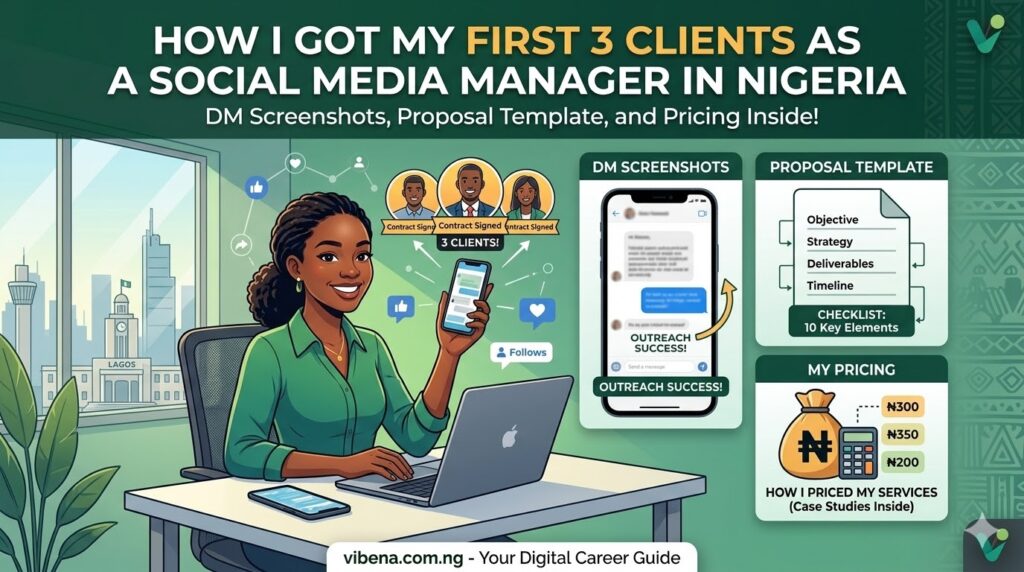
My first social media management client paid me ₦50,000 per month. I remember the exact moment I saw the OPay notification come in because I screamed so loud my neighbour knocked on my wall thinking something was wrong. Nothing was wrong. Everything was finally going right.
That was September 2025. I was a broke freelancer in Yaba, Lagos, with zero formal marketing experience, a Tecno phone, a secondhand laptop, and a Canva free account. I had been scrolling job boards for weeks, sending generic messages to anyone who posted about needing help with their business page, and hearing nothing back.
Then I changed my approach. I stopped sending desperate “I can manage your page” messages and started doing something that actually worked. Within six weeks, I had three paying clients bringing in a combined ₦200,000 per month. Not millions. Not viral success. But real money that covered my rent and gave me room to breathe.
This is the full story of how I did it. I am sharing the actual DM conversations (anonymised), the exact proposal template I used, and the real pricing structure that got me from zero to three clients. If you are a freelancer, remote worker, student, or anyone trying to become a social media manager in Nigeria, this is the most honest breakdown I can give you.
Why Social Media Management Is a Real Opportunity in Nigeria Right Now
Before I share my story, let me give you the context that made me confident enough to pursue this career in the first place.
According to DataReportal’s Digital 2026 Nigeria report, there were 109 million internet users in Nigeria at the end of 2025 and approximately 47.8 million social media user identities. That is a massive audience that Nigerian businesses need to reach. And most of these businesses, especially small and medium enterprises, do not have the time or knowledge to manage their own social media presence effectively.
According to data from Bizmartek Nigeria, 98% of Nigerian social media access is via mobile, Facebook remains the top platform with roughly 39 million users, WhatsApp has over 90% penetration among internet users, and TikTok has seen explosive growth to approximately 37 million users. These are not abstract numbers. These are real people scrolling, buying, and making decisions based on what they see on social media.
The demand for people who can manage this for businesses is growing fast. According to research from 6W Research, the Nigeria social media management market is experiencing significant growth driven by increasing digitalization and internet penetration.
When I started, I did not know all these statistics. But I knew one thing from observation: almost every small business owner I interacted with in Lagos was struggling with their Instagram or Facebook page. They knew they needed to post. They just did not have the time, the design skills, or the strategy to do it consistently.
That gap was my entry point.
My Starting Point: What I Had and What I Did Not Have
Let me be transparent about where I was when I started because I think a lot of guides gloss over the ugly parts.
What I had:
- A Tecno Camon 20 phone (decent camera, enough for basic content)
- A secondhand HP EliteBook laptop that I bought for ₦85,000 from Computer Village
- A free Canva account
- Basic knowledge of Instagram and Facebook (from running my personal pages)
- A reliable internet connection through my MTN 4G hotspot
- Hunger. Genuine, rent-is-due-next-week hunger.
What I did NOT have:
- A degree in marketing or communications
- Any previous client work or portfolio
- Expensive tools like Hootsuite, Buffer, or Adobe Creative Suite
- A large social media following of my own
- Professional graphic design skills
I wrote about the full career path in my guide on how to become a social media manager in Nigeria, which covers salary data, required skills, and step-by-step instructions. But this article is specifically about the client-getting process, because that is where most people get stuck.
The 3 Weeks I Spent Preparing Before I Sent a Single DM
I know you want to skip to the DM templates. I get it. But the preparation work I did in the first three weeks is what made those DMs actually work. If I had skipped this step, I would still be getting ignored.
Week 1: I Built a Portfolio Using My Own Content
Nobody was going to hire me based on promises. They needed to see proof that I could create content that looks professional and gets engagement.
So I treated my own Instagram page as my first “client.” Over seven days, I created 15 posts using Canva’s free plan. Canva offers over 250,000 free templates, and I used them as starting points, then customised the colours, fonts, and text to match a consistent visual style.
I focused on creating content about productivity tips for Nigerians (a topic I was already interested in). Each post had a clean design, a clear headline, and a practical tip. I also wrote proper captions with hashtags and calls to action.
By the end of the week, my page looked like it belonged to someone who knew what they were doing. It was not perfect. But it was consistent, visually clean, and clearly showed that I could plan and execute a content strategy.
I also created three “mock client” portfolios. These were sample content calendars and posts I designed for fictional businesses: a Lagos bakery, a fashion brand, and a tech accessories shop. I designed 5 sample Instagram posts for each, complete with captions, and saved them in a Google Drive folder that I could share via link.
Week 2: I Learned the Tools That Matter
You do not need expensive software to start managing social media in Nigeria. Here is what I learned to use during that second week:
Canva Free: This became my primary design tool. The free plan gives you access to thousands of templates for Instagram posts, stories, Facebook covers, and more. I learned how to create consistent visual branding using Canva’s colour palette tool and free fonts. For anyone starting out, Canva is genuinely all you need for design.
Meta Business Suite: This is Facebook’s free, official tool for managing both Facebook and Instagram from one dashboard. You can schedule posts, respond to messages, view analytics, and manage your inbox without paying for any third-party tool. I still use this daily.
Google Sheets: For content calendars, client reporting, and tracking post performance. Free and works on any device.
CapCut: Free video editing app for creating Reels and TikTok content. Works entirely on mobile, which was important because my laptop was not powerful enough for video editing.
These four free tools handled about 90% of what I needed for my first three clients. I eventually upgraded to Canva Pro when I had enough income, but the free versions got me started.
I also made sure I had solid productivity apps that work offline installed on my phone and laptop, because power outages and internet issues are part of life in Lagos. You cannot afford to miss a client deadline because NEPA took light.
Week 3: I Identified My Target Market
This is where most aspiring social media managers go wrong. They try to work with anyone and everyone. I made that mistake for the first few days, sending messages to random businesses. Not a single one replied.
Then I got specific. I decided to focus on three types of businesses:
Small fashion and beauty brands on Instagram with 500 to 5,000 followers who were posting inconsistently (maybe once a week or less).
Food vendors and small restaurants in Lagos that had a Facebook page but rarely updated it.
Service businesses (hair salons, skincare brands, phone accessory shops) that were active on WhatsApp but had a dead Instagram or Facebook page.
I chose these because they were small enough to be approachable, had an obvious need (inconsistent posting), and could clearly benefit from social media management without needing a massive budget.
How I Actually Got Client Number 1: The Cold DM That Worked
Let me walk you through exactly what happened.
Finding the Prospect
I found Client Number 1 by scrolling through Instagram hashtags. Specifically, I searched #lagossmallbusiness, #lagosfashion, and #madeinnigeria. I was looking for accounts that met three criteria:
- They had a business that was clearly selling products or services
- Their last post was more than two weeks old (showing inconsistency)
- They had at least 300 followers (showing some traction)
I found a women’s clothing brand run by a young woman in Surulere. She had 1,200 followers but had not posted in 23 days. Her last few posts were blurry phone photos with no captions. Her bio had a WhatsApp number but no call to action.
The DM I Sent
Here is what I sent (I am sharing the structure, not word for word, to protect her privacy):
“Hi [Name], I came across your page while looking at Lagos fashion brands and I love your pieces, especially the ankara midi dress from your last collection. I noticed your page has not been updated recently and I think you are leaving money on the table. I am a social media manager and I put together 3 free sample posts for your brand just to show you what consistent, branded content could look like. Can I send them to you? No charge, no obligation.”
That was it. Short. Specific. Complimentary without being fake. And most importantly, I offered something free and tangible before asking for anything.
What Happened Next
She replied within four hours: “Yes please, send them.”
I spent that evening creating three Instagram posts for her brand using photos from her existing page (I screenshotted and redesigned them in Canva). I created a carousel post showcasing three outfits, a single-image promotional post with a clean layout and price overlay, and an Instagram Story template with a “Swipe Up to Order” design.
I sent them via DM with a short message: “Here are the three samples. If you like them and want to discuss having content like this posted consistently for your brand, I would love to chat. I have availability for one more client this month.”
That last line was intentional. Scarcity. Even though I had zero clients, saying “one more client” implied I was already working with others. It is not dishonest. It is positioning.
She loved the posts. She asked how much I charge. And that is when I sent my proposal.
The Proposal Template That Closed My First 3 Clients
I spent an entire day creating this proposal template in Google Docs. It is clean, professional, and structured to answer every question a potential client might have before they ask it. Here is the exact structure I used:
Section 1: About Me (Keep It Short)
Two to three sentences about who you are, what you do, and who you have helped. If you have no clients yet, focus on your skills and the results from your own page.
“I am a social media manager based in Lagos, specialising in helping small Nigerian brands build a consistent, professional online presence. I create branded content, manage posting schedules, and track growth metrics to help businesses turn followers into customers.”
Section 2: What I Noticed About Their Business
This is the section that separates your proposal from every generic pitch. I wrote three to four specific observations about their page. For Client Number 1, I noted:
- Inconsistent posting (last post was 23 days ago)
- No branded visual style (each post looked different)
- No call to action in the bio
- Product photos were not optimised for Instagram’s square or 4:5 format
- No use of Stories or Reels
This shows the client that you have actually studied their business, not just copied and pasted a template.
Section 3: What I Will Do (The Deliverables)
I listed specific deliverables in a clear table format:
| Deliverable | Details | Frequency |
|---|---|---|
| Instagram feed posts | Professionally designed using brand colours and fonts | 4 per week |
| Instagram Stories | Promotional, behind-the-scenes, or engagement (polls, Q&A) | 3 per week |
| Captions and hashtag research | Written captions with relevant hashtags for reach | Every post |
| Content calendar | Monthly calendar shared via Google Sheets | 1 per month |
| Community management | Responding to DMs and comments within 4 hours during business hours | Daily |
| Monthly performance report | Follower growth, engagement rate, top posts, recommendations | 1 per month |
Section 4: Pricing
This is the section everyone wants to see, so let me share exactly what I charged and why.
My pricing for Client Number 1 (Starter Package):
₦50,000 per month for one platform (Instagram only).
According to data from PayScale, the average salary for a social media manager in Nigeria is approximately ₦330,000 per year for full-time employment. For freelancers, rates vary widely depending on experience and scope.
As a beginner with no track record, I needed to price competitively enough to get hired while still valuing my time. At ₦50,000 for roughly 16 feed posts, 12 stories, daily community management, and monthly reporting, I was working for about ₦1,500 per post plus community management. It was not a lot, but it was my first client and the goal was to build proof and testimonials.
Section 5: Timeline and Next Steps
I included a simple onboarding process:
- Day 1 to 3: Brand questionnaire and visual style agreement
- Day 4 to 7: First week’s content created and sent for approval
- Day 8 onward: Posting begins on agreed schedule
I also included payment terms: 50% upfront before any work begins, 50% on the 15th of the month. I used OPay for receiving payments because it was what my clients were most comfortable with.
What I Sent It In
I sent the proposal as a Google Docs link (view-only) so the client could read it on their phone without downloading anything. This is important in Nigeria where many people do everything on mobile. Sending a PDF attachment that takes 2 minutes to download on a slow network is a guaranteed way to lose attention.
Client Number 1: The Fashion Brand Owner
She accepted the proposal within two days. Her only negotiation was asking if I could include one Reel per month, which I agreed to. We started on October 1, 2025.
What Happened in the First Month
I created a brand colour palette (sage green and cream, which matched her clothing aesthetic), designed a set of Instagram templates in Canva, and began posting four times per week.
By the end of October, her account went from 1,200 to 1,847 followers. More importantly, her DM enquiries about purchasing clothes went from roughly 2 to 3 per week to about 8 to 12 per week. She told me she made an additional ₦180,000 in sales that month that she directly attributed to Instagram.
That was when she became my first testimonial. I asked if she would write a short review, and she sent me a voice note on WhatsApp that I transcribed (with her permission) and added to my portfolio.
How I Got Client Number 2: The Instagram Story Approach
Client Number 2 came from a completely different method. Instead of cold DMing, I used my own Instagram Story to attract inbound interest.
What I Posted
I created a series of three Instagram Stories showing a before and after of Client Number 1’s page. The first slide showed a screenshot of how the page looked before I started (blurry photos, no consistency). The second slide showed the same page after one month of my management (clean, branded, consistent). The third slide said: “I have space for one more client in November. DM me if you want this for your brand.”
I also posted a feed post breaking down 3 common Instagram mistakes Nigerian small businesses make, with a carousel format. It got 47 likes and 11 saves, which was significant for my small page at the time.
The DM I Received
A woman who runs a natural skincare brand in Lekki saw the Story (she was following me because we were in a mutual Lagos business WhatsApp group). She sent me a DM:
“Hi, I saw your before and after. My page is a mess honestly. How much do you charge?”
This is the ideal scenario. Instead of me chasing her, she came to me. And she came already convinced that I could deliver because she had seen real proof.
I sent the same proposal template but customised it for her business. I adjusted the deliverables to include both Instagram and Facebook management because she wanted both platforms covered.
Pricing for Client Number 2
₦80,000 per month for two platforms (Instagram and Facebook).
I charged more because the scope was larger. Managing two platforms means creating platform-specific content (what works on Instagram does not always work on Facebook), managing two inboxes, and tracking two sets of analytics.
She accepted within 24 hours. No negotiation.
How I Got Client Number 3: The WhatsApp Group Strategy
This one surprised me because I had not planned it.
I was a member of a WhatsApp group for Lagos small business owners. About 150 members, mostly women running small businesses in fashion, beauty, food, and services. I never once advertised my services in the group. Instead, I did something that worked even better.
What I Did
Whenever someone in the group asked a question about social media (things like “Why is my engagement dropping?” or “What time should I post on Instagram?” or “How do I create a reel?”), I answered thoroughly and helpfully. Not with one-line responses. I would write a full paragraph explaining the issue, sometimes with screenshots from Canva showing how to do something.
I did this consistently for about three weeks. Not every day, but whenever I saw a question I could answer, I answered it well.
What Happened
The group admin, who runs a catering business in Ikeja, sent me a private message:
“You seem to really know your stuff. I have been struggling with my Instagram for months. Can you help me? What do you charge?”
I had not pitched her. I had not sent a single promotional message. She came to me because I had demonstrated expertise organically over three weeks of helpful contributions.
Pricing for Client Number 3
₦70,000 per month for Instagram management plus a weekly WhatsApp Status content pack (5 designed images per week for her to post on her WhatsApp Business Status).
The WhatsApp addition was her idea. According to data from Bizmartek, WhatsApp has over 90% penetration among Nigerian internet users and is the primary channel where actual sales happen for many small businesses. She knew her customers were on WhatsApp more than Instagram, so she wanted branded content for both.
I agreed and added the WhatsApp content to my standard Instagram package for an additional ₦20,000 per month. This was a smart lesson: listen to what your clients need, not just what you planned to offer. If you are curious about how small businesses are using WhatsApp for sales, I wrote about how to start selling on WhatsApp Business in Nigeria with zero capital.
My Full Pricing Structure in 2026
After landing those first three clients and gaining confidence, I refined my pricing into three clear packages. Here is what I charge now, updated for March 2026:
| Package | Platforms | Deliverables | Monthly Price |
|---|---|---|---|
| Starter | 1 platform (Instagram OR Facebook) | 12 feed posts, 8 stories, captions, hashtags, community management, monthly report | ₦80,000 |
| Growth | 2 platforms (Instagram + Facebook OR Instagram + TikTok) | 16 feed posts, 12 stories, 4 Reels/TikToks, content calendar, community management, monthly report | ₦130,000 |
| Premium | 3 platforms + WhatsApp content | 20 feed posts, 15 stories, 8 Reels/TikToks, WhatsApp Status content (5/week), content calendar, ad management consultation, bi-weekly reporting | ₦200,000 |
My initial ₦50,000 was a starting point, not a permanent price. After three months with Client Number 1, I raised my rate to ₦75,000 and she agreed without pushback because I had proven my value with real results.
According to pricing data from eBrand Promotion, the cost to hire a social media manager in Nigeria ranges from ₦100,000 to ₦500,000 per month depending on experience, scope, and whether you hire a freelancer, in-house manager, or agency. My current pricing sits comfortably in the freelancer range for someone with proven results.
If you are just starting, do not be afraid to charge ₦50,000 to ₦80,000 for your first client. The goal is to get a client, deliver excellent results, get a testimonial, and raise your rates. It is a stepping stone, not a ceiling.
The Mistakes I Made That You Should Avoid
I want to be honest about what went wrong because learning from my errors will save you time and frustration.
Mistake 1: Not Setting Clear Boundaries
With Client Number 1, I said “community management” in my proposal but did not specify hours. She started sending me WhatsApp messages at 10 PM asking me to respond to a customer DM immediately. Within two weeks, I was essentially on call 24 hours a day.
I fixed this by updating my proposal to specify: “Community management: responses to DMs and comments within 4 hours during business hours (9 AM to 6 PM, Monday to Saturday). Messages received outside these hours will be addressed the next business day.”
If you struggle with boundary-setting, I wrote about why setting boundaries is important for work-life balance. It is relevant for every freelancer, not just social media managers.
Mistake 2: Not Getting Content Approval Before Posting
In my second week with Client Number 2, I posted a product photo with a caption that described the skincare product as “affordable.” She messaged me immediately saying she never uses that word because it makes her brand sound cheap. She preferred “accessible” or “value-driven.”
Now, every client goes through a brand voice questionnaire during onboarding where they list words they love, words they hate, and their overall tone (professional, friendly, playful, luxurious, etc.). I also send every week’s content for approval at least 48 hours before posting.
Mistake 3: Undercharging and Then Feeling Resentful
At ₦50,000 per month for 16 posts, 12 stories, daily community management, and a full monthly report, I was working far below minimum wage when I calculated my hourly rate. By week three, I was spending about 25 to 30 hours per month on Client Number 1 alone. That is roughly ₦1,700 per hour, which felt unsustainable.
The lesson: calculate your hourly rate before setting your price. Decide the minimum you are willing to earn per hour, estimate how many hours the work will take, and price accordingly. I now aim for at least ₦3,500 per hour minimum.
Mistake 4: Not Having a Contract
I started all three clients with verbal agreements over WhatsApp. No signed contracts. This was reckless. When Client Number 3 was late on payment by two weeks, I had no written agreement to reference.
Now I use a simple one-page agreement (created in Google Docs) that covers: scope of work, payment amount and schedule, cancellation terms (30 days notice), content ownership, and revision limits.
The Daily Workflow That Keeps Three Clients Running Smoothly
Managing three clients while working from a one-room apartment in Lagos requires serious organization. Here is what a typical day looks like for me:
6:30 AM: Wake up. Check all client DMs and comments that came in overnight. Respond to anything urgent.
7:30 AM: Content creation block. This is when I design posts in Canva and write captions. I try to batch-create content, doing an entire week’s worth for one client in a single sitting.
10:00 AM: Schedule posts using Meta Business Suite. I schedule everything for the week on Mondays.
11:00 AM: Community management round. Go through each client’s Instagram and Facebook, respond to comments, reply to DMs, engage with relevant accounts.
12:00 PM: Break. Lunch. I usually follow my meal prep timetable to avoid spending time cooking during work hours.
1:00 PM: Reels and video content. I batch-edit short videos using CapCut on my phone.
3:00 PM: Second community management round.
4:00 PM: Administrative tasks. Client communication, invoice follow-ups, tracking performance metrics.
5:00 PM: Learning and personal brand. I spend 30 minutes to 1 hour studying social media trends, new features, or watching tutorials.
The key to this workflow is batching. I do not create content one post at a time. I sit down and create a full week of content for one client in one focused session. This is faster, produces more consistent results, and protects my energy.
If you struggle with staying focused during these deep work sessions (especially with Lagos distractions), my guide on how to stay focused during power outages has strategies that apply even when the power is on.
Tools I Use Daily (and What They Cost)
| Tool | What I Use It For | Cost |
|---|---|---|
| Canva Pro | Designing all social media content | ₦5,500/month |
| Meta Business Suite | Scheduling and analytics for Instagram + Facebook | Free |
| Google Sheets | Content calendars, performance tracking, client reporting | Free |
| CapCut | Editing Reels and TikTok videos | Free |
| Google Drive | Storing and sharing content with clients | Free (15GB) |
| WhatsApp Business | Client communication | Free |
| TOTAL | ₦5,500/month |
My total tool cost is ₦5,500 per month. That is it. Against a combined client income of ₦200,000 per month, my tool overhead is less than 3% of revenue.
I wrote about other useful free AI tools that work on slow Nigerian data that can help with caption writing, image editing, and research. These have saved me hours of work every week.
How to Handle the “Your Price Is Too High” Objection
This will happen. Almost every Nigerian small business owner will try to negotiate your price down. Here is how I handle it.
When Client Number 3 initially said ₦70,000 was “too much,” I did not reduce the price. Instead, I said:
“I understand the concern. Let me show you what this investment could return. Based on what I did for my first client, she went from 2 to 3 DM enquiries per week to 8 to 12 per week within the first month. She made an additional ₦180,000 in sales. My fee of ₦70,000 would need to generate just 3 extra orders per month to pay for itself. Do you think consistent, professional content could bring in 3 extra orders?”
She said yes and signed.
The key is to frame your price as an investment with a return, not as a cost. Small business owners understand ROI. They just need you to spell it out in terms that relate to their specific business.
If someone genuinely cannot afford your base price, it is better to recommend they learn to do it themselves (point them to free resources) than to undercharge and deliver resentful work. I wrote about digital skills to learn as a Nigerian student which includes social media management for people who want the DIY route.
What Clients Actually Care About (It Is Not What You Think)
After six months of managing social media for Nigerian businesses, here is what I have learned about what clients actually value. It is not what most social media management guides tell you.
They Care About Sales, Not Followers
Not a single one of my three clients has ever asked me “how many followers did we gain this week?” What they ask is: “Are we getting more enquiries?” and “Did anyone buy because of the post?” Follower count is a vanity metric. DM enquiries and sales are what keep them paying your fee.
They Care About Consistency More Than Creativity
Fancy graphics and viral Reels are nice, but what my clients appreciate most is the reliability. The fact that content goes up four times a week, every week, without them having to think about it. Before they hired me, their pages were dead for weeks at a time. Just being present consistently is valuable.
They Care About Communication
Clients want to feel like you are paying attention to their business. A quick Monday morning WhatsApp message saying “Here is this week’s content plan” and a Friday message saying “This post performed really well this week, here is why” goes further than any fancy report.
They Care About Speed
When a client sends you a photo at 2 PM and asks “Can you make a post with this?”, getting it back to them within 2 hours makes them feel prioritised. Getting it back 2 days later makes them feel like an afterthought.
Scaling Beyond Three Clients: What I Am Working on Now
Three clients at ₦200,000 per month covers my basic cost of living in Lagos, but it is not comfortable, especially with the recent petrol price increases pushing up the cost of everything. My goal is to reach ₦500,000 per month by the end of 2026. Here is my plan:
Adding two more clients at my current Growth package rate of ₦130,000 each. That would bring total revenue to ₦460,000 per month.
Increasing rates for existing clients as I hit milestones. When I deliver measurable results (increased sales, follower growth, better engagement), I plan to propose a 20% rate increase at the six-month mark.
Offering a one-time setup service for businesses that want to manage their own social media but need a professional foundation (brand identity, content templates, strategy document). I am pricing this at ₦100,000 to ₦150,000 as a one-time fee.
Building my personal brand to attract inbound clients. I am posting consistently on my own page, sharing results and case studies, and contributing to Nigerian business communities. Every client I have gotten after the first one came from inbound interest, not cold outreach.
I am also exploring how to grow on TikTok in Nigeria because several potential clients have asked about TikTok management, and adding that skill set would let me charge premium rates.
Frequently Asked Questions
How much do social media managers charge in Nigeria?
Based on my experience and market research, freelance social media managers in Nigeria charge between ₦50,000 and ₦500,000 per month depending on experience, scope, number of platforms, and deliverables. Beginners typically start at ₦50,000 to ₦80,000 for one platform. According to data from Finepoint Design, basic freelance services can start as low as ₦30,000 per month, while top-tier managers charge upwards of ₦700,000 monthly.
Do I need a degree to become a social media manager in Nigeria?
No. None of my clients have ever asked about my educational background. They care about results, portfolio, and reliability. However, you do need to learn the actual skills: content creation, copywriting, basic analytics, and platform-specific strategies. You can learn all of these for free online.
How do I get my first client with no experience?
Build a portfolio using your own social media page and mock client projects. Then find businesses that clearly need help (inconsistent posting, poor-quality content) and offer free sample posts to demonstrate your value. The cold DM approach I described above works if you are specific and generous with your initial offer.
What tools do I need to start?
At minimum: Canva (free plan), Meta Business Suite (free), Google Sheets (free), and a phone with a decent camera. That is genuinely enough to start. You can upgrade to paid tools once you have income from clients.
How many clients can one person manage?
From my experience, 3 to 5 clients is manageable for a single freelancer working full-time. Beyond that, you either need to hire help, increase your prices (so you earn more from fewer clients), or specialise in a niche where you can reuse content frameworks.
Final Thoughts
Getting your first client as a social media manager in Nigeria is the hardest part. Everything after that gets progressively easier because you have proof, testimonials, and confidence.
The Nigerian market is massive and growing. According to DataReportal, there are over 109 million internet users in Nigeria. Businesses need help reaching these people. And most small business owners do not have the time, skills, or consistency to do it themselves.
You do not need a fancy degree. You do not need expensive tools. You do not need to be in Lagos (though it helps). You need a Canva account, a phone, a genuine willingness to learn, and the courage to send that first DM.
My first DM was terrifying. My hands were sweating. I rewrote it four times before hitting send. But that single DM led to a ₦50,000 per month client who then led to a testimonial that attracted a second client, which led to the visibility that attracted a third.
Start. That is the only advice that actually matters. Start with one DM. Start with one free sample. Start with one client. The rest builds from there.
Want to explore more income opportunities? Check out my guides on student side hustles in Nigeria and how to start freelance writing in Nigeria without experience for additional paths you can pursue alongside social media management.

Oladepo Babatunde (Prince Babatee Tunde) is a Computer Scientist, researcher, and professional content writer with a Higher National Diploma in Computer Science from Kwara State Polytechnic, Nigeria.
With a background in technology and a passion for clear communication, Babatunde specializes in creating thoroughly researched, reader-focused content on productivity, personal development, home living, and technology. Every article he writes is backed by extensive research and fact-checking to ensure readers receive accurate, actionable information.
As a freelance writer, he has helped brands and publications deliver content that educates, engages, and empowers their audiences. His mission at Vibena is simple: make complex topics easy to understand and help Nigerians live smarter, more productive lives.