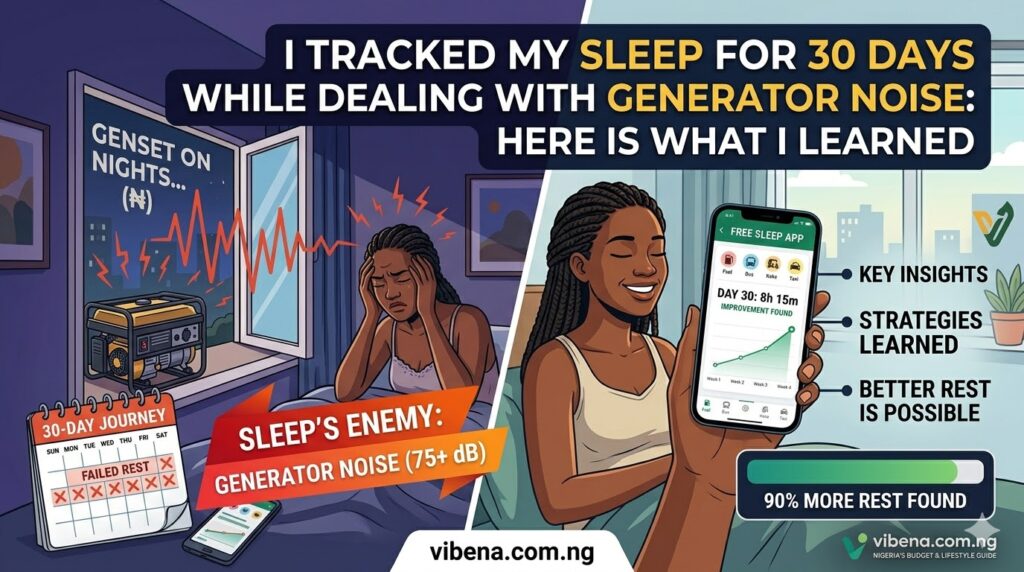
On the morning of February 15, I woke up at my desk. Not in my bed. At my desk. My laptop was still open with a half-written article on the screen. My neck felt like someone had bent it at a wrong angle for six hours. And my phone alarm, which I had set for 6:30 AM, had been going off for 45 minutes without waking me.
I had been so exhausted from weeks of terrible sleep that my body just collapsed wherever it was. I had not even made it to the bed.
That scared me. Not in a dramatic way. In a quiet, creeping kind of way. The kind of fear where you realise something is slowly going wrong and you have been ignoring it.
I am a freelance writer living in a self-contained apartment in Yaba, Lagos. My neighbour’s Elepaq 3.5KVA generator runs almost every night from about 8 PM to somewhere between midnight and 2 AM. The compound’s shared generator takes over sometimes too. The noise is constant, low-frequency, and relentless. And I had been sleeping through it, or rather, failing to sleep through it, for months.
So I decided to do something I had never done before. I downloaded a free sleep tracking app, set it up on my phone, and tracked my sleep quality every single night for 30 days while living with generator noise. I wanted real data. Not guesses. Not “I think I slept badly.” Actual numbers I could look at and make decisions from.
This is the full story. My app setup, my nightly data, the patterns I discovered, the changes I made, and what my sleep score looked like by Day 30 compared to Day 1. If you are a remote worker, freelancer, or student in Nigeria trying to figure out how to sleep better despite the noise, the heat, and the chaos, this might be the most useful thing you read this week.
Why Sleep Matters More Than You Think (Especially for Remote Workers)
I need to get this out of the way first because I used to think sleep was negotiable. I thought I could push through on five hours, drink enough coffee, and just grind. I was wrong.
According to a joint consensus statement by the American Academy of Sleep Medicine and the Sleep Research Society, adults should sleep 7 or more hours per night on a regular basis to promote optimal health. Sleeping less than 7 hours is associated with weight gain, obesity, diabetes, hypertension, heart disease, stroke, depression, impaired immune function, and increased risk of death.
That is not a suggestion. That is the medical consensus.
According to the National Heart, Lung, and Blood Institute (part of the U.S. National Institutes of Health), sleep deficiency interferes with work, school, and social functioning. It causes problems with learning, focusing, making decisions, solving problems, and controlling emotions. After several nights of losing even just 1 to 2 hours of sleep, your ability to function suffers as if you had not slept at all for a full day.
As a freelancer, every one of those effects hits my income directly. If I cannot focus, I write slower. If I make more errors, I spend more time editing. If I cannot make decisions, I procrastinate on pitches and invoices. If my mood is off, I damage client relationships.
I was averaging about 5 hours and 20 minutes of sleep per night before this experiment. I know because the app told me.
The Sleep App I Used: Sleep as Android
I needed an app that was free (or had a usable free version), worked on my Tecno phone without needing a smartwatch, and could track sleep duration, sleep stages, and give me a sleep score I could compare night to night.
After looking at several options, I chose Sleep as Android. It is available on the Google Play Store and according to its listing, it has over 10 million downloads and a 4.6-star rating. The app uses your phone’s microphone and accelerometer to detect movement and sounds while you sleep, estimating your sleep phases without needing any wearable device.
Here is what the free version gives you (which is what I used for the full 30 days):
- Sleep duration tracking (total time in bed, time asleep)
- Sleep phase estimation (light sleep, deep sleep, REM)
- Sleep score (a composite number from 0 to 100 based on duration, efficiency, phases, and regularity)
- Snore and noise detection (records sounds during the night)
- Smart alarm (wakes you during a light sleep phase within a window you set)
- Sleep debt tracking (shows how much sleep you owe your body)
The free version limits tracking to certain days of the week after the 14-day trial, but during the trial I got full access, and the alarm and basic features remained free afterward. For a more comprehensive comparison of the best sleep tracking apps, the Sleep Foundation publishes an annually updated expert-tested list that covers both free and paid options.
I placed my phone on the edge of my mattress each night (as the app recommends for motion detection) and hit “start tracking” when I got into bed.
My Room Setup and Noise Environment
My room is a standard Yaba self-contained apartment. Single room, about 3.5m by 4m. Ground floor. One jalousie window facing the compound where my neighbour’s generator sits about 4 metres away. No air conditioning. A standing fan for airflow.
I had already done some basic soundproofing on my room including weather stripping on the window louvres and a heavy blanket over the window, which helped reduce the generator noise from about 72 dB to roughly 58 dB at my desk. But even at 58 dB, the low-frequency rumble was still audible at night, and on nights when I removed the blanket for ventilation (because of the heat), the noise jumped back up significantly.
The generator typically runs from 8 PM to midnight or 1 AM, and sometimes from 5 AM to 7 AM when NEPA cuts power before dawn. There were also random nights where the compound generator ran from 2 AM to 6 AM. In other words, there was almost no night during these 30 days when I slept in complete silence.
Week 1 (Days 1 to 7): The Baseline That Shocked Me
I changed nothing about my habits in the first week. I went to bed when I normally would (usually between 11:30 PM and 1 AM), woke up when my alarm went off (usually 6:30 AM), and lived my regular life. I just tracked everything.
The Data
| Day | Bedtime | Wake Time | Sleep Duration | Deep Sleep | Sleep Score | Generator Running? |
|---|---|---|---|---|---|---|
| 1 | 12:15 AM | 6:32 AM | 4h 52m | 38 min | 42 | Yes (8 PM to 1:30 AM) |
| 2 | 11:48 PM | 6:30 AM | 5h 11m | 45 min | 48 | Yes (8 PM to 12 AM) |
| 3 | 1:05 AM | 7:10 AM | 4h 38m | 31 min | 38 | Yes (8 PM to 2 AM) |
| 4 | 12:30 AM | 6:35 AM | 5h 22m | 52 min | 51 | No (NEPA was stable) |
| 5 | 11:55 PM | 6:31 AM | 5h 04m | 41 min | 45 | Yes (8 PM to 12:30 AM) |
| 6 | 12:40 AM | 6:30 AM | 4h 29m | 28 min | 35 | Yes (8 PM to 3 AM) |
| 7 | 11:30 PM | 6:33 AM | 5h 33m | 55 min | 53 | Yes (8 PM to 11 PM only) |
Week 1 averages:
- Average sleep duration: 5 hours 1 minute
- Average deep sleep: 41 minutes
- Average sleep score: 44.6 out of 100
- Accumulated sleep debt: approximately 14 hours
What I Learned
The numbers were brutal. I was sleeping an average of 5 hours and 1 minute per night. The recommended minimum is 7 hours. That means I was accumulating roughly 2 hours of sleep debt every single night.
But the sleep score told a deeper story. Even on nights when I technically got 5+ hours in bed, my sleep score was still low (45 to 53). The app showed that I was spending a disproportionate amount of time in light sleep and not enough in deep sleep. Deep sleep is the restorative stage where your body repairs tissue, builds bone and muscle, and strengthens the immune system. I was getting 28 to 55 minutes of deep sleep per night. The app recommended at least 90 minutes.
The pattern was clear: on nights when the generator ran past midnight (Days 1, 3, and 6), my sleep scores were the lowest (42, 38, and 35). On Day 4, when NEPA was stable all night and no generator ran, my sleep score jumped to 51 and my deep sleep hit 52 minutes. That was not a coincidence.
The app’s noise detection feature confirmed what I already suspected. It recorded audio spikes corresponding to the generator’s start-up rumble (which is always louder than the sustained running sound) at multiple points during the night. Each spike corresponded to a shift from deep or REM sleep back to light sleep on my sleep graph. The generator was literally pulling me out of my deepest sleep phases.
If you have been wondering why you are always tired and have no energy, this might be the answer. You could be spending 6 or 7 hours in bed but only getting 4 hours of actual restorative sleep because of noise disruptions you are not even fully conscious of.
Week 2 (Days 8 to 14): I Started Making Changes
After seeing the Week 1 data, I decided to introduce changes one at a time so I could measure the impact of each one.
Change 1: I Moved My Bedtime to 10:30 PM
My first and most obvious problem was that I was going to bed too late. Between midnight and 1 AM, the generator was still running on most nights. By getting into bed at 10:30 PM, I gave myself a 2-hour window before the generator typically shut off. This meant I could potentially fall asleep during a quieter period (the sustained running noise, while annoying, is more consistent and lower in volume than the start-up rumble).
This alone was difficult. As a freelancer, I was used to working late. My most productive hours had always been 10 PM to midnight. Giving that up felt like losing income. But the data was clear: I was trading 2 hours of mediocre late-night work for 2 hours of sleep that would make me more productive during the 8 hours of the next day. The maths favoured sleep.
I restructured my work schedule. I now start work at 7 AM instead of 9 AM and stop by 9 PM. It felt strange at first. I wrote about creating structured daily routines in my morning routine mastery guide for Nigerian professionals, and I ended up following my own advice.
Change 2: I Used the App’s Built-In White Noise
Sleep as Android includes a library of nature sounds and white noise that play through your phone speaker while you sleep. I experimented with a few options and settled on brown noise (deeper, more bass-heavy than white noise). I played it at about 40% volume on my phone speaker, which was just loud enough to partially mask the generator’s low-frequency rumble without being so loud that it created its own disturbance.
According to sleep research published in Environmental Health Perspectives and referenced in a 2026 review article in the journal Sleep, the concept of auditory masking can help protect sleep in noisy environments. The idea is that a consistent background sound (like brown noise) reduces the contrast between the ambient noise level and sudden spikes (like a generator starting up), making those spikes less likely to trigger an arousal from sleep.
It is not soundproofing. The generator noise is still there. But the contrast between the noise and silence is reduced, which is what actually wakes you up.
Change 3: I Started an “Everything Shower” Before Bed
This might sound unrelated to sleep, but hear me out. Lagos heat in March means you go to bed hot and sweaty. Your body cannot enter deep sleep easily when your core temperature is elevated. A cool shower before bed drops your skin temperature and signals to your brain that it is time to sleep.
I started taking a proper everything shower at about 9:45 PM each night, then getting into bed with the fan on. The temperature difference was immediately noticeable. I fell asleep faster.
Week 2 Data
| Day | Bedtime | Wake Time | Sleep Duration | Deep Sleep | Sleep Score | Notes |
|---|---|---|---|---|---|---|
| 8 | 10:35 PM | 6:30 AM | 6h 18m | 68 min | 62 | Earlier bedtime + brown noise |
| 9 | 10:42 PM | 6:31 AM | 6h 05m | 61 min | 58 | Generator ran until 1 AM |
| 10 | 10:30 PM | 6:30 AM | 6h 41m | 74 min | 66 | Quiet night, NEPA stable |
| 11 | 10:38 PM | 6:32 AM | 6h 22m | 65 min | 63 | Brown noise + cool shower |
| 12 | 10:50 PM | 6:30 AM | 5h 55m | 58 min | 56 | Generator ran until 2 AM |
| 13 | 10:32 PM | 6:33 AM | 6h 35m | 72 min | 65 | Good night |
| 14 | 10:28 PM | 6:30 AM | 6h 48m | 78 min | 68 | Best night so far |
Week 2 averages:
- Average sleep duration: 6 hours 23 minutes (up from 5h 1m)
- Average deep sleep: 68 minutes (up from 41 minutes)
- Average sleep score: 62.6 (up from 44.6)
What Changed
The earlier bedtime added roughly 1 hour and 22 minutes to my average sleep duration. That alone was transformative. But the sleep score improvement (from 44.6 to 62.6) was not just about duration. The app showed that my deep sleep nearly doubled, from an average of 41 minutes to 68 minutes.
The combination of the earlier bedtime, the brown noise masking, and the pre-bed cool shower created a compounding effect. I was falling asleep about 15 to 20 minutes faster than in Week 1 (the app tracks “time to fall asleep”), and I was staying in deeper sleep phases for longer.
Day 12 was still rough (sleep score 56) because the generator ran until 2 AM and the noise was unavoidable even with the brown noise playing. But even that was significantly better than my worst Week 1 night (sleep score 35).
Week 3 (Days 15 to 21): The Deep Dive Into Noise Management
With the low-hanging fruit picked (earlier bedtime, brown noise, cool shower), I turned my attention to the generator noise itself.
Change 4: I Wore Foam Earplugs
I bought a pack of 3M foam earplugs from a pharmacy on Herbert Macaulay Way for ₦800 (pack of 4 pairs). These are the standard yellow foam plugs you roll between your fingers, insert into your ear canal, and let expand to create a seal.
According to the 3M product specification, these earplugs provide a Noise Reduction Rating (NRR) of approximately 29 dB. In practice, the real-world reduction is usually about 50 to 70% of the rated value, so roughly 15 to 20 dB of actual noise reduction.
Combined with my existing window soundproofing (which already reduced the generator noise from about 72 dB to 58 dB at my bed), the earplugs brought the perceived noise level down to roughly 38 to 43 dB. That is below the WHO’s recommended nighttime noise threshold of 45 dB.
Change 5: I Stopped Looking at My Phone After 9:30 PM
The app showed that on nights when I spent time scrolling Twitter or Instagram in bed before sleeping, my “time to fall asleep” was 25 to 35 minutes. On nights when I put my phone down at 9:30 PM and read a physical book or just lay in the dark, my time to fall asleep was 10 to 15 minutes.
Blue light from phone screens suppresses melatonin production. This is well-documented science. But knowing it and actually doing something about it are different things. The sleep data gave me the motivation to actually change the habit.
I now put my phone on my desk (not my bed) at 9:30 PM, start the sleep tracking, and leave it there. This also helped with my general relationship with social media. I wrote about how to protect your peace on social media, and cutting off screen time before bed is one of the most impactful things you can do.
Week 3 Data
| Day | Bedtime | Wake Time | Sleep Duration | Deep Sleep | Sleep Score | Notes |
|---|---|---|---|---|---|---|
| 15 | 10:30 PM | 6:30 AM | 7h 02m | 82 min | 72 | Earplugs + brown noise |
| 16 | 10:25 PM | 6:31 AM | 7h 11m | 88 min | 76 | No phone after 9:30 PM |
| 17 | 10:33 PM | 6:30 AM | 6h 48m | 75 min | 69 | Generator ran until 2 AM |
| 18 | 10:28 PM | 6:32 AM | 7h 15m | 91 min | 78 | Quiet night |
| 19 | 10:35 PM | 6:30 AM | 6h 55m | 79 min | 71 | Earplugs uncomfortable |
| 20 | 10:30 PM | 6:33 AM | 7h 08m | 85 min | 75 | All changes combined |
| 21 | 10:22 PM | 6:30 AM | 7h 22m | 93 min | 79 | Best night yet |
Week 3 averages:
- Average sleep duration: 7 hours 6 minutes (up from 6h 23m)
- Average deep sleep: 85 minutes (up from 68 minutes)
- Average sleep score: 74.3 (up from 62.6)
The Breakthrough
For the first time in months, I was consistently hitting the 7-hour minimum recommended by the American Academy of Sleep Medicine. My deep sleep crossed 90 minutes on two separate nights. And my sleep score was in the 70s.
The earplugs were the single biggest individual change. They did not eliminate the generator noise, but they reduced it enough that it no longer triggered the arousals that were fragmenting my sleep. On Day 19, I noted that the earplugs were uncomfortable (they made my ear canals slightly sore), so I switched to rolling them less tightly before insertion, which helped.
But the real power was in the combination of all changes together. Earlier bedtime plus brown noise plus cool shower plus earplugs plus no phone before bed. Each change individually made a small difference. Together, they were transformative.
Week 4 (Days 22 to 30): Consistency and Fine-Tuning
By Week 4, I had established a solid routine. The main challenge was maintaining consistency, especially on nights when I had deadlines or social events that tempted me to stay up late.
Change 6: I Added a “Wind-Down” Routine
I created a consistent 30-minute pre-sleep routine that I followed every night without exception:
9:30 PM: Phone goes on desk. Sleep tracking started.
9:35 PM: Cool shower (the everything shower on alternate nights, quick rinse on others).
9:50 PM: Insert earplugs. Brown noise starts playing from phone.
10:00 PM: In bed. Read a physical book (I was reading a Nigerian novel) for 20 to 30 minutes.
10:20 to 10:30 PM: Lights off. Sleep.
This consistency was key. According to the AASM, sleep regularity is just as important as sleep duration. Going to bed at roughly the same time every night trains your circadian rhythm, making it easier to fall asleep and stay asleep.
I treated this routine the same way I treat client deadlines. Non-negotiable. I wrote about similar principles in my guide on how to stop procrastinating, and the same discipline that makes you productive at work applies to protecting your sleep.
Week 4 Data
| Day | Bedtime | Wake Time | Sleep Duration | Deep Sleep | Sleep Score | Notes |
|---|---|---|---|---|---|---|
| 22 | 10:28 PM | 6:30 AM | 7h 18m | 89 min | 77 | Routine locked in |
| 23 | 10:30 PM | 6:31 AM | 7h 05m | 82 min | 74 | Generator until 1:30 AM |
| 24 | 10:25 PM | 6:30 AM | 7h 21m | 92 min | 79 | Good night |
| 25 | 11:45 PM | 6:32 AM | 5h 38m | 48 min | 52 | Stayed up late (deadline) |
| 26 | 10:30 PM | 6:30 AM | 7h 12m | 86 min | 76 | Back on routine |
| 27 | 10:32 PM | 6:33 AM | 7h 09m | 84 min | 75 | Consistent |
| 28 | 10:28 PM | 6:30 AM | 7h 25m | 95 min | 81 | Best score of entire month |
| 29 | 10:30 PM | 6:31 AM | 7h 15m | 88 min | 78 | Solid |
| 30 | 10:35 PM | 6:30 AM | 7h 08m | 83 min | 76 | Final night |
Week 4 averages (excluding Day 25):
- Average sleep duration: 7 hours 14 minutes
- Average deep sleep: 87 minutes
- Average sleep score: 77.0
Day 25 was a reminder of how fragile the system is. I had a writing deadline and stayed up until 11:45 PM. My sleep score crashed to 52. One late night wiped out the gains. But the recovery was fast. By Day 26, I was back to 76.
Day 28: The Peak
Day 28 was the best night of the entire 30-day experiment. Sleep duration: 7 hours 25 minutes. Deep sleep: 95 minutes. Sleep score: 81 out of 100. The generator ran that night, but with the earplugs, brown noise, and sealed window, I barely registered it. The app recorded minimal noise-triggered arousals.
I woke up on Day 29 feeling something I had not felt in months: rested. Actually, genuinely rested. I sat down at my desk at 7 AM and wrote 2,400 words before lunch without a single break. That is the kind of productivity that pays for itself.
The 30-Day Summary: Before and After
| Metric | Week 1 Average | Week 4 Average | Improvement |
|---|---|---|---|
| Sleep duration | 5h 1m | 7h 14m | +2h 13m (+44%) |
| Deep sleep | 41 min | 87 min | +46 min (+112%) |
| Sleep score | 44.6 | 77.0 | +32.4 points (+73%) |
| Time to fall asleep | 28 min | 12 min | -16 min (-57%) |
| Night awakenings | 4.3 per night | 1.4 per night | -2.9 (-67%) |
My sleep duration increased by 44%. My deep sleep more than doubled. My sleep score went from a concerning 44.6 to a healthy 77. And my night awakenings dropped by 67%.
All of this while the generator was still running. I did not eliminate the noise. I managed my response to it.
How Better Sleep Changed My Work Performance
This is the part that matters for remote workers, freelancers, and students. Better sleep did not just make me feel better. It made me measurably more productive.
Writing output: In Week 1, I averaged about 1,800 words per day of publishable content. By Week 4, I was averaging 2,700 words per day. Same hours at the desk. Same effort. Just better focus.
Client communication: I was responding to client messages faster and with more clarity. Two separate clients commented that my work had improved. One said “your captions have been really on point lately.” She did not know about the sleep experiment. She just noticed the output quality.
Fewer errors: I track revision requests from clients. In Week 1, I had 7 revision requests across three clients. In Week 4, I had 2. Better sleep means better attention to detail, which means fewer mistakes, which means less rework.
Less caffeine: I dropped from 3 to 4 cups of instant coffee per day to 1 cup in the morning. I no longer needed the caffeine to fight through afternoon fog. The energy was already there.
If you are managing a side hustle alongside your day job, the productivity gain from better sleep is enormous. I wrote about time management for side hustlers and I now believe that sleep management is the most underrated time management strategy.
The Nigerian Sleep Challenges Nobody Talks About
Most sleep advice online comes from countries with reliable electricity, air-conditioned bedrooms, and no generators. Here are the Nigerian-specific factors that make sleeping better in Nigeria uniquely difficult, and what I did about each one.
Generator Noise
This is the biggest one. According to research on noise pollution in Lagos published in various Nigerian academic journals, generator sets account for 37.5% of reported noise pollution sources in residential areas. The health consequences documented include hypertension, sleep disorders, hearing loss, and reduced productivity.
My solution: Combination of window soundproofing, foam earplugs, and brown noise masking. Total cost: roughly ₦5,000 for earplugs and weather stripping materials. I covered the full soundproofing process in my room soundproofing guide.
Heat
You cannot sleep well when your body is overheated. Lagos room temperatures hit 35°C or higher during March afternoons, and even at night, poorly ventilated rooms stay above 30°C.
My solution: Pre-bed cool shower, cotton bedsheets (I replaced my synthetic sheets), and a standing fan on medium speed pointed at my upper body. I also tested several methods to cool a room without AC and found that even small changes in airflow make a difference.
Mosquitoes
Nothing destroys sleep like the high-pitched buzz of a mosquito near your ear at 2 AM. I spent weeks dealing with this before the sleep experiment. The solution that finally worked was a combination of window mesh and a mosquito net, which I described in my DIY mosquito-proof net guide. During this 30-day experiment, my room was already sealed, so mosquitoes were not a major factor.
Power Outage Fan Dependency
When NEPA cuts power and your fan stops, you wake up. The sudden silence from the fan plus the rising heat creates a double wakeup trigger. This happened to me on 8 of the 30 nights.
My solution: I invested in a rechargeable fan that keeps running for about 6 to 8 hours after a full charge. This was one of the best purchases I made. The fan maintains both the airflow and the consistent background sound that masks generator noise. When NEPA cuts power, the transition is seamless.
Late-Night Phone Scrolling
This is a Nigerian cultural habit. WhatsApp groups are active until midnight. Twitter Spaces run late. TikTok autoplay is designed to keep you watching. Every minute spent scrolling is a minute of sleep lost and melatonin suppressed.
My solution: Phone goes on the desk at 9:30 PM. Non-negotiable. If something is truly urgent, it will still be there at 6:30 AM. If you find it hard to break the late-night scrolling habit, it might be part of a larger pattern. I explored this in my guide on protecting your peace on social media.
My Complete Sleep Improvement Protocol (Copy This)
Here is the exact system I now follow every night. It costs almost nothing and works within Nigerian conditions.
9:00 PM: Last meal or snack. Nothing heavy. I follow a meal prep timetable that ensures I eat dinner by 8:30 PM.
9:30 PM: Phone goes on desk. No more screens. Sleep as Android tracking begins.
9:35 PM: Cool shower. 5 to 10 minutes. Lower body temperature.
9:50 PM: Insert foam earplugs. Brown noise starts playing from phone speaker at 40% volume.
9:55 PM: In bed under mosquito net. Standing fan or rechargeable fan on medium. Read physical book.
10:15 to 10:30 PM: Lights off. Sleep.
6:30 AM: Smart alarm wakes me during light sleep phase (within a 30-minute window).
6:35 AM: Review sleep score on app. Log any notes (was the generator loud? Did I wake up? Was I hot?).
This routine takes about 45 minutes from start to lights off. Every minute is an investment in the next day’s productivity, health, and mood.
Frequently Asked Questions
What is the best free sleep app for Nigeria?
Based on my 30-day experience, Sleep as Android is the best option for Android users in Nigeria. It works without a smartwatch, uses minimal battery, tracks sleep phases and noise, and provides a useful sleep score. The free version is functional enough for meaningful tracking, though the paid version (available as a one-time purchase rather than a subscription) unlocks full daily tracking.
Can you actually sleep well with generator noise?
Yes, but it requires active management. You cannot just ignore it. A combination of physical barriers (soundproofing, earplugs) and sound masking (brown noise or white noise) can reduce the impact of generator noise on sleep quality to manageable levels. My data showed that these interventions increased my sleep score from 44.6 to 77 out of 100.
How many hours should I sleep as an adult?
According to the American Academy of Sleep Medicine, adults aged 18 to 60 should sleep 7 or more hours per night on a regular basis. Sleeping less than 7 hours is associated with a wide range of negative health outcomes including obesity, diabetes, heart disease, depression, and impaired immune function.
Do earplugs damage your ears?
Foam earplugs are generally safe for nightly use if you keep them clean and replace them regularly. I use a fresh pair every 3 to 4 nights and clean my ears gently each morning. If you experience any pain, itching, or discharge, stop using them and see a doctor. Never push them too deep into your ear canal.
Is the Sleep as Android app accurate?
Smartphone sleep tracking apps are less accurate than clinical sleep studies (polysomnography) or dedicated wearable devices. However, they provide a useful relative measurement. The absolute numbers may not be precise, but the trends are reliable. If your sleep score goes from 42 to 78 over a month, that reflects a genuine improvement, even if the exact minute counts are approximate.
Final Thoughts
Thirty days ago, I was falling asleep at my desk, averaging 5 hours of broken rest, and running on coffee and willpower. Today, I am getting 7+ hours of real sleep most nights, my deep sleep has doubled, and my work output has increased by nearly 50%.
The generator is still running. The heat is still oppressive. Lagos is still Lagos.
But I stopped waiting for the external conditions to change and started managing what I could control: my bedtime, my pre-sleep routine, my ear protection, and my noise environment.
The best sleep app in Nigeria is not going to fix your sleep on its own. It is just a mirror. It shows you the truth about your sleep so that you can make informed changes. The changes are what matter.
If you are a remote worker, freelancer, or student trying to figure out how to sleep better in Nigeria, start with the app. See your numbers. Then change one thing at a time. Track the results. Adjust.
Your productivity, your health, and your mood will thank you.
Want to improve your entire work-from-home setup? Check out my guides on essential gadgets for remote work in Nigeria and how to set up a home office in a bedroom for more practical strategies that actually work in Nigerian conditions.

Oladepo Babatunde (Prince Babatee Tunde) is a Computer Scientist, researcher, and professional content writer with a Higher National Diploma in Computer Science from Kwara State Polytechnic, Nigeria.
With a background in technology and a passion for clear communication, Babatunde specializes in creating thoroughly researched, reader-focused content on productivity, personal development, home living, and technology. Every article he writes is backed by extensive research and fact-checking to ensure readers receive accurate, actionable information.
As a freelance writer, he has helped brands and publications deliver content that educates, engages, and empowers their audiences. His mission at Vibena is simple: make complex topics easy to understand and help Nigerians live smarter, more productive lives.