You have made up your mind. You are done with unreliable internet. You are tired of video calls freezing in the middle of client meetings, tired of buffering while trying to submit work, tired of mobile data that eats through your airtime and still underdelivers. Starlink is the answer, and you know it. This guide explains starlink Mini vs Standard in simple, practical terms.
But then you hit the page and see two options. Starlink Mini. Starlink Standard. Two different price tags. Two different dishes. And suddenly a decision that felt simple a moment ago becomes genuinely confusing.
You start searching. Most articles you find are written for people in the United States or the United Kingdom. They talk about setup in a suburban backyard or RV. None of them talk about what it is like to set up satellite internet in a Lagos mini flat with a shared roof, erratic NEPA supply, and a budget that has real limits. None of them ask the questions you are actually asking.
This article does. This is a complete, honest comparison of the Starlink Mini versus the Standard Kit specifically for Nigerians in 2026, written with the realities of Nigerian living firmly in mind.
What You Are Actually Comparing: Two Products With Different Jobs
The single most important thing to understand before comparing prices or speeds is that the Starlink Mini and the Standard Kit are not simply different sizes of the same product. They were designed for fundamentally different use cases, and buying the wrong one for your situation will leave you frustrated regardless of which is cheaper.
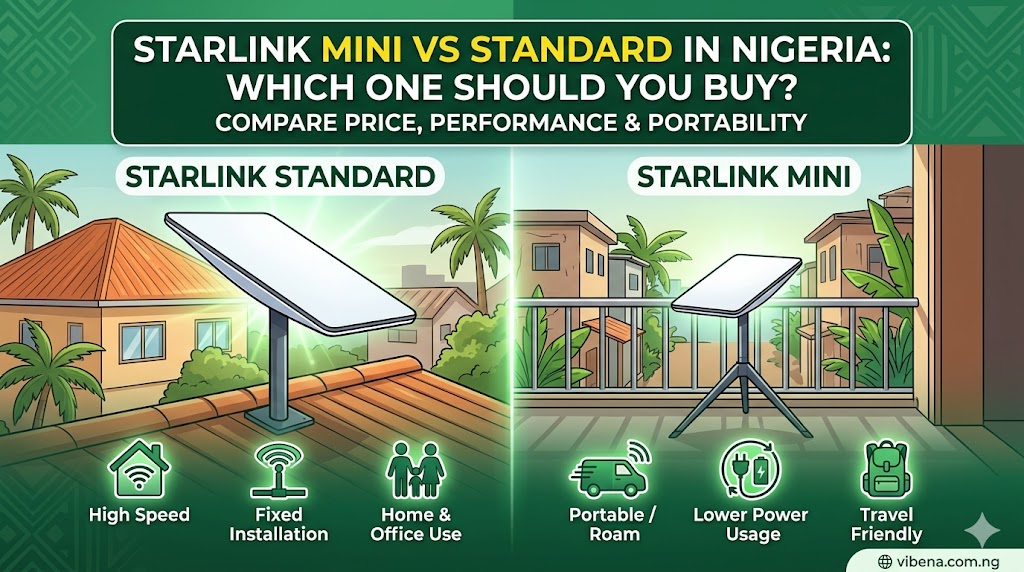
The Starlink Mini was built for portability and personal use. It is compact enough to fit in a laptop bag, weighs approximately 1.1 kilograms, and draws as little as 25 watts during normal operation. It has an integrated WiFi 5 router, which means the dish and router are one combined unit. SpaceX designed it primarily for travelers, remote workers on the move, and people who need reliable internet in locations where traditional broadband does not reach.
The Standard Kit, also called the Starlink Gen 3 dish, was built for fixed household and business use. It is larger, heavier at approximately 2.8 kilograms, draws 75 to 100 watts, and includes a separate WiFi 6 router that sits inside your home while the dish mounts outside. It was designed to serve multiple users simultaneously, support whole-home coverage, and handle the kind of consistent heavy usage that a household or small office produces day after day.
When you see the Mini priced lower, it is not because it is a stripped-down version of the Standard Kit. It is because it is a genuinely different product with a different purpose. The price reflects the hardware capability, not just the size.
Understanding this distinction is what prevents the most common and most expensive mistake Nigerian buyers make: choosing the cheaper option without knowing whether it actually fits their situation.
Price Difference in 2026: What Each One Costs in Nigeria
Let’s put the numbers side by side clearly.
As of May 2026, purchasing directly from the official Starlink Nigeria website:
- Starlink Mini Kit: ₦318,000 (one-time hardware cost)
- Starlink Standard Kit: ₦590,000 (one-time hardware cost)
- Residential Plan (both kits): ₦57,000 per month
- Roam Plan (both kits): ₦38,000 per month
The hardware price difference between the two is ₦272,000. That is a significant gap. But since both kits use the same subscription plans, the monthly cost going forward is identical regardless of which hardware you choose.
Over a full year of using the Residential Plan, the Mini saves you ₦272,000 in year one but costs the same as the Standard Kit from year two onward. Over two years, a Mini buyer pays approximately ₦1,686,000 in total. A Standard Kit buyer pays approximately ₦1,958,000. The Mini saves you ₦272,000 over two years purely from the hardware difference. That saving diminishes in importance the longer you use either kit, but it matters enormously as an entry barrier for many Nigerian buyers.
For a deeper look at total first-year costs, hidden fees, and reseller pricing warnings, the detailed Starlink Mini price in Nigeria guide covers every cost component you need to budget for before buying.
Always purchase directly from the official website. Resellers in Computer Village, Jiji, and WhatsApp groups consistently charge ₦30,000 to ₦100,000 above the official hardware price for both kits. You receive full warranty and return policy protection only when buying directly from Starlink.
Speed and Performance: What to Expect From Each Kit in Nigeria
Speed is where many comparison articles mislead you by quoting international lab results that do not reflect what Nigerian users actually experience on the ground. Here is a realistic breakdown.
The Starlink Standard Kit in Nigeria delivers typical download speeds between 100 and 250 Mbps during off-peak hours, with upload speeds of 10 to 30 Mbps and latency averaging 25 to 50 milliseconds. During peak hours, particularly evenings between 7pm and 10pm when satellite network usage is highest, speeds can drop to 40 to 80 Mbps. This is still significantly faster than most mobile data and fixed broadband alternatives available in Nigeria right now.
The Starlink Mini delivers typical download speeds between 50 and 150 Mbps, with upload speeds of 5 to 20 Mbps and similar latency characteristics. The Mini performs closest to its maximum capability when used for personal or small group usage with one to three devices. When multiple heavy users push the Mini’s capacity simultaneously, speeds become noticeably more variable.
For a full documented test of the Mini’s actual speeds, upload performance, and latency under real-world Nigerian network conditions, the Starlink Mini Nigeria latency test and performance benchmarks article provides timed real-world results rather than theoretical figures.
For practical purposes: if you are a remote worker using one laptop, a video call, and a few background browser tabs, the Mini handles this comfortably. If you have a household where multiple people are streaming, downloading, gaming, or on calls at the same time, the Standard Kit is the better investment.
Power Consumption: The Factor That Matters Most in Nigeria
This is the comparison point that most international articles barely mention but Nigerian users absolutely need to understand. Power in Nigeria is not a guaranteed commodity. NEPA goes, it comes back, it goes again. If your Starlink cannot stay online during outages, you are paying ₦57,000 a month for an internet connection that only works when PHCN cooperates.
The power difference between these two kits is dramatic in the Nigerian context.
The Starlink Mini draws between 25 and 40 watts during normal operation. The Standard Kit draws between 75 and 100 watts, with brief peaks of up to 120 watts during startup. That means the Standard Kit uses roughly three times more power than the Mini at any given moment.
Why does this matter? Because your power backup solution scales directly with how much power your internet connection consumes.
A standard 100Ah 12V inverter battery storing around 1,200 watt-hours of usable power can keep a Starlink Mini running for approximately 25 to 40 hours under normal usage. The same battery keeps a Standard Kit running for approximately 10 to 14 hours. The difference is not a rounding error. It is the difference between your internet staying online through a full day of NEPA outage versus running out before your afternoon meetings.
For Nigerian homes already running a modest inverter or solar system, the Mini often integrates seamlessly with existing infrastructure. The Standard Kit may require upgrading your battery bank or solar capacity to maintain the same backup duration.
The solar inverter setup guide for Nigerian flats and the article on setting up a small solar system for under ₦150,000 are both worth reading before you finalize your Starlink decision, because your power setup will determine how reliable your internet actually is in daily use.
If you already use a portable solar generator, the Mini’s low wattage makes it one of the most compatible internet solutions available. The breakdown of portable solar generators in Nigeria covers options that pair well with the Mini specifically.
Physical Setup: Where Each Kit Can and Cannot Go
Setup logistics matter differently in Nigeria than in other countries. Many Nigerians live in apartments, shared compounds, and high-rise buildings where mounting a satellite dish requires permission, cooperation from other tenants, or creative problem-solving about roof access. Understanding the physical requirements of each kit before you buy prevents installation headaches.
Starlink Mini setup options:
The Mini includes a kickstand and is designed to sit on a flat surface with a clear view of the sky. You can place it on a balcony, a flat rooftop, a windowsill, or even a tabletop outdoors. It does not require drilling, wall brackets, or landlord permission in most cases. This makes it especially suitable for renters in Lagos, Abuja, and Port Harcourt who cannot make permanent modifications to their apartments. The dish can be moved whenever you relocate without any installation cost or complexity.
Starlink Standard Kit setup options:
The Standard Kit is designed for permanent or semi-permanent outdoor mounting. It comes with a mounting pole and is typically installed on a rooftop, exterior wall, or dedicated mast. While this gives you a cleaner and more stable installation, it requires more effort, potential landlord approval, and cable routing from the dish outside down to the router inside. In a compound house or serviced apartment, coordinating this with property management adds time and potential friction.
The Mini’s flexibility is particularly valuable in Nigeria’s rental market where many professionals move between apartments frequently. If you are the kind of person who has changed apartments twice in the last three years, the Mini’s portability protects your Starlink investment in a way that a permanently mounted Standard Kit cannot.
WiFi Coverage: Where the Standard Kit Pulls Ahead Clearly
This is the area where the Standard Kit has a clear, undisputed advantage over the Mini, and it matters enormously for households rather than individuals.
The Mini’s integrated WiFi 5 router is designed to serve a small coverage area. Think of one room or a studio apartment comfortably. In a two-bedroom flat with thick walls, concrete construction, or multiple floors, the Mini’s WiFi signal will weaken noticeably beyond its primary room. You can solve this by adding a separate wireless access point or mesh router, but this adds cost and complexity.
The Standard Kit’s WiFi 6 router delivers faster wireless speeds, handles more simultaneous device connections without degradation, and provides better coverage across a larger living space. WiFi 6 is also more efficient at managing multiple devices, which matters in a home where laptops, phones, smart TVs, tablets, and smart home devices are all connected at the same time.
For context: a household of four people, each with a smartphone and a laptop, plus a smart TV running Netflix, is already putting nine to ten simultaneous connections on the network. The Mini will handle this but will show performance variability during peak household usage. The Standard Kit handles this comfortably as its baseline.
If you live alone or with one other person in a small apartment and primarily use internet for work, the Mini’s WiFi coverage is sufficient. If you have children, multiple adults, or a small home office with shared internet access, the Standard Kit’s superior WiFi capability justifies the premium.
Who the Starlink Mini Is Actually Built For in Nigeria
The Mini makes the most sense for a specific type of Nigerian user, and if you recognize yourself in this description, it is almost certainly the right choice for you.
Remote workers and freelancers who work from home alone or with one colleague benefit significantly from the Mini. The combination of sufficient speeds for video calls, uploads, and cloud work, lower power consumption that pairs with existing inverter setups, and the portability to carry it to a client site, another city, or a coworking space makes the Mini a genuinely practical productivity tool. If your income depends on reliable internet and you work primarily as an individual, this is your kit.
Nigerians who travel regularly between cities but need consistent broadband wherever they are find the Mini transformative. Carrying a full broadband connection in a bag that moves with you from Lagos to Abuja to Enugu to Port Harcourt without needing to set up new internet at each location changes how you can live and work.
First-time Starlink buyers who want to test the service before committing to the full Standard Kit investment can start with the Mini and upgrade later. The subscription is the same, and the experience of satellite internet versus mobile data is immediately apparent from day one even on the smaller hardware.
Budget-conscious buyers for whom the ₦272,000 hardware difference is the deciding factor between buying now and waiting find the Mini a genuinely sensible entry point. The performance difference between the two kits is real but for solo users it is not transformative. You get satellite broadband at a meaningfully lower entry cost.
Who the Starlink Standard Kit Is Actually Built For in Nigeria
The Standard Kit makes the most sense for a different profile entirely, and the use case is equally specific.
Households with three or more regular internet users consistently doing data-intensive activities need the Standard Kit’s superior WiFi performance and higher sustained speeds. A family where two people are on work video calls, one child is streaming YouTube Kids, and another is downloading homework resources is asking more of a network than the Mini is designed to deliver reliably. The Standard Kit handles this household load comfortably.
Small businesses, home offices serving multiple clients, and content creators who regularly upload large video files or stream at high quality benefit from the Standard Kit’s maximum speed ceiling and stronger WiFi infrastructure. The ₦272,000 premium is a justifiable business cost when it directly affects your output quality and delivery speed.
People in locations where mobile data is particularly unreliable, such as some areas in the FCT outskirts, remote locations in Plateau, Benue, or Cross River states, and newer residential developments in Ogun and Lagos states that are still awaiting fiber infrastructure, benefit more from the Standard Kit’s maximum capability because it will serve as their primary and only broadband connection for everything the household does.
Property owners rather than renters who can mount the dish permanently and are not concerned about portability or relocation find the Standard Kit’s installation more fitting for their situation.
The Nigerian Apartment Reality: Compound Houses, Shared Roofs, and Estate Rules
This section deserves its own space because it is a uniquely Nigerian consideration that directly affects which kit is feasible for you.
In a serviced apartment or gated estate with a residents’ association, installing a satellite dish on the roof often requires written approval. Some estates in Lekki, Ajah, Maitama, and Jabi have strict appearance and roof access rules that complicate Standard Kit installations. The Mini, placed discreetly on a balcony or terrace, typically falls under the radar of these restrictions.
In face-me-I-face-you compounds and traditional Lagos apartment blocks where the roof is shared among multiple tenants, gaining access and maintaining a permanently mounted dish can become a source of conflict. The Mini sidesteps this entirely.
For those who have recently moved into a new apartment or are about to, the guide on hidden costs of Lagos apartment hunting covers the kind of installation and infrastructure costs that affect total housing budgets, including considerations that affect your technology setup.
Rain, Harmattan, and Weather: How Each Kit Handles Nigerian Conditions
Starlink markets both kits as weatherproof and capable of operating through rain and dust. Both dishes are rated IP54, meaning they are protected against dust ingress and water splashing from any direction. In practice, both kits will show some speed reduction during heavy Nigerian rain, but they remain connected in moderate rainfall.
The Starlink Mini’s smaller form factor means it is slightly more susceptible to signal obstruction from rainfall compared to the Standard Kit’s larger dish aperture. During particularly heavy downpours of the Lagos rainy season, the Mini may show more noticeable speed reduction than the Standard Kit. This difference is real but typically temporary, lasting only as long as heavy rainfall continues.
During harmattan, both kits can accumulate dust on the dish surface which reduces signal quality over time. Periodic wiping of the dish face is recommended for both, and this is easier to do safely with the Mini given its lower placement and lighter weight. If harmattan dust is a concern in your specific location, you might also find the guide on how to reduce dust in your house during harmattan useful for managing your overall home environment during that season.
For specific issues related to Starlink disconnecting during rain in Nigeria, the dedicated guide on Starlink disconnecting in rain in Nigeria covers diagnosis and fixes in detail. If you encounter obstruction errors during setup, the Starlink obstruction error guide for Nigeria is equally worth bookmarking.
The Subscription Plan Question: Residential vs Roam for Each Kit
Both kits can use any Starlink subscription plan, but the plan you choose matters as much as the hardware in determining your actual internet experience.
The Residential Plan at ₦57,000 per month gives you the best network priority and the most consistent speeds. It is tied to one service address, meaning Starlink’s system expects you to use it primarily at the location you registered. Using a residential plan far outside your registered address for extended periods can result in plan restrictions.
The Roam Plan at ₦38,000 per month gives you location flexibility across Nigeria and beyond, which makes it natural pairing with the Mini’s portable design. However, the Roam Plan receives lower network priority than the Residential Plan, meaning during peak satellite usage hours your speeds are deprioritized behind residential subscribers. If maximum speed and consistency are your priority, the Residential Plan is always the better performing option.
The Business Plan at ₦159,000 per month is primarily relevant to Standard Kit buyers setting up a commercial location, as the higher cost is only justifiable when multiple employees or customers depend on the connection for business operations.
One important point about plan switching: you can change between plans through the Starlink app at any time, but changes take effect at the start of the next billing cycle. This gives you flexibility to start on Roam and switch to Residential once your address is confirmed and capacity becomes available in your area.
Side-by-Side Comparison: Every Factor That Matters for Nigerian Buyers
| Feature | Starlink Mini | Starlink Standard |
|---|---|---|
| Hardware price (official 2026) | ₦318,000 | ₦590,000 |
| Monthly subscription | ₦57,000 (same) | ₦57,000 (same) |
| Year one total (Residential) | ~₦1,002,000 | ~₦1,274,000 |
| Dish size | Compact, backpack-sized | Full-size, requires fixed mount |
| Weight | ~1.1 kg | ~2.8 kg |
| Power consumption | 25 to 40 watts | 75 to 100 watts |
| Typical download speed (Nigeria) | 50 to 150 Mbps | 100 to 250 Mbps |
| WiFi standard | WiFi 5 (integrated) | WiFi 6 (separate router) |
| WiFi coverage | Small apartment / one room | Whole home / multi-room |
| Ethernet port | USB-C adapter required | Built-in on router |
| Mounting | Kickstand / portable | Permanent outdoor mount |
| Best for renters | Yes | Requires landlord approval |
| Best for frequent movers | Yes | No |
| Best for multiple users | 1 to 3 | 3 to 10+ |
| Power backup compatibility | Excellent (low draw) | Requires larger battery bank |
Making the Final Decision: A Simple Framework for Nigerian Buyers
After all the technical comparison, the right choice comes down to four honest questions about your own situation.
How many people use your internet connection simultaneously? If the answer is one to two people, the Mini is sufficient. If the answer is three or more people doing different intensive activities at the same time, choose the Standard Kit.
Do you move between locations or are you settled in one apartment? If you move often or want the option to take your internet with you, the Mini is clearly the better fit. If you are settled and your connection will stay in one place permanently, the Standard Kit serves you better long-term.
What is your power backup situation? If you have a modest inverter battery or solar setup that is already working well, the Mini integrates cleanly. If you are willing to invest in a more capable power backup that handles the Standard Kit’s higher draw, then that extra investment unlocks the full capability of the larger kit.
Is the ₦272,000 hardware difference genuinely meaningful to your budget right now? If yes, start with the Mini. It delivers real satellite broadband at a lower entry cost, and you can always upgrade later. If the price difference is manageable for your current financial position and your household genuinely needs the Standard Kit’s performance, paying more upfront avoids the frustration of upgrading in six months.
For remote workers and digital professionals building a full home office setup, the complete guide on essential gadgets for remote work in Nigeria helps you think about how your internet investment fits into the broader technology ecosystem of a productive workspace.
What About Amazon Kuiper and Other Alternatives?
Starlink is not the only satellite internet option available or approaching availability in Nigeria. Amazon Kuiper is currently in active testing and is expected to launch commercially in Nigeria within the next twelve to eighteen months. The broader comparison of Amazon Kuiper versus Starlink in Nigeria is worth reading if you are considering whether to wait for Kuiper or invest in Starlink now.
For urban Nigerians already served by fiber, the honest comparison of Starlink versus fiber in Nigeria may reveal that a fiber plan from a local ISP is still the more cost-effective choice depending on your specific neighborhood and usage requirements. Starlink is not automatically the best internet option for every Nigerian. It is the best option for specific situations, and knowing whether yours qualifies is part of making a smart buying decision.
Final Verdict: Mini or Standard?
Here is the direct answer.
Buy the Starlink Mini if you are a remote worker, freelancer, or digital professional who works primarily alone or with one other person, you rent rather than own your home, you move between locations, you have modest power backup infrastructure, or the ₦272,000 hardware saving is genuinely significant to your current budget. The Mini gives you real, high-quality satellite broadband in a form that fits how most urban Nigerians in 2026 actually live and work.
Buy the Starlink Standard Kit if you have a household of three or more active internet users, your work requires maximum speeds and whole-home coverage, you own your property or have full permission to install, you have the power backup infrastructure to support it, and the higher hardware cost is within your budget. The Standard Kit rewards you with better performance, stronger WiFi, and the infrastructure to serve a full household without compromise.
Both kits use the same satellite network. Both deliver an internet experience that surpasses what most Nigerian mobile data or home ISP connections offer. The choice between them is about matching the right tool to your specific situation, not about which one is universally better.
Buy from the official Starlink website. Verify current pricing before purchasing. Budget your power backup requirements before setup. And once it is running, you will understand very quickly why Nigerians who have made the switch rarely go back.
Frequently Asked Questions
Is the Starlink Mini faster than the Standard Kit in Nigeria?
No. The Standard Kit delivers higher maximum speeds, typically 100 to 250 Mbps, compared to the Mini’s 50 to 150 Mbps. For solo or two-person use, the Mini’s speeds are sufficient. For households with heavy simultaneous usage, the Standard Kit performs better.
Can I use the Starlink Mini subscription on the Standard Kit?
Yes. Both kits use the same subscription plans. There is no Mini-specific or Standard-specific subscription. Your monthly cost is the same regardless of which hardware you choose.
Which kit is better for remote work in Nigeria?
The Mini is generally better for individual remote workers because of its lower power consumption, portability, and sufficient speeds for video calls, uploads, and cloud work. The Standard Kit is better for a home office shared by multiple people.
Does the Starlink Mini work during NEPA outages in Nigeria?
Both kits stop working during power outages without a backup power source. The Mini draws 25 to 40 watts, making it much easier and cheaper to power with an inverter or solar battery during outages than the Standard Kit’s 75 to 100 watts.
Can I travel with the Starlink Mini from Lagos to Abuja and use it there?
Yes, with the Roam Plan. The Roam Plan allows you to use your Starlink anywhere across Nigeria and in other Starlink-active countries. If you are on the Residential Plan, extended use far outside your registered address may trigger plan restrictions.
Is the Starlink Mini good for a family of four in Nigeria?
It depends on usage. For light to moderate use across four people, the Mini can work. For a family where multiple people stream video, attend online classes, and work simultaneously, the Standard Kit is the more appropriate choice for consistent performance.
Where should I buy Starlink in Nigeria to get the official price?
Always buy directly from starlink.com/ng to get the official price and full warranty protection. Resellers in physical markets and on third-party platforms typically charge ₦30,000 to ₦100,000 above the official price.
Starlink Mini vs Standard: Quick Recap
That is the full picture on starlink Mini vs Standard. Save this guide, share it with someone who needs it, and check back, because we update our Nigerian guides when things change.

Oladepo Babatunde (Prince Babatee Tunde) is a Computer Scientist, researcher, and professional content writer with a Higher National Diploma in Computer Science from Kwara State Polytechnic, Nigeria.
With a background in technology and a passion for clear communication, Babatunde specializes in creating thoroughly researched, reader-focused content on productivity, personal development, home living, and technology. Every article he writes is backed by extensive research and fact-checking to ensure readers receive accurate, actionable information.
As a freelance writer, he has helped brands and publications deliver content that educates, engages, and empowers their audiences. His mission at Vibena is simple: make complex topics easy to understand and help Nigerians live smarter, more productive lives.