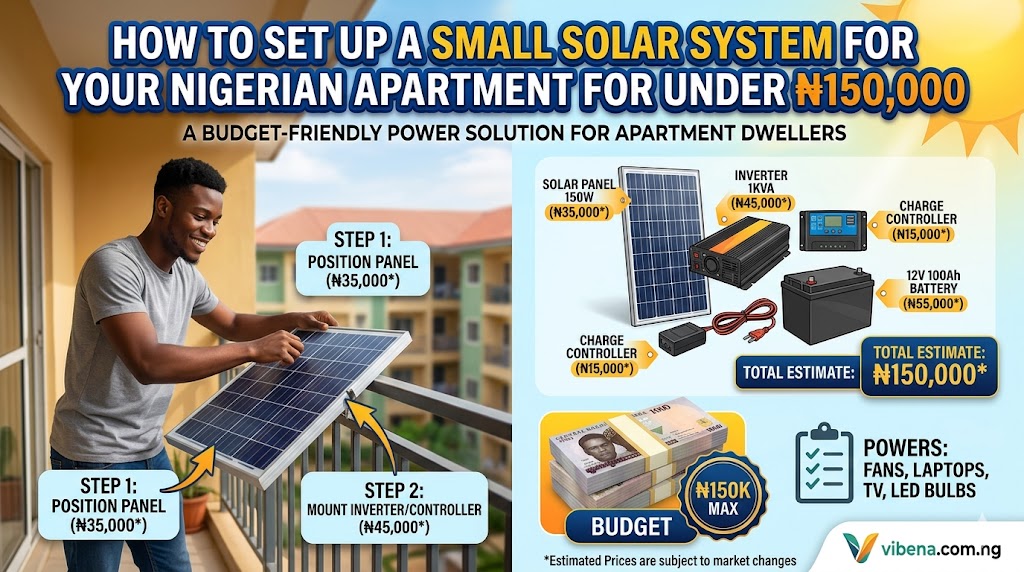
I have installed over 200 small solar systems across Lagos, Abuja, and Port Harcourt apartments. And one thing I can tell you from experience is this: you do not need ₦500,000 or ₦1 million to start enjoying solar power in Nigeria.
If you are a student, remote worker, or content creator living in a self-contain or mini flat, a small solar setup for your apartment in Nigeria can keep your phone charged, your laptop running, and your rechargeable fan spinning through those long NEPA blackouts.
This is a complete solar panel beginner guide for Nigeria that walks you through exactly what to buy, how to connect everything, and how to avoid the mistakes I see people make every single week.
Why a Small Solar System Makes Sense for Nigerian Apartments Right Now
Fuel prices crossed ₦1,200 per litre in early 2026. Running a generator for even 4 hours daily now costs over ₦30,000 monthly. That is money most students and young professionals simply do not have.
Meanwhile, electricity supply from DisCos remains unreliable across most bands. If you are on Band B or Band C, you are likely getting between 8 and 16 hours of power daily, and sometimes far less.
A cheap solar panel setup solves a specific problem: keeping your essential devices alive without fuel costs, generator noise, or dependence on grid power.
This is not about powering your entire apartment. This is about building a small, portable solar system that handles your most critical needs.
What a ₦150,000 Solar Budget Can Actually Power
Let me be honest with you. A budget of ₦150,000 will not run your air conditioner, pressing iron, or electric cooker. Those appliances pull between 1,000W and 2,500W, which requires a system costing ₦500,000 or more.
But here is what a small solar setup in this price range can comfortably power:
- 1 laptop (45W to 65W) for 4 to 6 hours
- 2 phones charging simultaneously
- 1 rechargeable fan (if charged during solar hours)
- 2 to 3 LED bulbs (7W to 9W each)
- 1 Wi-Fi router (12W to 18W)
- 1 small LED TV (24-inch, about 30W) for 2 to 3 hours
This covers what most remote workers, students, and content creators actually need during a blackout.
The Exact Components You Need (With Current Nigeria Market Prices)
I am breaking this down into the four core components every beginner needs to understand. These prices reflect what you will find at Computer Village in Ikeja, Arena Market in Oshodi, and verified online stores as of April 2026.
Solar Panel
For a small apartment system, a 100W monocrystalline solar panel is the sweet spot. Monocrystalline panels are more efficient than polycrystalline in the same physical size, which matters when your balcony or window space is limited.
Price range: ₦25,000 to ₦38,000
Look for panels from brands like Felicity Solar, Rubitec, or Rosen. Avoid no-name panels from roadside sellers that claim 200W but actually deliver 80W.
Solar Charge Controller
The charge controller sits between your solar panel and battery. It regulates the voltage coming from the panel to prevent overcharging, which according to information from manufacturers like Luminous and Felicity Solar, is one of the leading causes of early battery death in Nigeria.
You have two options:
PWM (Pulse Width Modulation): Cheaper, works fine for small systems. A 20A PWM controller costs between ₦5,000 and ₦8,000.
MPPT (Maximum Power Point Tracking): More efficient, extracts up to 30% more power from your panels in cloudy conditions. However, a decent MPPT controller starts at ₦25,000, which eats heavily into a ₦150,000 budget.
My recommendation for beginners: Go with a 20A PWM charge controller for now. At this system size, the efficiency difference is marginal.
Price: ₦5,000 to ₦8,000
Inverter Battery
The battery stores the energy your solar panel collects during the day. For a budget apartment setup, you have two practical choices:
12V 100Ah Deep Cycle Lead-Acid Battery: This is the most common option in Nigeria. Brands like Mercury, Genus, and Starplus offer reliable options. Deep cycle batteries are specifically designed for repeated charging and discharging, unlike car batteries which deliver short bursts of high current.
Price range: ₦55,000 to ₦85,000
12V 50Ah Lithium Iron Phosphate (LiFePO4) Battery: Lighter, lasts 3 to 5 times longer than lead-acid, and can safely discharge up to 90% of total capacity without damage. However, a genuine 50Ah LiFePO4 battery costs ₦80,000 to ₦120,000 in Nigeria right now.
My recommendation: For a ₦150,000 budget, a 12V 100Ah deep cycle lead-acid battery (tubular or AGM type) gives you the best capacity for money.
Price: ₦60,000 to ₦75,000
Inverter
The inverter converts the 12V DC power stored in your battery into the 220V AC power your appliances use. For a small apartment system, a 600W to 1,000W pure sine wave inverter handles all the devices listed above.
Do not buy a modified sine wave inverter for a setup that will power a laptop. Modified sine wave inverters produce a rough electrical output that can damage sensitive electronics over time. Pure sine wave inverters produce clean power identical to what comes from the grid.
Brands to consider: Mercury, SU-KAM, Luminous, Felicity Solar.
Price range: ₦20,000 to ₦35,000 (for 600W to 1kVA pure sine wave)
Wiring and Accessories
You will also need:
- 4mm or 6mm solar cable (2 metres): ₦1,500 to ₦3,000
- Battery cables with lugs: ₦1,000 to ₦2,000
- MC4 connectors (for panel to controller connection): ₦500 to ₦1,000
- Fuse or circuit breaker (30A): ₦500 to ₦1,500
Accessories total: ₦3,500 to ₦7,500
Complete Budget Breakdown
| Component | Specification | Estimated Price (₦) |
|---|---|---|
| Solar Panel | 100W Monocrystalline | 30,000 |
| Charge Controller | 20A PWM | 6,000 |
| Battery | 12V 100Ah Deep Cycle Lead-Acid | 70,000 |
| Inverter | 800W Pure Sine Wave | 30,000 |
| Cables & Accessories | Solar cables, connectors, fuse | 5,000 |
| Total | ₦141,000 |
That leaves you about ₦9,000 as buffer for transport, minor fittings, or slightly higher prices depending on your location.
Step-by-Step Installation Guide for Beginners
I am going to walk you through this the way I explain it to my clients who have never touched a solar panel before. Every connection follows a specific order for safety.
Step 1: Position Your Solar Panel
If you live in an apartment, your options for panel placement are:
- Balcony railing (most common for Lagos apartments)
- Window ledge facing south or west
- Rooftop if your landlord permits
The panel should face south to capture maximum sunlight in Nigeria, which sits in the Northern Hemisphere. Tilt the panel at roughly 15 degrees from horizontal. This angle closely matches Nigeria’s latitude and maximizes year-round energy capture.
Important: Make sure the panel is secured with cable ties, brackets, or clamps. During harmattan winds, an unsecured panel can fall and crack.
Step 2: Connect the Charge Controller
Always connect the battery to the charge controller first, before connecting the solar panel. This is critical. Connecting the panel first without a battery attached can damage the controller.
Here is the correct order:
- Connect the positive (+) battery cable from the battery to the battery positive terminal on the charge controller
- Connect the negative (-) battery cable from the battery to the battery negative terminal on the controller
- The controller screen should light up, confirming battery detection
- Now connect the solar panel positive wire to the PV positive terminal on the controller
- Connect the solar panel negative wire to the PV negative terminal
Your charge controller should now show both battery voltage and solar input.
Step 3: Connect the Inverter to the Battery
Connect the inverter directly to the battery terminals, not to the charge controller.
- Red cable from inverter to battery positive terminal
- Black cable from inverter to battery negative terminal
Make sure the connections are tight. According to maintenance guides from Mercury Direct and Starplus, loose battery terminals cause poor current flow, voltage drops, and can even create sparks that damage your equipment.
Install a 30A fuse on the positive cable between the battery and inverter. This protects your entire system if a short circuit occurs.
Step 4: Test Your System
Turn on the inverter. Plug in a small device like a phone charger first. If it charges normally, plug in your other devices one at a time.
Check the charge controller display:
- Battery voltage should read between 12.4V and 13.5V for a healthy, charged lead-acid battery
- Solar input should show current flowing in (measured in amps) during daylight hours
If the battery voltage reads below 10V, something is wrong. Either the battery was dead on arrival or your connections are reversed.
Common Mistakes Nigerian Beginners Make (and How to Avoid Them)
I see these errors constantly when people try to set up solar systems without guidance.
Using a Car Battery Instead of a Deep Cycle Battery
Car batteries are designed to deliver a short burst of high current to start an engine, then get immediately recharged by the alternator. They are not built for the slow, deep discharge cycles that solar systems demand.
If you use a car battery for solar, it will likely die within 3 to 6 months. Deep cycle batteries, whether tubular lead-acid or AGM, are engineered to be discharged to 50% and recharged hundreds of times. Information from battery manufacturers like Genus and Mercury confirms that proper deep cycle batteries last 3 to 5 years with correct maintenance.
Overloading the System
Your 800W inverter does not mean you should connect 800W of appliances. As a rule, keep your total connected load at 60% to 70% of the inverter’s rated capacity. For an 800W inverter, stay below 500W to 560W at any given time.
Overloading forces the battery to discharge faster, generates excessive heat in the inverter, and shortens the lifespan of every component.
Ignoring Battery Maintenance
If you chose a flooded lead-acid battery (the type with removable caps), you must check the water level at least once a month. Add only distilled water, never tap water or borehole water. Tap water contains minerals that cause chemical reactions inside the battery, permanently reducing its capacity.
According to information from Luminous Nigeria, you should add distilled water only after the battery is fully charged, and the water level should cover the lead plates completely but not overflow.
If you want to skip this maintenance entirely, choose an AGM (Absorbent Glass Mat) or Gel battery, which are sealed and maintenance-free but cost slightly more.
Discharging the Battery Below 50%
Every time you drain a lead-acid battery below 50% state of charge, you shorten its lifespan. According to technical data from solar installers like D’Young Energy, regularly discharging a lead-acid battery beyond 80% depth of discharge will dramatically reduce its total number of charge cycles.
Set your inverter’s low voltage cutoff to 11.5V for a 12V system. This automatically shuts off the inverter before the battery drains dangerously low.
How to Calculate Your Daily Power Needs
Before buying anything, you should calculate how much energy you actually consume daily. This prevents you from buying a system that is too small or wasting money on one that is too large.
Here is a simple formula:
Wattage of appliance × Hours of use = Watt-hours (Wh)
Sample Calculation for a Nigerian Student or Remote Worker
| Appliance | Wattage | Hours/Day | Daily Wh |
|---|---|---|---|
| Laptop | 60W | 5 | 300 Wh |
| Phone (x2) | 10W each | 3 | 60 Wh |
| LED bulbs (x3) | 9W each | 4 | 108 Wh |
| Wi-Fi router | 15W | 8 | 120 Wh |
| Total | 588 Wh |
A 12V 100Ah battery stores approximately 1,200Wh of energy. But since you should only discharge to 50%, your usable energy is 600Wh. That covers the daily consumption above almost exactly.
A 100W solar panel in Nigeria receives roughly 5 peak sun hours daily (varies by season and location). That means it produces about 500Wh per day. On sunny days, this nearly fully recharges the battery. On cloudy days, you might only get 60% to 70% of that, so plan accordingly.
Where to Buy Solar Components in Nigeria
Lagos
- Computer Village, Ikeja has dozens of solar equipment vendors. Compare at least 3 shops before buying.
- Arena Market, Oshodi offers competitive prices but verify product quality carefully.
- Jumia Nigeria and Konga list solar panels and charge controllers with buyer protection.
Abuja
- Wuse Market has a growing number of solar vendors.
- Gwarinpa solar shops along the 3rd and 4th Avenue stretch.
Online Options
- Jumia.com.ng (check seller ratings)
- Konga.com (look for Konga-fulfilled items for better quality assurance)
- Direct from Nigerian solar brands like Felicity Solar and Rubitec through their official websites
Always ask for a warranty card and receipt. Reputable brands offer 12 to 25 year warranties on panels and 1 to 2 years on batteries and inverters.
How to Maintain Your Small Solar System Long Term
Based on my experience installing and maintaining systems across Nigeria, here is a monthly maintenance routine that takes less than 15 minutes:
Monthly Checks
- Wipe the solar panel with a damp cloth to remove dust, especially during harmattan when dust accumulation can reduce output by 20% to 30%
- Inspect battery terminals for white or greenish corrosion. Clean with a mixture of baking soda and warm water, then apply petroleum jelly to prevent future buildup
- Check water levels (for flooded lead-acid batteries only) and top up with distilled water if the level is below the plates
- Verify all cable connections are tight and free of damage
Quarterly Checks
- Test battery voltage with a multimeter when fully charged and with no load connected. A healthy 12V lead-acid battery should read between 12.6V and 13.2V. If it reads below 11V after a full charge, the battery may be failing
- Check the inverter fan for dust blockage and clean if necessary
- Review your power consumption to confirm you are not gradually overloading the system with new devices
If you want a deeper guide on maintaining your battery specifically, check out our detailed post on how to extend your inverter battery life to last 3 years instead of 1 in Nigeria.
Can You Expand This System Later?
Absolutely. That is one of the biggest advantages of solar. You can start small and scale up as your budget allows.
Phase 2 upgrades (₦50,000 to ₦100,000 additional):
- Add a second 100W solar panel in parallel to double your daily charging capacity
- Upgrade to an MPPT charge controller for better efficiency during cloudy weather
Phase 3 upgrades (₦100,000 to ₦200,000 additional):
- Add a second 100Ah battery in parallel to double your backup time
- Upgrade to a 1.5kVA or 2kVA inverter to handle heavier appliances like a small fridge
If you are considering a more comprehensive setup for a full apartment, our guide on solar inverter setup for a Nigerian 2-bedroom flat covers the larger system architecture. And for a bigger budget breakdown, see our post on cost of solar power for a 3-bedroom flat in Nigeria.
Solar vs Generator: Quick Cost Comparison for Apartment Dwellers
| Factor | Small Solar System | Small Generator (I Better Pass My Neighbour) |
|---|---|---|
| Upfront cost | ₦141,000 (one-time) | ₦45,000 to ₦75,000 |
| Monthly running cost | ₦0 (sunlight is free) | ₦15,000 to ₦30,000 (fuel at ₦1,200/litre) |
| Noise level | Silent | 65dB to 80dB (disturbs neighbours) |
| Maintenance | Minimal (battery water, panel cleaning) | Oil changes, spark plugs, carburetor servicing |
| Lifespan | 3 to 5 years (battery), 15 to 25 years (panel) | 1 to 3 years with heavy use |
| Fumes | None | Carbon monoxide risk |
| 6-month total cost | ₦141,000 | ₦135,000 to ₦255,000 |
Within 5 to 6 months, the solar system pays for itself. After that, your power is essentially free.
If you recently switched from a generator, you might relate to our experience post: I switched from generator to solar after fuel hit ₦1,200: my 90-day honest review.
Tips Specifically for Remote Workers and Content Creators
If you work from home or create content, power reliability is not optional. It directly affects your income. Here are specific tips from my installations for clients in this category:
Prioritize your laptop and router. These two devices are your money-makers. A 100W panel and 100Ah battery can keep both running for a full work day (8 hours) if you are not loading the system with other appliances simultaneously.
Use a power strip with individual switches so you can turn off devices you are not actively using. Every watt saved extends your backup time.
Charge power banks during peak solar hours (10 AM to 3 PM) as an emergency backup for your phone. We reviewed the best options in our guide on best power banks for laptops in Nigeria.
If your work depends on internet, consider a secondary power source for your router. A small 12V adapter connected directly to the battery (bypassing the inverter) is more efficient and keeps your internet alive longer. This is a trick many of my clients in Lekki and Yaba use.
For a full breakdown of gadgets that help you stay productive during outages, see our guide on essential gadgets for remote work in Nigeria. And if you struggle with focus during power disruptions, our post on how to stay focused during power outages has practical strategies.
Frequently Asked Questions
Is ₦150,000 Enough for Solar in a Nigerian Apartment?
Yes, if your goal is powering essential devices like a laptop, phone, LED bulbs, router, and a small fan. It will not run heavy appliances like air conditioners or refrigerators, but it covers what most students and remote workers need daily.
How Long Will the Battery Last Before Replacement?
A well-maintained deep cycle lead-acid battery lasts 3 to 5 years. If you avoid deep discharging below 50%, keep terminals clean, and top up with distilled water regularly, you will get the maximum lifespan. A lithium (LiFePO4) battery can last 7 to 10 years but costs significantly more upfront.
For signs that your battery is approaching end of life, read our guide on how to know when your Nigerian inverter battery needs replacement.
Can I Install This Myself Without an Electrician?
For a small system like this, yes. The connections are straightforward: panel to charge controller, controller to battery, battery to inverter. However, if you are uncomfortable working with electrical connections, hiring a local solar technician costs between ₦5,000 and ₦15,000 for a basic setup.
What Happens on Cloudy or Rainy Days?
Your 100W panel will still generate power on cloudy days, but output drops to roughly 30% to 50% of its rated capacity. During the rainy season (June to September in southern Nigeria), you might get only 250Wh to 350Wh per day instead of 500Wh. Plan your usage accordingly, and consider having a portable solar generator as a supplementary option.
Do I Need Permission From My Landlord?
For a small system with one panel on your balcony, most landlords in Nigeria do not object because the panel is portable and causes no structural changes. However, if you need to mount the panel on the roof or run cables through shared areas, it is respectful and practical to ask first.
Final Thoughts From an Installer
After years of setting up solar systems for Nigerians, the biggest regret I hear from clients is not starting sooner. A small solar setup for an apartment in Nigeria under ₦150,000 is not a luxury anymore. With fuel above ₦1,200 and electricity supply still unreliable across most states, it is a practical financial decision.
Start with the basics: one panel, one battery, one controller, one inverter. Use it, learn how it works, and expand when your budget allows.
If you are budgeting carefully for your apartment setup overall, our guide on how to furnish a mini flat in Nigeria for under ₦500k can help you plan your spending wisely. And if you are exploring whether to check your current electricity situation first, start with how to know your electricity band in Nigeria.
The sun is free. Your power should be too.
For official information and updates, visit the Nigerian Electricity Regulatory Commission.

Oladepo Babatunde (Prince Babatee Tunde) is a Computer Scientist, researcher, and professional content writer with a Higher National Diploma in Computer Science from Kwara State Polytechnic, Nigeria.
With a background in technology and a passion for clear communication, Babatunde specializes in creating thoroughly researched, reader-focused content on productivity, personal development, home living, and technology. Every article he writes is backed by extensive research and fact-checking to ensure readers receive accurate, actionable information.
As a freelance writer, he has helped brands and publications deliver content that educates, engages, and empowers their audiences. His mission at Vibena is simple: make complex topics easy to understand and help Nigerians live smarter, more productive lives.