I have been installing, repairing, and advising Nigerians on power solutions for over 8 years. And the single most common question I get from first-time buyers, especially students, remote workers, and apartment dwellers, is this: “Should I buy a solar generator, a solar inverter, or a full solar system?” This guide explains solar Generator vs Solar Inverter in simple, practical terms.
The confusion is understandable. These three terms get thrown around in Nigerian markets like they mean the same thing. Sellers at Computer Village, Arena Market, and even online stores on Jumia use them interchangeably. But they are fundamentally different products with different components, capabilities, price points, and ideal use cases.
This guide breaks down every difference in plain language, with real Nigeria market prices, honest pros and cons, and my personal recommendations based on years of hands-on installation experience.
What Exactly Is a Solar Generator?
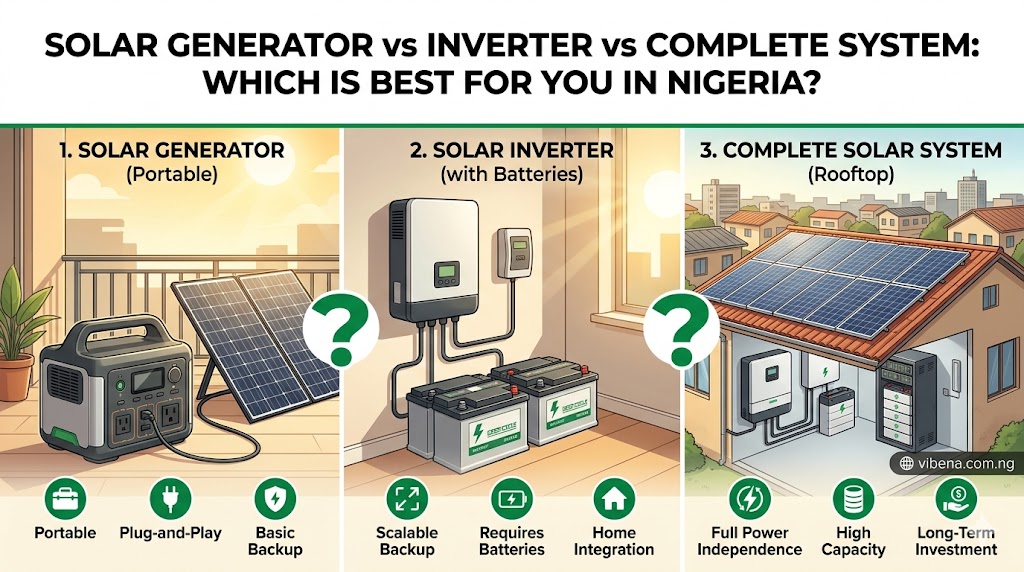
A solar generator is an all-in-one portable power station that combines a battery, inverter, and charge controller inside a single compact unit. You charge it using a solar panel (sold separately in most cases), a wall outlet, or even a car charger.
Think of it as a rechargeable power box. You plug your devices directly into it. No wiring. No installation. No electrician needed.
What Is Inside a Solar Generator?
Every solar generator contains four core components packed into one housing:
- Lithium battery (usually lithium-ion or LiFePO4) that stores energy
- Built-in inverter that converts stored DC power to 220V AC
- Charge controller (typically MPPT) that regulates incoming solar power
- Battery Management System (BMS) that prevents overcharging, overheating, and short circuits
The most popular solar generators in Nigeria right now come from brands like Jackery, Bluetti, EcoFlow, and more recently, Itel with their budget-friendly solar generator range targeting Nigerian households.
Itel Solar Generator: Is It Worth the Hype?
Itel entered the Nigerian portable power market with a solar generator designed specifically for budget-conscious Nigerians. According to product listings and specifications from Itel Nigeria, their units offer built-in LED lighting, multiple USB ports, and AC output sockets in a lightweight, carry-anywhere design.
The Itel solar generator is best suited for charging phones, powering LED bulbs, and running small fans. It is not designed for heavy-duty appliances like refrigerators or air conditioners.
For Nigerians who need something basic and ultra-portable for a self-contain apartment, it is a reasonable entry point. But if you work from home and rely on a laptop and Wi-Fi router for income, you will outgrow it quickly.
Solar Generator Price in Nigeria (April 2026)
Here is what solar generators for home use currently cost in the Nigerian market:
| Brand/Model | Battery Capacity | Output | Estimated Price (₦) |
|---|---|---|---|
| Itel Solar Generator (basic) | 150Wh to 300Wh | 200W to 300W | ₦45,000 to ₦90,000 |
| Jackery Explorer 300 Plus | 288Wh | 300W | ₦180,000 to ₦250,000 |
| Bluetti EB3A | 268Wh | 600W | ₦200,000 to ₦280,000 |
| EcoFlow River 2 | 256Wh | 300W (600W surge) | ₦220,000 to ₦300,000 |
| Bluetti AC200L | 2,048Wh | 2,400W | ₦900,000 to ₦1,200,000 |
| EcoFlow Delta 2 Max | 2,048Wh | 2,400W | ₦1,000,000 to ₦1,400,000 |
Prices vary depending on whether you are buying from Jumia Nigeria, Konga, or imported directly. Always confirm wattage ratings and battery chemistry before paying.
What Is a Solar Inverter System?
A solar inverter system is a permanently installed power backup that consists of separate components wired together: solar panels on your roof or balcony, a charge controller, deep cycle batteries, and an inverter.
Unlike a solar generator, everything is modular. You buy each piece individually, wire them together (or hire an installer like me to do it), and the system becomes part of your apartment or home’s electrical wiring.
This is what most Nigerians mean when they say “I want to install solar” or “I want to do inverter.”
Core Components of a Solar Inverter System
- Solar panels (monocrystalline or polycrystalline) mounted on a rooftop, balcony, or window ledge
- Charge controller (PWM or MPPT) that regulates voltage from panels to battery
- Deep cycle batteries (lead-acid tubular, AGM, gel, or lithium LiFePO4) that store the energy
- Inverter (pure sine wave recommended) that converts 12V/24V/48V DC to 220V AC for your appliances
- Wiring, fuses, breakers, and distribution board connecting everything
The biggest advantage here is scalability. You start small and add more panels or batteries as your budget grows. I have clients in Lekki who started with a single 100W panel and one battery, then expanded to a 3kVA system within 18 months.
If you are considering a starter setup, our step-by-step guide on how to set up a small solar system for your Nigerian apartment for under ₦150,000 covers every component and connection.
What Is a “Solar System” in the Nigerian Context?
When Nigerians say solar system, they usually mean one of two things:
1. A complete solar power installation that includes panels, batteries, charge controller, inverter, and wiring. This is the same as a solar inverter system described above.
2. A solar home system (SHS), which is a pre-packaged kit sold as a single unit. Companies like Lumos Nigeria (partnered with MTN), Arnergy, Rensource, and d.light sell these as subscription or outright purchase products. They typically include a small solar panel (20W to 100W), a battery pack, LED bulbs, phone charging ports, and sometimes a small fan or radio.
These solar home systems are popular in rural Nigeria and among low-income households because they require zero technical knowledge. You unbox, mount the panel, and plug in.
However, they are not designed for heavy-duty home use. You cannot run a laptop, refrigerator, or multiple appliances on a basic solar home system.
For this article, when I say solar system, I mean a full solar inverter installation with individually selected components, because that is what gives you real power independence.
Solar Generator vs Solar Inverter vs Solar System: Full Comparison
This is the comparison table every Nigerian buyer needs before spending money. I have based this on real installations, real products, and real performance in Nigerian conditions.
| Factor | Solar Generator | Solar Inverter System | Solar Home System (SHS) |
|---|---|---|---|
| Setup | Zero installation; plug and play | Requires professional installation or DIY wiring | Minimal; follow included instructions |
| Portability | Fully portable; carry it anywhere | Fixed installation | Semi-portable (small panel, battery box) |
| Scalability | Limited; most units cannot be expanded | Highly scalable; add panels, batteries anytime | Not scalable |
| Battery type | Lithium-ion or LiFePO4 (built-in) | Lead-acid tubular, AGM, gel, or lithium (your choice) | Sealed lithium (built-in) |
| Typical capacity | 150Wh to 2,000Wh | 1,200Wh to 10,000Wh+ | 50Wh to 500Wh |
| Can power fridge? | Only high-end models (2,000W+) | Yes, with proper sizing (1.5kVA+ inverter, 200Ah+ battery) | No |
| Can power laptop + router? | Yes (300W+ models) | Yes | Some models, briefly |
| Lifespan | 5 to 10 years (lithium battery) | 3 to 5 years (lead-acid) or 7 to 10 years (lithium) | 3 to 5 years |
| Maintenance | Virtually none | Monthly checks (water levels, terminals, panel cleaning) | Minimal |
| Starting price (Nigeria) | ₦45,000 | ₦120,000 to ₦150,000 | ₦25,000 to ₦80,000 |
| Best for | Students, travelers, light backup | Full home backup, remote workers, content creators | Basic lighting, phone charging, rural areas |
| Noise | Silent | Silent | Silent |
| Fuel cost | ₦0 | ₦0 | ₦0 |
Pros and Cons of a Solar Generator for Home Use
Pros
No installation required. You unbox it, charge it, and plug in your devices. I recommend this for tenants who cannot drill holes or mount panels permanently.
Truly portable. You can carry it between rooms, take it to a friend’s house, or use it during outdoor content creation sessions. If you create content, our guide on cheap content creation kits in Nigeria under ₦20,000 pairs well with a portable solar generator.
Lithium battery built in. No need to buy a separate battery or worry about checking water levels. The battery management system handles overcharge and over-discharge protection automatically.
Silent operation. Zero noise, zero fumes. Unlike a fuel generator, you can use it in your bedroom at 2 AM without disturbing anyone.
Cons
Limited capacity. Even the best solar generator in Nigeria at the mid-range price (₦200,000 to ₦300,000) only stores 250Wh to 300Wh. That powers a laptop for about 4 hours or an LED TV for roughly 3 hours. For a full workday, that is not enough.
Not scalable. You cannot add more batteries to most solar generators. Once you outgrow it, you have to buy a bigger unit entirely.
Slow recharging with solar. A 100W portable solar panel takes 3 to 5 hours of direct Nigerian sunlight to fully charge a 300Wh solar generator. On cloudy days, this stretches to 6 to 8 hours. You are essentially limited to one full charge cycle per day.
Expensive per watt-hour compared to a DIY solar inverter system. You are paying a premium for the compact design and convenience.
Pros and Cons of a Solar Inverter System for Home Use
Pros
Much larger capacity. A basic home solar inverter system with a 12V 200Ah battery bank stores 2,400Wh, which is 8 to 10 times more than most portable solar generators. That can run a laptop, router, fan, LED bulbs, and a 24-inch TV for an entire day.
Fully scalable. Start with one panel and one battery. Add a second panel next month. Add another battery in three months. I have walked dozens of clients through this phased approach.
For a detailed cost breakdown of a bigger installation, check our article on cost of solar power for a 3-bedroom flat in Nigeria.
Can power heavy appliances. With a properly sized system (2.5kVA inverter and above, 200Ah battery bank or larger), you can run a refrigerator, washing machine, and even a small AC unit. A 5,000W inverter can comfortably power a standard home refrigerator that draws 150W to 300W running watts.
Long-term cost savings. After the initial investment, your running cost is ₦0. No fuel, no PHCN bills for the appliances on your solar circuit. Our generator fuel cost calculator shows exactly how much you save compared to running a petrol generator.
Integrates with your home wiring. An installed solar inverter system connects to your apartment’s distribution board through a changeover switch, so your wall sockets and ceiling lights work normally. You do not need to plug and unplug devices.
Cons
Requires installation expertise. Wiring a charge controller, battery bank, and inverter incorrectly can damage equipment or create fire hazards. If you are not confident doing it yourself, hire a certified solar installer.
Battery maintenance. If you use tubular lead-acid batteries (the most common and affordable option in Nigeria), you need to check water levels monthly, clean terminals, and avoid deep discharge below 50%. According to information from D’Young Energy, repeatedly draining lead-acid batteries below their safe depth of discharge dramatically shortens lifespan.
Our detailed guide on how to extend your inverter battery life to last 3 years instead of 1 in Nigeria covers every maintenance step.
Not portable. Once installed, the system stays in your apartment. If you relocate, you either disassemble and reinstall (which costs money) or leave it behind.
Higher upfront cost for full home coverage. While a basic setup starts under ₦150,000, a system that powers a full 2-bedroom flat costs ₦400,000 to ₦1,200,000 depending on your load requirements. Our solar inverter setup for a Nigerian 2-bedroom flat gives a precise breakdown.
Inverter or Generator: Which Is Best for Home Use in Nigeria?
This is one of the most searched questions in Nigeria right now, and the answer depends entirely on your budget, power needs, and how often NEPA fails in your area.
When a Fuel Generator Makes More Sense
- You need to power very heavy loads like a deep freezer, multiple AC units, and a water heater simultaneously
- You need power for a commercial business (restaurant, barber shop, welding workshop) where loads exceed 5kW consistently
- Your budget is extremely tight (a “better pass my neighbour” generator costs ₦45,000 to ₦75,000)
When a Solar Inverter System Wins
- You primarily power lights, fans, phones, laptops, routers, and a TV
- You work from home and need silent, reliable power for Zoom calls and deadlines
- You want to eliminate fuel costs entirely (fuel is above ₦1,200/litre in April 2026)
- You are in an apartment where generator noise is a problem for neighbours
I documented my personal experience switching from generator to solar in our post: I switched from generator to solar after fuel hit ₦1,200: my 90-day honest review.
Quick Cost Comparison Over 12 Months
| Cost Category | Fuel Generator (1kVA) | Solar Inverter System (1kVA) |
|---|---|---|
| Upfront purchase | ₦55,000 to ₦75,000 | ₦140,000 to ₦200,000 |
| Monthly fuel (4 hours/day) | ₦18,000 to ₦30,000 | ₦0 |
| 12-month running total | ₦271,000 to ₦435,000 | ₦140,000 to ₦200,000 |
| Maintenance (oil, plugs, servicing) | ₦3,000 to ₦5,000/quarter | ₦0 to ₦2,000/year (distilled water) |
| Noise level | 65dB to 80dB | Silent |
| Fumes | Carbon monoxide risk | None |
The math is clear. A solar inverter system pays for itself within 5 to 7 months and then gives you free power for years.
The 4 Types of Solar Batteries Used in Nigeria
Your battery is the most important (and most expensive) component in any solar system. Choosing the wrong type is the number one reason batteries die within a year instead of lasting 3 to 5 years.
According to information from Solar.com.ng, lead-acid batteries are the most common in Nigerian solar installations, with typical lifespans of 3 to 5 years when properly maintained. Here are all four types available in Nigeria:
1. Flooded Lead-Acid (Tubular) Battery
Most popular in Nigeria. Brands like Genus, Mercury, Starplus, and Luminous dominate this segment.
Requires monthly distilled water top-ups. Must not discharge below 50%. According to maintenance guidelines from Starplus Nigeria, a healthy 12V tubular battery should read between 11V and 12V when fully charged and measured without load. Below 10V indicates the battery is dead and needs replacement.
Lifespan: 3 to 5 years Price (200Ah): ₦120,000 to ₦180,000
2. AGM (Absorbent Glass Mat) Battery
Sealed and maintenance-free. No water top-ups needed. Handles vibration better than flooded types, which is useful in apartments where the battery might be stored on a shelf or in a tight space.
Slightly more expensive than tubular but lower maintenance.
Lifespan: 3 to 5 years Price (200Ah): ₦150,000 to ₦220,000
3. Gel Battery
Also sealed and maintenance-free. Gel batteries perform better in high temperatures than AGM, making them a reasonable choice for Nigerian weather. They are more resistant to deep discharge damage, but they charge more slowly and are sensitive to overcharging.
Lifespan: 4 to 6 years Price (200Ah): ₦160,000 to ₦240,000
4. Lithium Iron Phosphate (LiFePO4) Battery
The premium option. LiFePO4 batteries can safely discharge up to 90% of capacity (compared to 50% for lead-acid), meaning a 100Ah lithium battery delivers almost the same usable energy as a 200Ah lead-acid. According to information from D’Young Energy, lithium batteries offer the longest life of all types, lasting 10 to 15 years with minimal maintenance.
The downside is cost. A 12V 100Ah LiFePO4 battery costs ₦150,000 to ₦250,000 in Nigeria, and a 200Ah unit can exceed ₦400,000.
Lifespan: 10 to 15 years Price (100Ah): ₦150,000 to ₦250,000
Which Battery Type Should You Choose?
If you are on a tight budget, tubular lead-acid is the practical choice, but you must commit to monthly maintenance. If you can afford the upfront premium and want a set-it-and-forget-it experience, LiFePO4 lithium saves you money over a 10-year period because you will not need to replace it every 3 years.
For detailed guidance on battery replacement timing, see our guide: how to know when your Nigerian inverter battery needs replacement before it dies completely.
Can a 3,000W Generator Run a Refrigerator?
Yes. A standard Nigerian household refrigerator (Hisense, Haier Thermocool, LG) draws between 100W and 250W while running. However, when the compressor kicks in (which happens every time the fridge cycles), it pulls a startup surge of 800W to 1,200W for 2 to 3 seconds.
A 3,000W generator handles this surge comfortably. You will have roughly 1,800W to 2,000W of headroom left for other devices.
The same logic applies to inverters. A 3,000W (3kVA) pure sine wave inverter can power a refrigerator without issues, as long as your battery bank has enough capacity to sustain the load for the duration you need.
A 5,000W inverter gives even more margin and can simultaneously power a fridge, TV, fan, lights, and laptop.
What Should You Not Plug Into a Generator or Solar Inverter?
Whether you are using a fuel generator or solar inverter system, certain appliances will either damage your equipment or drain your battery dangerously fast.
Avoid Plugging These Into a Small Generator (Below 3kVA)
- Electric pressing iron (1,000W to 2,200W) pulls constant high wattage
- Electric kettle (1,500W to 2,000W) will overload most small generators
- Hot plate or electric cooker (1,000W to 2,500W) draws sustained heavy load
- Air conditioner (1,200W to 2,500W plus surge) unless your generator is rated for it
Avoid Plugging These Into a Small Solar Inverter System (Below 1.5kVA)
- Anything with a heating element (iron, kettle, toaster, water heater)
- Washing machines (especially during the spin cycle, which surges to 500W to 800W)
- Refrigerators unless your battery bank is 200Ah or larger
According to maintenance guidance from Daibau Nigeria, overloading your inverter system is one of the fastest ways to kill your batteries and shorten the inverter’s lifespan. Always keep connected load at 60% to 70% of your inverter’s rated capacity.
What Is the 20/20/20 Rule for Generators?
The 20/20/20 rule is a maintenance guideline followed by experienced generator users and technicians. It states:
- Every 20 hours of use, check the engine oil level
- Every 20 hours, inspect the air filter for dust and debris
- Every 20 hours, verify fuel quality and check for water contamination
Following this rule prevents the most common causes of generator breakdown in Nigeria: low oil seizure, clogged air filters reducing performance, and bad fuel (which is common with adulterated petrol sold at some roadside stations).
If you currently rely on a generator, keeping your generator space organized helps with regular maintenance. See our guide on generator room organization for practical tips.
What Happens After 25 Years of Solar Panels?
Solar panels do not just stop working after 25 years. That 25-year figure is the warranty period that most tier-one manufacturers like Jinko Solar, LONGi, Canadian Solar, and Trina Solar guarantee.
After 25 years, panels typically still produce 80% to 85% of their original rated output. This is called the degradation rate, and for modern monocrystalline panels, it is approximately 0.5% per year according to data from the National Renewable Energy Laboratory (NREL) in the United States.
In practical terms, a 100W panel installed in 2026 will likely still produce 80W to 85W in 2051. That is still useful power. Many installations worldwide have panels operating efficiently past 30 and even 40 years.
In Nigeria specifically, the main threats to long-term panel health are:
- Harmattan dust accumulation reducing output by 20% to 30% if not cleaned regularly
- Physical damage from falling objects or poor mounting
- Corrosion at junction boxes due to humidity, especially in southern Nigeria
Regular cleaning and secure mounting extend panel life significantly. If you deal with dust seasonally, our article on how to reduce dust in your house during harmattan includes tips applicable to panel maintenance too.
Which Is Cheaper: Solar or Generator in Nigeria?
Over any period longer than 6 months, solar is cheaper for the typical Nigerian household or apartment dweller.
Here is a realistic 3-year comparison:
| Item | Fuel Generator (1kVA) | Solar Inverter System (1kVA) |
|---|---|---|
| Purchase price | ₦65,000 | ₦150,000 |
| Fuel (3 years, 4 hrs/day) | ₦648,000 to ₦1,080,000 | ₦0 |
| Maintenance (3 years) | ₦36,000 to ₦60,000 | ₦6,000 to ₦10,000 |
| Battery replacement (once) | N/A | ₦70,000 to ₦100,000 |
| 3-year total | ₦749,000 to ₦1,205,000 | ₦226,000 to ₦260,000 |
That is a potential saving of over ₦500,000 to ₦900,000 across 3 years. The generator is cheaper upfront but devastatingly expensive over time.
If you want to see exactly how much fuel is eating into your budget right now, use our generator fuel cost calculator.
So, Which Should You Buy? My Honest Recommendation
After 8 years of installing power solutions in Nigeria, here is my straightforward advice:
Buy a Solar Generator If:
- You live in a rented apartment and cannot do permanent installations
- You only need to power phones, LED bulbs, a small fan, and occasionally a laptop
- You travel frequently and want a portable power solution
- Your total budget is between ₦45,000 and ₦300,000
- You want zero maintenance and zero technical knowledge required
Our detailed review of portable solar generators in Nigeria covers the best models currently available.
Buy a Solar Inverter System If:
- You need to power a laptop, router, TV, fan, and lights for a full workday
- You work from home and power reliability directly affects your income
- You are willing to learn basic maintenance (or hire someone quarterly)
- You plan to expand your system as your budget grows
- Your budget starts at ₦120,000 and up
For a budget system, start with our guide on how to set up a small solar system for your Nigerian apartment under ₦150,000. For a more comprehensive setup, see solar inverter setup for a Nigerian 2-bedroom flat.
Keep Your Fuel Generator As Backup If:
- You occasionally need to run heavy appliances like a washing machine or deep freezer
- You live in an area with prolonged rainy season cloud cover (June to September in southern Nigeria) and want a fallback
- Your work involves equipment that cannot tolerate any power interruption
The smartest approach I see among my clients in Lagos and Abuja is a hybrid setup: a solar inverter system for daily essentials and a small generator reserved for rare heavy-load situations. This combination keeps fuel costs near zero while covering every scenario.
Frequently Asked Questions
Which Is Better, a Solar Inverter or a Solar Generator?
A solar inverter system is better for permanent home backup with larger capacity and scalability. A solar generator is better for portability, zero installation, and light-duty use. If you work from home and need consistent power for 6 to 8 hours daily, a solar inverter system is the practical choice.
What Are the Disadvantages of a Solar Generator?
The main disadvantages are limited battery capacity, inability to expand, slow solar recharging (3 to 5 hours for a full charge on a sunny day), and higher cost per watt-hour compared to a modular solar inverter system. High-capacity models that can run a refrigerator cost ₦900,000 and above.
Can I Run a Refrigerator on an Inverter Generator?
Yes, provided the inverter generator is rated at 2,000W or higher to handle the compressor startup surge of 800W to 1,200W. For solar inverter systems, a 1.5kVA pure sine wave inverter with a 200Ah battery bank can run a standard Nigerian fridge for 8 to 12 hours.
Which Is Better, a Solar Generator or a Solar System?
A full solar system (solar inverter system) is better for long-term home use. It stores more energy, powers more appliances, lasts longer when maintained, and costs less per watt-hour over time. A solar generator is better as a supplement or for people who need grab-and-go portable power.
How Do I Know When My Inverter Battery Needs Replacement?
According to information from The Home Upgrade, key signs include drastically reduced backup time, the battery taking unusually long to charge, frequent inverter shutdowns, visible bulging or swelling of the battery case, corrosion or leaks at terminals, and the battery running excessively hot during use.
Information from Gold Star Power adds that most inverter batteries have a lifespan of 3 to 5 years, so even without visible symptoms, batteries approaching this age should be monitored closely.
We covered this topic in depth here: how to know when your Nigerian inverter battery needs replacement before it dies completely.
The bottom line is simple. Fuel generators had their era. With petrol above ₦1,200, unreliable grid power, and solar equipment prices dropping every year, the future of home power in Nigeria is solar. The only question is which type fits your apartment, your budget, and your daily power needs right now.
If you are still unsure, start with our guide on how to stay focused during power outages to manage your productivity while you plan your solar transition. And check our honest review of cheap inverters in Nigeria to find equipment that fits your budget without sacrificing quality.

Oladepo Babatunde (Prince Babatee Tunde) is a Computer Scientist, researcher, and professional content writer with a Higher National Diploma in Computer Science from Kwara State Polytechnic, Nigeria.
With a background in technology and a passion for clear communication, Babatunde specializes in creating thoroughly researched, reader-focused content on productivity, personal development, home living, and technology. Every article he writes is backed by extensive research and fact-checking to ensure readers receive accurate, actionable information.
As a freelance writer, he has helped brands and publications deliver content that educates, engages, and empowers their audiences. His mission at Vibena is simple: make complex topics easy to understand and help Nigerians live smarter, more productive lives.